
On the same evening, Alphabet and Microsoft opened their books on the AI boom. Cloud revenue was accelerating. Infrastructure spending was surging. And beneath those matching headlines, two different stories emerged about how to build—and pay for—the next computing era.
For the quarter ended 30 September 2026, Google Cloud revenue more than doubled to $30.7 billion, while Azure grew 48% to $33.2 billion. Those numbers provide powerful evidence of demand for the infrastructure beneath AI. But the most revealing part of the story begins with how each company is pursuing that opportunity.
Alphabet is building across the AI stack. Its own TPU chips power its Gemini models; those models feed products such as Search; Google Cloud puts that technology in the hands of developers and enterprises. The strategic wager is that advances in one layer can strengthen the others: more efficient computing, more capable models, more useful products, and more demand for the infrastructure underneath. Alphabet is using AI both to renew the business that made it dominant and to expand the cloud business that could become its next great growth engine.
Microsoft is bringing AI into the businesses it already serves. Azure supplies the computing infrastructure. Microsoft 365 and Copilot bring AI into documents, spreadsheets, conversations and workflows. The strategic logic is to turn established customer relationships into deeper demand for software, agents and cloud capacity. As customers put more work through those systems, Microsoft has opportunities to earn revenue from both the applications they use and the infrastructure those applications consume.
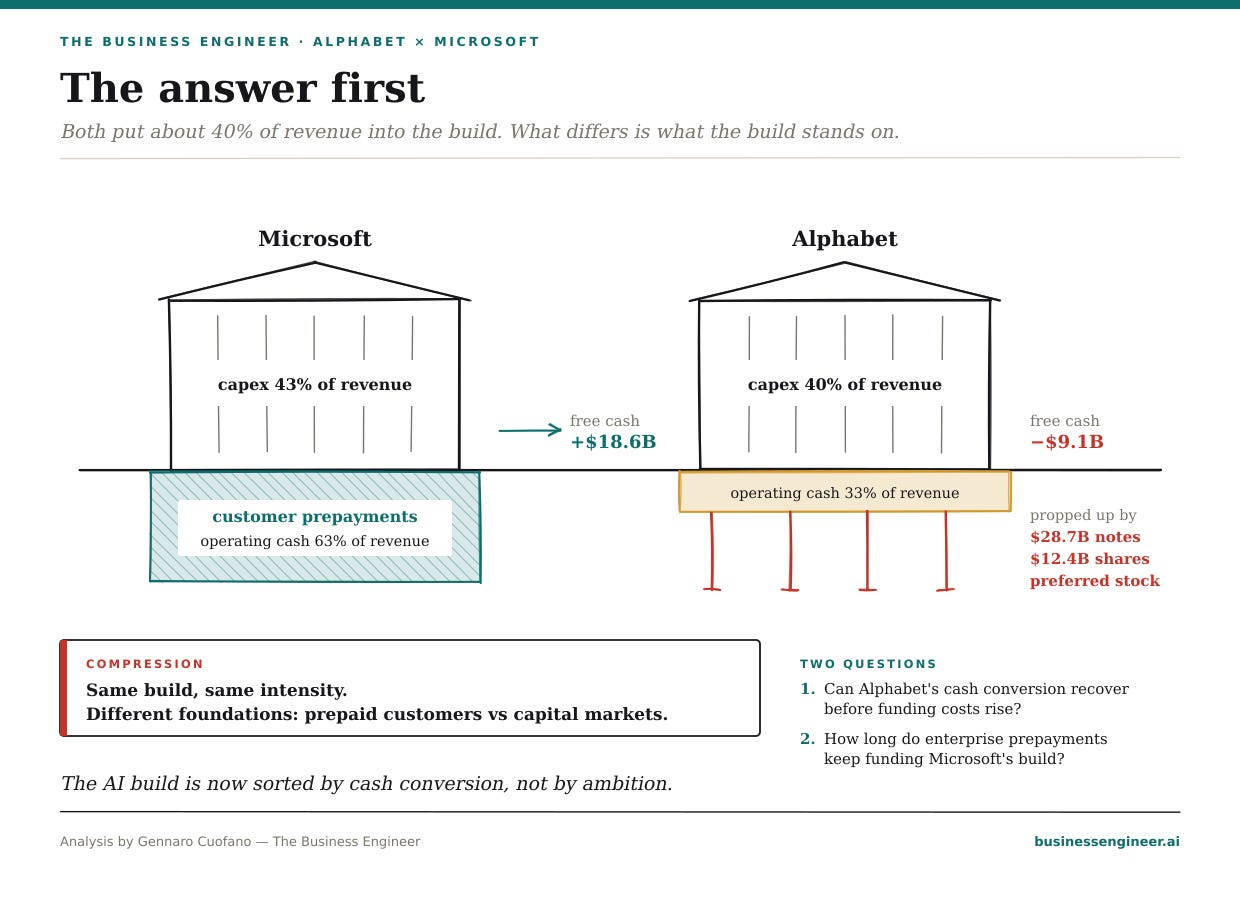
Both approaches require enormous investment. This quarter, Alphabet’s cash spending on property and equipment equalled 40% of revenue. Microsoft’s reached 43%, with its broader capital expenditure measure, including finance leases, reaching 49%. These are businesses committing close to half their sales to expanding their physical foundations.
Then the cash-flow statements reveal the difference.
For every $100 of revenue, Microsoft generated approximately $63 in operating cash. Alphabet generated $33. After cash capital expenditure, Microsoft still had $18.6 billion in free cash flow. Alphabet’s spending exceeded its operating cash generation by $9.1 billion. During the same quarter, Alphabet also raised $28.7 billion through new notes and $12.4 billion through share sales, adding external capital as it expanded.
That gives this quarter’s results their strategic significance. Microsoft’s operating cash generation covered its cash investment bill with room to spare. Alphabet combined operating cash with access to capital markets to support its ambitions. Both are building aggressively, but the financial room around those investments looks different.
Cash conversion is becoming a decisive advantage in the AI buildout. Demand gives companies a reason to build. Cash generation gives them more freedom to keep building.
That changes how to read the Map of AI. Alongside chips, models, distribution and customer relationships, we need to watch the time between committing capital and collecting the returns. Long-term contracts can provide visibility into future business, but the infrastructure must be financed before all that revenue arrives.
Alphabet and Microsoft are pursuing the same enormous opportunity from different positions of strength. This quarter shows why the ability to finance that wait deserves a place alongside technology in the story of who captures it.
*Financial figures cover July–September 2026: Alphabet’s Q3 and Microsoft’s fiscal 2027 first quarter. Cash-flow and capital-spending ratios are our calculations. Free cash flow here means operating cash flow less cash purchases of property and equipment; finance lease additions are shown separately. Forward capital expenditure guidance should be read alongside the earnings-call commentary.