
The AI Agent Is Taking Over The Computer

Over the last year and a half, I’ve argued that the best mental model for understanding where AI is headed is to see the current wave of AI agents as a transitional phase. Today, agents are learning how to use computers built for humans. But that is not the end state.
For three years, the AI industry has debated which layer of the stack captures value: the chip, the cloud, the model, the application. The debate has assumed the interface layer — how humans actually talk to computers — would remain roughly where it has been since 2007: tap an app, type into a box, swipe across a screen.
WWDC 2026 was Apple quietly signaling that this assumption is over.
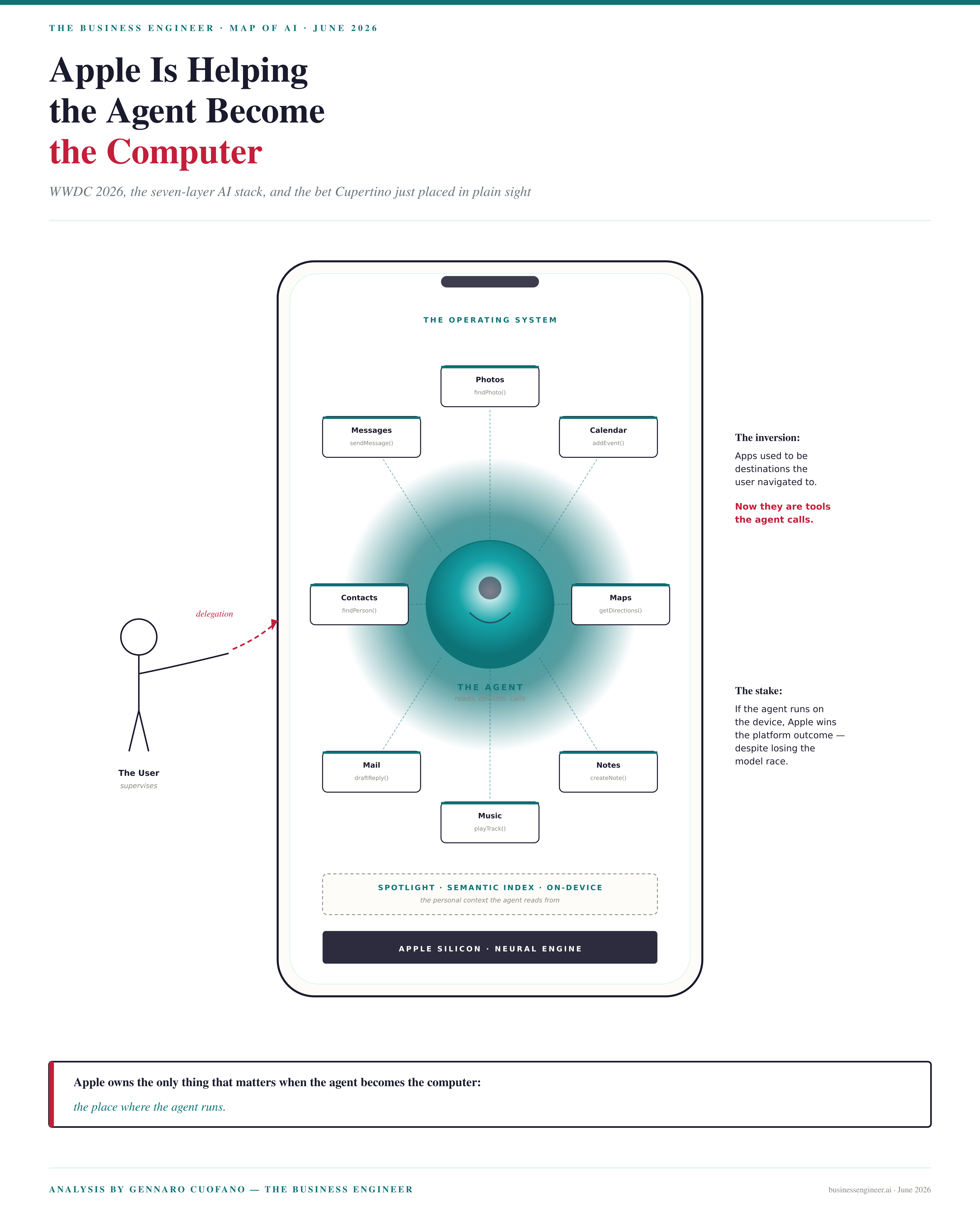
The most structurally significant thing Apple announced last week is not a new model, a new chip, or even a new design language. It is an operating system in which the primary user of an app is no longer a human — it is an agent. Spotlight becomes a knowledge graph the agent reads from. App Intents becomes the surface the agent acts on. View annotations let the agent see what you see. Siri AI becomes the broker that calls apps on your behalf.
This is the agent-as-computer move. And Apple, the company most often described in 2025 as “losing the AI race,” is now better positioned than any competitor to execute it — not because Apple has a better model, but because Apple owns the only thing that matters when the agent becomes the computer: the place where the agent runs.
That is the whole story. Everything else is mechanics.
A map first, so the rest reads cleanly
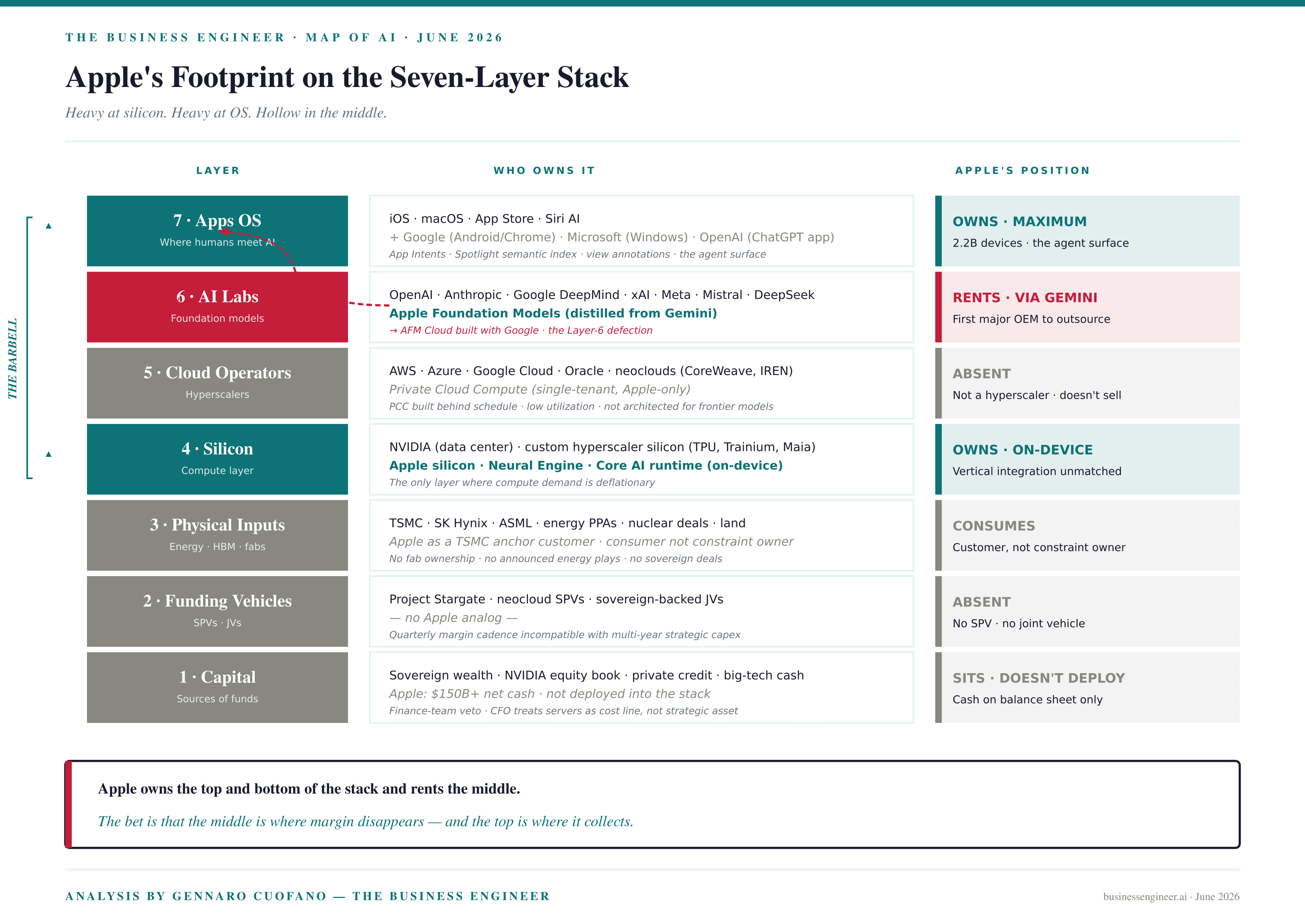
The AI industry runs across roughly seven layers. From the bottom up:
Capital sources — sovereign wealth funds, NVIDIA’s equity book, private credit, big tech cash piles.
Funding vehicles — Project Stargate, neocloud SPVs, joint ventures designed to spread the capex risk.
Physical inputs — energy, real estate, high-bandwidth memory, fab capacity.
Compute and silicon — NVIDIA in the data center, custom silicon at the hyperscalers, Apple silicon on devices.
Cloud operators — AWS, Azure, Google Cloud, Oracle, and the emerging neoclouds.
AI labs and foundation models — OpenAI, Anthropic, Google DeepMind, xAI, Meta, Mistral, DeepSeek.
Application and governance — the operating systems, apps, and surfaces where end users actually meet AI.
Most analysts spend almost all their attention on Layers 4 through 6, because that is where the headlines are. The chip race, the cloud race, the model race.
The interesting question is not which layer is winning. It is which layer captures the rents over the next decade. And the structural pattern across previous platform shifts — desktop, web, mobile — is consistent: the layer that owns the interface to the human eventually captures the rents the layers below it generate.
That is the layer Apple owns. It always has.
Join Yearly Premium Membership To Get The Builder-PM