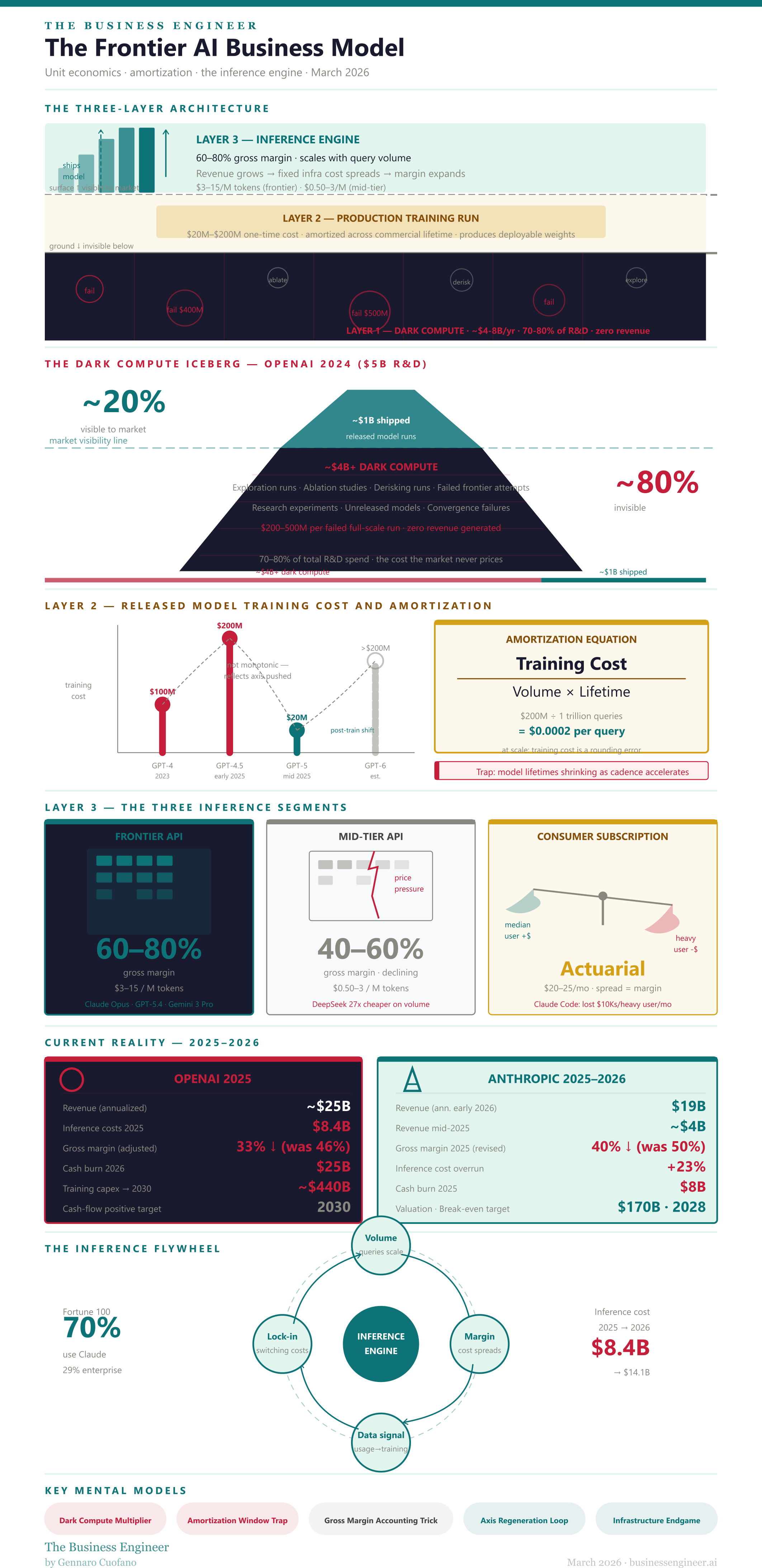

A frontier AI company is not a software business. It is a capital-intensive discovery operation with a high-margin inference engine attached — and those two halves have almost nothing in common economically.
Understanding the full business model requires holding both simultaneously: the part that burns money to create capability, and the part that monetizes that capability at software-like margins.
The gap between them, and how fast it closes, is the entire investment thesis.
The business runs on three sequential economic layers:
Layer 1 — R&D and dark compute: The discovery operation. No direct revenue. Generates the capability that makes everything downstream possible.
Layer 2 — Model production and amortization: The one-time training run that converts discovered capability into a deployable asset, whose cost must be recovered across the model’s commercial lifetime.
Layer 3 — Inference: The revenue engine. High gross margin. Scales with usage. This is where, eventually, the business works.
The race is whether Layer 3 can grow fast enough — and sustain long enough — to justify the combined cost of Layers 1 and 2 before capital runs out.