

For more than a decade, I have been fascinated by neural networks for a simple reason: they felt intuitively powerful because they were, however loosely, inspired by the architecture of the human brain. The caveat matters. Artificial neural networks are not faithful simulations of biological brains. They began as biologically inspired computational abstractions and have since evolved largely according to the demands of mathematics, data and computation.
Part of that fascination came from neuroscience itself. I spent part of my early professional life in San Diego, home to an unusually dense neuroscience ecosystem around institutions such as UC San Diego and the Salk Institute. In my early twenties, one of the ideas that struck me most deeply was neuroplasticity: the realization that the brain is not a fixed structure, but something continuously reshaped by experience, learning and the environment. Experiences do not simply fill the brain with information. They can alter its functional organization and even its physical structure.
That idea stayed with me.
Fast-forward to the mid-2010s. I was sitting in a startup office trying to understand where AI might go next. By then, neural networks were no longer merely a promise. Deep learning had already produced major breakthroughs in computer vision, speech recognition and sequence modeling. Yet these systems still seemed remarkably limited when compared with the messiness of intelligence in the real world.
This was one reason I found reinforcement learning so compelling.
AlphaGo became perhaps the most visible demonstration. Its famous Move 37 against Lee Sedol in 2016 looked almost alien to expert Go players, yet emerged from a system combining deep neural networks, search and reinforcement learning. Around the same period, reinforcement learning also occupied a prominent place in OpenAI’s early research agenda, with projects such as OpenAI Gym and Universe focused explicitly on agents learning through interaction with environments.
What appealed to me about reinforcement learning was its relationship with experience. Intelligence in the real world is not simply a matter of performing reasoning in isolation. We act, encounter consequences, update our understanding, and act again. The world gives us feedback. Much of what we eventually call intuition is accumulated experience compressed into a form that allows us to navigate situations whose relationships are nonlinear, incomplete and difficult to express explicitly (by the way this is what The Business Engineer’s discipline is all about).
And this is where the story becomes particularly interesting.
The extraordinary progress of modern AI has come primarily from neural methods. Yet neural models have an enduring problem: they do not encounter a task with all of the context that makes that task meaningful in the real world. They can contain enormous amounts of learned statistical knowledge, while still lacking the specific entities, relationships, rules, history, constraints and state required to operate reliably inside a particular environment.
This is where symbolic structures become important.
Neuro-symbolic AI refers broadly to attempts to combine the learning and pattern-recognition strengths of neural networks with explicit representations of knowledge and reasoning. Knowledge graphs, ontologies, rules and other structured representations can become part of that architecture. They do not replace the neural model. They give it something it otherwise struggles to construct reliably on demand: an explicit map of the world in which it is expected to act.
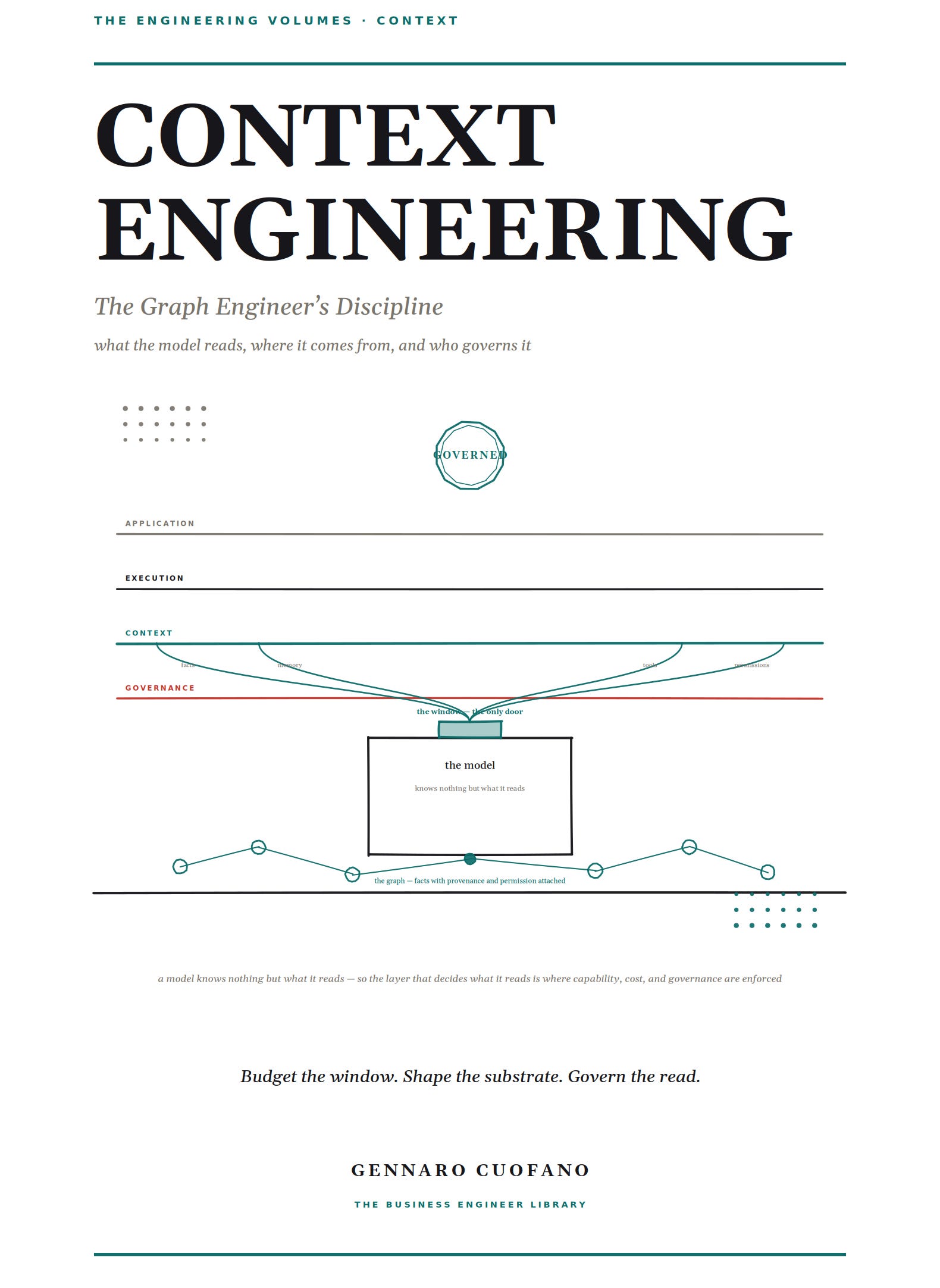
That is the subject of this book.
Context and Graph Engineering is about engineering that missing layer: how we represent entities, relationships, semantics, memory, rules and situational context so that increasingly powerful neural models can become increasingly useful in the real world.
The neural network gives us extraordinary generalization.
The graph gives us structure.
Context tells the system what world it is operating in.
And increasingly, useful intelligence will come from making those pieces work together.
This is another volume in The Business Engineer’s Foundation Series.
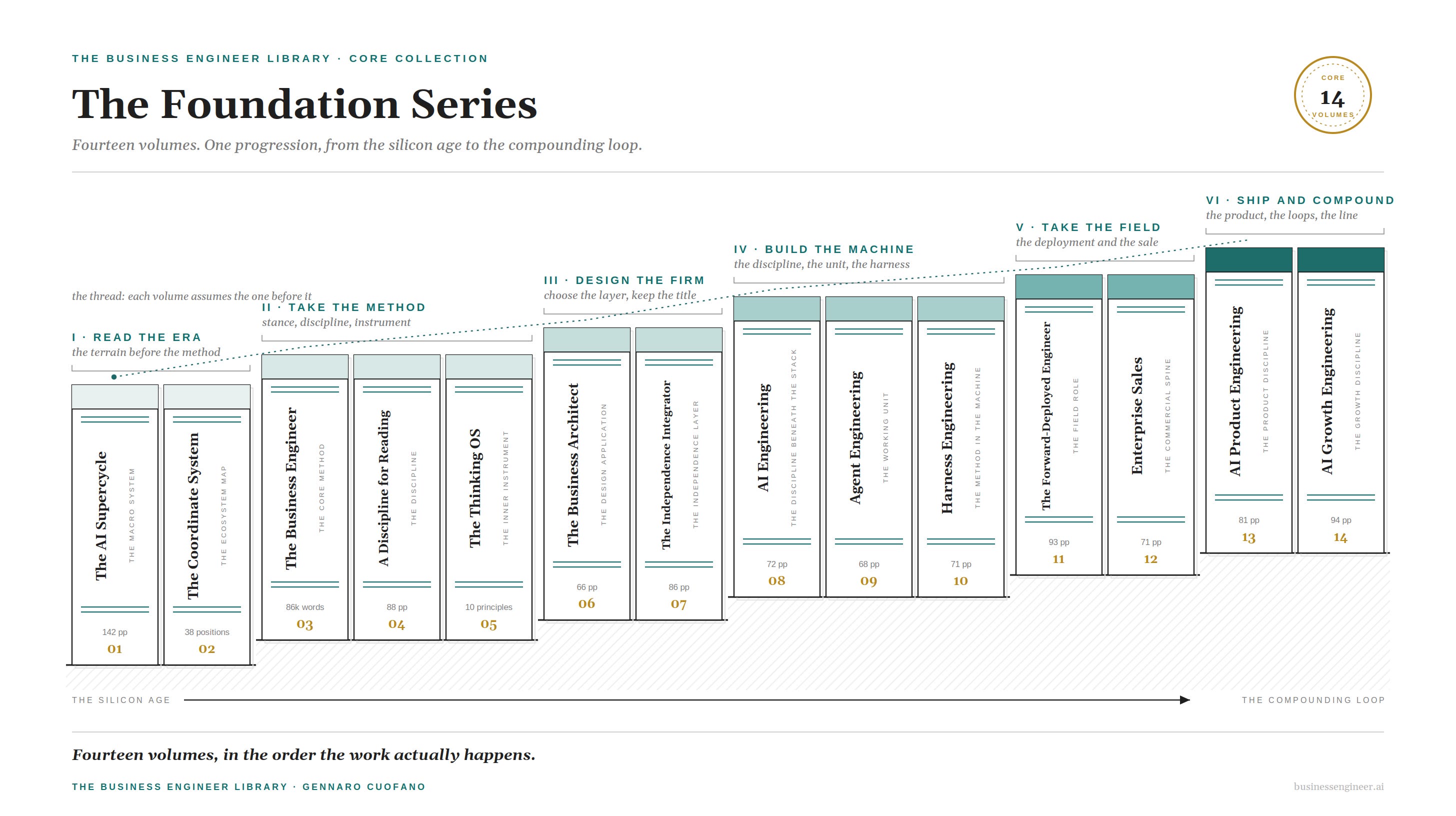
For the last three years, I’ve been rebuilding the Business Engineer’s curriculum from the ground up. That curriculum has now become the foundation of a new discipline, with the entire series taking shape around it.
If you’re already a paid member, simply reply to this email, and we’ll send it your way.