
The AR Interface Layer Wars

Every analyst covering AR glasses is asking the wrong question. They are asking whether consumers will buy the product, whether the battery lasts, and whether the frames look good enough to wear to dinner. These are reasonable questions about a consumer device.
The AR glasses race is being narrated as a hardware competition: which company ships the best frames, the most capable AI assistant, the longest battery life. That framing will produce good product reviews and bad investment theses.
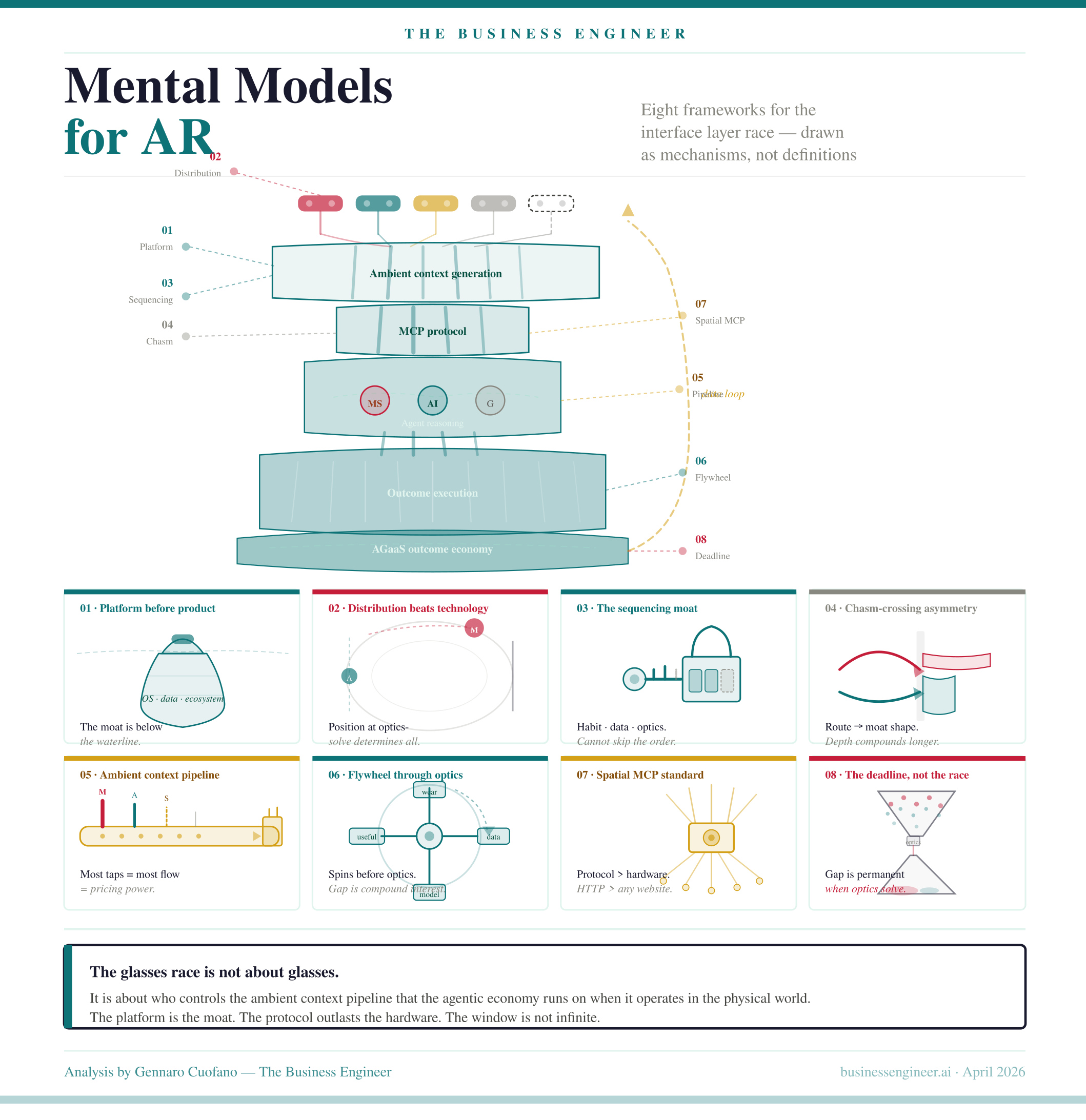
The hardware is not the asset being accumulated. The context pipeline is. Every hour a user wears a pair of AI glasses, they are generating ambient spatial, visual, audio, and behavioral data that flows into a model training infrastructure.
The model trained on that data becomes the AI layer for the next computing surface. The company that owns the richest pipeline when the optics constraint releases — when true AR glasses become lightweight, full-field-of-view, and day-long battery — walks into that transition with a compounding advantage that cannot be purchased or replicated on a short timeline.
The central thesis, compressed: The glasses race is not about glasses. It is about who controls the ambient context pipeline that the agentic economy runs on when it operates in the physical world. The platform is the moat, not the product. Distribution compounds before optics solve. The spatial protocol outlasts every hardware generation. And the window is not infinite.