
For over a decade, I’ve worked in enterprise sales, and one of the things I’ve come to appreciate is how different it is from consumer sales. Consumer is often driven by velocity, distribution, and a certain amount of luck in hitting the right market at the right moment. Enterprise sales is much closer to a science. If you understand its mechanics, incentives, stakeholders, timing, and nuances, you can systematically and dramatically increase your chances of success.
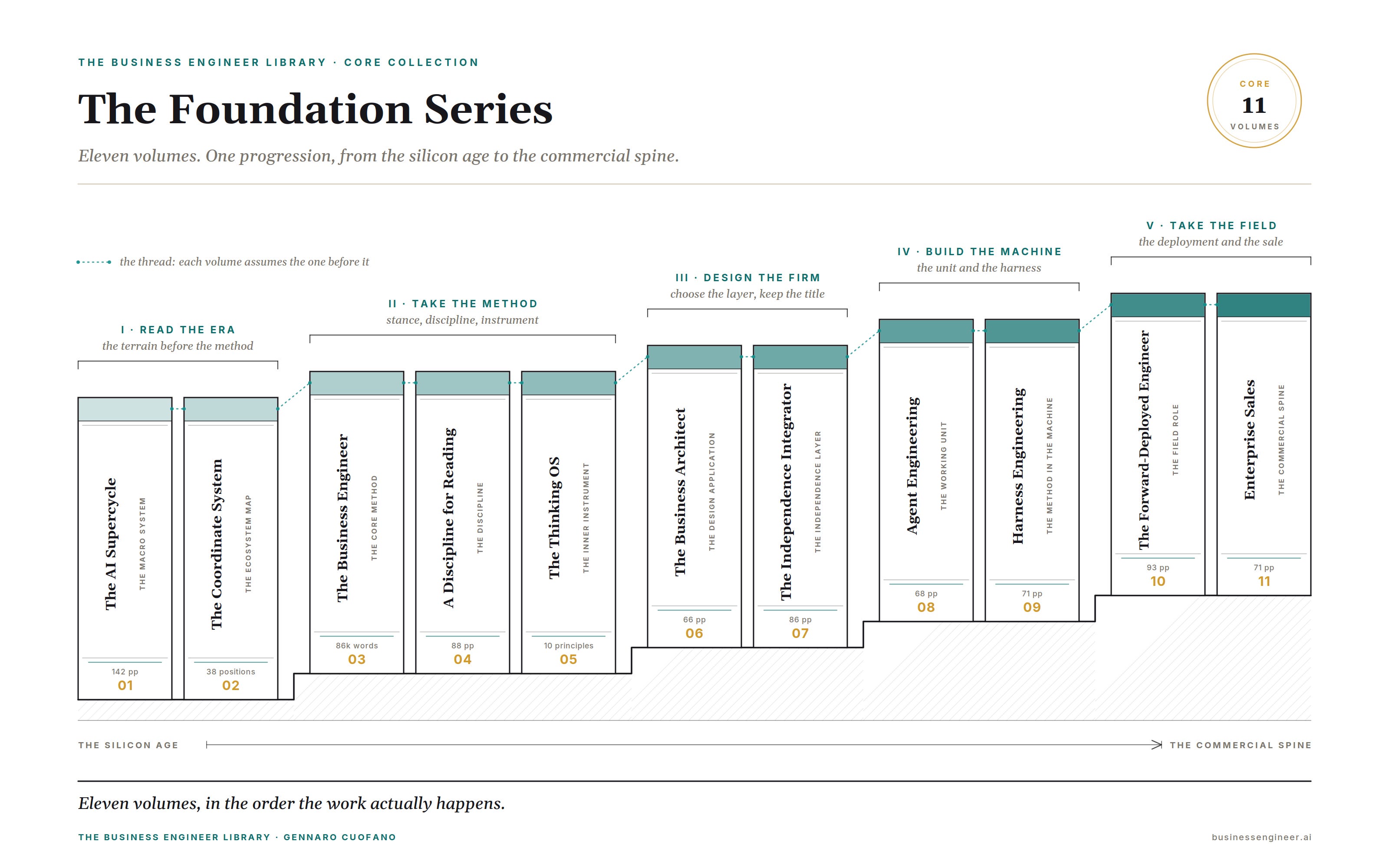
Over the last few years, I’ve spent hundreds of hours consolidating my work across a few foundational disciplines that have become part of The Business Engineer’s core curriculum.
Now that AI has dramatically accelerated this process, I felt it was time to launch the Foundation Series.
Enterprise Sales is another book in that series.
Enterprise sales is being rebuilt from the foundations, and the reason is simpler than most sales methodology makes it sound: the object of the sale changed.
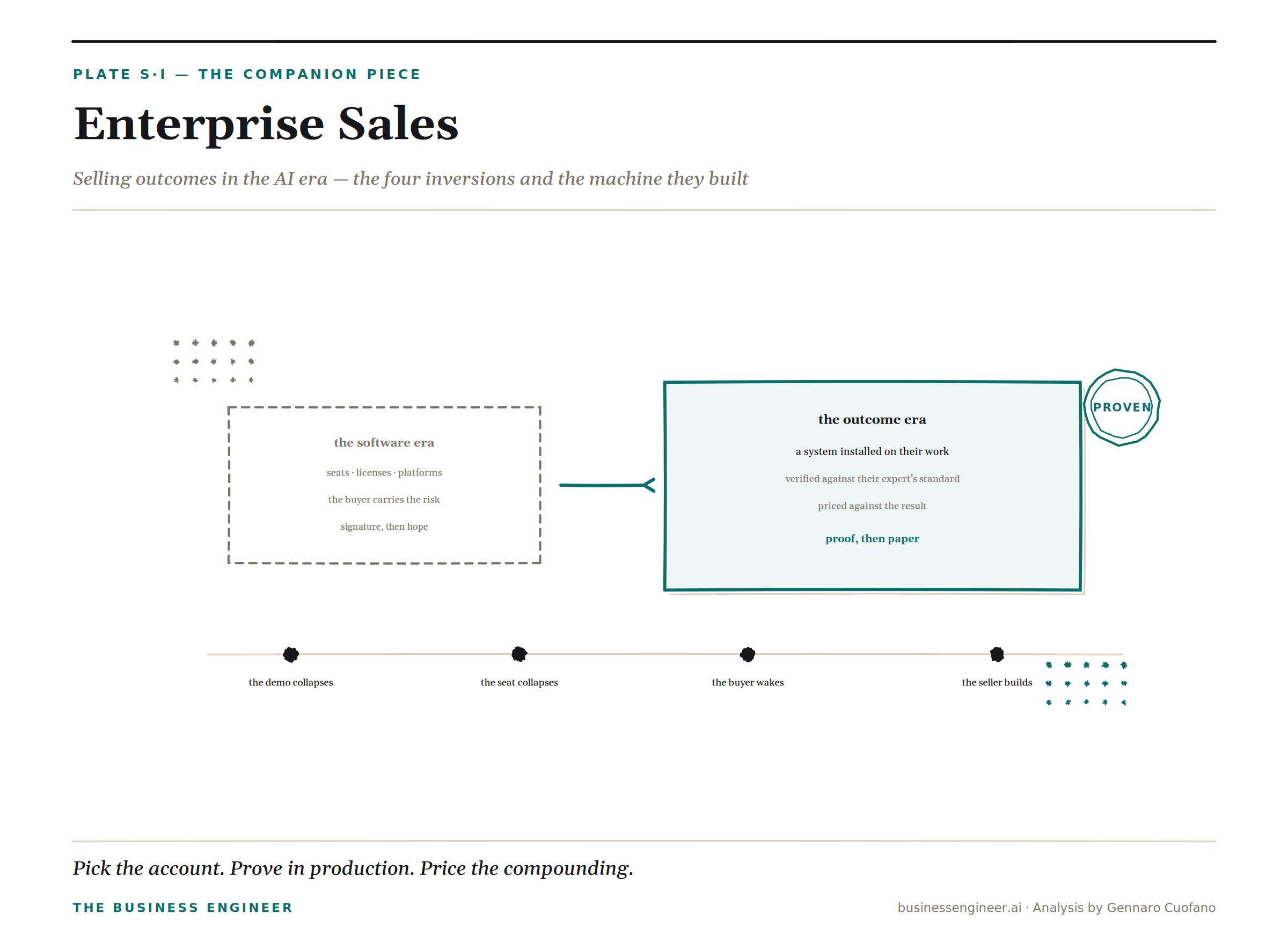
For four decades, enterprise technology companies largely sold software: seats, licenses, platforms, infrastructure. The vendor sold capability; the buyer carried the burden of translating that capability into value. A CRM vendor did not guarantee that the sales organization would sell more. An ERP vendor did not guarantee that the company would operate better. A cloud provider did not guarantee that an application would succeed. The contract transferred access to machinery, while most of the outcome risk remained with the customer.
AI begins to invert that arrangement because AI does not merely give people another interface through which to work. Increasingly, it performs part of the work itself. Once software begins doing the work, the distinction between product and outcome becomes unstable. A buyer does not care that an agent has access to a frontier model. It cares whether a claim is processed correctly, a contract is reviewed to the company’s standard, a support issue is resolved, an analyst gets three hours back, or a workflow that took five days now takes five hours.
The winning vendors therefore move closer to the result. They do not simply sell intelligence. They install a system capable of producing a measurable outcome on the customer’s own work, under the customer’s own constraints, against a standard the customer recognizes as legitimate.
Four inversions define the new sale. The demo collapses: seeing AI work in principle is no longer meaningful proof. The seat collapses: human headcount stops being the natural pricing denominator when machines increasingly perform the work. The buyer becomes capture-aware: ownership, portability, dependency, and exit move from renewal questions into the initial buying process. The seller becomes a builder: when proof requires deployment, selling and building begin to converge.
The sales organization that understands these inversions stops treating sales as persuasion wrapped around a product. It begins treating sales as a system for progressively removing the buyer’s uncertainty until the economic decision becomes almost mechanical.
The enterprise sale is a risk-reduction machine wearing a revenue target.
AI does not remove that old physics. It makes it visible.
If you’re already a paid member, simply reply to this email, and we’ll send it your way.