

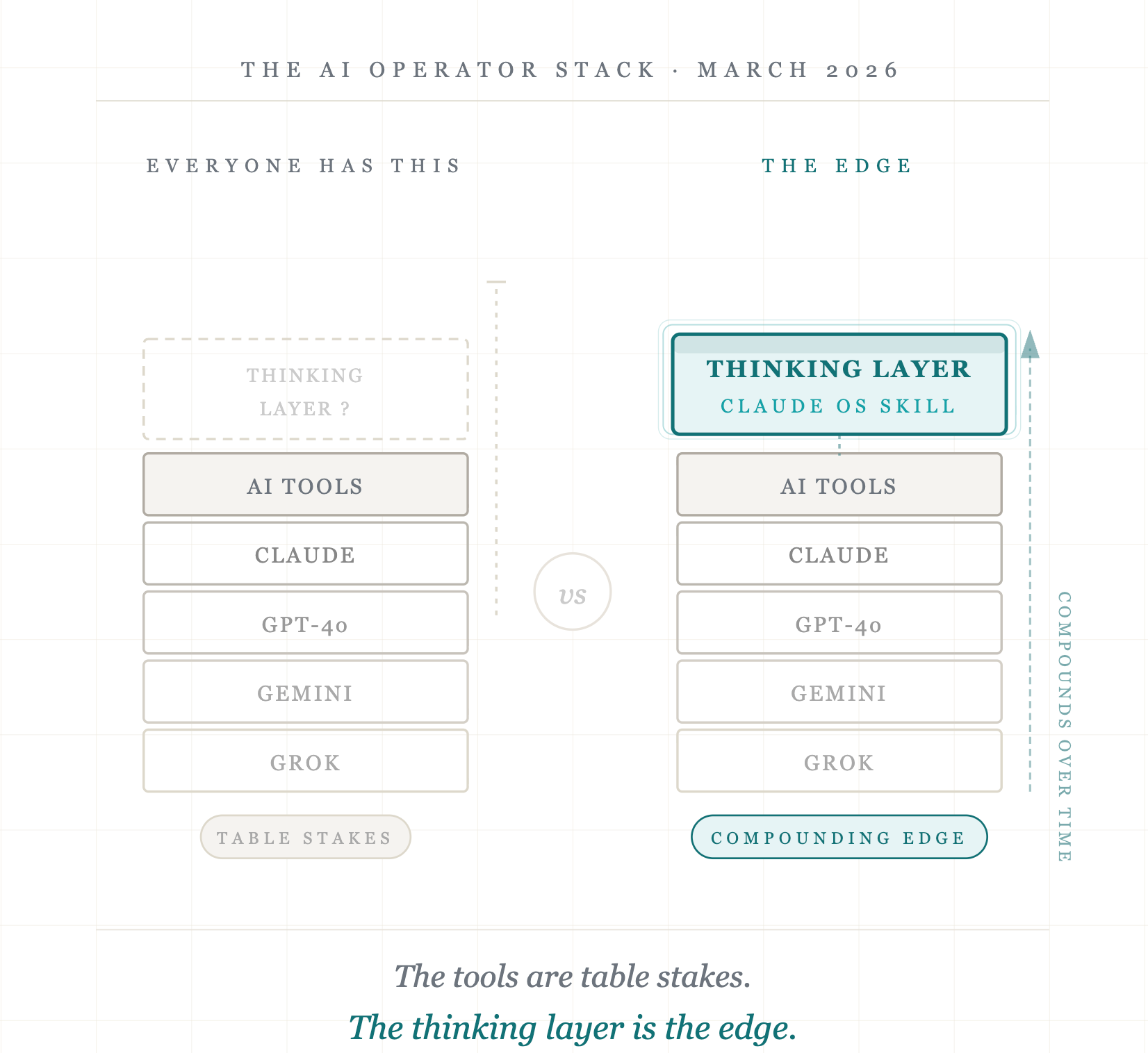
The Executive Plan with the Claude OS Skill included
In 2023, having a GPT workflow was an edge. In 2024, it was a differentiator. By the end of 2025, it was table stakes. We’ve run through three stages of the AI adoption curve in less than thirty months — and we’re now entering a fourth, quieter phase that most people haven’t named yet.
The fourth phase is this: AI capability is abundant. AI judgment is scarce. Tools are commoditized. Thinking systems are not.
Every serious operator now has access to Claude, GPT-4o, Gemini, Grok. The compute is cheap. The interfaces are frictionless. The capability gap between a well-resourced team and a solo analyst with a credit card has nearly closed. This is genuinely remarkable — and it changes the competitive calculus completely.
When a capability becomes universal, it stops being an advantage. The question shifts from “do you have the tool?” to “do you know what to do with it?”
The Commoditization Curve
There’s a pattern that runs through every major technology transition. Mainframes became minicomputers became PCs became cloud became SaaS.
At each stage, the technology democratized — and at each stage, the edge moved up the stack.
Hardware → software → distribution → data → now, in AI: the edge has moved to cognition.
Not the cognition of the model. The cognition of the operator.
How do you structure a problem before you hand it to Claude?
What frameworks do you apply to the output?
Whether you know the difference between a mechanism and a narrative, between a bottleneck and a symptom, between a moat and a temporary advantage.
The distribution of AI operators today looks roughly like this:
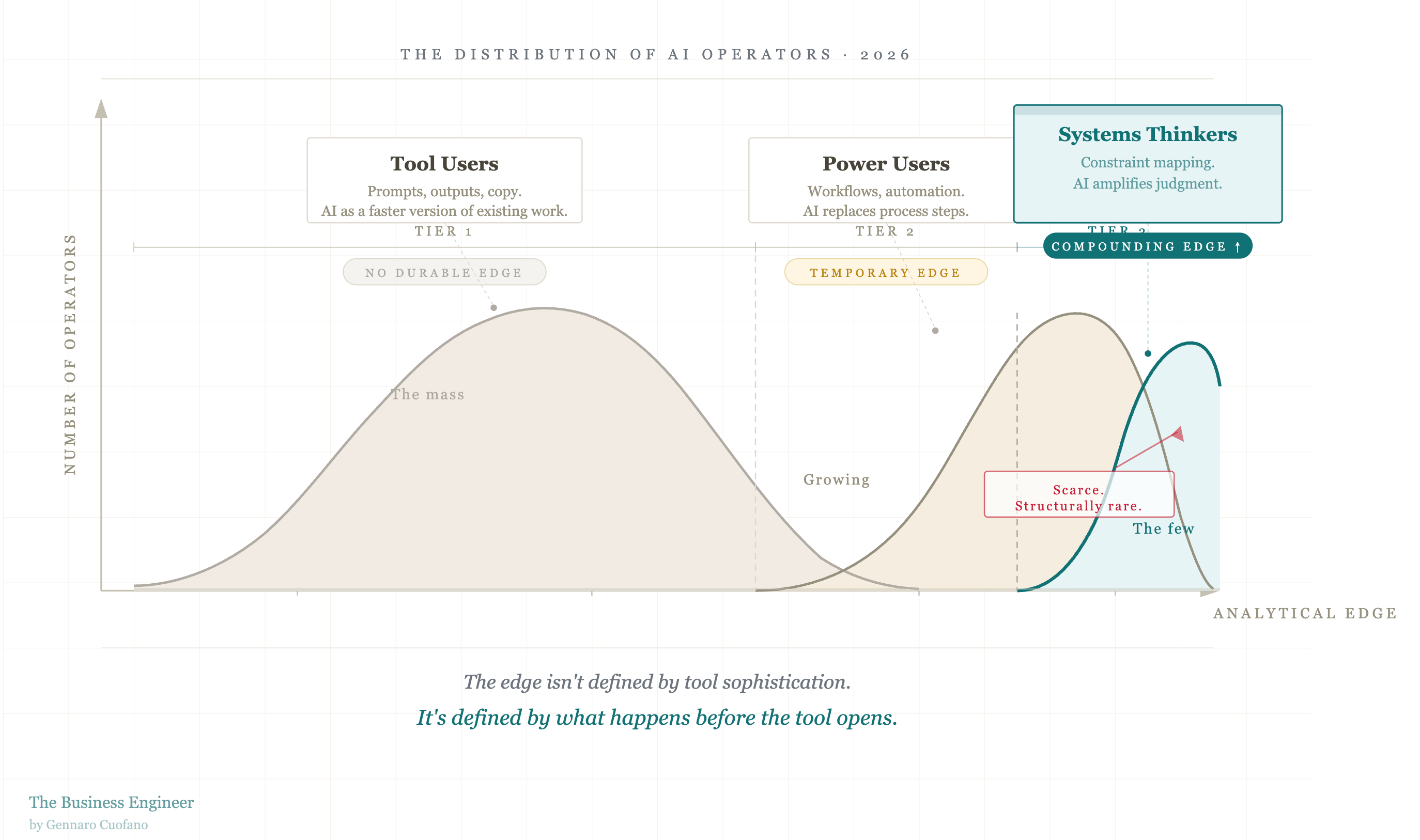
The market mass is in the first two tiers. The edge — the genuinely compounding one — sits in the third. And the third tier isn’t defined by tool sophistication. It’s defined by what happens before the tool opens.
What “AI Thinking” Actually Means
It’s worth being precise, because this phrase gets used loosely. AI thinking isn’t prompt engineering. It isn’t knowing how to write a better system prompt or chain tools together. Those are skills — useful, learnable, increasingly commoditized. AI thinking is something structural.
It means bringing a framework to the interaction before you open the chat window. Knowing what kind of problem you’re solving. Understanding whether you’re looking for a mechanism or a narrative, a constraint or a variable, a moat or a mirage. It means the model amplifies your thinking rather than substituting for it.
The difference in output quality between these two modes is not marginal. It’s categorical. The same model, the same context window, the same task — and one operator gets a sharper analysis in ten minutes than another gets in three hours. The gap isn’t the tool. It’s the thinking layer.
Why Frameworks Are the Scarce Resource
I’ve spent a decade building and refining analytical frameworks — the Business Engineering methodology, VTDF, the BIA engine, the moat classification system, the bottleneck cascade.
Not because frameworks are fashionable. Because they’re the only structural answer to a specific problem: how do you maintain analytical quality under time pressure, with incomplete information, across wildly different domains?
The answer isn’t to slow down. It’s to have a pre-built thinking structure that you apply consistently. Frameworks aren’t crutches. They’re compressed expertise — decades of pattern recognition distilled into a repeatable process. A good framework does in ten minutes what intuition takes ten years to develop.
In an AI-accelerated environment, this becomes more valuable, not less. Because the speed of output has increased dramatically — but the quality of the underlying reasoning hasn’t kept pace for most operators. You now produce more analysis faster. The question is whether any of it is structurally sound.
Frameworks aren’t crutches. They’re compressed expertise — decades of pattern recognition distilled into a repeatable process.
The Claude OS Skill
The Executive Plan with the Claude OS Skill included
Two years ago, I started thinking about how to encode the Business Engineering methodology directly into how an AI model thinks when I work with it.
Not as a prompt library. Not as templates you copy-paste. As an actual analytical operating system — structural assumptions, constraint-first reasoning, flywheel identification, competitive moat classification — running by default every time I engage.
The Claude OS Skill is that system.
It’s what I use on every analysis you’ve read in this newsletter. The company breakdowns, the market maps, the competitive dynamics — all of it runs on this substrate. It took a decade of framework development and two years of encoding to build. It’s not a shortcut. It’s the thinking layer made transferable.
What it does:
Constraint Mapping — Identify the binding constraint before analyzing anything else. Most problems aren’t what they look like on the surface.
Flywheel Identification — Find the reinforcing loop that compounds advantage over time. Not all growth is equal.
Moat Classification — Distinguish real competitive protection from temporary positioning. Five moat types, each with distinct decay signals.
Bottleneck Cascade — Trace the sequence of constraints from first principles. Solving the wrong bottleneck is worse than solving nothing.
Mechanism vs. Narrative — Separate what’s structurally true from what’s a compelling story. Most analysis never makes this distinction.
Cross-Domain Synthesis — Pattern match across industries. The best insights come from recognizing that a pattern in logistics also appears in media.
The point isn’t that you can’t develop these capabilities independently. You can — it takes years. The point is that in a world where everyone has the same tools, the person who arrives at the interaction with a structured thinking system compounds faster than everyone running on intuition alone.
That’s the AI moment we’re in. The tools are table stakes. The thinking layer is the edge.