
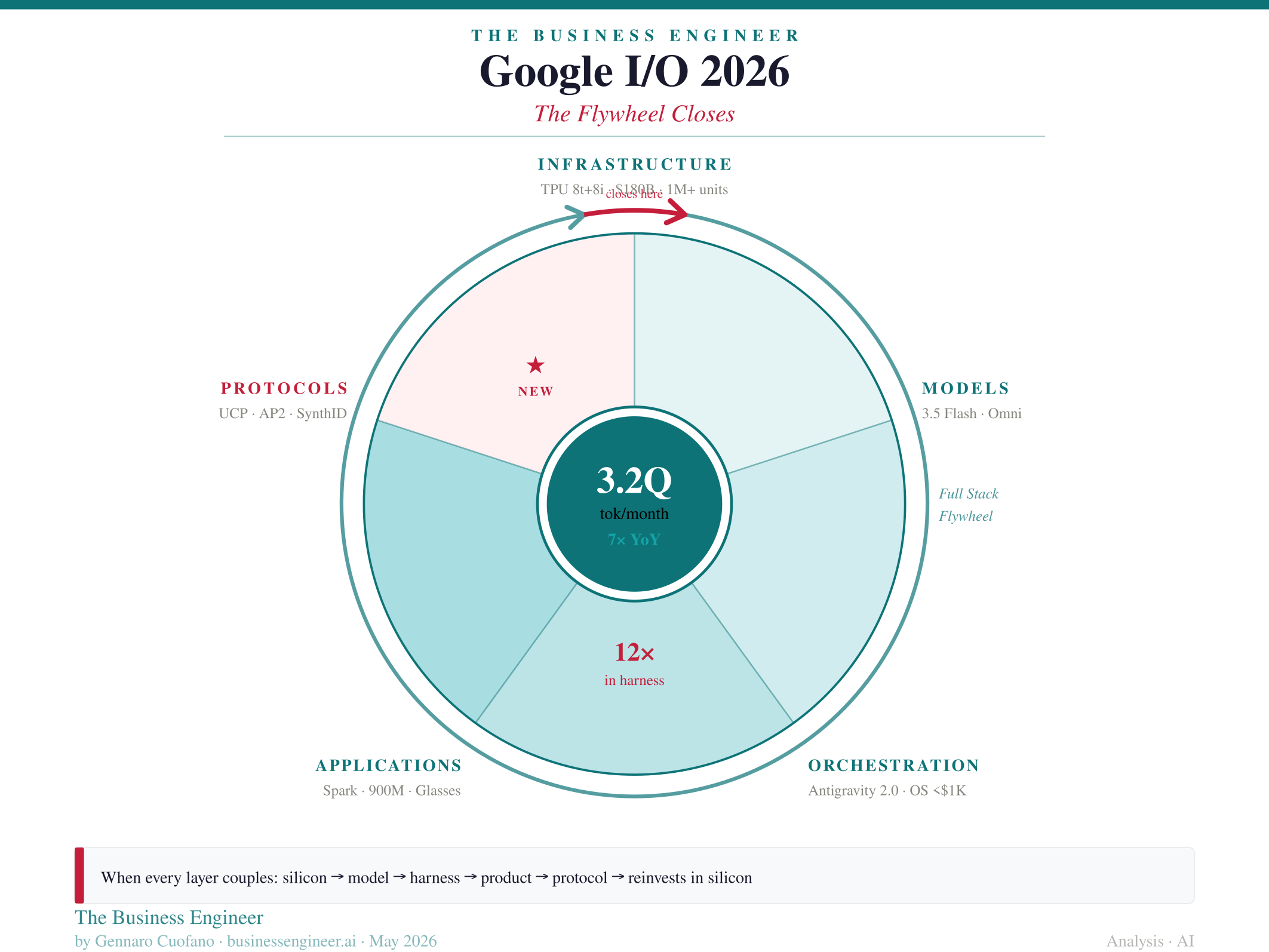
Google I/O 2026 was not a product showcase. It was a demonstration of coupling — every layer of the AI stack advancing simultaneously, each reinforcing the others. Read any single announcement in isolation, and it is incremental.
Read them together, and you see something structural: the full-stack flywheel completing its first revolution.
The Scale Context
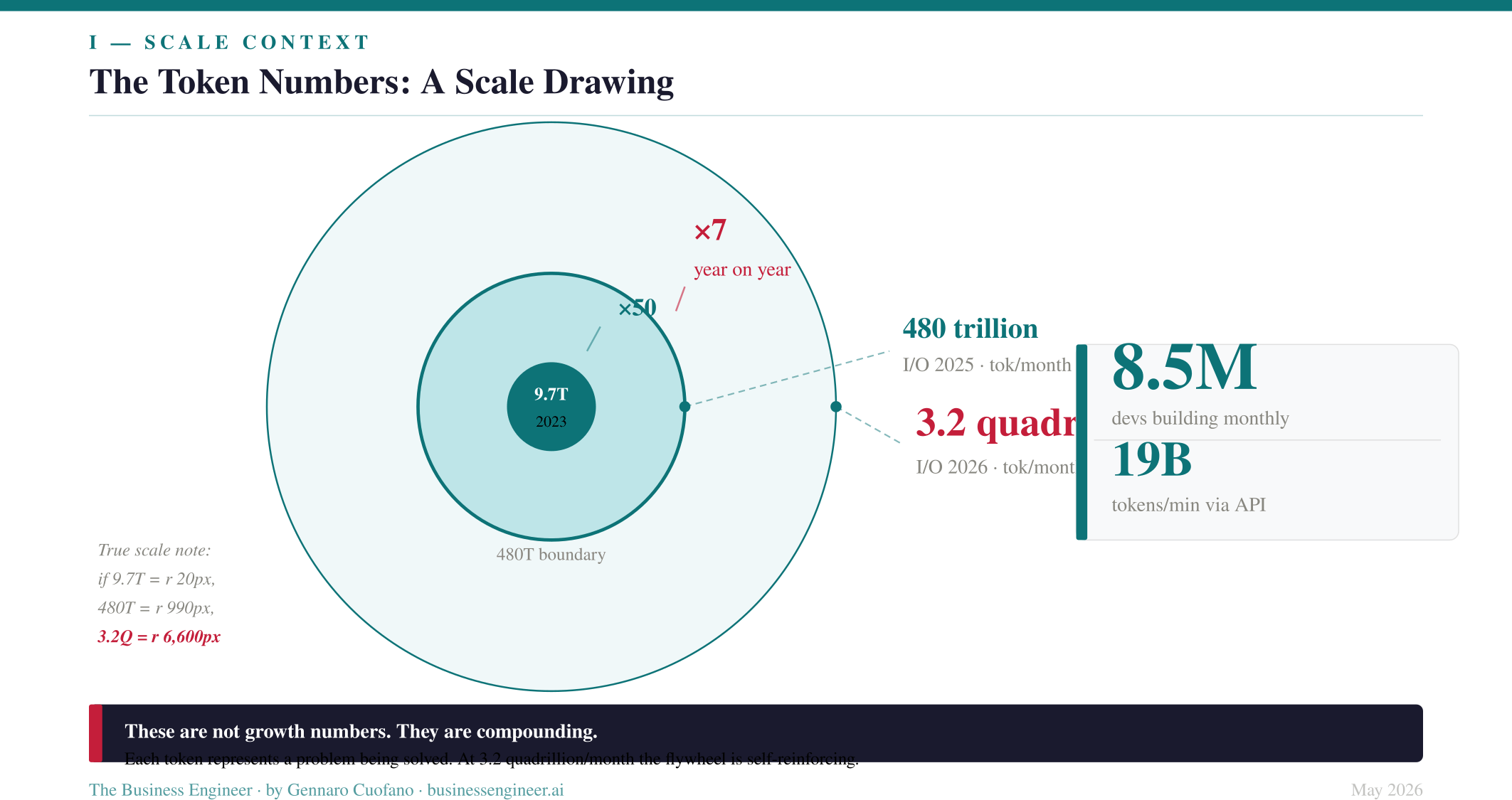
Before the announcements, Sundar Pichai established the frame with three numbers.
Two years ago, Google processed 9.7 trillion tokens per month across its services. Last year at I/O that had grown to 480 trillion. Today: 3.2 quadrillion tokens per month — a 7× increase year over year. More than 8.5 million developers now build on Google’s models monthly. The APIs process around 19 billion tokens per minute. Over 375 customers each processed more than 1 trillion tokens in the past twelve months.
These are not vanity metrics. Tokens are the atomic unit of AI work — each one represents a fragment of a problem being solved, a question being answered, a task being automated. At 3.2 quadrillion per month, AI is no longer a feature being piloted. It is load-bearing infrastructure in production, at civilization scale.
The product numbers tell the same story. Google now has 13 products with over 1 billion users each — five of them above 3 billion. AI Overviews reached 2.5 billion monthly users. AI Mode, launched just one year ago, already has 1 billion monthly users with queries more than doubling every quarter. The Gemini app went from 400 million MAU at last year’s I/O to 900 million today, with daily requests growing seven times over the same period. Fifty billion images have been generated with Nano Banana alone.
The scale numbers matter for understanding the announcements that follow. They explain the $180–190 billion capex Google expects to deploy in 2026 — roughly six times the $31 billion it spent in 2022 — and they validate why investing in proprietary infrastructure at that level makes structural sense.
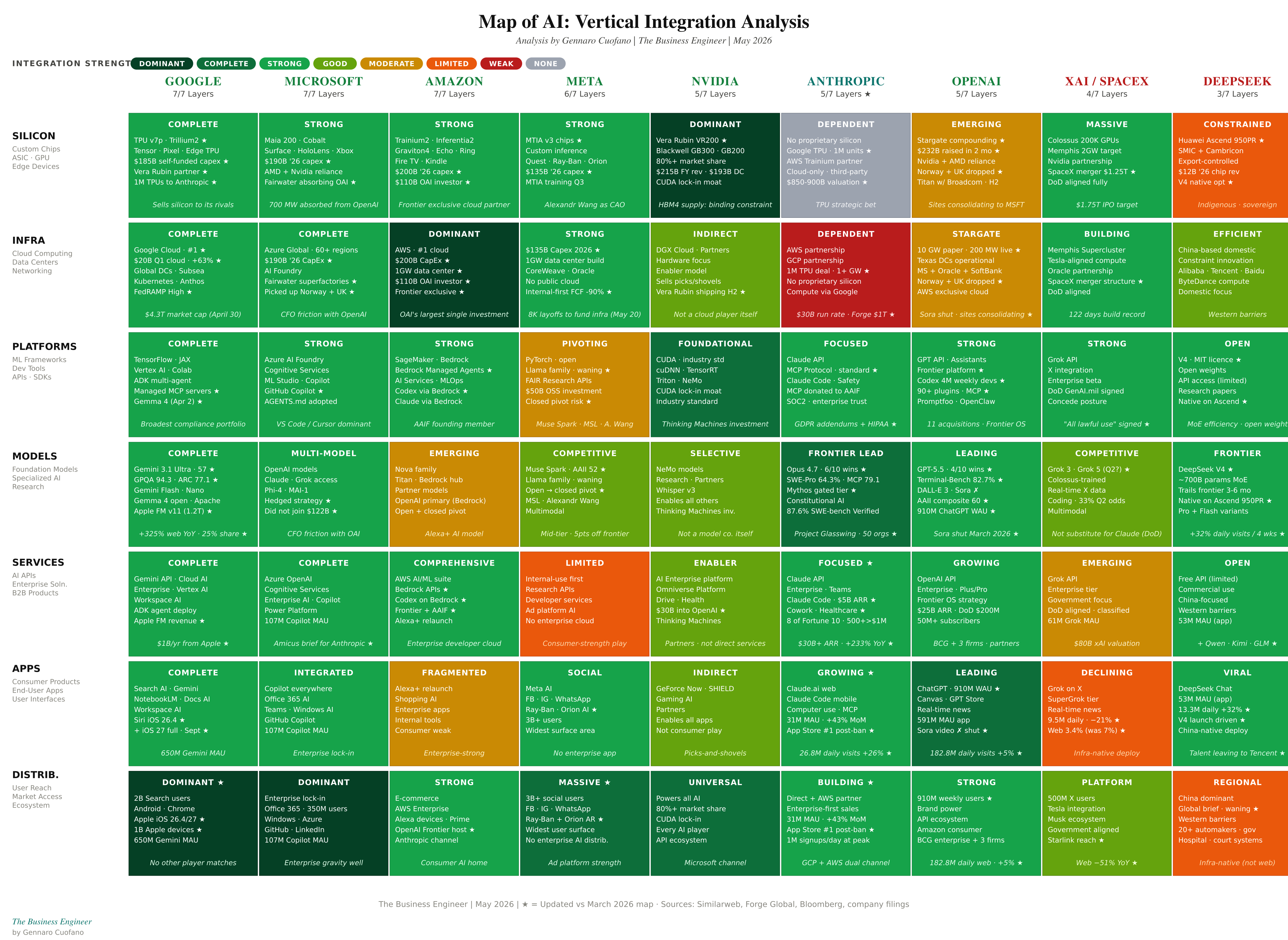
Interactive Map of AI Available Here!