

Since the ChatGPT moment, the industry has gone through a series of inflection points that progressively moved the frontier of AI one layer up the stack.
The first was the chatbot interface itself. ChatGPT turned large language models into something millions of people could interact with directly. As the product evolved, we started to see a second capability emerge: reasoning. Through chain-of-thought-style workflows, tool use, and more complex task execution, LLMs stopped behaving only like answer engines and started looking like systems that could plan and act.
Then came Claude Code, which showed much more clearly what an agent could actually be. For the first time, the model was not simply responding inside a chat. It could inspect environments, manipulate files, use tools, execute code, and work through tasks with a meaningful degree of autonomy. But that agent was still trapped inside its own harness. Powerful, yes, but bounded by the environment around it.
OpenClaw pushed the idea further by showing what a more fully empowered harness could unlock. At the same time, it forced Anthropic to accelerate Claude Code itself. Anthropic shipped rapidly, expanding Claude’s ability to use tools, operate across workflows, and behave more agentically. That product velocity became one of the major drivers of Claude Code’s success over the following year.
But the next frontier is still unresolved.
Today’s agents are powerful, yet mostly isolated. They do not naturally coordinate with one another. Context and learning do not move easily between agents. Workflows are difficult to transfer. Each agent often behaves like an intelligent individual operating inside its own container rather than as part of a coordinated system.
Several products have tried to push beyond that limitation. Perplexity Computer, Claude Tag, and now Grok Bot all point toward a new phase where agents become persistent, coordinated, and increasingly independent from the user’s immediate session.
Grok Bot is particularly interesting because of the strategic chain that produced it. The catalyst was not simply a product breakthrough. It was Anthropic’s decision to move against what had been its most important API customer, before Anthropic’s business shifted more heavily toward subscriptions and direct user relationships.
That makes this more than a product story. It is simultaneously a story of product innovation, strategic maneuvering, vertical integration, and the consolidation of the AI stack.
The same competitive moves that strengthened Anthropic’s position at the application layer may also have helped create the conditions for a rival to assemble the next generation of the agentic harness.
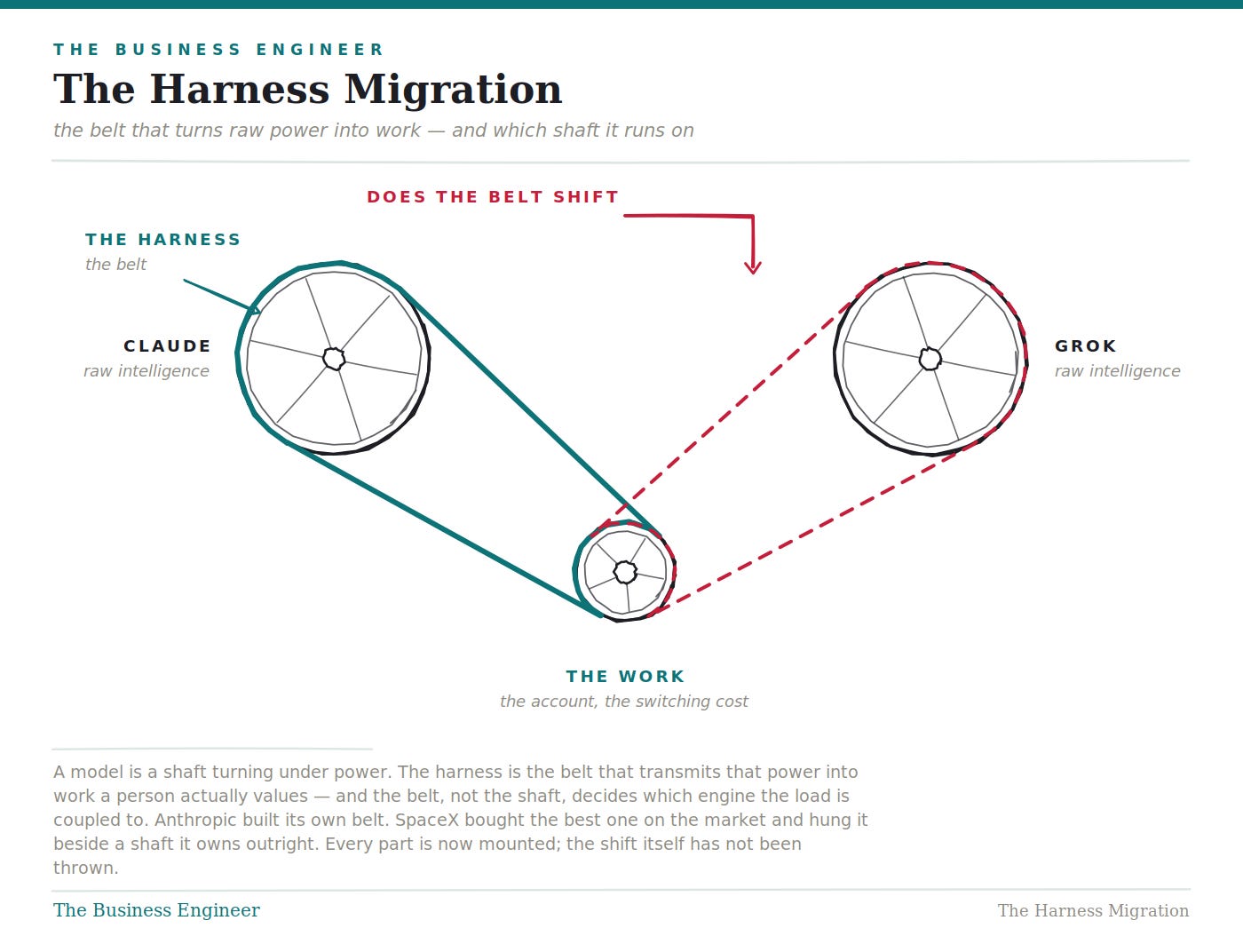
The pieces are now in place for the agentic layer to shift from Anthropic’s largest customer to its best-funded rival. Whether that shift actually happens is the open question. And it may be one of the most consequential questions in the AI stack right now.
Before anything else, one distinction matters because the entire argument depends on it. Almost everything below has already happened. The deals were signed. The products shipped. The capital moved. The speculation is not about the setup. It is about the outcome. The setup is fact. The migration is the hypothesis. Read the history as settled. Read the ending as genuinely open.