
Whatever the stock does at the open has almost nothing to do with what follows.
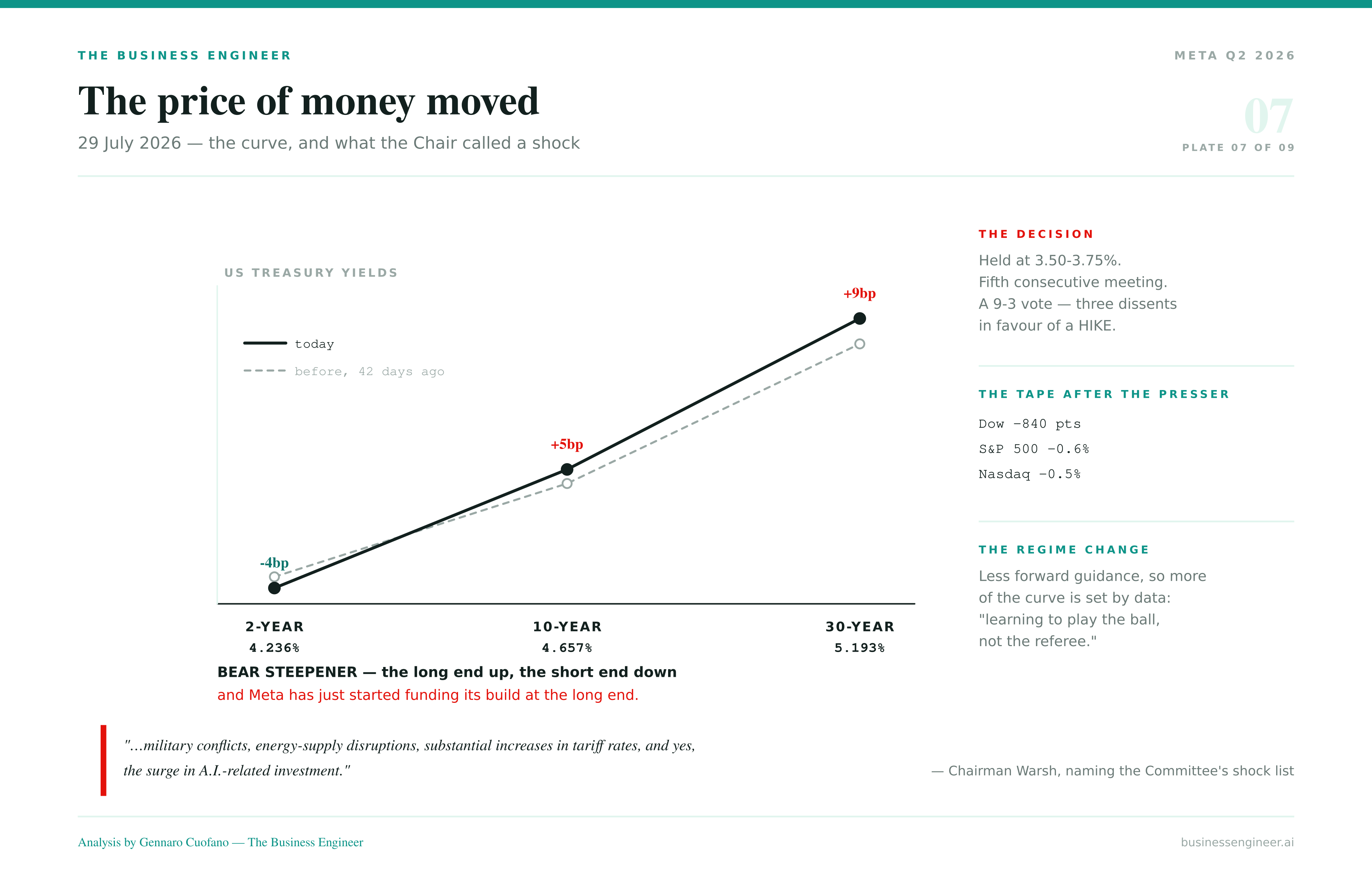
The print landed into a rough day. The Federal Reserve held rates at 3.50–3.75% for a fifth meeting on a 9–3 vote, with three members dissenting for a hike. Chair Kevin Warsh said there is no soft inflation target and this Fed will not waver. The Dow fell more than 840 points into the close, the 30-year yield rose nine basis points to 5.19% while the 2-year fell four — a bear steepener. Add a crowded trade unwinding, thin summer liquidity, blackout on corporate buybacks, and month-end two days away.
So the first move in META will be a macro move wearing a Meta jersey.
The two things live on different clocks:
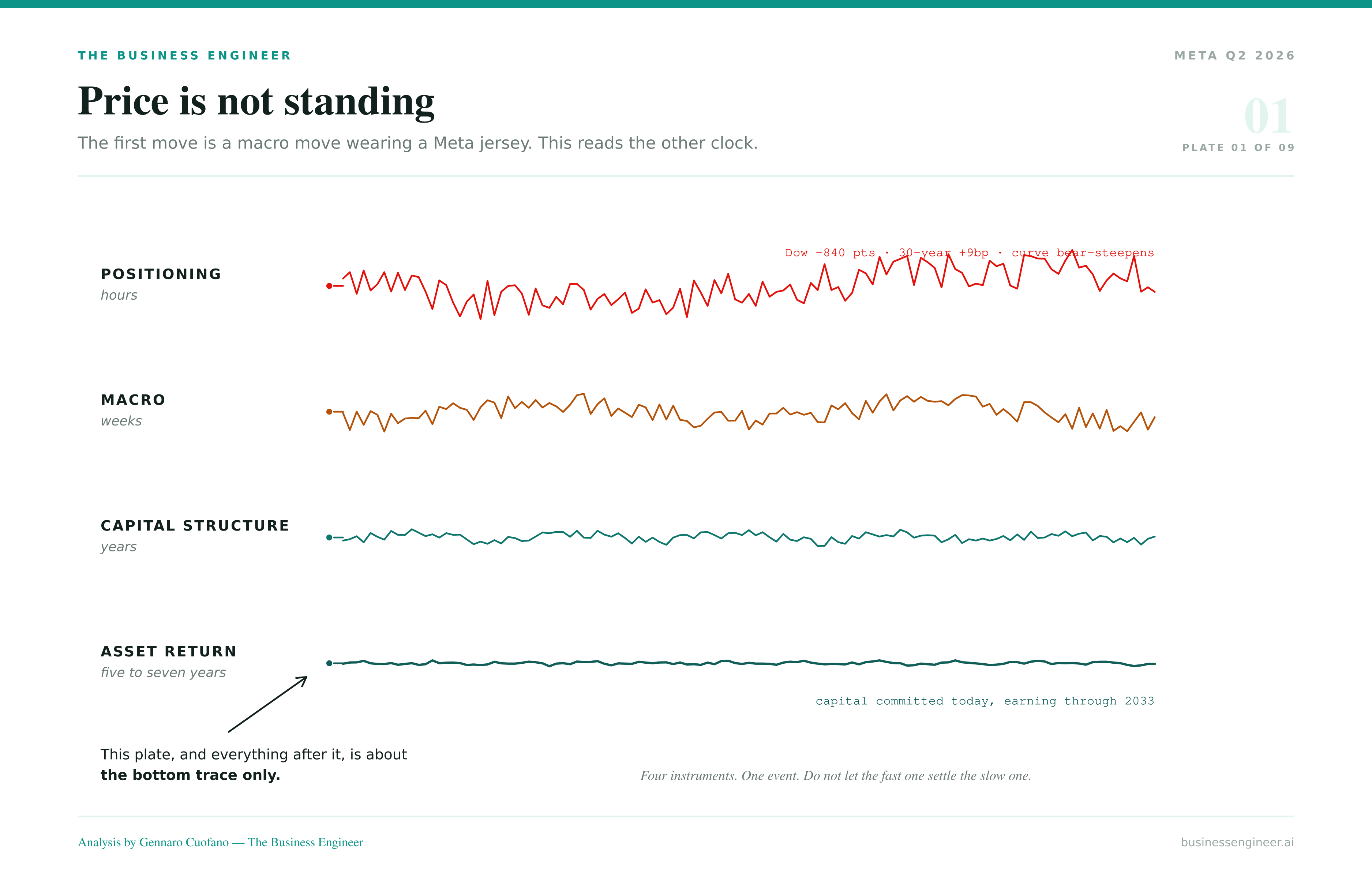
Positioning resolves in hours.
Macro in weeks.
Capital structure in years.
A data centre’s return in five to seven years.
This piece is a reading of the last one — the durable standing of the business. It is deliberately useless for guessing the next move. Where the macro genuinely changes the structure rather than the price, and today it does in one specific way, that shows up in Section 5 of this analysis.
Follow me on The AI Supercycle as well!

The one-page version
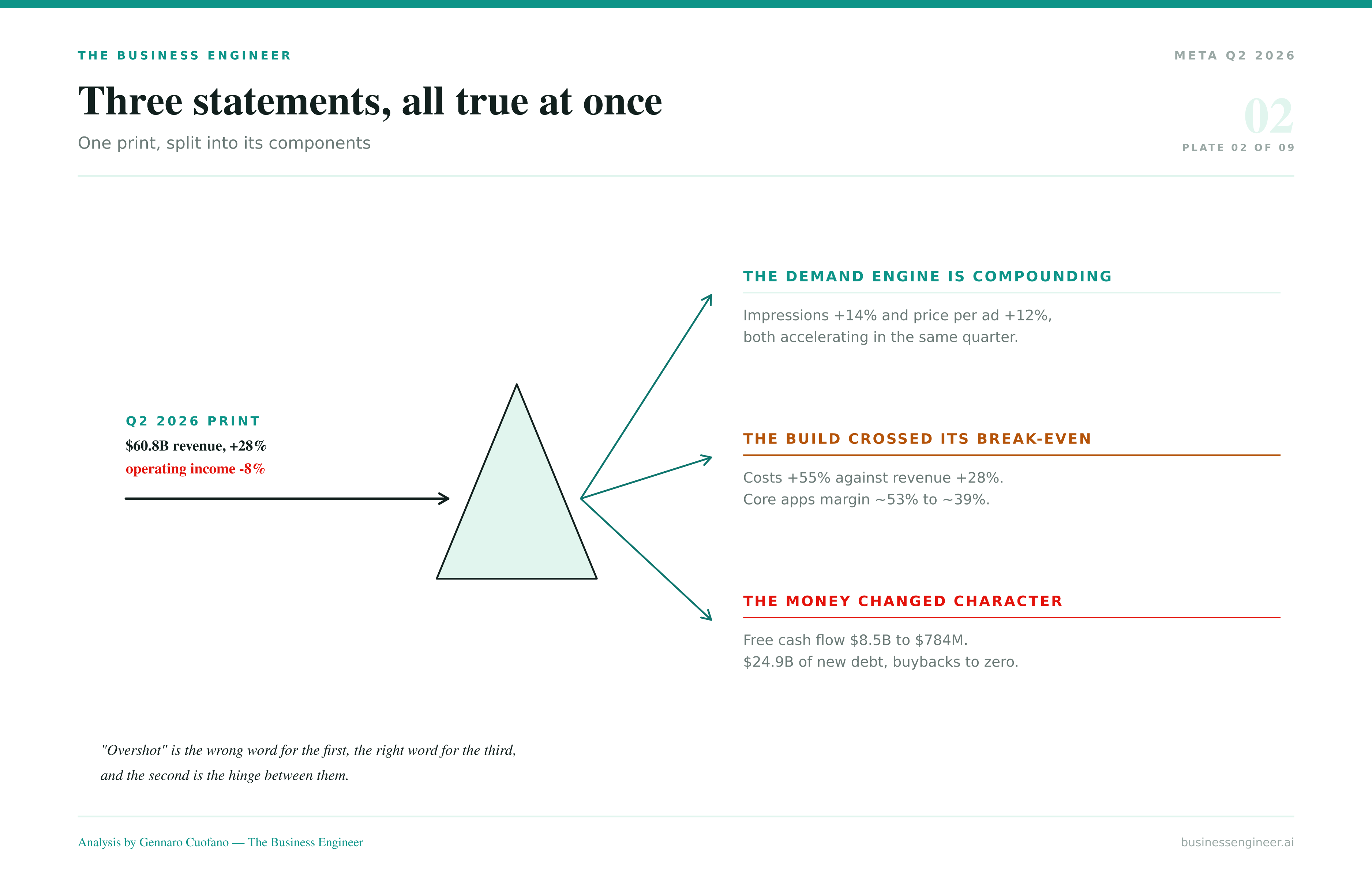
Q2 2026 divides cleanly into three statements. All three are true at the same time.
The demand engine is compounding. Revenue +28% to $60.8B. Ad impressions +14% and price per ad +12%, both in the same quarter. That is the signature of an ad system getting better, and it is the only receipt anyone has on the AI capital.
The build has crossed its own break-even. Costs +55% against revenue +28%. Operating income fell 8%; margin dropped from 43% to 31%. Strip the one-timers and the underlying margin is ~37% — still six full points lower than a year ago. For the first time, the AI build is eating the core apps’ own profit, not just Reality Labs’.
The money changed character. Free cash flow collapsed 91%, from $8.5B to $784M. Meta raised $24.9B of new debt in one quarter, stopped buying back stock entirely, and now converts essentially all of its operating cash into servers, buildings and power.
The word “overshot” is wrong for the first, right for the third, and the second is what connects them.
The rest of this piece walks that connection, one section per link.
The core still works
Follow me on The AI Supercycle as well!
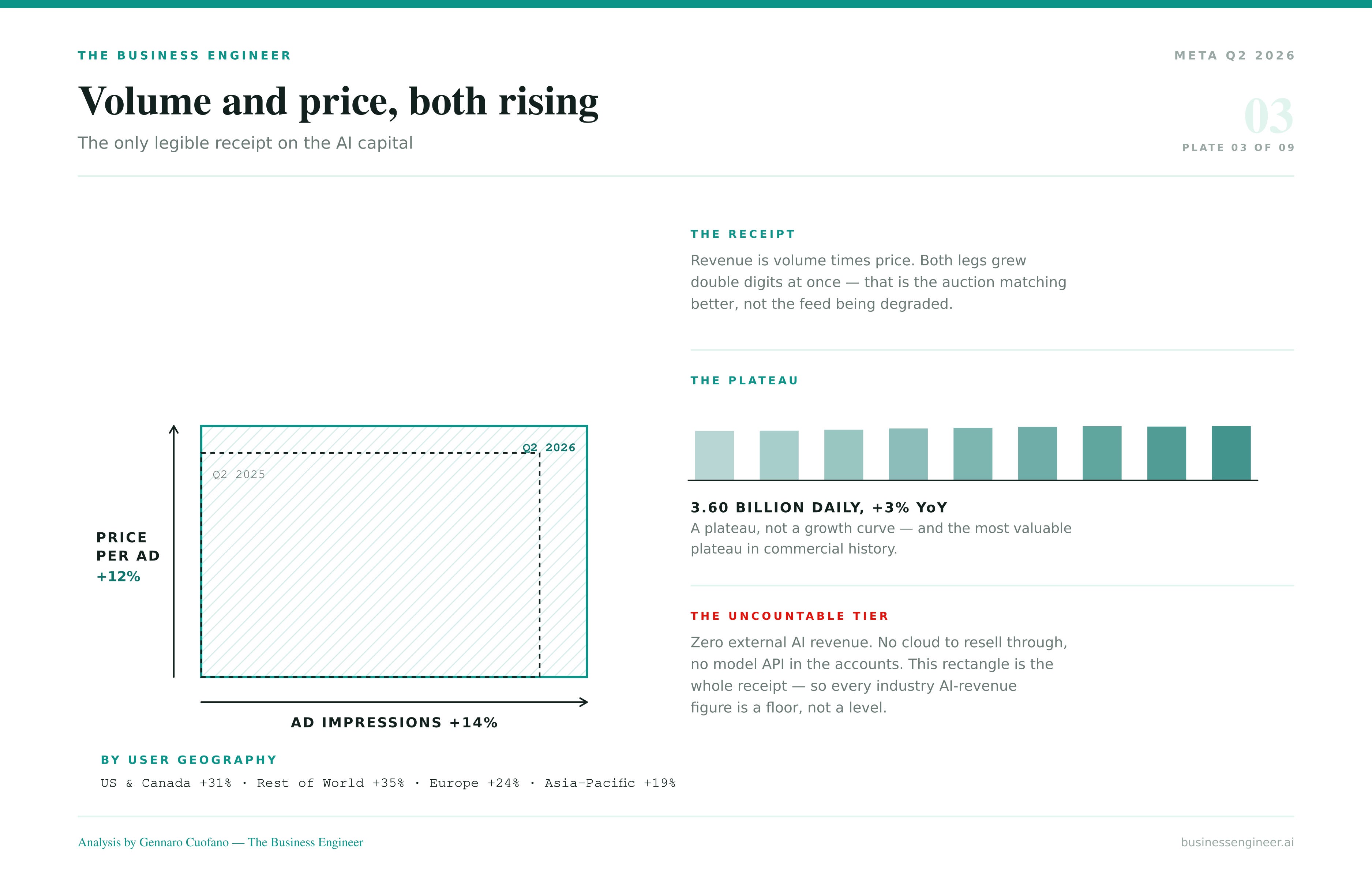
Family of Apps revenue was $60.4B, up 28%. Advertising was $59.4B, up 27%. Daily active people reached 3.60B, up 3% — at this scale, that is not a growth number, it is confirmation the audience is not leaking. A plateau at 3.5 billion people is the most valuable plateau in commercial history.
The interesting numbers are underneath.
Impressions +14%. Price per ad +12.
Revenue is volume times price. Both legs grew double digits in the same quarter, and that combination is hard to fake. A platform can manufacture more impressions by loading the feed more heavily, but that usually shows up as a falling clearing price — advertisers pay less for worse inventory. Getting more impressions and a higher price means the auction is matching ads to people better. Which is exactly what improved AI ranking is supposed to produce.
This matters far beyond Meta, because Meta is the purest example of a category the whole AI-revenue debate keeps mislabelling. Every published tally of “AI revenue” — the frontier labs, the hyperscaler cloud lines, the agentic-software vendors — has a hole in it exactly the shape of this company.
Meta spends more on AI infrastructure than almost anyone alive and books zero dollars of external AI revenue.
There is no public cloud to resell capacity through, no model API showing up as a line item. The entire return comes back as ad-ranking lift inside an already-enormous ad business, inseparable from the rest of the auction. So the impressions-times-price line is the only window into whether the capex is earning something. This quarter, the window showed light.
One wrinkle to carry forward: growth is concentrating in the United States. Ad revenue rose 31% in US and Canada and 35% in Rest of World, against 24% in Europe and 19% in Asia-Pacific. The fastest-growing 44% of the ad base is also the most legally exposed (see Section 6).
The cost line crossed
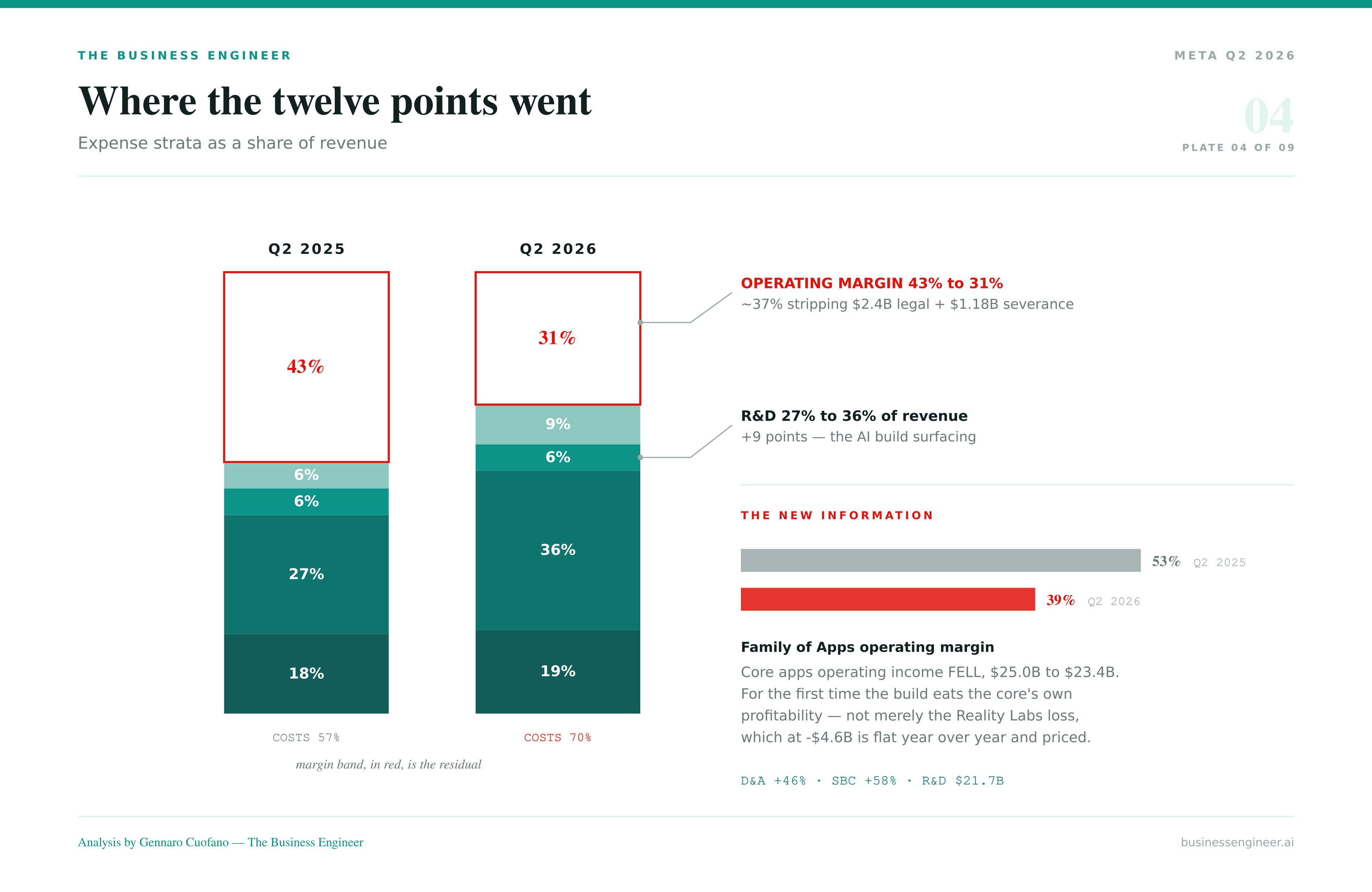
Total costs rose 55% to $42.0B, against revenue growth of 28%. When your cost base grows at roughly twice your revenue rate, the margin math is not a matter of opinion. Operating income was $18.8B, down 8%. Margin fell from 43% to 31%.
Two items inflate the headline:
$2.4B of legal charges (in G&A).
$1.18B of severance from the ~8,000-person May layoff.
Strip both and underlying operating income is nearer $22.4B, a margin around 37%. That is the honest structural read — and it is still six points below last year, none of it one-time.
Where did the six points go? Almost entirely into research and development.
R&D rose 67% to $21.7B, and now takes 36% of revenue, up from 27%.
D&A rose 46% to $6.4B, and is accelerating.
Stock-based compensation rose 58% to $7.7B — the visible edge of a market where the marginal AI researcher prices like a professional athlete.
Nine points of revenue moved into R&D in a single year. That is the AI build finally surfacing on the income statement.
But the most important cut is one only the segment table lets you see.
Reality Labs lost $4.6B, roughly flat year-on-year. That drag is old news and already priced.
The new information is inside Family of Apps. Operating income there actually fell, from $25.0B to $23.4B, and margin dropped from about 53% to about 39%.
For the first time, the AI build is eating the core apps’ own profitability — not merely being offset against the metaverse loss.
The cash machine still generates enormous cash. It generates meaningfully less of it per dollar of revenue than a year ago, and the reason is the cost of the thing management believes is protecting the revenue in the first place.
A company whose demand engine is compounding is watching the profitability of that same engine compress, because the capital being deployed to improve it depreciates faster than the incremental margin arrives. That is not a contradiction. It is what the early years of a capital-ahead-of-revenue buildout look like. Whether it resolves well is not decided on the income statement at all — it is decided on the cash flow statement.
The financing changed character
Follow me on The AI Supercycle as well!
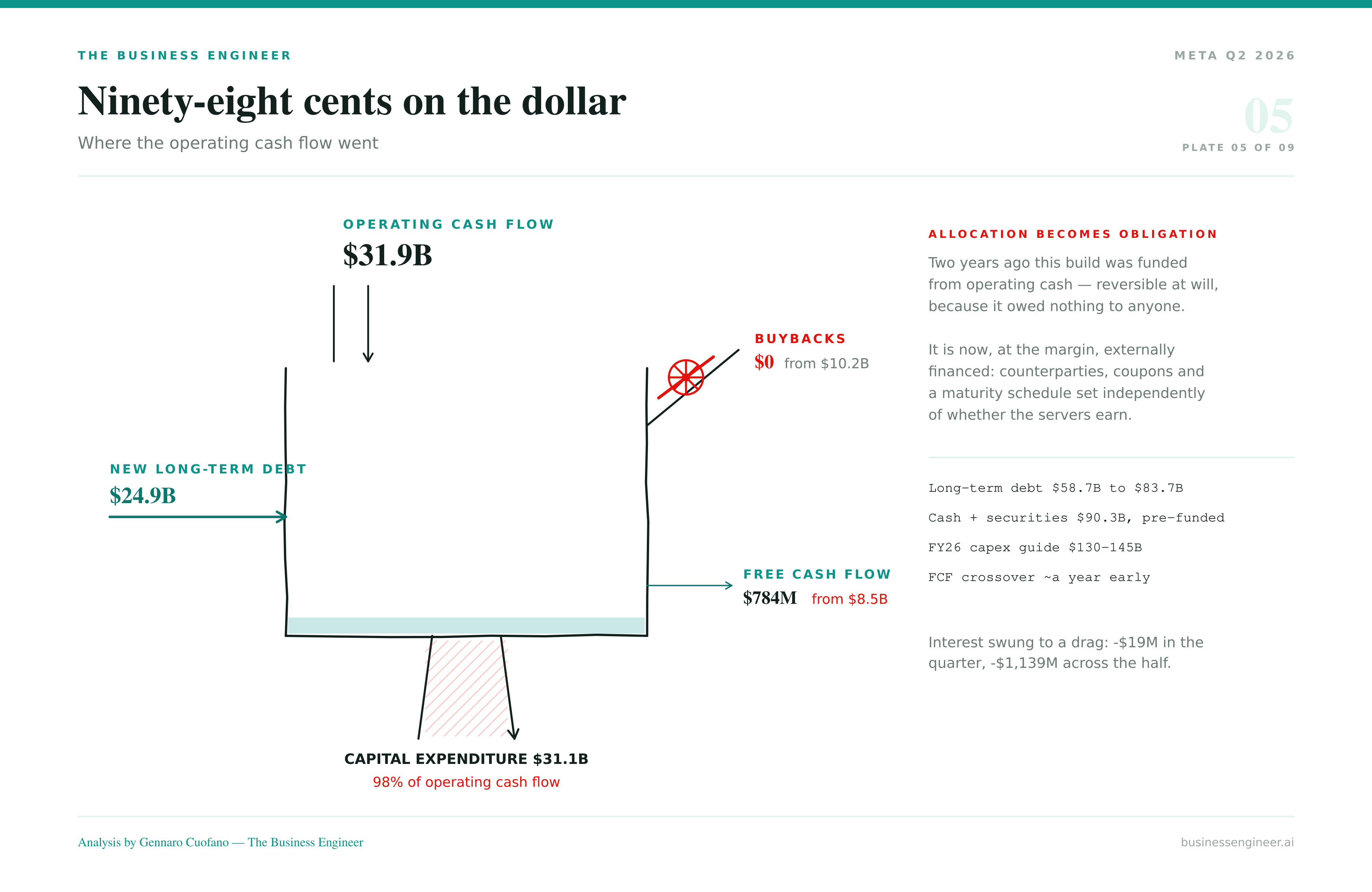
Meta generated $31.9B of operating cash flow this quarter — a healthy, growing number. It spent $31.1B on capital expenditure including finance leases. That leaves $784M of free cash flow, down from $8.5B — a 91% collapse.
Read the ratio directly: capex now equals about 98% of operating cash flow.
The company that historically reinvested a fraction of its cash and returned the rest now converts essentially all of it into physical assets. And 98% is not the ceiling — it is this quarter’s reading on a line that is still rising. Management guided full-year capex to $130–145B (raising the floor from $125B), and full-year expenses to $165–169B. Facing the margin compression in Section 2, Meta pressed the accelerator, not the brake.
The gap between near-total reinvestment and continuing to pay a dividend has to be closed somewhere. This quarter, it was closed on the balance sheet.
Debt: $24.9B of net new long-term debt in the quarter. Total debt rose from $58.7B at year-end to $83.7B.
Buybacks: zero. In Q2 2025 the number was $10.2B.
Cash and securities: $90.3B on hand. The debt was raised into cash and securities, not spent — this was pre-funding a build already committed to, not plugging a hole that opened this quarter.
No single one of these is alarming on its own. Meta’s balance sheet absorbs $25B of debt without breaking a sweat; interest coverage remains enormous. But the character of the enterprise changed.
Two years ago this was a corporate investment programme funded out of operating cash — a decision management could reverse at will, because it owed the money to no one.
It is now, at the margin, an externally financed infrastructure programme. It has counterparties, coupons, and a maturity schedule. Interest and other income swung from a positive contribution a year ago to a small drag this quarter, and to more than a billion dollars of drag across the first half. That is the first faint pull of the debt on the P&L.
There is a name for this transition: allocation becomes obligation.
A buildout paid for from cash flow can be slowed the moment the return disappoints. A buildout paid for with bonds cannot — the servers were bought with money that has to be repaid on a schedule set independently of whether the servers earn their keep. Meta crossed further along that line this quarter than in any prior one, and ahead of schedule. The point at which its free cash flow would approach zero was widely pencilled in for 2027. It arrived this quarter.
One honest note. First-half net income of $42.6B is up year over year — but that is a first-quarter tax benefit, not operating strength. The Q2 quarter itself shows net income down 14% and EPS down 13%, and with buybacks halted there was no shrinking share count to cushion the per-share line. The half-year flatters. The quarter tells you the truth.
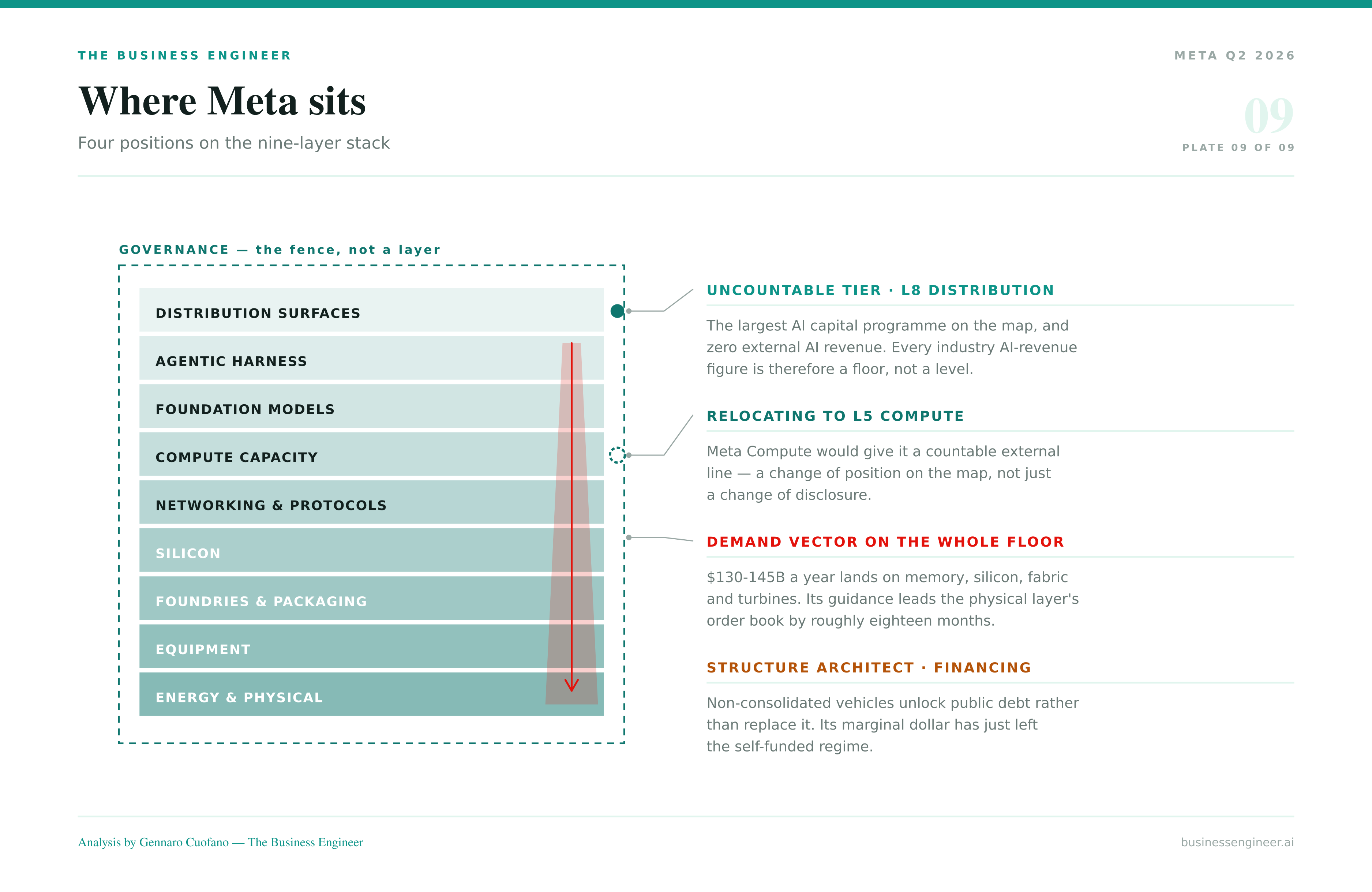
Meta Compute — the development that could invert the question
The most consequential thing about Meta’s capital programme is not in this release at all.
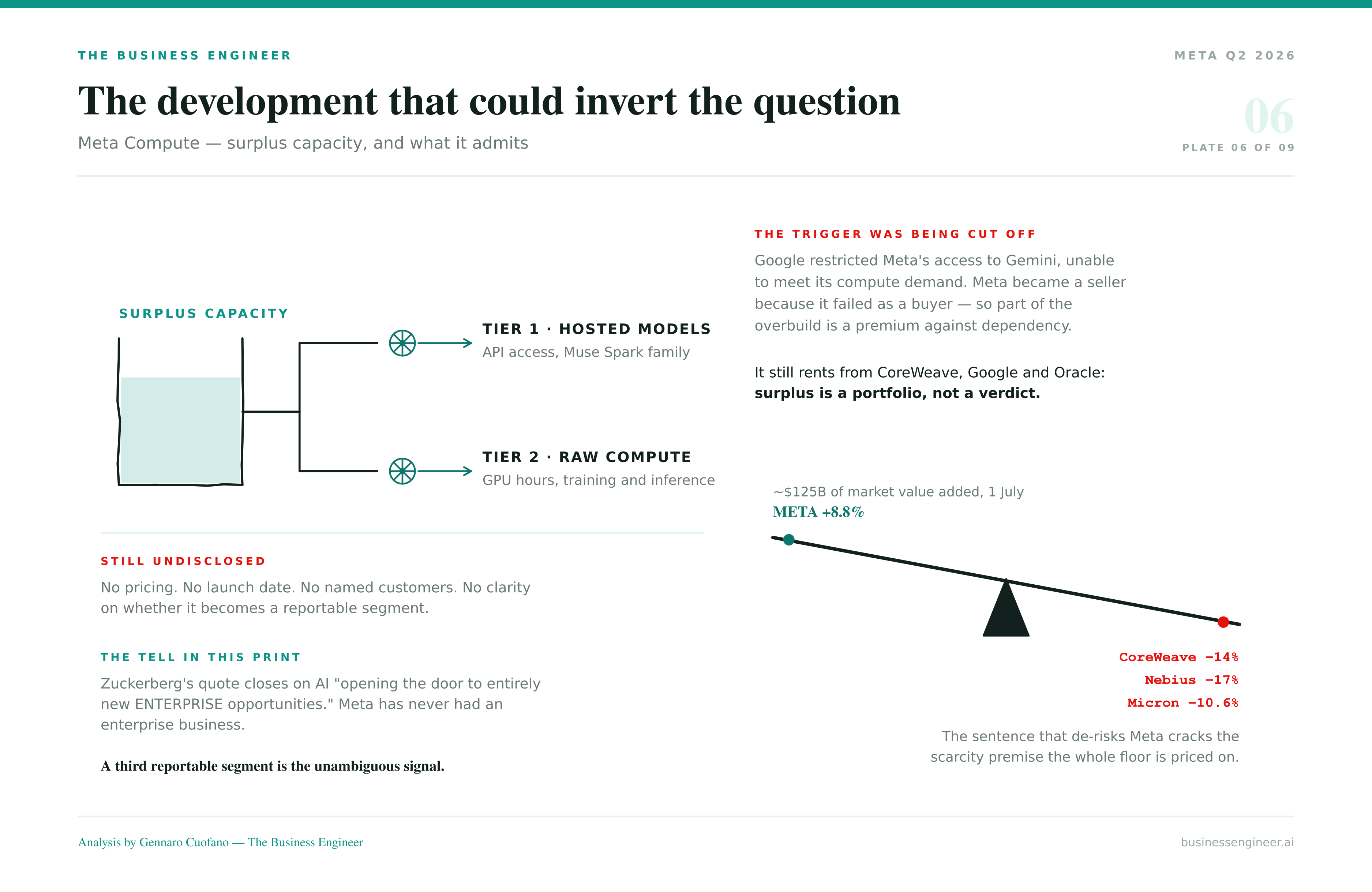
It is the decision, reported by Bloomberg on 1 July and corroborated since, to build Meta Compute — an internal unit that will sell surplus AI capacity to outside customers. It has two tiers:
Tier 1: hosted models through an API, including the Muse Spark family.
Tier 2: raw compute — GPU hours for training and inference.
It is run by infrastructure head Santosh Janardhan, Superintelligence Labs’ Daniel Gross, and president Dina Powell McCormick. Zuckerberg has said selling compute access is “definitely on the table.”
Today’s release contains the tell. His quote closes on AI “opening the door to entirely new enterprise opportunities.” Meta has never had an enterprise business.
Is that clause Meta Compute being pre-announced inside a CEO quote?
That would be a game changer.
The macro repricing — where the outside world changes the mechanism
Follow me on The AI Supercycle as well!
Section 3 established that Meta now funds part of its build with borrowed money. That makes the price of money a structural input, not background noise. Today, the price of money moved.
Chair Warsh flagged, as the first of two economic developments worth highlighting, that nominal and real yields are materially higher across the Treasury curve — with inter-meeting increases in market rates “among the most significant in the last two decades, ranking around the top decile or so.” He attributed the move partly to a deliberate reduction in forward guidance:
“Market participants are learning to play the ball, not the referee.”
That is a regime statement. A Fed that guides less leaves more of the yield curve to be set by incoming data. Which means more volatility in the exact instrument Meta has just started depending on.
The cascade into this company is direct:
Meta issued $24.9B of long-dated debt in the quarter. It will need considerably more. A 30-year yield at 5.19% and rising raises the coupon on every future tranche and on the eventual refinancing of this one.
The three dissents were for a hike. The risk is skewed toward higher, not lower.
The same hawkish turn strengthens the dollar. That is why the one-point currency tailwind in this quarter’s revenue is guided to become a one-point headwind in Q3.
The effective tax rate rose from 11% to 16%, with guidance lifted to 15–17% from 13–16%.
None of these is fatal on its own. Together, they tighten every line beneath the revenue: financing cost up, translated revenue down, tax up.
Then there is the part that should genuinely unsettle anyone modelling this sector.
Warsh named the AI buildout twice, in company that should give pause. He described the surge in high-tech capex as “the most striking feature of the economy,” with four-quarter growth near 20% in AI-related equipment and software. And when he listed the economic shocks the Committee had discussed, the list read:
“…pandemic supply chains, military conflicts, energy-supply disruptions, substantial increases in tariff rates — and yes, the surge in A.I.-related investment.”
The Fed Chair placed the AI buildout in the same analytical category as war and tariffs.
The third question he says the Committee took up is the sharpest of all. The capex boom, in his words, “is driving up prices of memory and logic chips and associated A.I. infrastructure. Do those changes indicate a broader inflationary dynamic, or do we just focus on them because they are under the bright streetlight?”
That is price is not capacity, asked from the chair of the Federal Reserve. A meaningful share of what the industry reports as capital expenditure is component-price inflation rather than incremental compute — memory pricing was part of why Meta itself raised this range.
If the Fed concludes that AI capex is a source of inflation rather than merely a source of growth, the cost of financing that capex rises because of the capex. That is a feedback loop nobody in the sector has priced, and it turns a macro headline into a structural feature of the buildout.
The governance fence
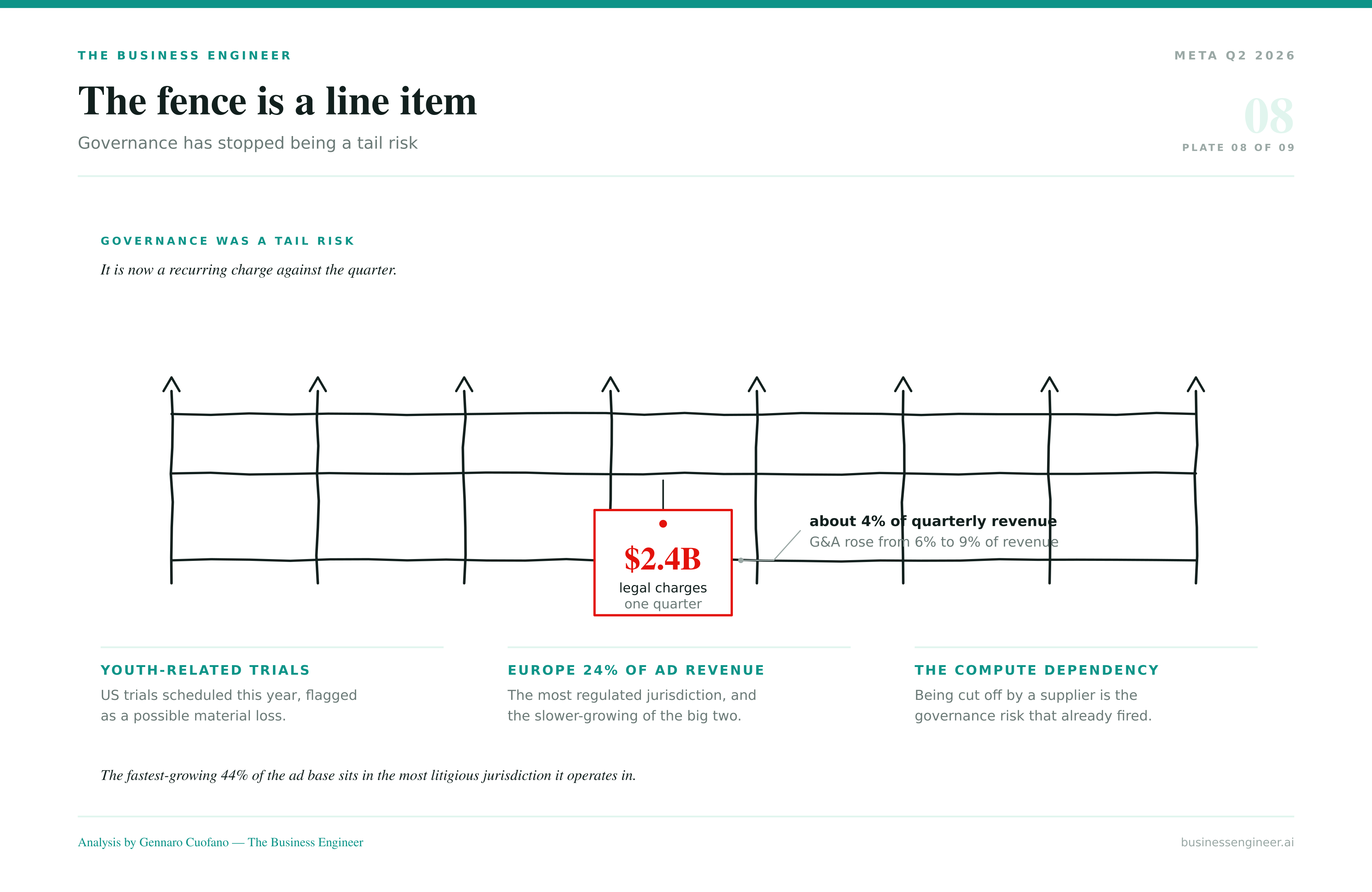
Warsh’s shock list mentioned tariffs and military conflict for a reason: policy is now an operating variable across this whole stack. Meta sits in an unusual position on it.
The most quantified instance is in this quarter’s own numbers.
$2.4B of legal charges — about 4% of quarterly revenue.
G&A rose from 6% of revenue to 9%.
Management explicitly flags continuing scrutiny on youth-related issues in several markets, with US trials scheduled this year that “may ultimately result in a material loss.”
That is the governance fence arriving as a recurring line item, not a tail risk. It is the cost of operating the distribution surface at 3.5 billion people.
The geographic mix compounds it.
Europe is 24% of ad revenue and the most heavily regulated jurisdiction Meta operates in — and it is growing slower than the US.
Asia-Pacific is 18% and the slowest-growing of all.
The fastest-growing 44% of the ad base sits in the United States, where the legal exposure is most acute.
On the infrastructure side, Meta is exposed to the same export-control and supply architecture as every other builder, and to two specifics of its own. Its compute strategy now depends on third-party capacity — Google, Oracle, CoreWeave — which is exactly the dependency that produced the Gemini cut-off and, in turn, Meta Compute.
And its open-weight position is not incidental: Meta is a signatory to the open-weights push, and an open-model tier is what makes a hosted-model business viable for a company that does not hold the frontier. Restriction versus diffusion is not an abstract debate for Meta. It is the precondition for the second tier of its new revenue stream.
Where it sits in the Map of AI