
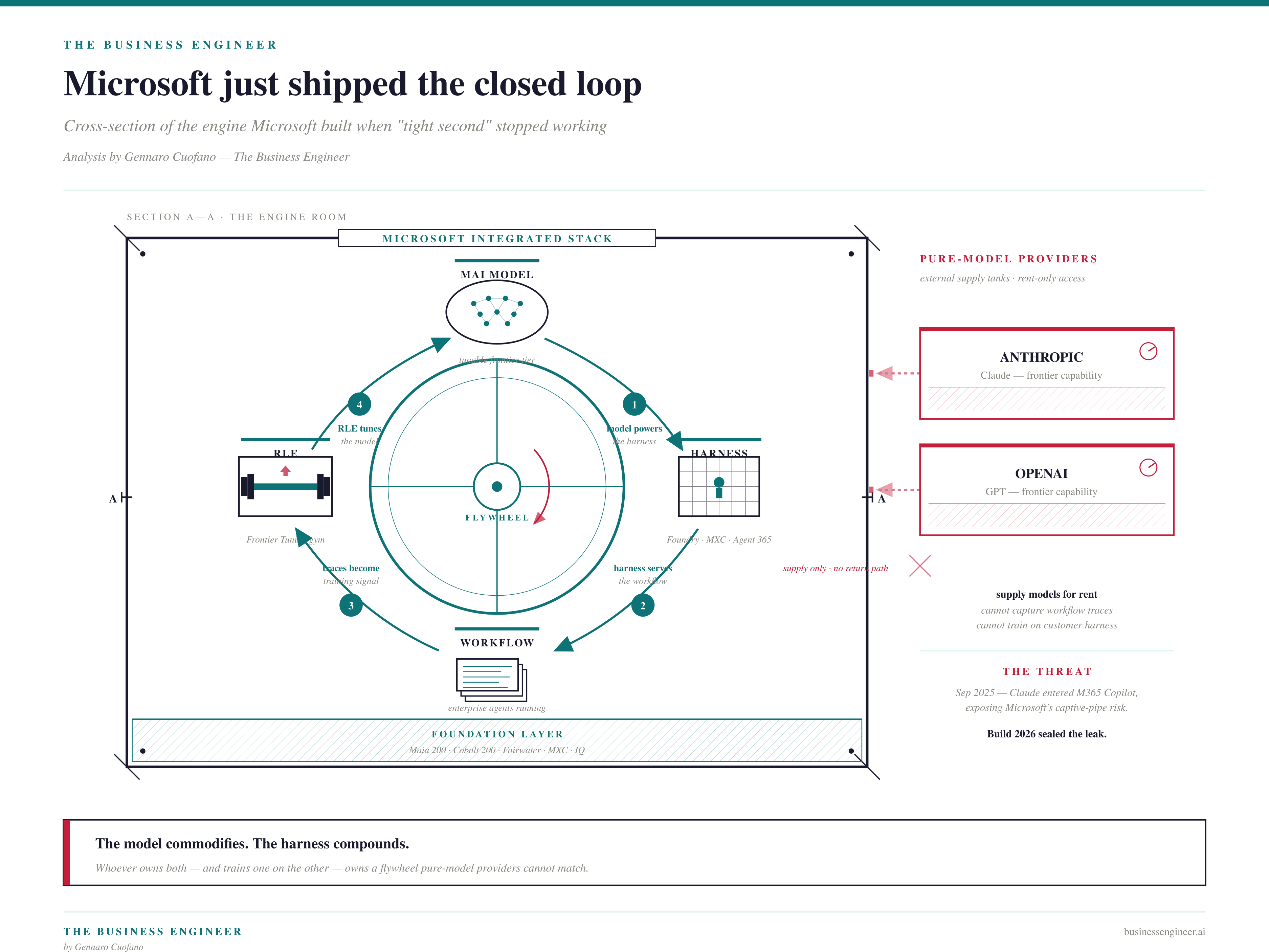
For the past eighteen months, The Business Engineer has been making one consistent structural argument about the agentic AI race: in the next two to three years, the durable competitive moat will not be the frontier model itself — it will be control of the harness, and the ability to feed harness data back into the model as training signal. The model commodifies; the orchestration layer compounds. Whoever owns the harness and can train a frontier model on it owns a flywheel the pure-model providers cannot match.
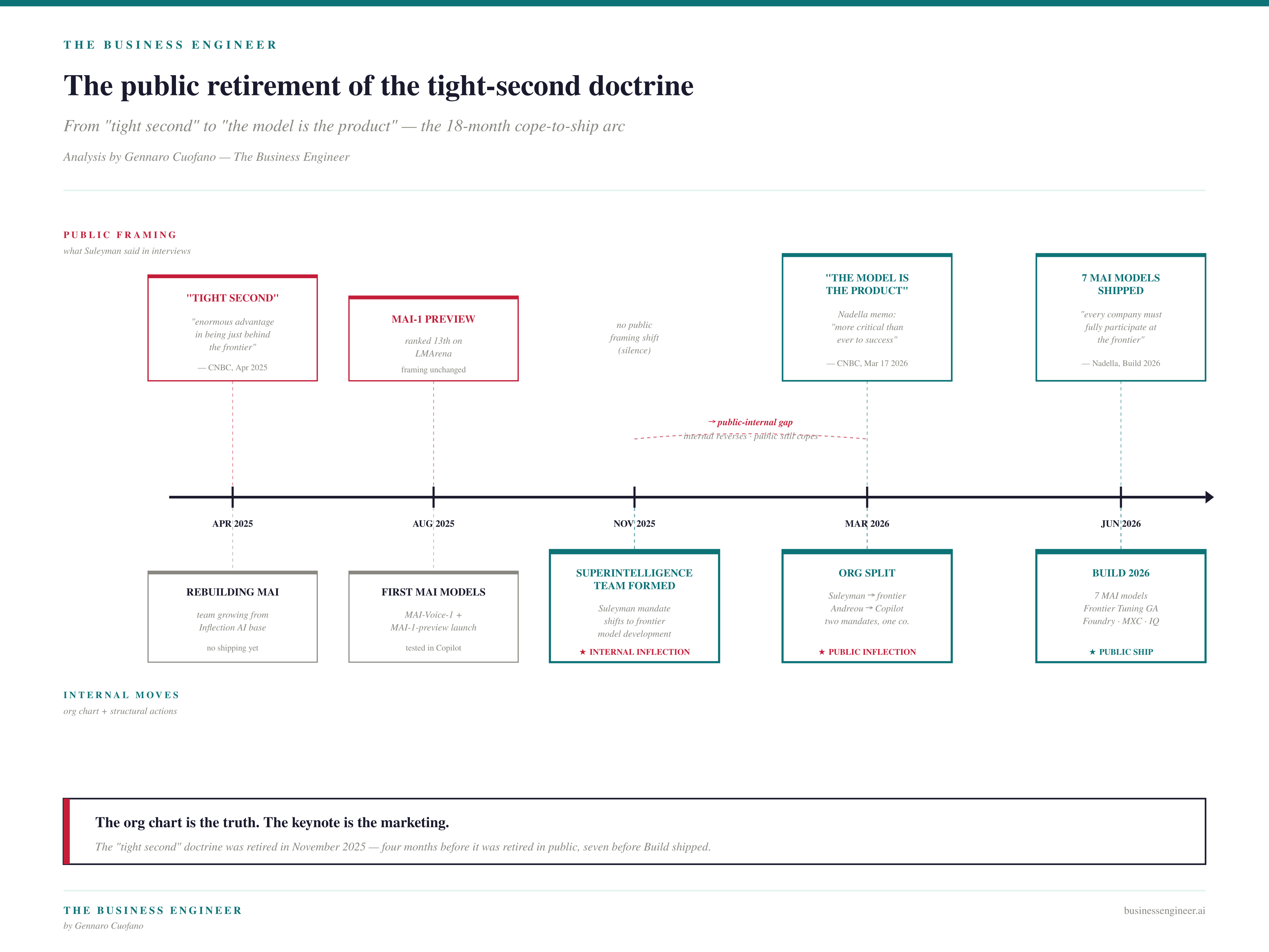
This framework — Harness Theory in earlier pieces — sat alongside a related call about Microsoft specifically: the official Microsoft AI doctrine through most of 2025 and early 2026 (Suleyman’s “tight second” line, the argument that being three to six months behind the frontier was a feature not a bug) was strategic cope. Not because trailing the frontier is structurally bad — it isn’t — but because trailing without a credible frontier path of your own turns the product stack into a captive distribution channel for someone else’s IP. In Microsoft’s case, the someone else was increasingly Anthropic.
The Anthropic threat to Microsoft’s enterprise position became visible the moment Claude was integrated into Microsoft 365 Copilot in September 2025. Once the product stack accepted that frontier models are interchangeable inputs, the competitive geometry inverted. Anthropic was no longer a model supplier sitting underneath Microsoft’s distribution — it was a frontier provider with direct enterprise mindshare, increasingly preferred by developers, increasingly the model behind agentic coding workflows, and increasingly positioned to disintermediate the parts of Copilot that actually generate revenue. The product stack was eating itself: Microsoft was distributing the competitor that could erode its own enterprise franchise.
Build 2026 is the closure of that exposure. The seven MAI models, the Foundry hosted-agent runtime, the MXC containment layer on Windows, the IQ context stack, and — most importantly — Frontier Tuning with customer-owned reinforcement learning environments are not separate announcements. They are the operational answer to the harness-as-moat thesis. Microsoft just shipped the closed loop: customer agent traces feed RLE training, RLE training improves MAI models, improved MAI models run better on the Microsoft harness, the harness compounds, the loop tightens, the dependence on Anthropic and OpenAI moves from structural to optional.
Satya’s framing on stage was unambiguous: “the time has come for every company to just move from consuming a frontier model to fully participating at the frontier in the frontier ecosystem.” That is the public retirement of the tight-second doctrine, and the public adoption of the harness-flywheel thesis. The internal record confirms the reversal was already in motion: Microsoft formed the Superintelligence team under Suleyman in November 2025; the March 17, 2026 reorganization narrowed Suleyman’s mandate to frontier models while Jacob Andreou took unified Copilot leadership; Nadella’s memo: “Progress at the AI model layer is more critical than ever to our success as a company over the next decade”; Suleyman to CNBC on the same day: “The model is the product” — the exact inverse of his April 2025 framing.
The architectural fact behind Build 2026 is now legible. Nadella owns the product stack and the platform narrative. Suleyman owns the frontier shop. Two leaders, two mandates, one company — and one closed-loop flywheel that the absolute-frontier model providers cannot replicate without becoming hyperscalers themselves.
This piece works through the four-layer analytical reading of the announcements, then closes with a focused competitive assessment of the MAI stack specifically — because the headline benchmarks obscure what’s actually being built.
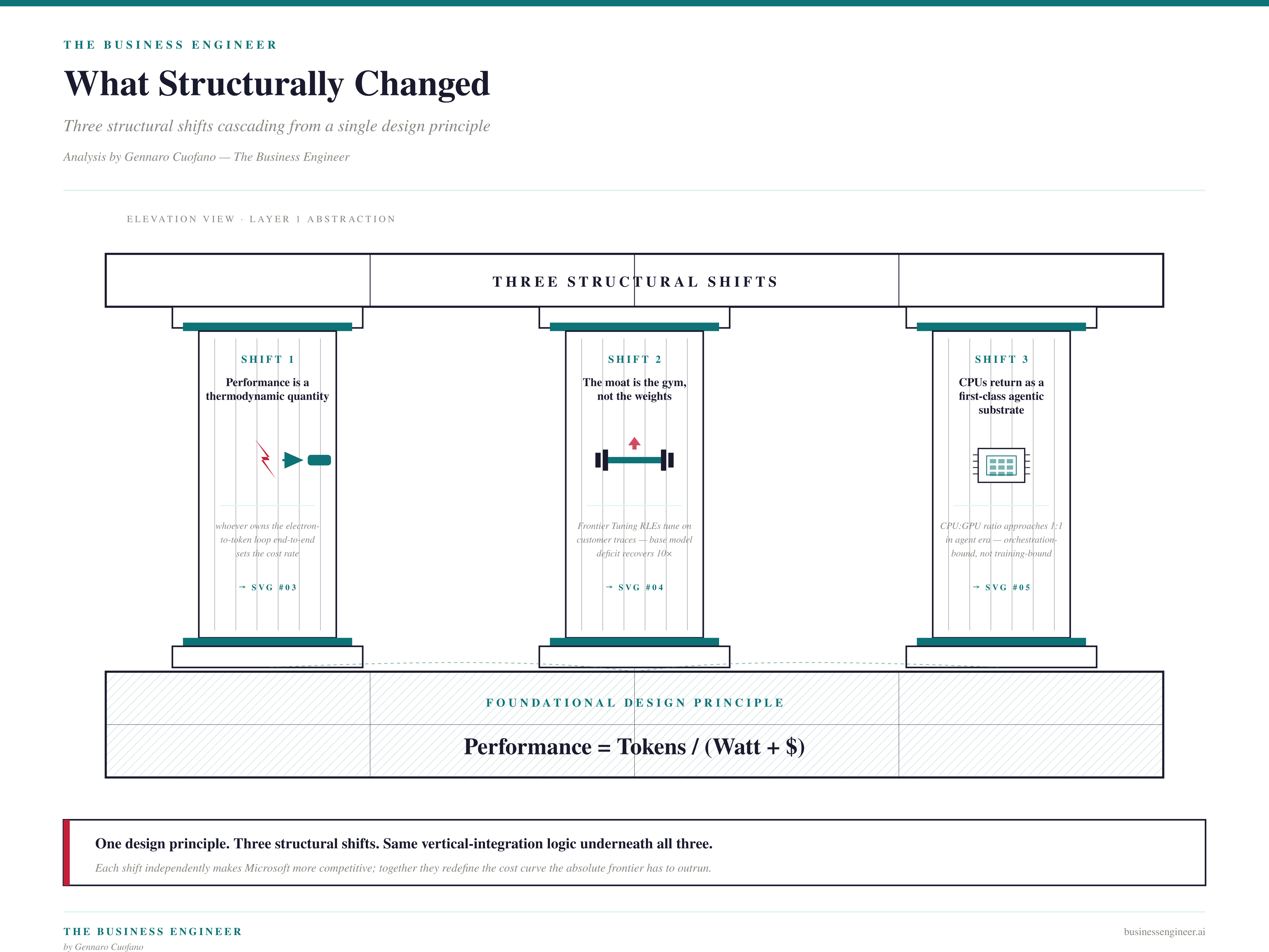
What Structurally Changed