
Every market correction revives the same question: “Is this the AI bubble finally popping?”
If you’re a trader looking to profit from short-term price swings, it’s a perfectly reasonable question. A major market dislocation can generate outsized returns.
But if you’re an executive, entrepreneur, investor, or practitioner building with AI, a different question matters far more: what is actually changing beneath the market?
The AI buildout is increasingly being interpreted as a single speculative cycle approaching its peak. That interpretation mistakes an industrial system for a market.
Follow me on The AI Supercycle as well!
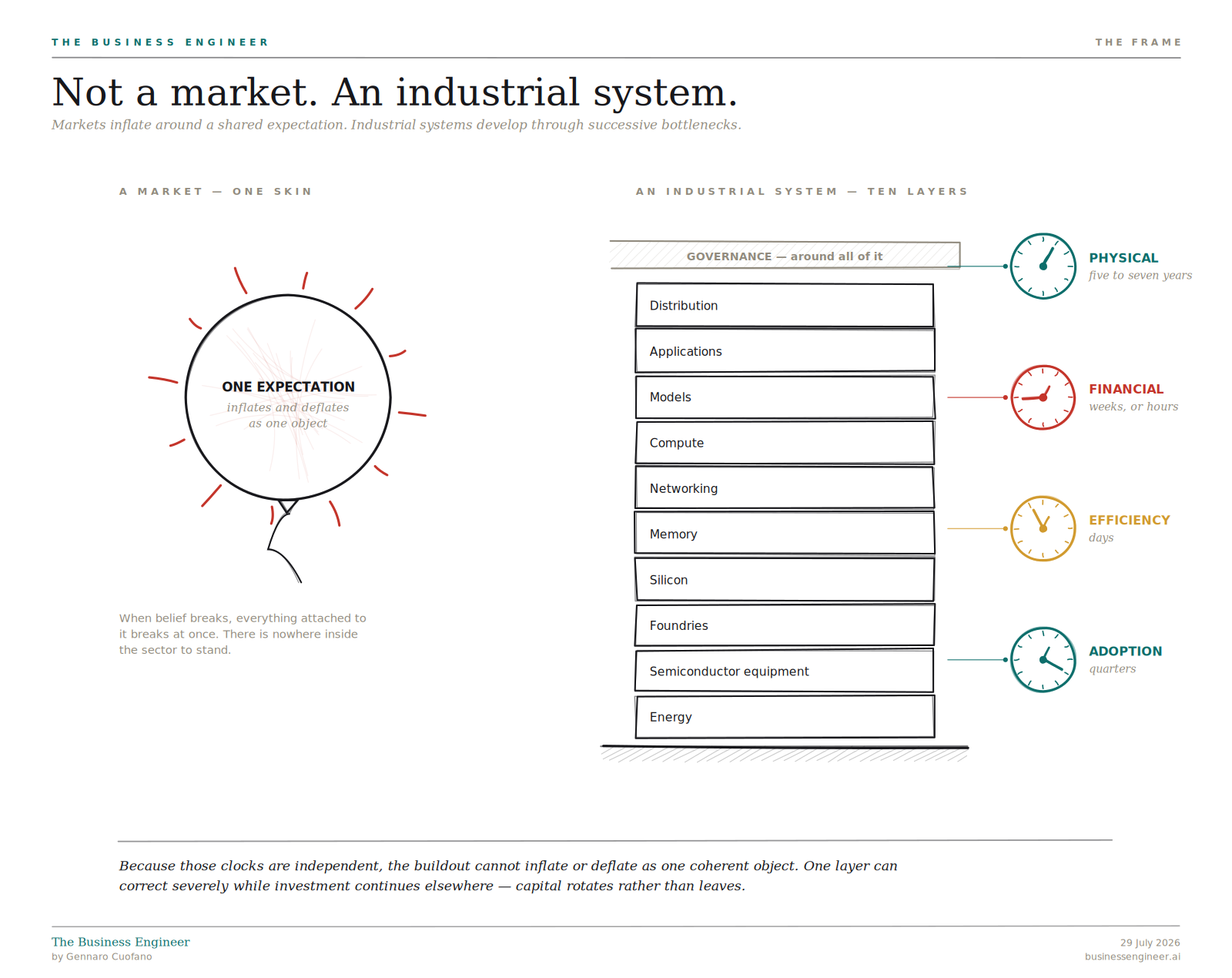
Markets can inflate and deflate around a shared expectation. Industrial systems develop through successive bottlenecks, each governed by different physical, financial and organizational constraints. What reprices at any given moment is rarely the entire system. It is whichever layer has become the marginal constraint on further expansion.
The AI economy is not one industry. It is a stack comprising energy, semiconductor equipment, foundries, silicon, memory, networking, compute, models, applications and distribution, with governance surrounding all of them. These layers operate on different clocks. Semiconductor fabs and power infrastructure are planned over five to seven years. Financial markets reprice in weeks or hours. Model efficiency can change in days. Enterprise adoption advances over quarters.
Because those clocks are independent, the AI buildout cannot inflate or deflate as one coherent object. One layer can experience a severe correction while investment continues elsewhere. Capital does not necessarily leave the system; it rotates toward the part of the stack where scarcity, pricing power or strategic importance has increased.
That is the most useful way to interpret this week.
Follow me on The AI Supercycle as well!
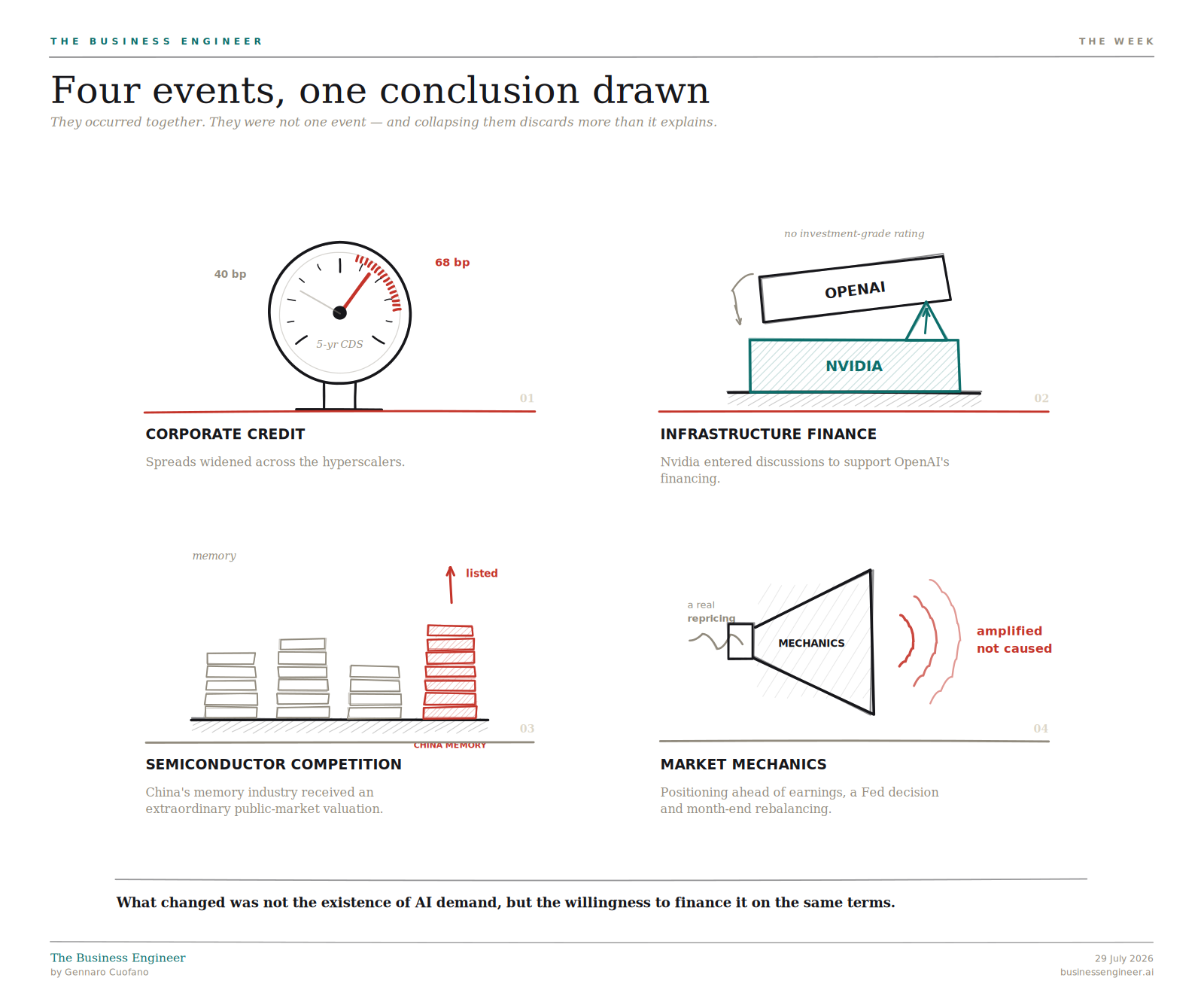
Semiconductor stocks fell sharply, credit spreads widened across the hyperscalers, Nvidia reportedly entered discussions to support OpenAI’s financing, and China’s memory industry received an extraordinary public-market valuation. At the same time, investors were positioning ahead of Microsoft, Meta and Amazon earnings, a Federal Reserve decision and month-end rebalancing.
These events occurred together, but they were not one event. One belonged to corporate credit, another to infrastructure finance, another to semiconductor competition, and the last to market mechanics.
Collapsing them into a single conclusion that “the AI bubble has burst” discards more information than it explains.
What changed was not the existence of AI demand. What changed was the market’s willingness to finance that demand on the same terms.

Credit Did Not Signal Insolvency
The most important signal did not come from the equity market. It came from bonds.
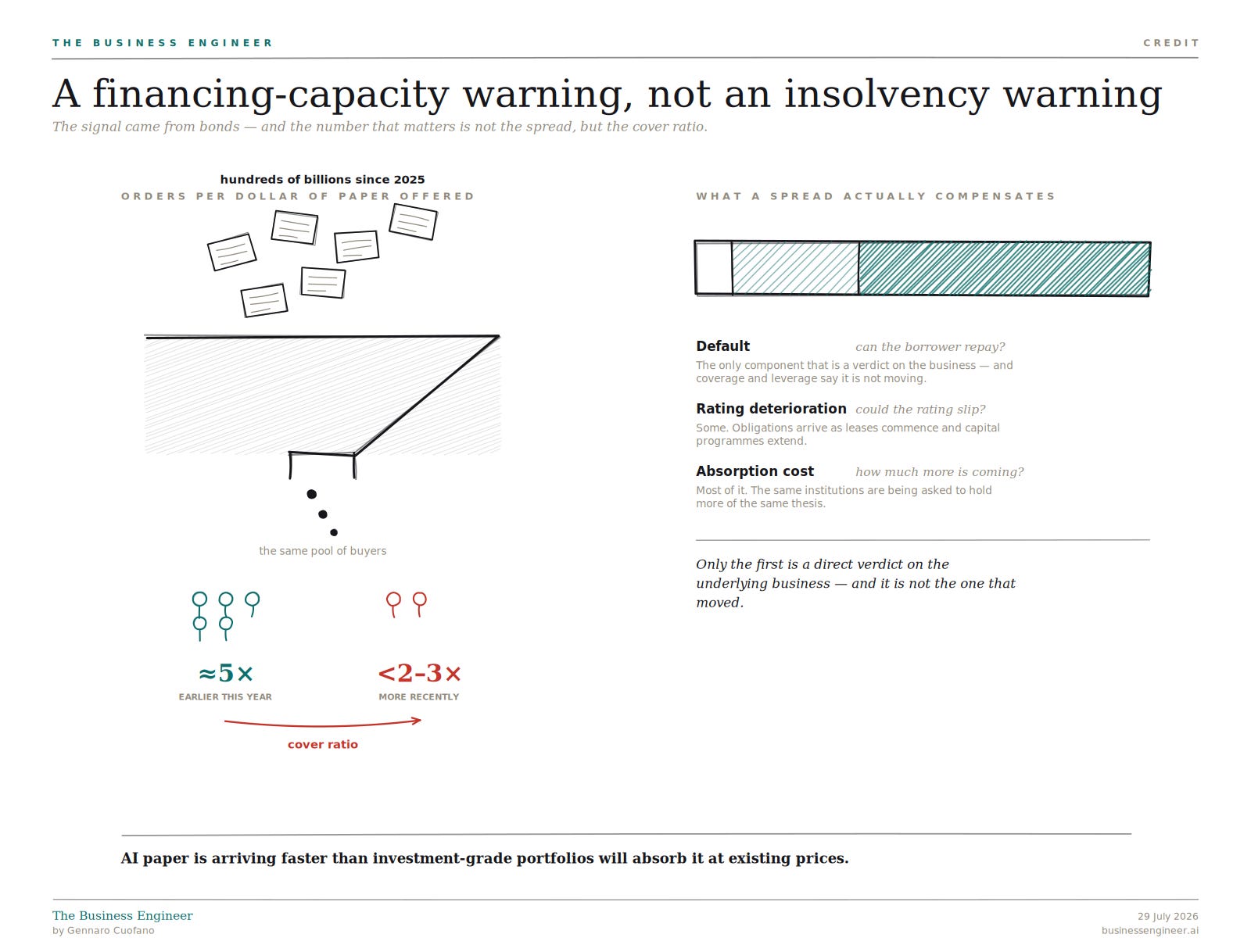
The average five-year credit-default-swap spread across the largest hyperscalers rose from roughly 40 basis points at the end of last year to around 68 basis points, moving above the broader investment-grade index. That widening was quickly interpreted as evidence that investors had begun questioning the financial sustainability of AI investment.
The balance sheets do not support that conclusion.
The largest hyperscalers still carry relatively modest leverage, exceptionally high interest coverage and enormous operating cash flows. A credit trading at 68 basis points is not being priced as a distressed borrower. Genuinely distressed companies trade at spreads measured in hundreds or thousands of basis points.
The more relevant signal was the deterioration in demand for new bond supply.
When a company issues debt, the bank arranging the transaction collects orders from institutional investors. The ratio between those orders and the amount of debt offered is the cover ratio. A $10 billion transaction receiving $50 billion of orders has a cover ratio of five times.
Earlier this year, large hyperscaler offerings were clearing at around that level. More recently, cover ratios have fallen below two or three times. Investors are still buying the debt, but they are demanding more yield and showing less appetite for each additional dollar of issuance.
The explanation is supply.
Alphabet, Meta, Amazon, Oracle and Nvidia have collectively issued hundreds of billions of dollars of debt since the beginning of 2025. They are repeatedly approaching the same pool of insurers, pension funds, sovereign investors and asset managers. Even if each issuer remains individually creditworthy, portfolios can become saturated with exposure to the same sector, investment thesis and capital-spending cycle.
A credit spread compensates investors for several different risks:
The possibility that the borrower defaults.
The possibility that its rating deteriorates.
The cost of absorbing additional supply into an already concentrated portfolio.
Only the first is a direct verdict on the underlying business.
In this case, the bond market was not saying that the hyperscalers might be unable to repay their debt. It was saying that AI-related paper was arriving faster than traditional investment-grade portfolios were willing to absorb it at existing prices.
This was not an insolvency warning. It was a financing-capacity warning.
Nvidia Is Lending OpenAI Its Balance Sheet
Follow me on The AI Supercycle as well!
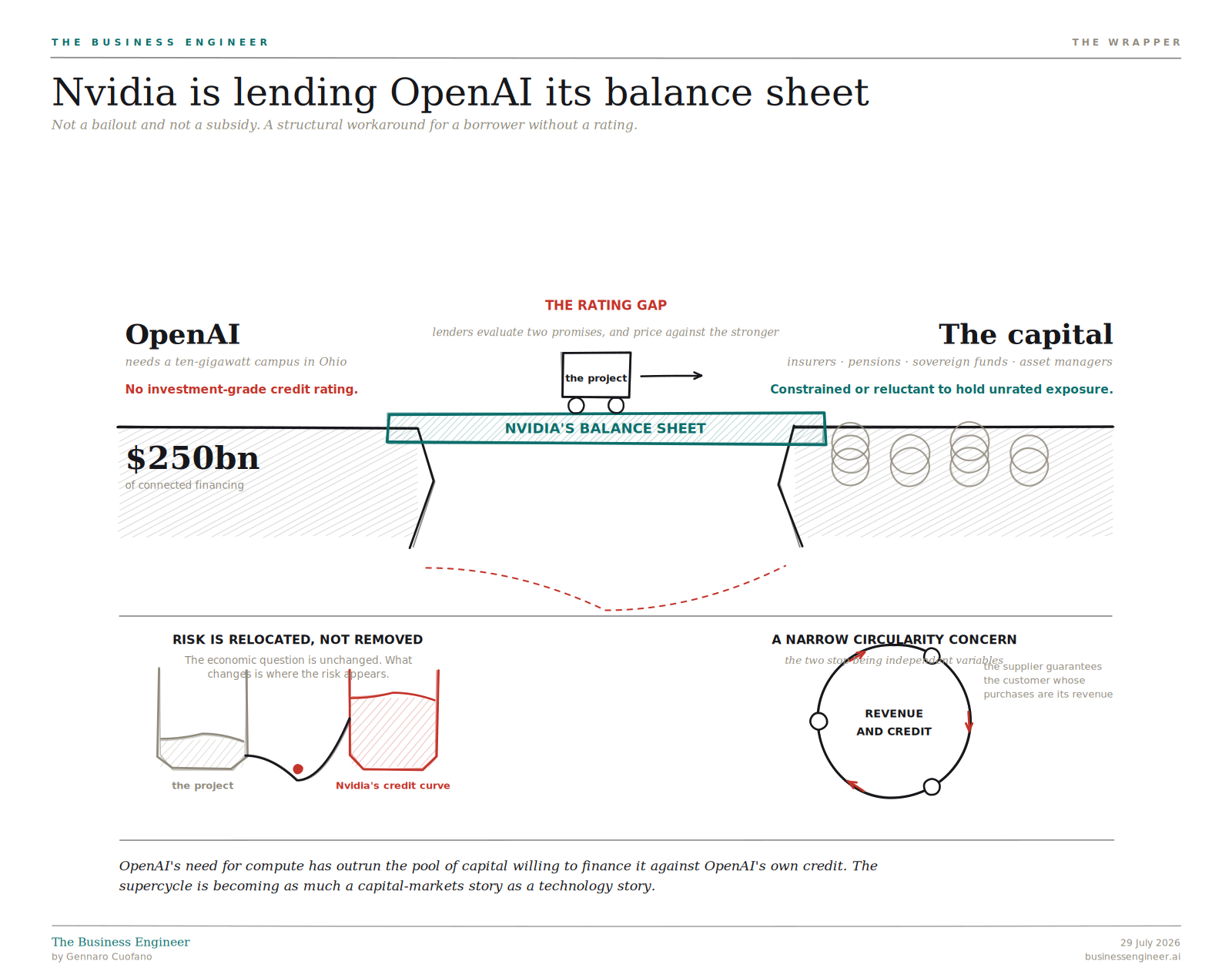
That distinction explains the most important development of the week: reports that Nvidia could guarantee approximately $250 billion of financing connected to OpenAI’s proposed ten-gigawatt campus in Ohio.
The transaction has been described as a bailout, a subsidy and evidence of circular demand. None of those descriptions fully captures the structure.
The underlying problem is simpler. OpenAI requires infrastructure on a scale normally funded by investment-grade capital, but it does not possess an investment-grade credit rating. Many of the institutions capable of financing projects of this size are either legally constrained or commercially reluctant to hold unrated or speculative-grade exposure.
The proposed guarantee bridges that gap.
By placing Nvidia’s balance sheet behind the financing, lenders can evaluate two promises rather than one and price the transaction against the stronger guarantor. OpenAI gains access to a larger and cheaper pool of capital because an investment-grade supplier has agreed to absorb part of the shortfall if the project cannot meet its obligations.
The guarantee does not remove the underlying risk. It relocates it.
The economic question remains unchanged: will the infrastructure generate enough cash to service the debt and lease commitments attached to it? What changes is where that risk appears. Instead of being concentrated visibly in OpenAI’s own credit profile, it becomes embedded inside Nvidia’s balance sheet and credit curve.
That is why the bond market reacted immediately. Nvidia is no longer only selling the equipment used to build the infrastructure. It may also become one of the principal financial instruments through which investors obtain exposure to the customer purchasing it.
Vendor and parent guarantees are not new in infrastructure finance. What is new is the combination of scale and relationship. The proposed backstop would be many times larger than previous technology-sector guarantees, and it would come from the supplier rather than the tenant’s parent company.
This creates a narrow but legitimate circularity concern. When a supplier guarantees the credit of a customer whose purchases support the supplier’s own revenue, revenue quality and credit quality cease to be fully independent variables.
That does not make the transaction fraudulent or irrational. Nvidia has extraordinary visibility into OpenAI’s infrastructure requirements and stands to benefit directly as those requirements grow. OpenAI is approaching one billion weekly ChatGPT users, while enterprise customers are becoming a larger share of its revenue base. Nvidia may therefore believe that the long-term demand justifies accepting financial risk that traditional lenders cannot or will not hold directly.
The correct interpretation is neither that Nvidia is rescuing OpenAI nor that the guarantee proves demand is artificial.
OpenAI’s need for compute has outrun the pool of capital willing to finance it against OpenAI’s own credit. Nvidia is lending OpenAI its balance sheet to keep the buildout moving.
That is a structural workaround. It is also evidence that the AI supercycle is becoming as much a capital-markets story as a technology story.
The Bull Case Is Strong but Incomplete
The counterargument deserves to be taken seriously.
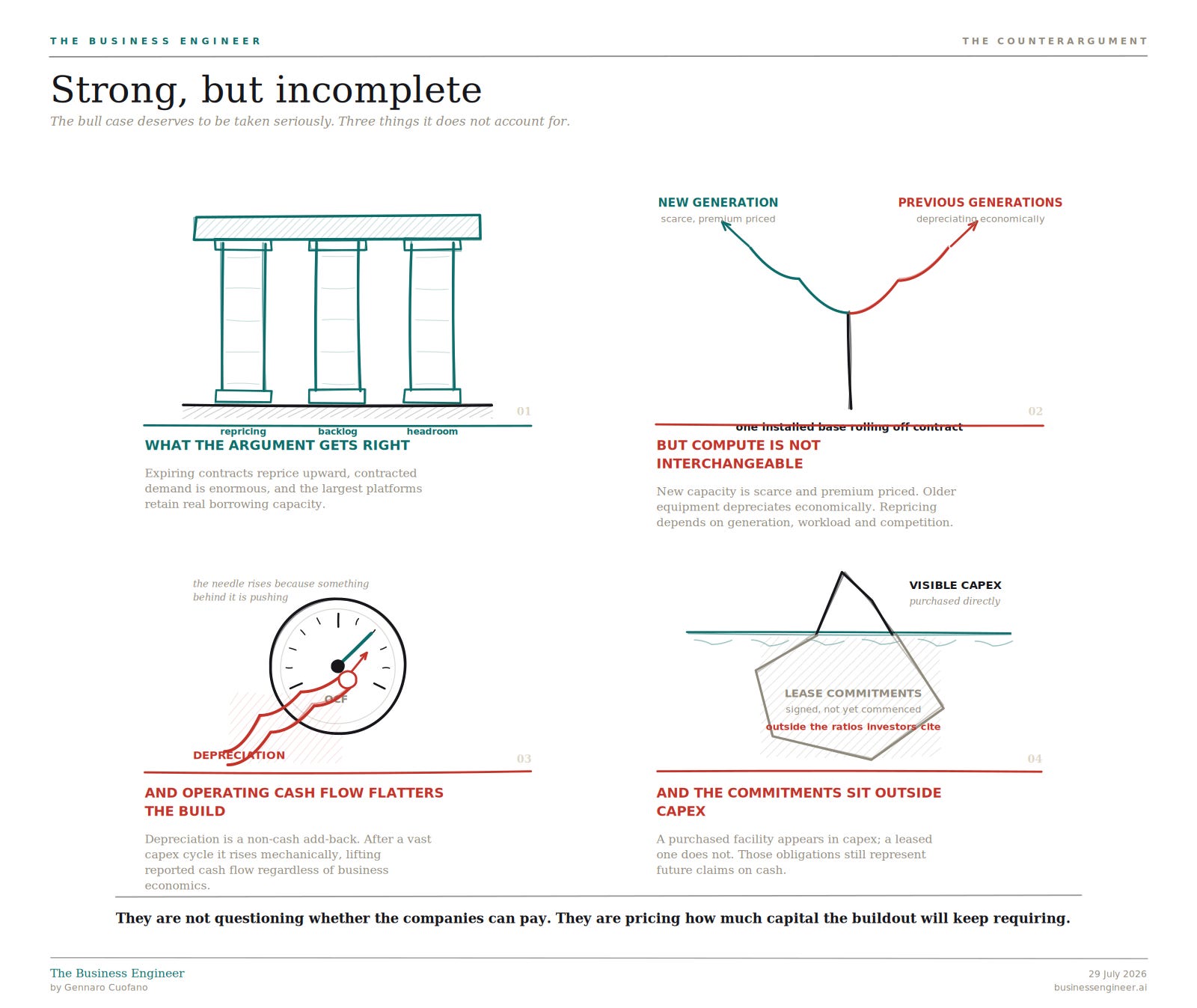
Hyperscalers may be able to fund a larger share of future AI investment internally as older GPU contracts expire and capacity is repriced at current market rates. Demand remains substantial: Google Cloud, Oracle, AWS and Microsoft collectively report an enormous volume of contracted or unmet demand. The largest platforms also retain considerable borrowing capacity and would remain investment grade after issuing substantially more debt.
Much of that argument is correct.
The weakness is that it treats all compute capacity as economically interchangeable. It is not.
New Blackwell capacity remains scarce and commands premium pricing. Older Hopper equipment is already depreciating economically, while previous-generation inference hardware can lose value more quickly as performance per watt improves. The degree to which expiring contracts can be repriced therefore depends on the generation, workload and competitive environment associated with each contract.
The second weakness concerns operating cash flow.
The second weakness concerns the distinction between operating cash flow and free cash flow.
Operating cash flow correctly adds depreciation back because depreciation has already reduced net income without representing a current-period cash outflow. Rising depreciation therefore does not, by itself, mechanically inflate operating cash flow.
The limitation is different. Operating cash flow excludes the current cash required to build and replace infrastructure because purchases of GPUs, data centers and power capacity are classified as investing activities rather than operating expenses.
A hyperscaler can therefore report substantial operating cash flow while spending an even larger amount on infrastructure. Free cash flow provides the more relevant measure of whether current operations are funding the buildout internally because it deducts that capital expenditure.
On that measure, the hyperscalers remain under pressure as investment continues to rise.
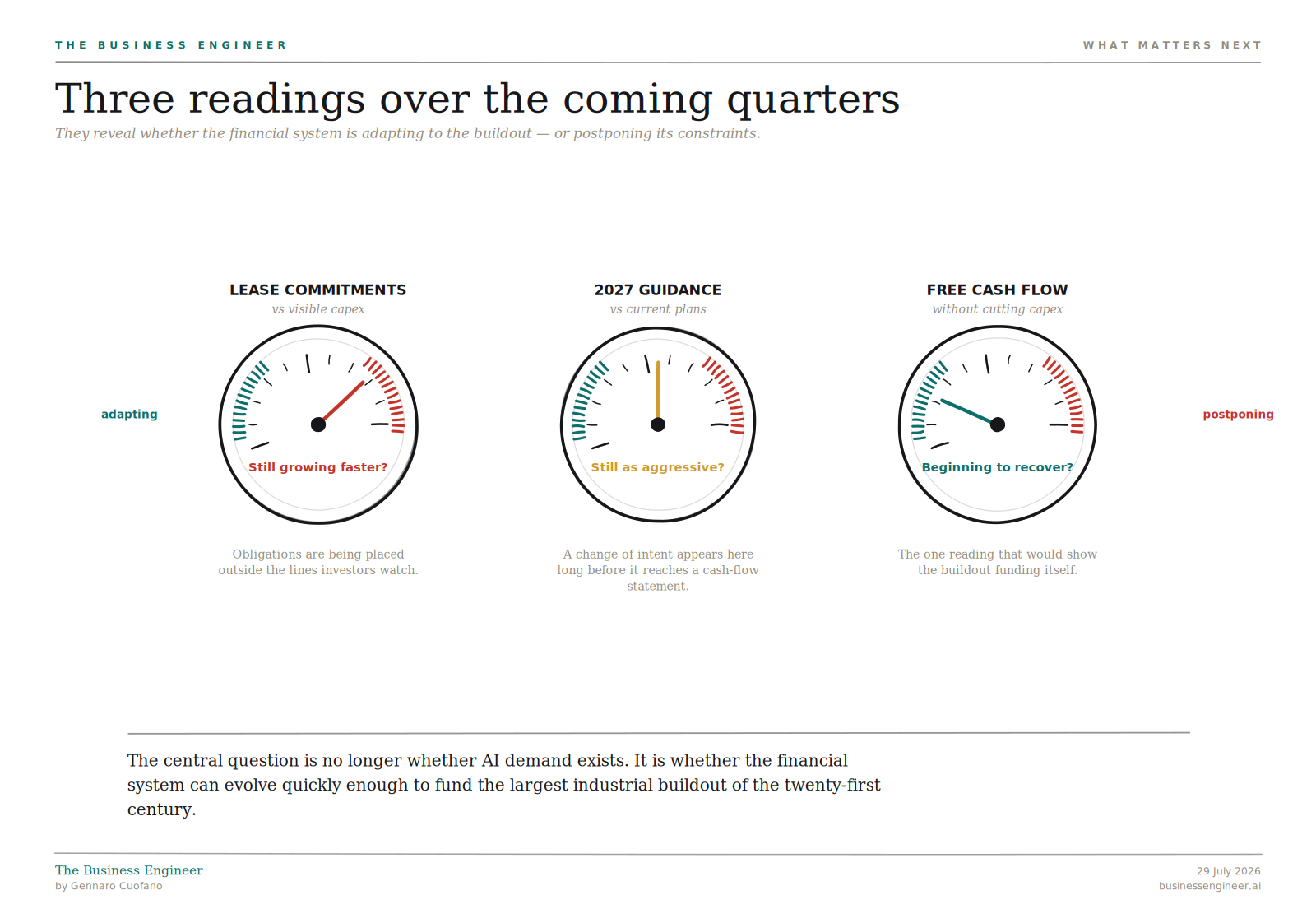
There is also a substantial category of commitments that ordinary capex figures do not capture. A data center purchased directly appears in capital expenditure. A data center secured through a long-term lease does not. Across the major hyperscalers, signed but not yet commenced lease commitments have grown into the hundreds of billions of dollars.
Those obligations may sit outside the leverage ratios investors usually cite, but they still represent future claims on cash flow.
None of this implies that the hyperscalers face a solvency problem. It explains why credit investors can remain confident in today’s balance sheets while becoming more cautious about tomorrow’s obligations.
They are not questioning whether the companies can pay. They are pricing how much capital the buildout will continue to require.
AI Is a Sequence of Rotating Bottlenecks
Follow me on The AI Supercycle as well!
The broader mistake is to think of AI as a single S-curve.
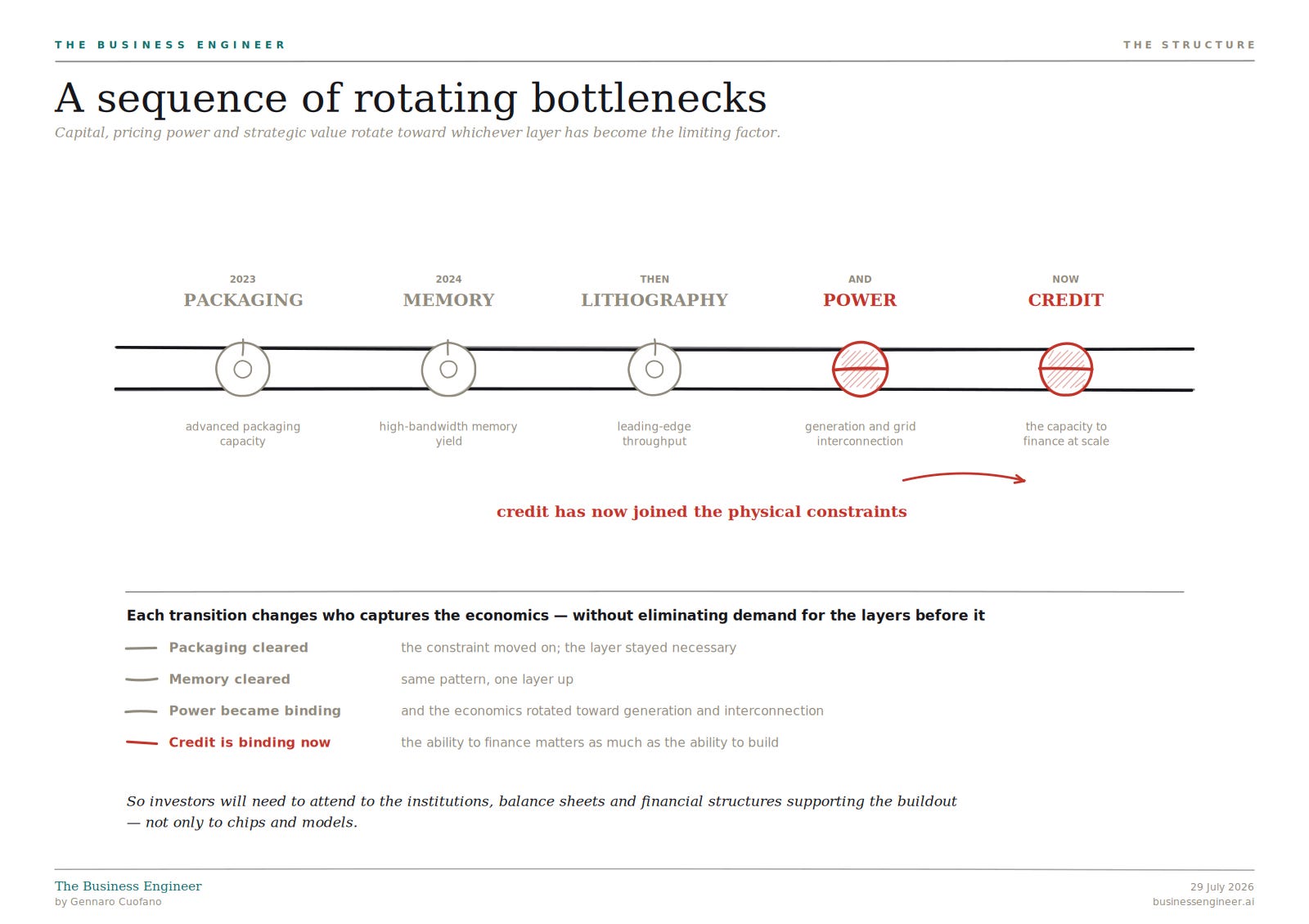
AI is better understood as a stack of independent bottlenecks. Capital, pricing power and strategic value rotate toward whichever layer has become the limiting factor.
In 2023, the principal constraint was advanced packaging. In 2024, it shifted toward high-bandwidth memory. It then moved into leading-edge lithography, power generation and grid interconnection. Each transition changed which companies captured the largest share of the economics without eliminating demand for the layers that came before.
Credit has now joined those physical constraints.
For the first time, the ability to finance infrastructure at the required scale is becoming as important as the ability to manufacture and deploy it. If that persists, investors will need to pay more attention to the institutions, balance sheets and financial structures supporting the buildout, rather than focusing exclusively on chips and models.
History suggests that this is normal for industrial supercycles.
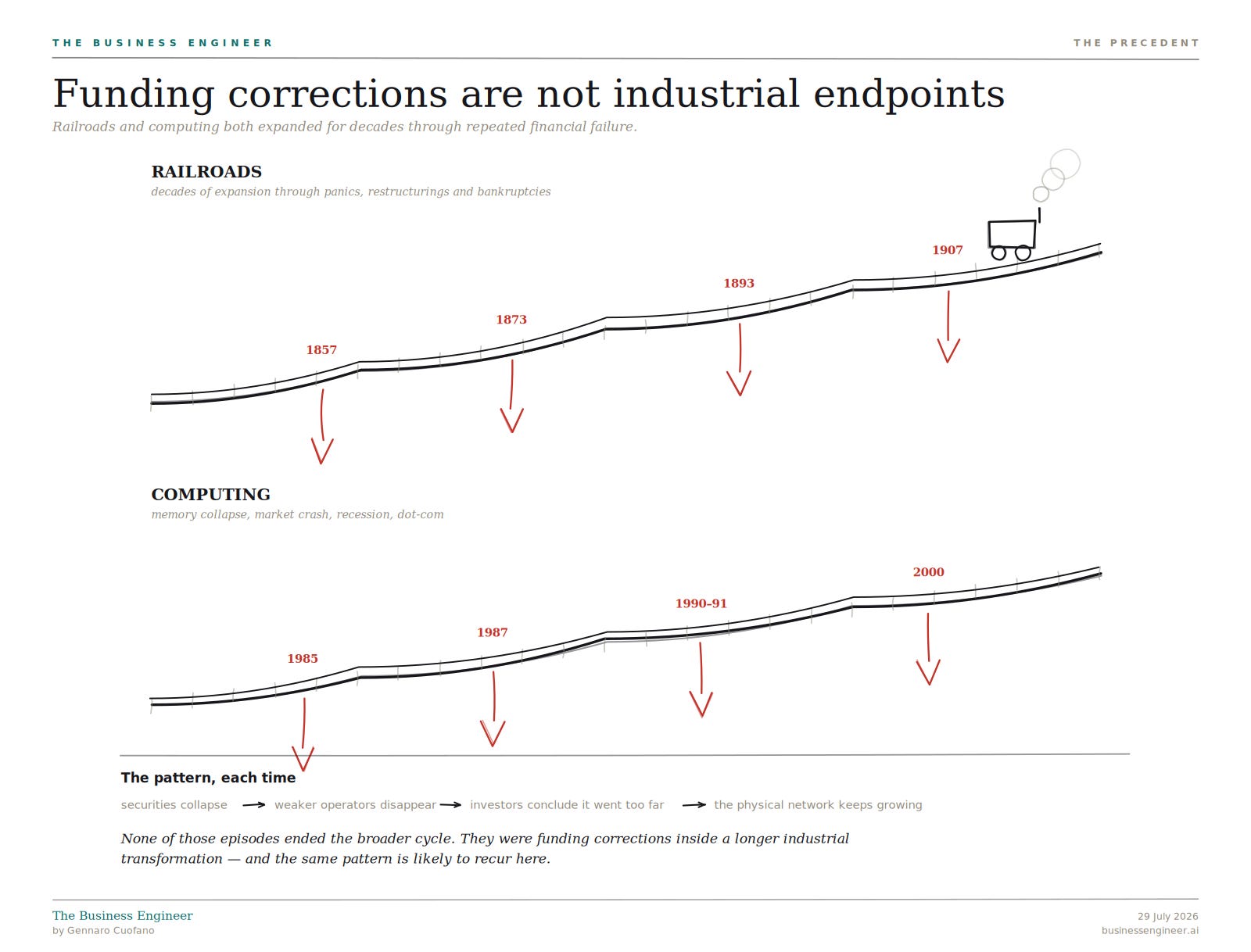
The American railroad system expanded for decades through repeated financial panics, restructurings and bankruptcies. Individual securities collapsed, weaker operators disappeared and investors repeatedly concluded that the expansion had gone too far. Yet the physical network continued to grow because the underlying demand for transportation remained intact.
Computing developed through a similar sequence. Memory collapsed in 1985. Technology stocks fell in 1987. The early-1990s recession damaged the sector, and the dot-com crash destroyed much of the equity capital associated with the internet. None of those episodes ended the broader compute cycle.
They were funding corrections inside a longer industrial transformation.
The same pattern is likely to recur in AI. Infrastructure stocks will experience violent drawdowns. Financing structures will fail. Some customers will overcommit, and some suppliers will discover that their revenue was less durable than expected. Efficiency improvements will reduce the value of certain assets even as they expand the addressable market for AI services.
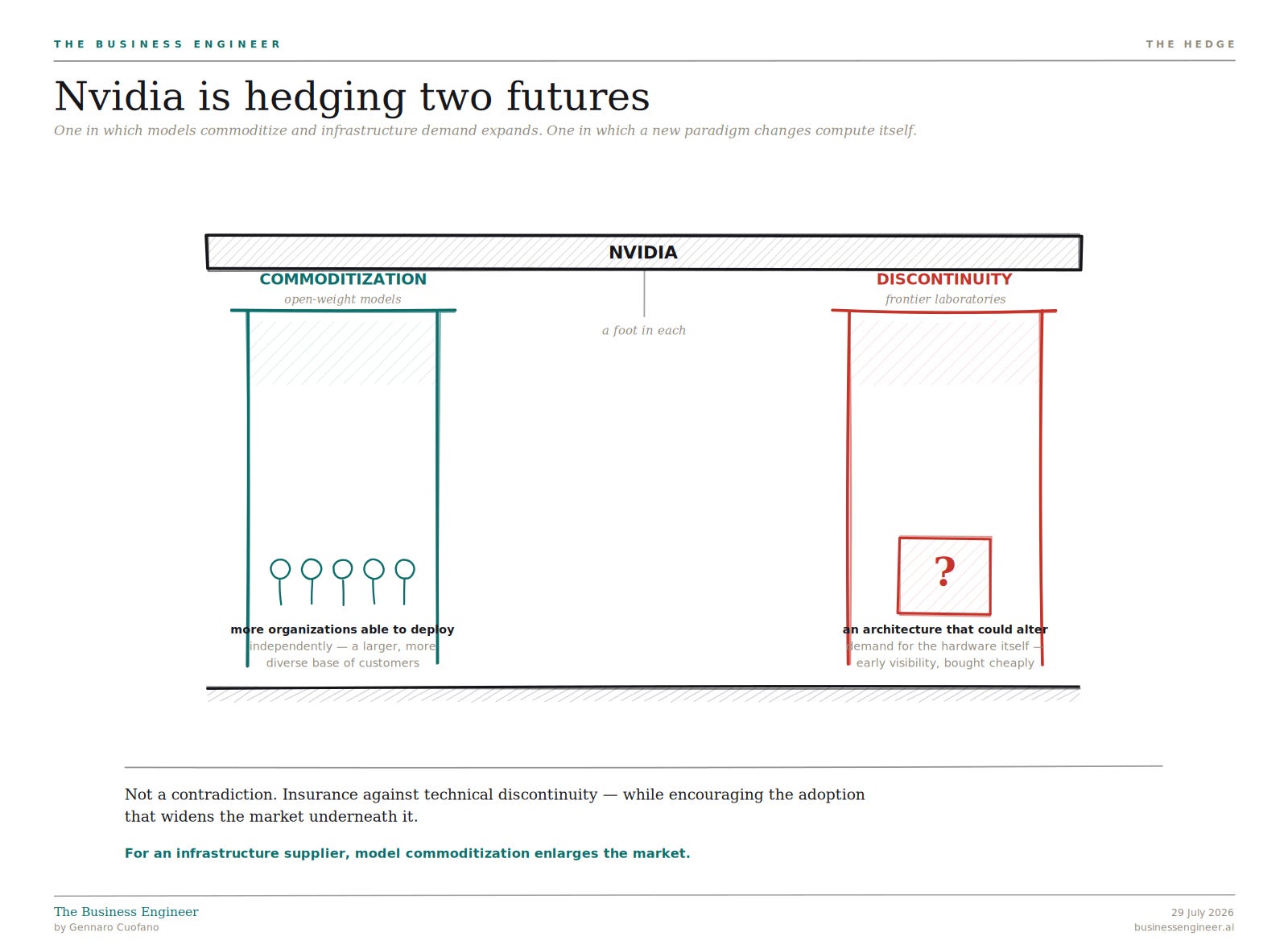
Nvidia appears to understand both sides of this dynamic. Its support for open-weight models encourages wider adoption and creates a larger, more diverse base of infrastructure customers. Its exposure to frontier laboratories gives it visibility into architectures that could eventually alter the demand for its own hardware.
It is therefore hedging two futures: one in which models commoditize and infrastructure demand expands, and another in which a new technical paradigm changes the structure of compute itself.
What Matters Next