
A method you have read is not necessarily a method you are running. The distinction sounds obvious, but it explains a surprisingly large part of what goes wrong when organizations try to operationalize AI. You can read a strategy book, agree with every argument, underline half the pages, and still make the next important decision exactly as you would have made it before.
Thursday afternoon arrives with a pricing problem, a customer deployment slipping, a product question that cannot wait, and a presentation due in three hours. Under pressure, the organization falls back to instinct. The method stays on the shelf. The work does not wait for it. The usual response is to create more documentation: another checklist, another operating manual, another set of prompts, another page explaining how the company thinks. That can help, but it does not solve the structural problem. Anything that depends on somebody remembering to consult it eventually loses to urgency.
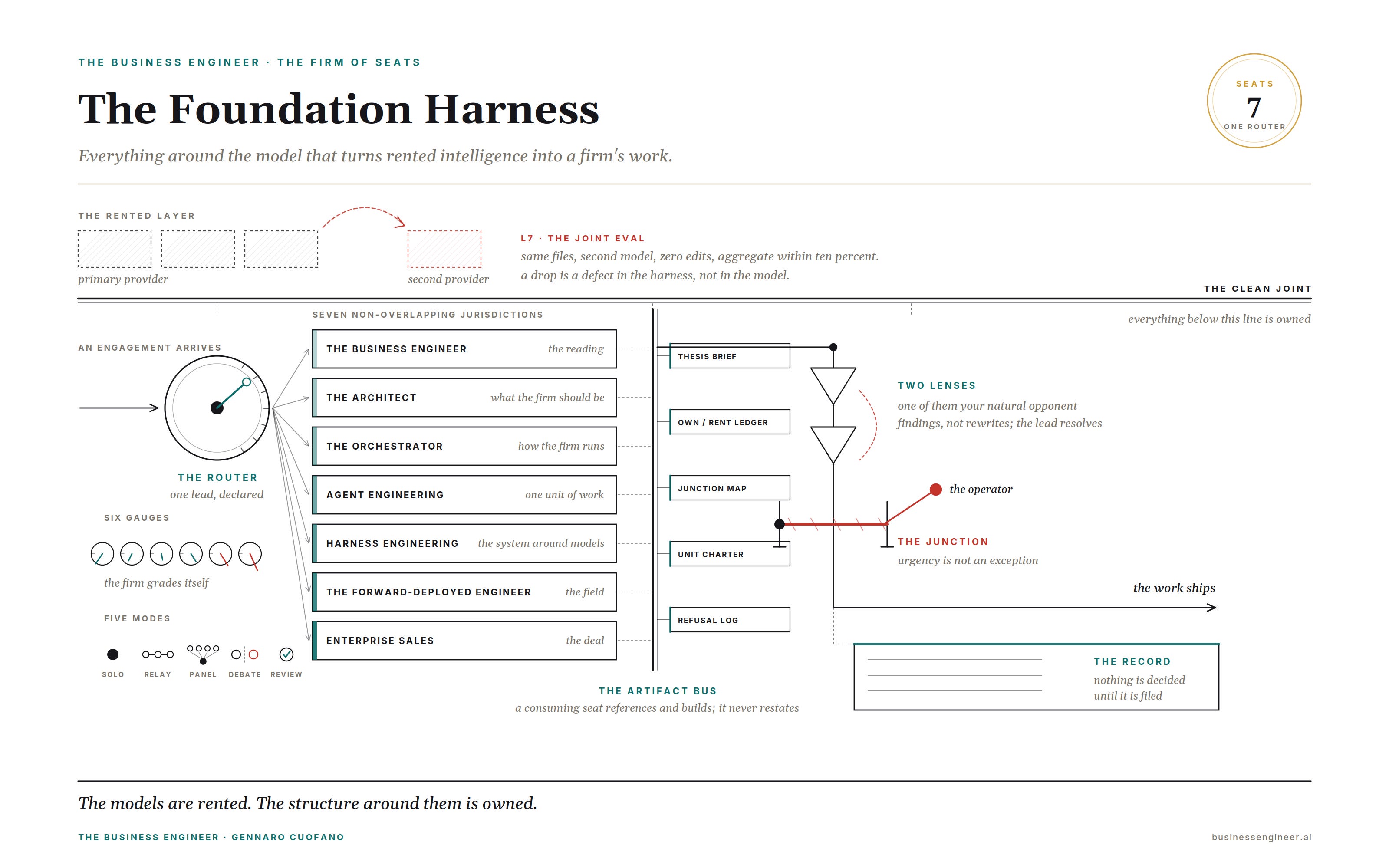
The alternative is to move the method into the machinery that produces the work. Instead of asking people or models to remember which framework applies, the system routes the problem to the right kind of reasoning. Instead of allowing every AI session to reconstruct the organization’s thinking from scratch, previous decisions become reusable artifacts. Instead of asking one model to produce and critique its own answer, opposing perspectives are wired into the review process. Instead of granting autonomy because the output looks convincing, autonomy is earned against explicit tests.
That operating architecture is what I call the Foundation Harness.
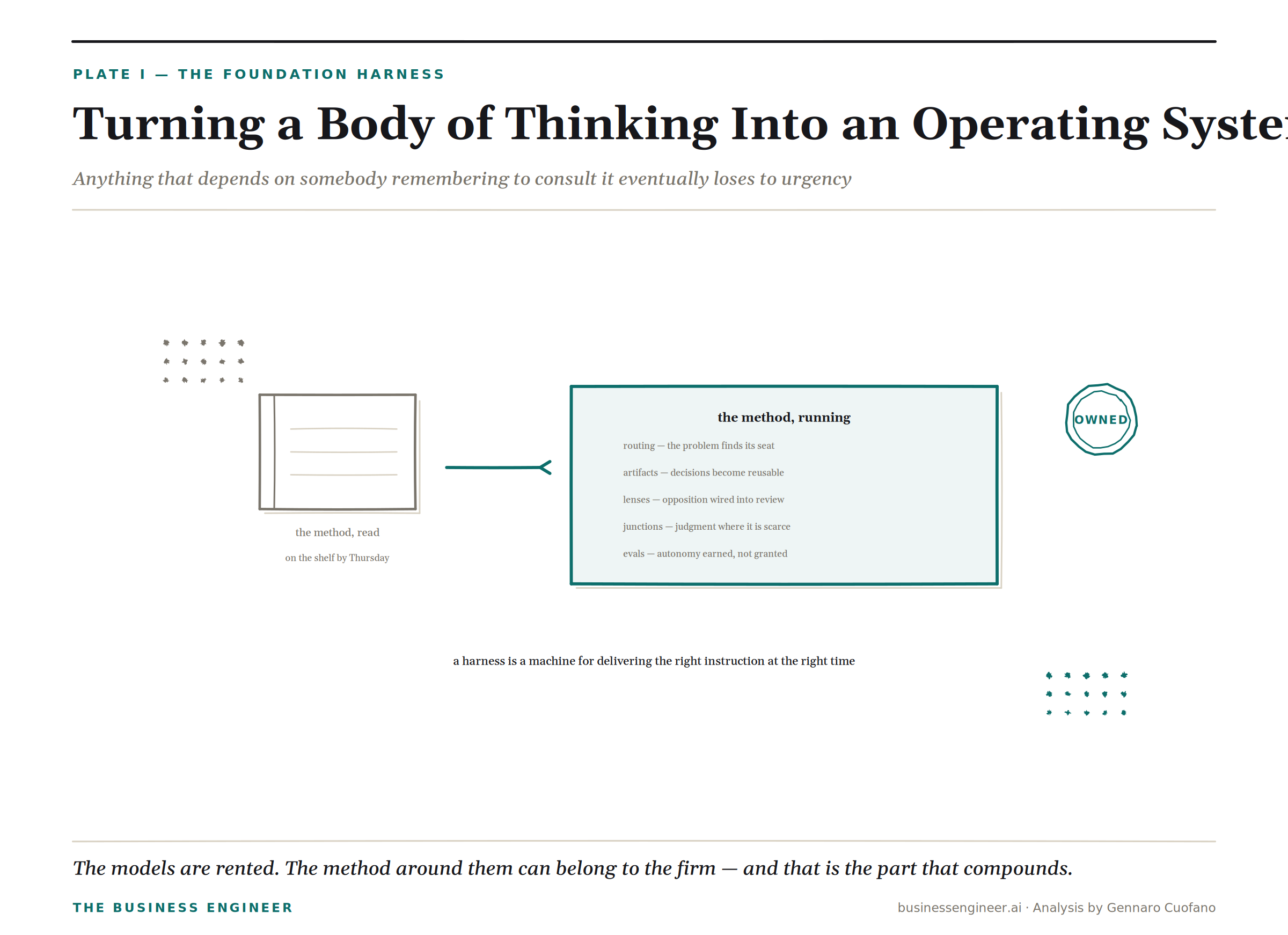
A harness is everything around the model that turns general intelligence into the work of a particular organization: the standing instructions, routing, memory, review system, guardrails, tools, evaluation suite, decision record, and feedback loops. The distinction matters because it establishes a property line. The models are rented. They become more capable, cheaper, and easier to replace. The method around them can belong to the firm. And that is the part that compounds.
The entire architecture follows from one principle: a harness is a machine for delivering the right instruction at the right time. Once you take that definition seriously, the problem becomes much more precise. Which instruction should arrive? For what kind of problem? Which perspective should produce it? What should survive after the work is finished? Which decisions should never be delegated? How should disagreements be resolved? And how do you know the whole system still works when the model underneath it changes?