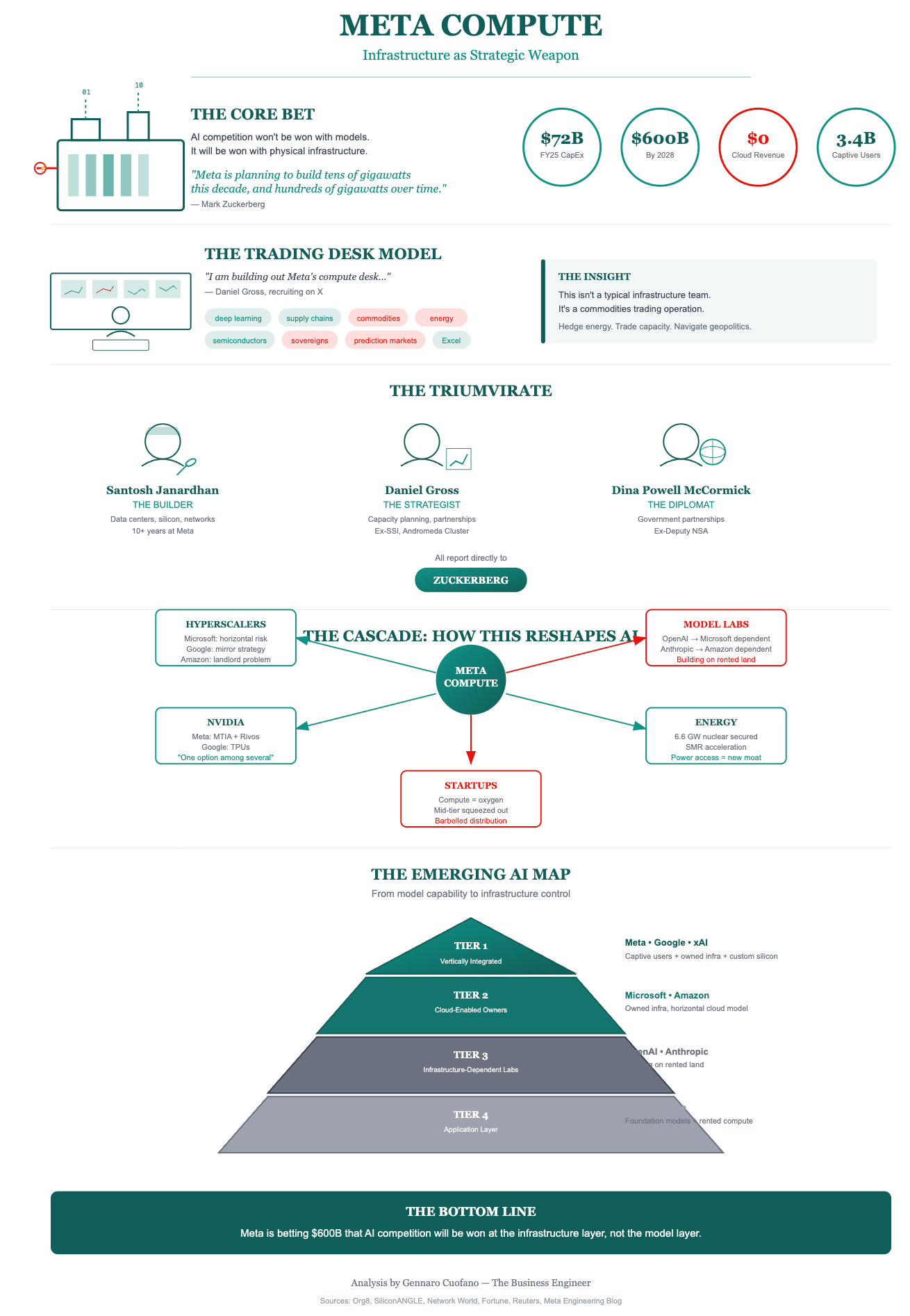

Meta Compute represents the missing structural transition that enables Meta’s long-term vertical integration in an AI-constrained world, where being “just” a digital platform is no longer enough to survive or compound advantage.
As AI competition shifts from software abstraction to physical execution, compute, power, and infrastructure become the binding constraints that determine who can deploy intelligence at scale. By elevating infrastructure to a top-level strategic function, Meta is signaling a hard truth: models commoditize, platforms saturate, and attention alone no longer compounds without control over the machine that delivers intelligence in real time.
By internalizing compute, energy, silicon, and deployment economics, Meta is closing the loop between demand (3.4 billion users) and supply (AI capacity), enabling a fully integrated stack in which products, models, and infrastructure co-evolve.
In this regime, vertical integration is no longer an efficiency play but a survival mechanism. Platforms that do not own infrastructure risk becoming tenants on competitors’ balance sheets.
Meta Compute is not an organizational reshuffle; it is the prerequisite for Meta’s transition from a social platform that uses AI into an AI infrastructure company that happens to own social platforms.
That’s why Meta’s creation of “Meta Compute” isn’t an organizational shuffle, it’s a declaration that infrastructure has become the primary battlefield in the AI wars.
By elevating compute capacity to a “top-level initiative” reporting directly to Zuckerberg, and staffing it with a team that reads like a commodities trading desk, Meta is making a bet that most observers are misreading: the future of AI competition isn’t about models. It’s about the physical infrastructure to run them.