
A conditional bet on the bifurcated frontier — and what would break it
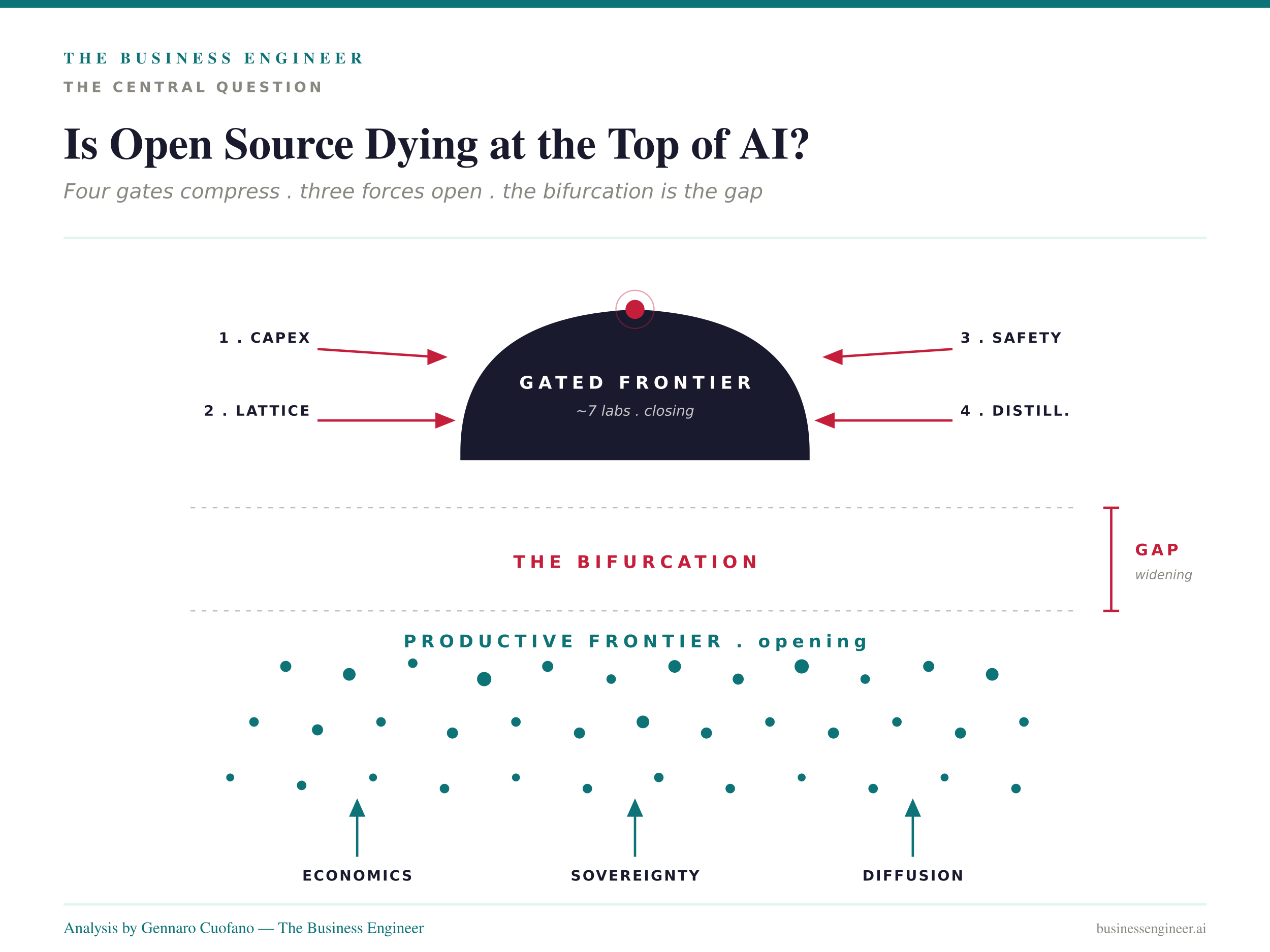
The question worth asking in June 2026 is not whether open source AI is sustainable. That question is too coarse to answer. The sharper one is: is open source dying at the top frontier of AI — and if it is, under what conditions does that hold, and what would break the bet?
DeepSeek V4 shipped in April 2026 under MIT — 1.6 trillion total parameters, one-million-token context, at one-thirtieth the cost of Claude Opus 4.7 and GPT-5.5. It is the closest open weights have ever come to the frontier. It is also, on the hardest benchmarks, three to six months behind. The gap has been stable for two years. By some measures it is widening.
Two readings of that fact are possible. The first: open source is converging on the frontier, just slowly. The second: open source has reached an asymptote, and the gap from here is structural, not temporal. Both readings are defensible from the data alone. Which one is right depends on conditions the data cannot answer — conditions about capital, governance, the architecture of the safety stack, the mechanics of how open source has been catching up, and the strategic posture of Chinese labs once they reach the frontier.
The argument of this piece is conditional, not declarative. If four gates hold — and if China’s open-weights moment turns out to be strategic rather than structural — open source is dying at the top frontier. If any one of these breaks, the bet breaks. Naming the gates, naming what would break them, and naming the Chinese question is the work.