

On February 15, 2026, OpenAI confirmed the acqui-hire of Peter Steinberger, the Austrian developer behind OpenClaw, the viral open-source personal agent that hit 198,000 GitHub stars in record time.
Meta also bid. Both offered billions. Steinberger chose OpenAI.
This single move redrew the competitive map of the agentic economy, giving OpenAI a consumer surface it never had and validating the thesis that the agent interface is messaging, not new apps. Here is the updated battle map.
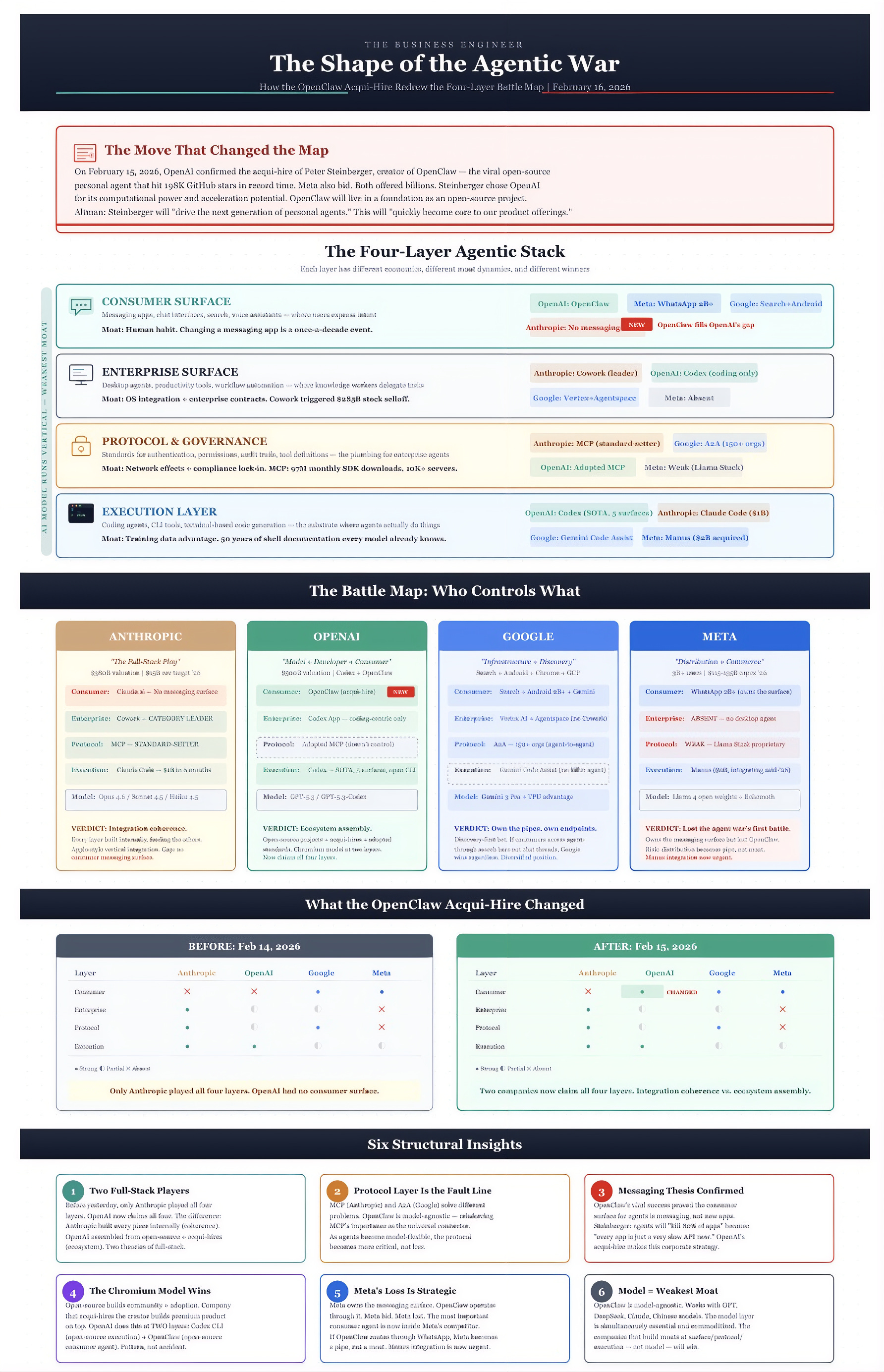
The Move That Changed The Map
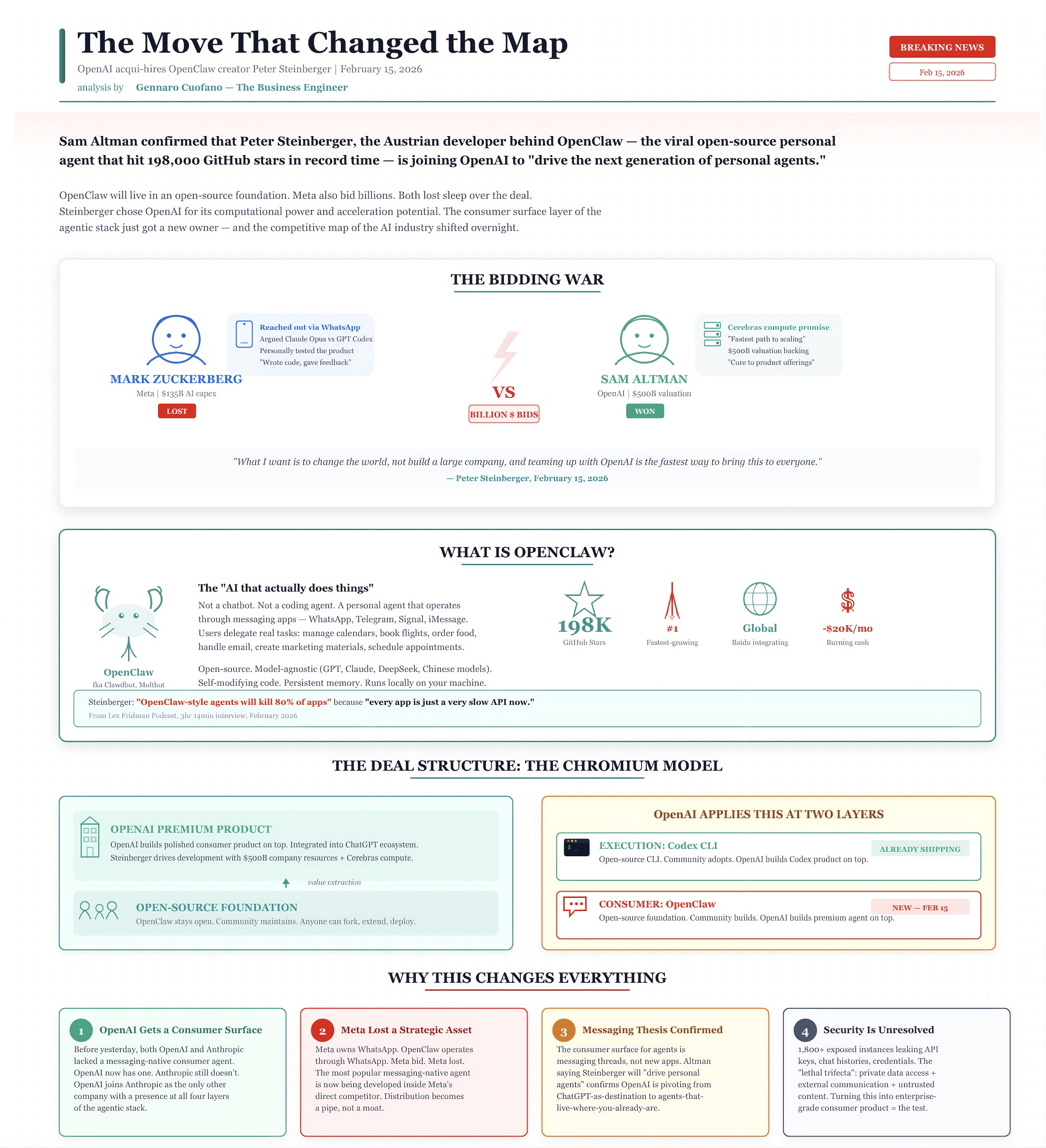
Sam Altman announced that Steinberger is joining OpenAI to “drive the next generation of personal agents.” OpenClaw will live in an open-source foundation that OpenAI will continue to support — the Chromium model Steinberger himself described in his Lex Fridman interview. Altman added: “We expect this will quickly become core to our product offerings.”
The bidding war was intense. Both Mark Zuckerberg and Sam Altman made concrete offers. Zuckerberg reached out via WhatsApp, and the two spent time arguing about whether Claude Opus or GPT Codex was better. Altman’s pitch included a promise of computational power tied to the Cerebras partnership. Steinberger, who was hemorrhaging $10,000–$20,000 per month to run the project, chose OpenAI for its potential to accelerate.
The context matters. OpenClaw (formerly Clawdbot, then Moltbot after an Anthropic trademark complaint) is not a traditional coding agent or enterprise tool. It is a personal agent that operates via messaging apps — WhatsApp, Telegram, Signal, and iMessage. Users delegate real-world tasks through chat: managing calendars, booking flights, ordering food, handling email. It achieved viral adoption precisely because it works where people already are — in messaging threads, not in new apps.
Steinberger’s own prediction: OpenClaw-style agents will “kill 80% of apps” because “every app is just a very slow API now.” That prediction is now OpenAI’s corporate strategy.
I sit down with you to understand what business goals you want to achieve in the coming months, then map out the use cases, and from there embed the BE Thinking OS into the memory layer of ChatGPT or Claude, for you to become what I call a Super Individual Contributor, Manager, Executive, or Solopreneur.

If you need more help in assessing whether this is for you, feel free to reply to this email and ask any questions!

You can also get it by joining our BE Thinking OS Coaching Program.