
I’ve been analyzing Palantir for almost a decade. As early as 2019–2020, I argued that its land-and-expand go-to-market model, powered by forward-deployed engineers, was perfectly suited to the large and complex enterprises it was targeting.
At the time, however, the prevailing view among many analysts was dismissive: “This is not a software company. It’s a consultancy.”
Today, the narrative has completely reversed. The forward-deployed engineer has become one of the defining go-to-market models in enterprise AI, and Palantir has emerged as one of the most prominent companies of the AI era.
But what really makes Palantir thick?
Drawing on its latest Q2 results, I’ll break down the mechanics of its business model, explain why its approach has worked, and explore where the company is pointing next as the enterprise AI market evolves.
There is a version of Palantir that reads the financial signature and stops. Ninety-three percent revenue growth. Sixty-two percent adjusted operating margins. Rule of 40 at 155%. $9.2 billion in cash and no debt. Three-quarters of one percent of revenue in capex.
Those numbers describe a business that should not exist. It is not a software company: its cost of delivery includes a real forward-deployed engineering motion. It is not a consulting firm: its subscription revenue lands at 86% adjusted gross margin. It is not a data-platform vendor: it refuses to be paid by seat, query, or token. It is not a hyperscaler: it owns almost no compute. It is not an agentic-AI startup: it has been in production in classified environments for twenty years, long before the technology it now sells acquired its current name.
It is all of those things at once, and this quarter is the read on why the hybrid works.
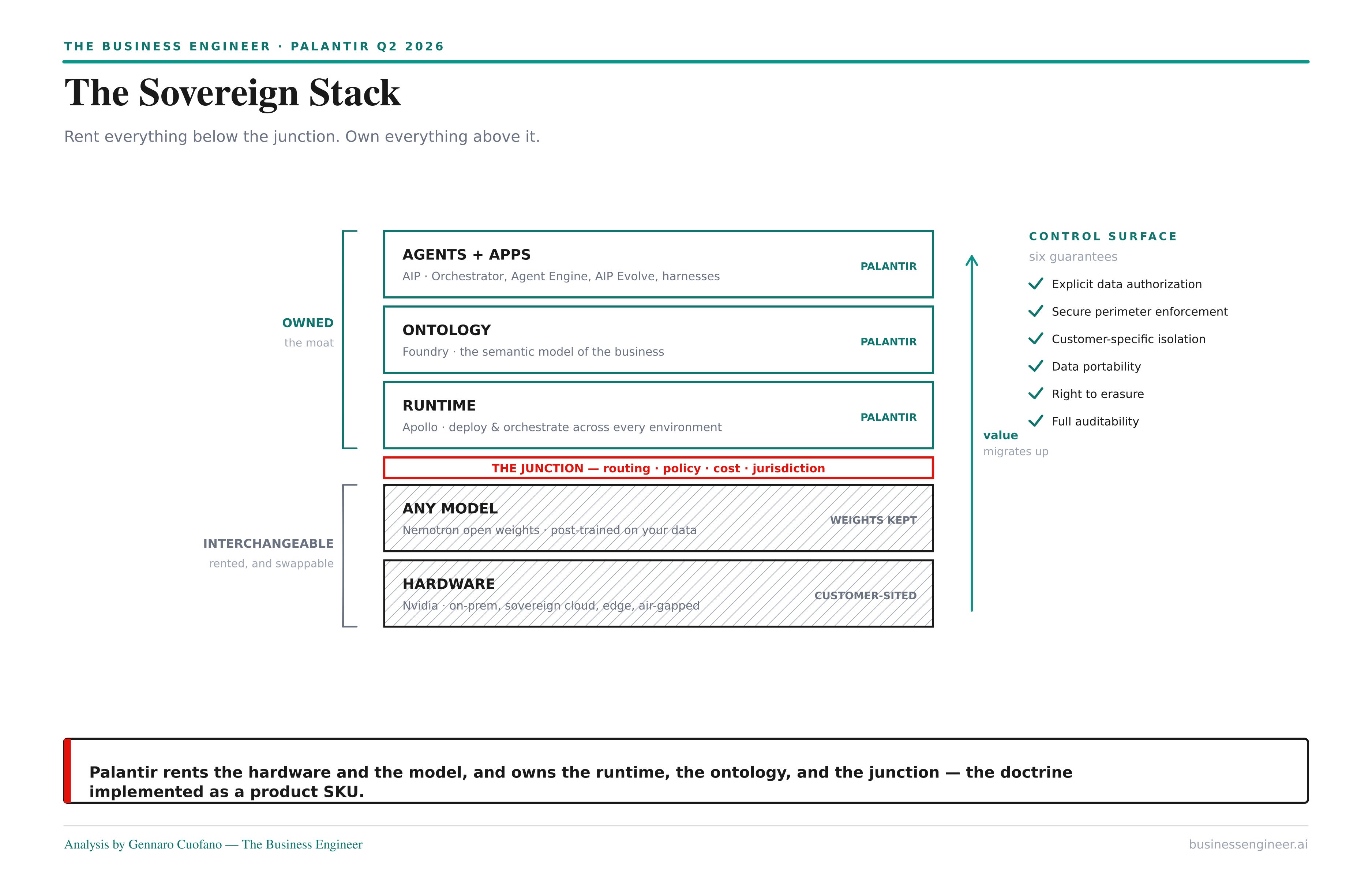
The deeper reason to look closely has little to do with Palantir’s own economics. Palantir has assembled, and is now selling as a product, the most complete answer any vendor has yet built to the question the enterprise market started asking in 2026: how do you deploy frontier AI capability without handing the frontier labs your institutional edge? That answer has a name, a five-layer architecture, and a specific coalition around it. This piece walks it in order: the stack itself, then the product map that sits on it, then the head start that made it possible, then the financials as evidence of the mechanism, then the alliance map, then the paradox at the heart of it, then the sales motion sovereignty opened, then the pricing model, then the third path the whole thesis eventually points at, then the buyer’s-side view, then the bet management is placing, then the fences.