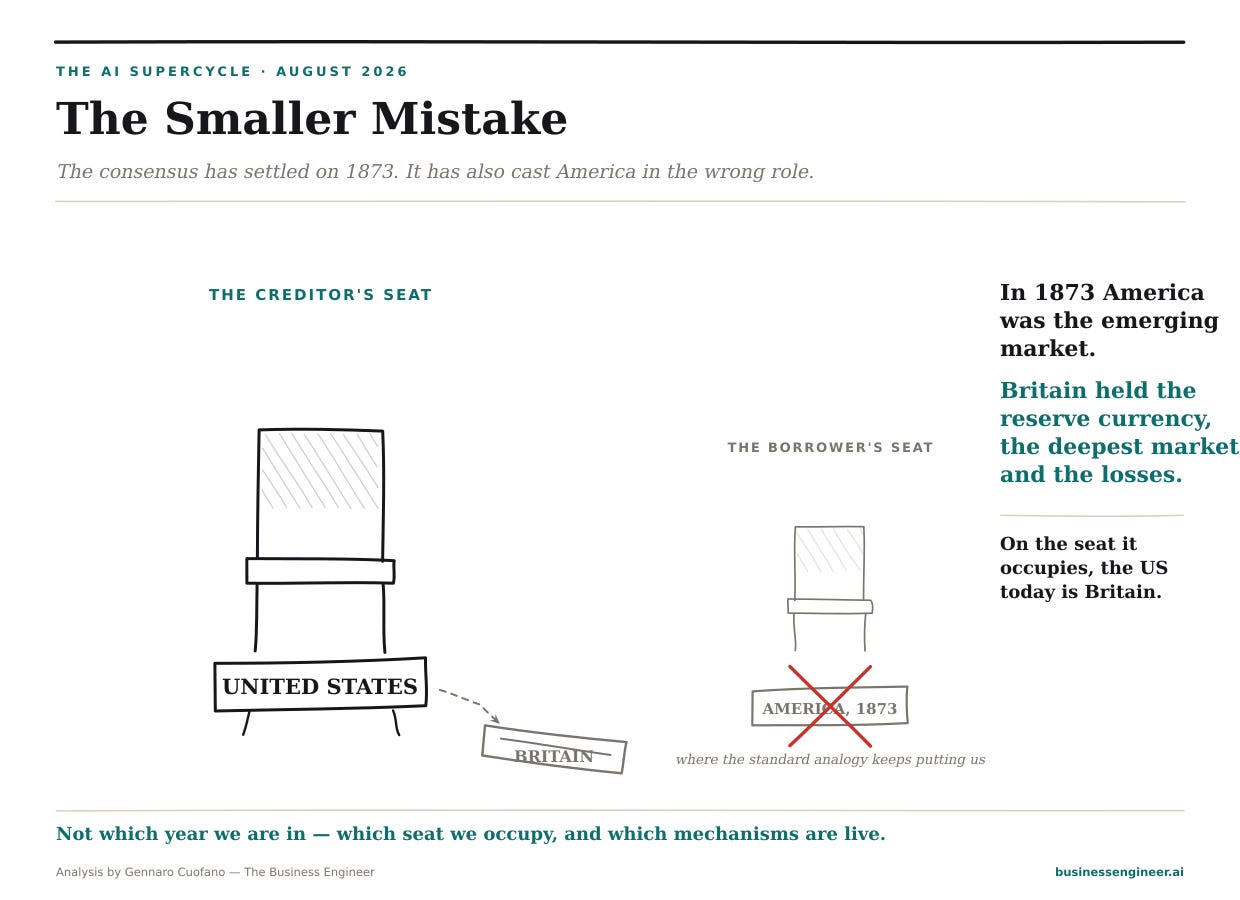

History can help us understand the present, but only up to a point. Historical analysis is difficult precisely because the moment analysts begin converging around the same analogies and the same narratives, those frameworks can start constraining our understanding rather than expanding it.
That is why, with this piece, I want to create some clarity around what history can teach us about the AI Supercycle, where those analogies break down, and what may actually be different this time.
For two years the analogy market traded between 1999 and 1929. It has settled somewhere better. The year you now hear from people who have done the reading is 1873.
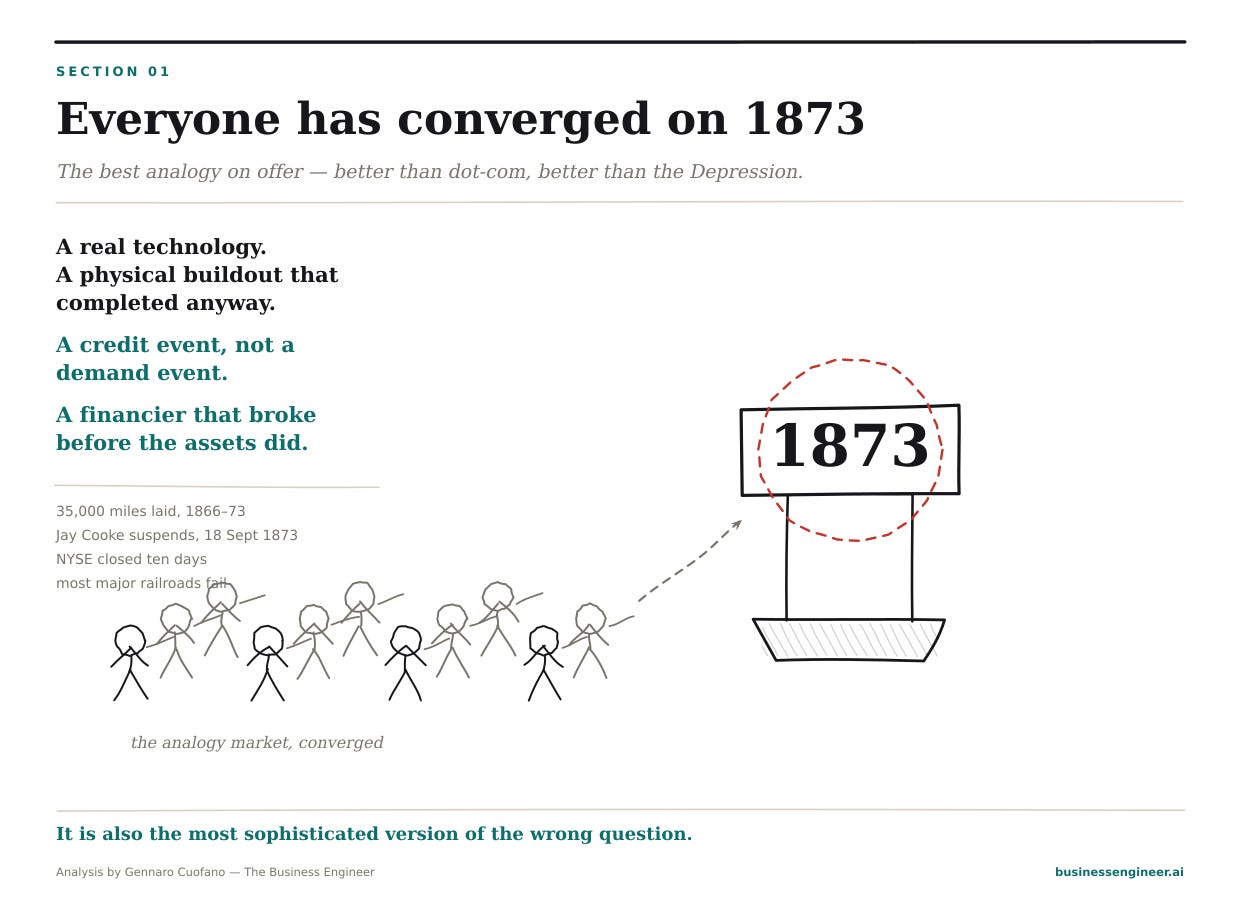
It is a good choice. Look at what it offers.
Between 1866 and 1873 American railroads laid 35,000 miles of new track. The industry became the country’s largest employer outside agriculture. The buildout was real, and the infrastructure proved essential for a century.
It was financed by bonds, sold at enormous scale by one dominant house. Jay Cooke & Company had marketed the Union war debt, then turned the same machinery to railroad paper — selling securities by advertising campaign to people who had never owned a security in their lives.
Cooke staked the firm on the Northern Pacific. The railroad hit mismanagement, cost overruns and a market far cooler than the one that had greeted the first transcontinental. Cooke was writing liabilities against bonds it had not yet sold, and funding long-dated assets with short-term deposits. In late 1872 a London partner said it was cruel to use depositors’ money to prop up Northern Pacific bonds, and that the railroad should go borrow at whatever price it could get. It could not.
On 18 September 1873 Cooke suspended withdrawals. The New York Stock Exchange closed for ten days. What followed ran until 1879.
You can see the appeal. A real technology. A buildout that completed anyway. A credit event rather than a demand event. A financier that broke before the assets did. Infrastructure paper sold to people with no way to evaluate it.
That is not a lazy analogy. It is the most sophisticated one in circulation.
And it casts the United States in the wrong role.