

Last week, I argued that TSMC has quietly become the Federal Reserve of the AI industry — that Wei’s quarterly earnings are the closest thing the sector has to a rate decision, and that the market completely misread this quarter’s guidance as an overspending signal when it was, in fact, a policy stance.
There was one line in that same earnings call that I did not have the space to properly develop. It deserves its own piece, because it is the single most important disclosure about the shape of the next AI cycle — not the size of it, the shape — that any physical-layer executive has made in six months.
Wei, buried inside a Q&A answer:
“The emergence of agentic AI is leading to a resurgence in the role of CPUs in AI data centers... whatever CPU architecture wins — x86, Arm-based, or RISC-V — they are almost all TSMC’s customers.”
Two sentences. Forty-one words. Everyone chasing the capex line missed the composition line.
Here is what those two sentences actually say. And why do they mean the AI Supercycle just changed compute shapes without changing size?
Follow me on The AI Supercycle as well!
The disclosure wasn’t a prediction. It was a description.
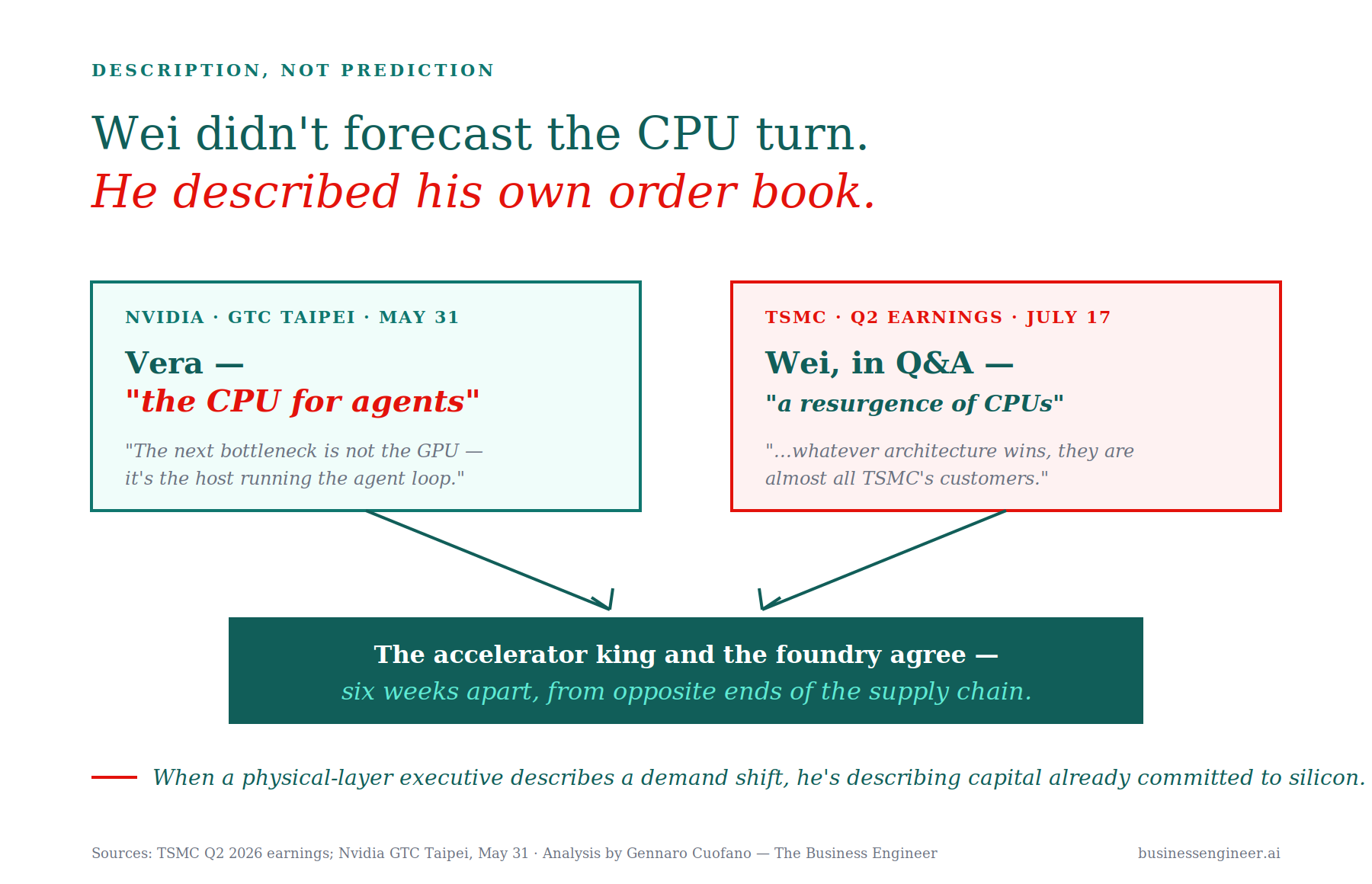
Six weeks before Wei made that comment, on May 31, 2026, at GTC Taipei, Nvidia had already announced — with almost no fanfare relative to the Rubin GPU headlines — that its next-generation host processor, Vera, was being explicitly positioned as “the CPU for agents.”
Not “the CPU for AI.” Not “the CPU for cloud.” The CPU for agents.
The specs matter less than the branding, but they matter too: 88 custom Olympus cores, ARM v9.2-compatible but not Neoverse-derived (Nvidia’s first fully in-house CPU core design), 1.2 TB/s of memory bandwidth, up to 1.5 TB per socket, with a memory subsystem tuned specifically for what Nvidia called “the control-heavy, data-movement-intensive work that agents generate.”
Nvidia’s own framing in the Vera launch materials — this is worth reading twice:
“The next bottleneck in AI infrastructure is not the GPU at all — it’s the host processor that runs the agent orchestration loop around it.”
Nvidia. The company whose entire market capitalization rests on GPUs being the bottleneck. Saying the bottleneck is moving.
So when Wei made his CPU comment on the earnings call this month, he was not predicting a workload phase change. He was describing the demand pattern that his largest customer had already committed silicon to. The two signals — from the accelerator king and from the foundry that manufactures for it — are converging on the same reading.
That reading is: the workload shape of AI is changing. The compute shape is following.
Compression: When Nvidia and TSMC are simultaneously repositioning around CPUs, the industry has already turned. The market just hasn’t priced it.
The workload shape has changed
Follow me on The AI Supercycle as well!
Every prior compute regime was defined by a dominant workload shape.
Training is dense, batched, matrix-bound. Every parameter update touches every core. Memory access is highly regular. This is the workload GPUs were literally built for.
Chat inference is similar at smaller scale. A user prompt goes in, tokens come out. One long matrix multiplication per token, tiny amounts of control flow between them, no meaningful state to maintain across the request.
Agentic execution is fundamentally different.
An agent is not a single inference call. It is a loop — a long-running orchestrated process that:
Plans a multi-step approach from a high-level goal
Calls tools (code execution, web browsing, database queries, retrieval)
Waits for tool responses, sometimes seconds, sometimes minutes
Aggregates results and re-plans
Maintains state across dozens or hundreds of steps
Spawns sub-agents and manages their coordination
Handles errors, retries, and recovery
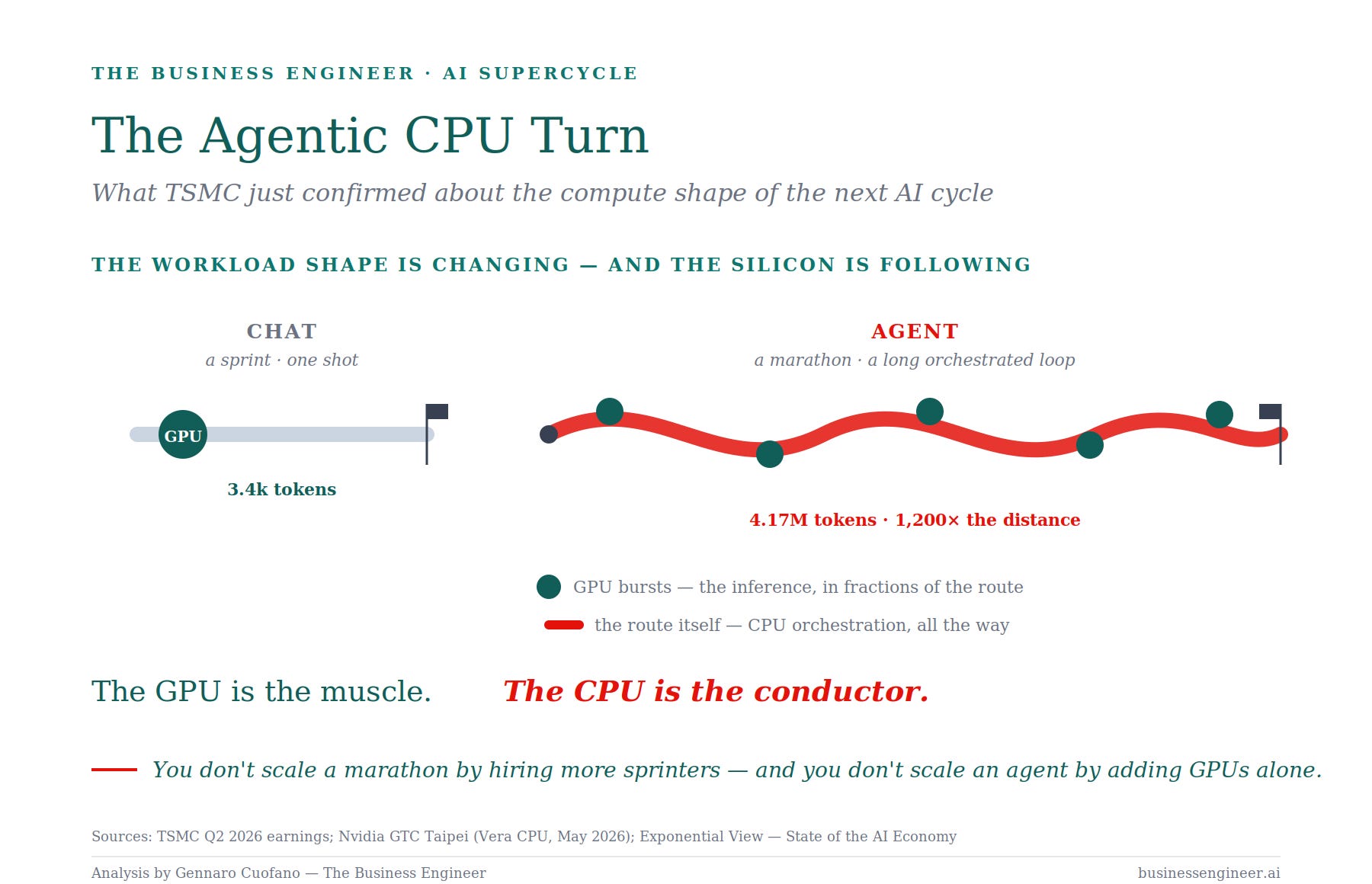
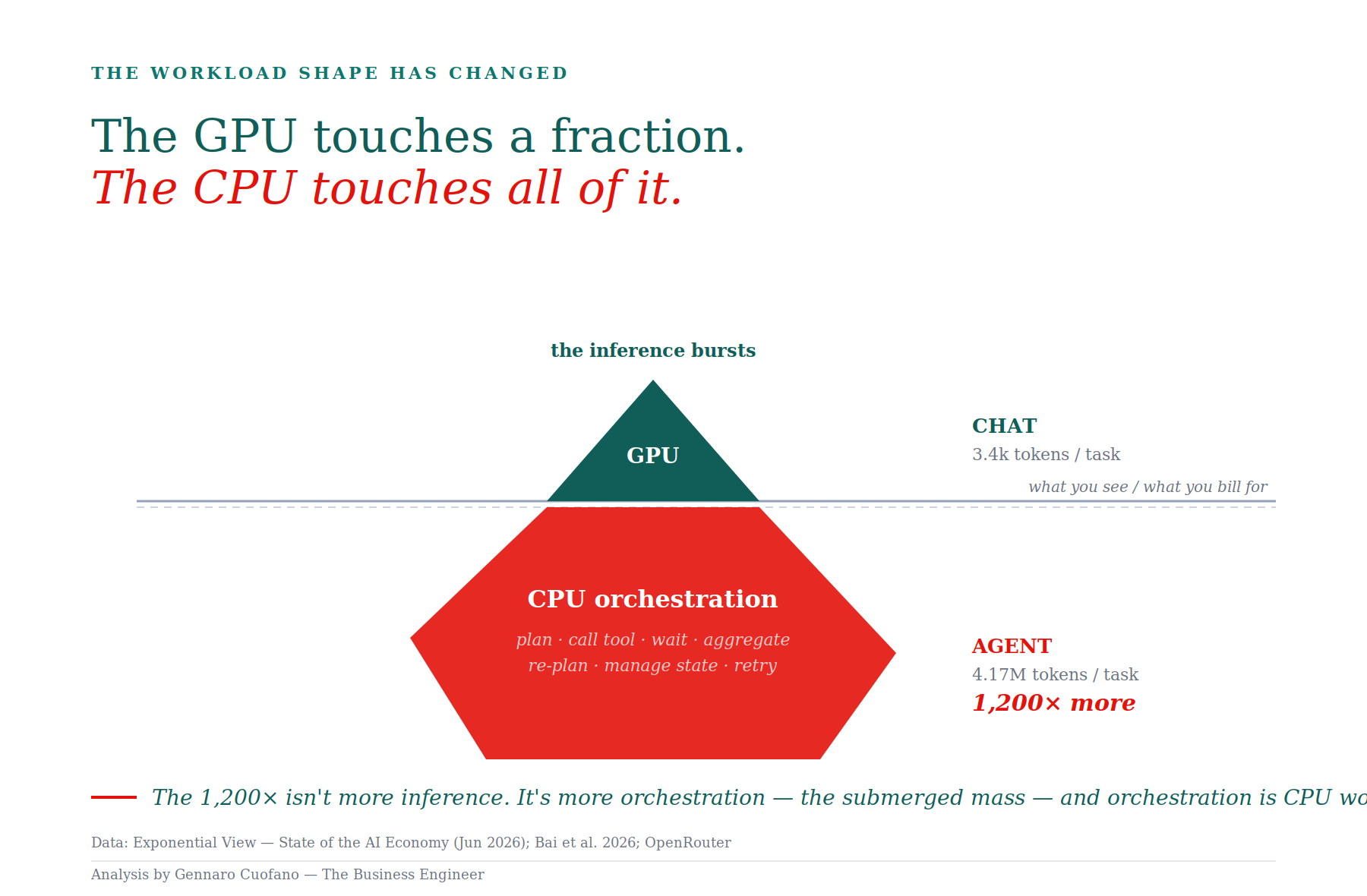
The LLM inference itself — the actual matrix multiplication that produces the next token — happens in tiny bursts inside this loop. The rest of the time, which is most of the time, the agent is doing work that looks nothing like matrix multiplication. It is control flow, state management, memory access, tool orchestration, and inter-process coordination.
That work has a name in silicon: it is CPU work.
The Exponential View State of the AI Economy report from June makes the volumetric case explicit. A single-turn code reasoning task consumes about 1,190 tokens. A multi-turn code chat consumes about 3,390 tokens. An agentic coding task using OpenHands consumes 4.17 million tokens — roughly 1,200x more than the chat equivalent.
But here is what almost every commentator gets wrong about that 1,200x number: it isn’t 1,200x more inference. It’s 1,200x more total token movement through the system. And most of that movement is orchestration — reading and writing context, passing tool responses around, maintaining state, aggregating outputs. The GPU touches a fraction of it. The CPU touches all of it.
A useful mental model: the GPU is the muscle. The CPU is now the conductor. In a chat workload, the conductor is doing almost nothing — one wave of the baton per token. In an agentic workload, the conductor is running a full orchestra with dozens of independent sections, all of which have to stay coordinated, in tempo, for the entire duration of a piece that may last minutes to hours.
You do not scale an orchestra by hiring more percussionists. You scale it by hiring a better conductor.
The industry has already pivoted. Almost every hyperscaler noticed. The market didn’t.
Follow me on The AI Supercycle as well!
If you look at what silicon has actually been announced in the last six months — not marketing language, actual silicon — the pattern is unambiguous.
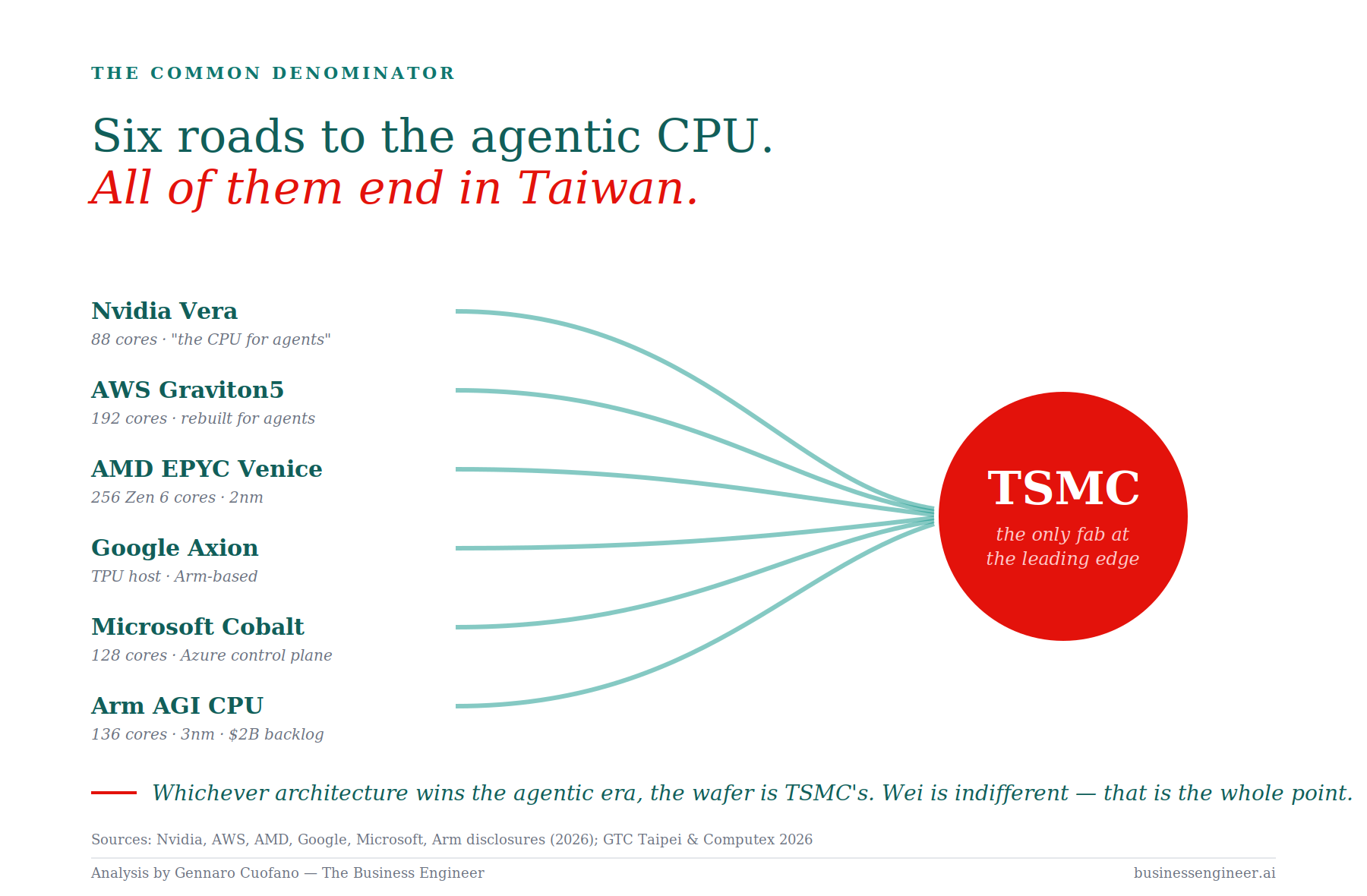
Nvidia — Vera. 88 Olympus cores, Arm v9.2, positioned as “the CPU for agents,” in full production Q1 2026, shipping in the Vera Rubin NVL72 rack alongside 72 Rubin GPUs and 36 Vera CPUs. The rack ratio — 2:1 GPU to CPU by socket — is worth noting. Blackwell’s Grace pairing was 2:1 as well by unit count, but the CPU per rack was less capable and the software framing was “accelerator host.” Vera Rubin flips the framing. The CPU is now equal-status silicon.
AWS — Graviton5. 192 cores, launched June 2026, described in AWS’s own materials as rebuilt for agentic AI. AWS disclosed at the same event that its custom silicon business — Graviton, Trainium, Nitro — had crossed a $20 billion annual run rate. Graviton now accounts for more than half of new CPU capacity added to AWS in the last three years. The Trainium3 UltraServer explicitly pairs Graviton CPUs with Trainium accelerators. The bundle isn’t accidental. It’s the architecture.
AMD — EPYC Venice. 256 Zen 6 cores, TSMC 2nm, paired with the Instinct MI400/MI450X in AMD’s Helios rack-scale platform for multi-gigawatt H2 2026 deployments. AMD has already publicly named the follow-on to Venice — codename Verano, also on 2nm, explicitly optimized for agentic workloads via native LPDDR memory support. The word “agent” now appears on x86 chip roadmaps. That is new.
Google — Axion. Arm-based, deployed as the host processor for the next-generation TPU 8t (training) and TPU 8i (inference) superpods. Google’s own numbers: C4A Axion instances deliver up to 65% better price-performance and 60% better energy efficiency versus comparable x86. Google is not marketing Axion as a general-purpose cloud CPU. It is marketing Axion as the orchestration layer around TPUs.
Microsoft — Cobalt. 128 Neoverse N2 cores, deployed across Azure regions, now powering production workloads for major customers including Databricks. Cobalt is the least aggressive of the hyperscaler custom CPUs in raw specifications, but it is the most deeply integrated into Azure’s control plane — which is precisely the layer that gets stressed by agentic workloads.
Arm — AGI CPU. 136 Neoverse V3 cores on TSMC 3nm, positioned as reference silicon specifically for agentic scaling. Reported $2 billion backlog with hyperscaler design wins. Arm’s CEO Rene Haas, blunt about the reframing: “AI has fundamentally redefined how computing is built and deployed. Agentic computing is accelerating that change.”
Meta. Reportedly signed with AWS to buy Graviton CPUs specifically for its agentic and inference workloads. This is significant. Meta has historically built its own custom silicon (MTIA), and Meta buying general-purpose Arm CPUs from a rival hyperscaler is a very unusual admission that the demand curve is running ahead of internal capacity.
Every single one of those is manufactured by TSMC.
Wei’s comment on the earnings call wasn’t a prediction. It was a description of his own order book. The Vera CPU tapes out at TSMC. Graviton5 tapes out at TSMC. EPYC Venice tapes out at TSMC. Axion tapes out at TSMC. The Arm AGI CPU tapes out at TSMC. The 3nm and 2nm capacity being converted from N-1 nodes, which I discussed in last week’s TSMC piece, is being converted precisely because the CPU designs have started to compete with the GPU designs for leading-edge wafer allocation.
That is what “resurgence in the role of CPUs” actually means when spoken by a foundry chairman. It means his customers have started ordering leading-edge CPU designs at rates that require him to allocate wafers accordingly.
Compression: The industry has already spent the money. The workload shape change has already been ratified by silicon commitments. What remains is for the software layer, the analyst layer, and the market to catch up.
x86’s era just ended, and almost no one wrote about it
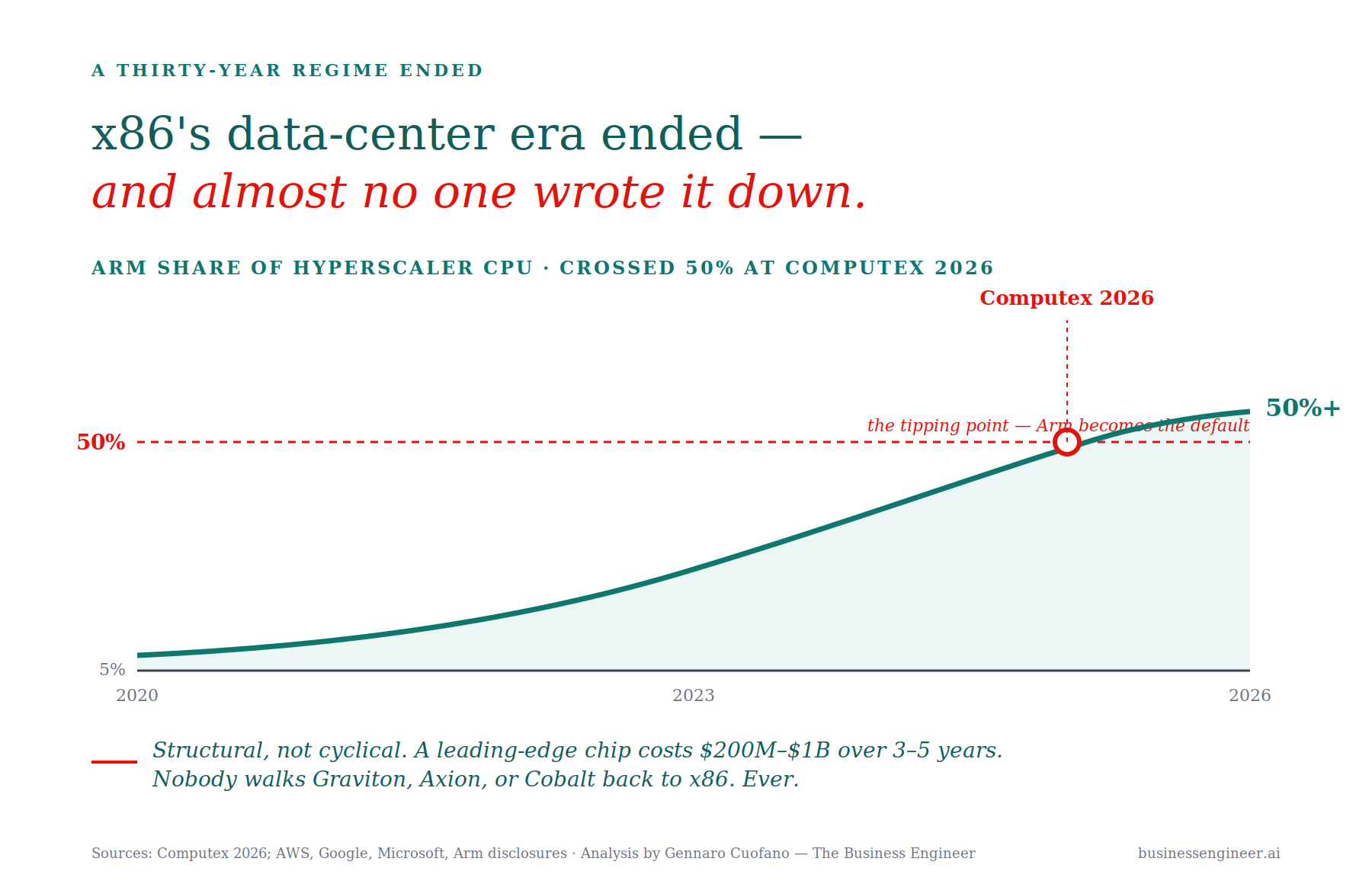
Buried in the June 2026 Computex disclosures — the same event where Nvidia’s Rubin platform got most of the headlines — was a data point that will look, in retrospect, like the moment a thirty-year technology regime ended.
Arm crossed 50% of hyperscaler CPU share.
That is not a projection. It is a share of the fleet, measured today. AWS runs more than half of its new CPU capacity on Graviton. Google’s next-generation TPU host is Axion. Microsoft’s Cobalt is in production. And Nvidia’s Vera — powering the flagship rack architecture that Microsoft, Google, AWS, and CoreWeave will all deploy — is Arm.
The economics of getting to 50% are structural, not cyclical. Developing a chip at 3nm or 2nm costs between $200 million and close to $1 billion, over 3–5 years of engineering. Hyperscalers have already committed those resources. Nobody is walking Graviton, Axion, or Cobalt back to x86. Ever.
What’s left for x86 is a defensive game. AMD has done a genuinely impressive job of adapting — EPYC Venice at 256 cores on 2nm is competitive on core count with anything Arm has shipped. Intel is behind but not absent, with Clearwater Forest (288 E-cores on 18A) and Diamond Rapids scheduled for later in 2026. But the interesting competitive question is no longer “x86 vs. Arm.” It is “who wins within the Arm ecosystem.”
That is a very different competitive geometry. And it maps directly onto the hyperscaler alignments that Wei described from TSMC’s side:
AWS is going custom (Graviton for CPU, Trainium for accelerator)
Google is going custom (Axion for CPU, TPU for accelerator)
Microsoft is going hybrid (Cobalt for internal, plus a very large Nvidia relationship for external customer-facing GPU capacity)
Meta is buying (from AWS, of all places — the surprise move of the year)
Nvidia is going vertically integrated (Vera + Rubin as a single platform, sold as a unit)
The one common denominator across all five is that they are all TSMC customers. Which is exactly why TSMC is indifferent to which CPU architecture wins. It gets the wafer either way.
Compression: The CPU wars aren’t between architectures anymore. They’re between vertical integration strategies within a single architecture family.
The fleet mix problem
Follow me on The AI Supercycle as well!
Here is where this becomes an AI Supercycle question, not a chip industry question.
Last week’s TSMC piece — and the Exponential View State of the AI Economy report before it — both organized their analysis around a single core question: can falling token prices move enough token volume to earn a return on the CapEx? The report’s depreciation waterfall assumed a specific mix of what gets consumed. Roughly $848B of 2026 hyperscaler + neocloud CapEx, generating roughly $111B of annual depreciation charge, requiring roughly $223B of AI revenue to clear the hurdle with 50% headroom.
Those numbers assume a fleet whose compute is being sold in a certain shape. Overwhelmingly, until now, that shape has been GPU-hours. Every unit-economic model in the industry — from hyperscaler pricing pages to app-layer per-user cost models — is calibrated to GPU-hours consumed per unit of work.
If the workload shape shifts toward agentic execution, the compute mix consumed to service a given user request changes. Roughly:
A chat completion: 95%+ of the paying compute is GPU. CPU is orchestration overhead, negligible.
A single-turn RAG query: ~80–85% GPU, 15–20% CPU (retrieval, embedding lookup, response assembly).
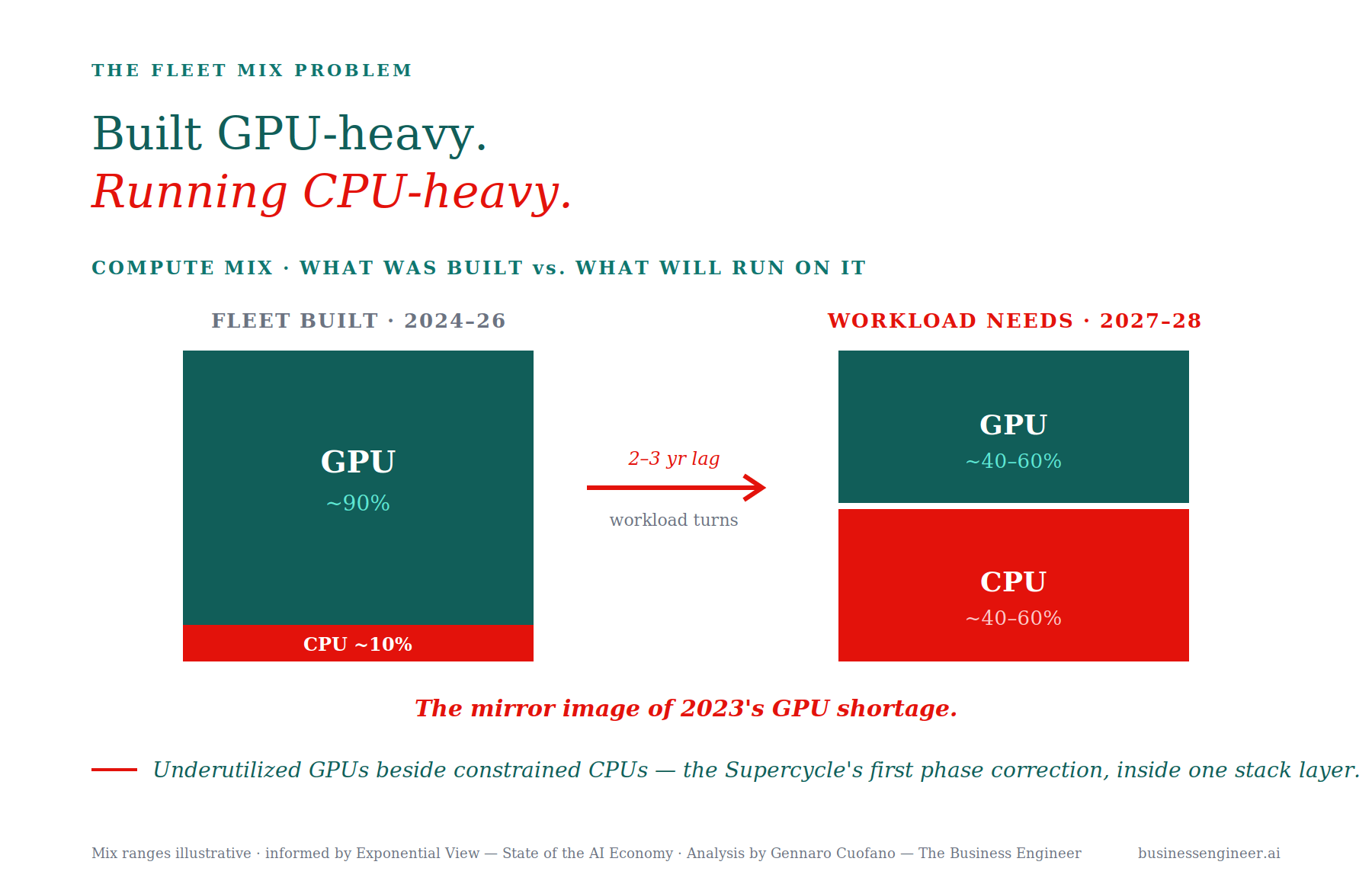
A multi-turn agent task: possibly 40–60% GPU, 40–60% CPU, depending on the ratio of inference calls to tool calls. This ratio is the number that matters, and there is no industry consensus yet on what it is at scale.
Take that shift seriously and two things become true simultaneously.
First, the hyperscaler fleets built in 2024–2026 will be GPU-heavy relative to the workload they end up serving in 2027–2028. This is the fleet mix problem. GPUs sitting under-utilized while CPU capacity is the constraint. This is the mirror image of the situation in 2023–2024, when CPU capacity was abundant and GPU capacity was rationed. The industry solved the GPU shortage by building GPU-heavy fleets. Now it is at risk of the opposite mismatch.
Second, the per-user economics of agentic products may actually improve, but only for operators who can control the mix. CPU compute is cheaper per unit of work than GPU compute. If you can shift 40% of an agent’s compute onto Graviton or Axion instead of H100s, per-agent margins go up meaningfully — but only if the workload orchestration is fine-grained enough to let you do that split. This is why AWS’s Bedrock+Trainium+Graviton bundle is starting to make commercial sense as a vertically integrated offering, and why Nvidia is pushing Vera Rubin as a single platform rather than as separate CPU and GPU procurements. The bundling strategy is the tell. Everyone building a stack knows what mix they need. Everyone selling a stack is trying to control it.
For app-layer players — Cursor, Claude Code, Devin-class products — this is a moment of genuine strategic choice. The most naïve approach is to remain a “wrapper” and let the model provider price the mix. The most defensible approach is to co-locate parts of the agent orchestration close to the compute, take advantage of the CPU/GPU mix themselves, and start capturing margin that would otherwise flow to Nvidia.
That is exactly the “value moving up the stack” pattern the Exponential View report documented — the app + model layer grew 2.95x in deduplicated share in a year. The agentic CPU turn is one of the specific mechanisms driving that migration.
Compression: The Supercycle just went from a single-variable problem (how much compute) to a two-variable problem (how much, and in what mix). The winners will be the operators who control both.
What the market saw vs. what actually happened
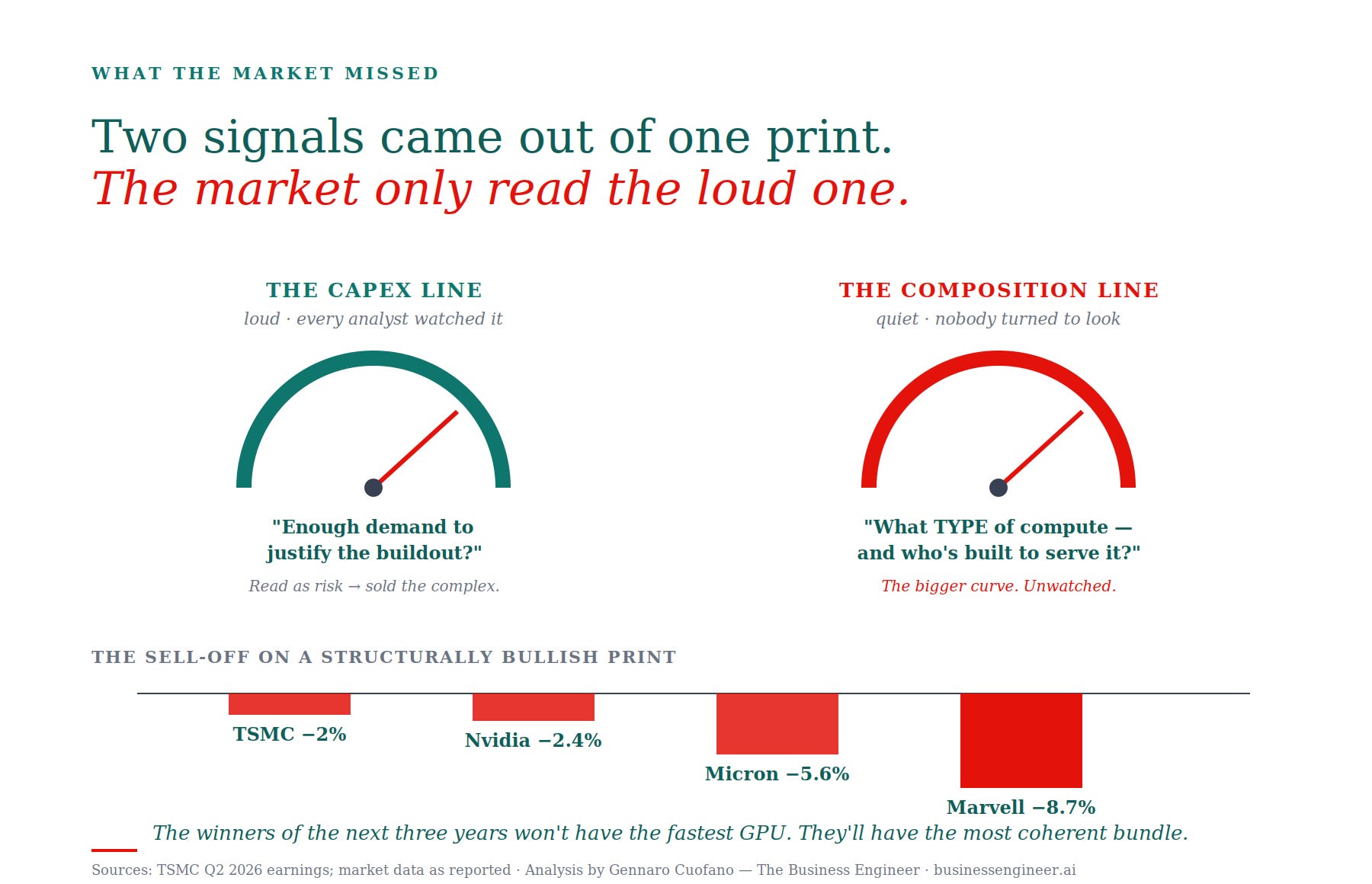
Last week I noted that TSMC’s stock fell 2% on the earnings guidance. Nvidia fell 2.4%. Micron fell 5.6%. Marvell fell 8.7%. The market read raised CapEx as risk.
If you now overlay the CPU disclosure onto that reaction, the misread becomes even clearer. The market was pricing a single question — is there enough demand to justify the buildout? — and used the capex line as the answer. But there were two demand curves in the disclosure. There was a capex curve, which the market interrogated. And there was a composition curve, which the market ignored.
The composition curve is arguably the more important one. It tells you not just that AI compute demand is going to keep growing, but that the type of AI compute demand is going to change in a way that only certain vendors are positioned to serve. Vera Rubin as a unit. Graviton5 + Trainium3 as a unit. Axion + TPU 8t/8i as a unit. Helios (Venice + MI450X) as a unit.
The vendors who win the next three years will not be the ones with the fastest single-chip GPU. They will be the ones with the most coherent bundle — CPU + GPU + interconnect + memory + software — engineered specifically for the orchestration-heavy shape that agents actually have.
That is a very different competitive question than “who has the best GPU.” And it is the question that the market’s reaction to last week’s TSMC earnings suggests it has not yet learned to ask.
What to watch for over the next 24 months
Follow me on The AI Supercycle as well!
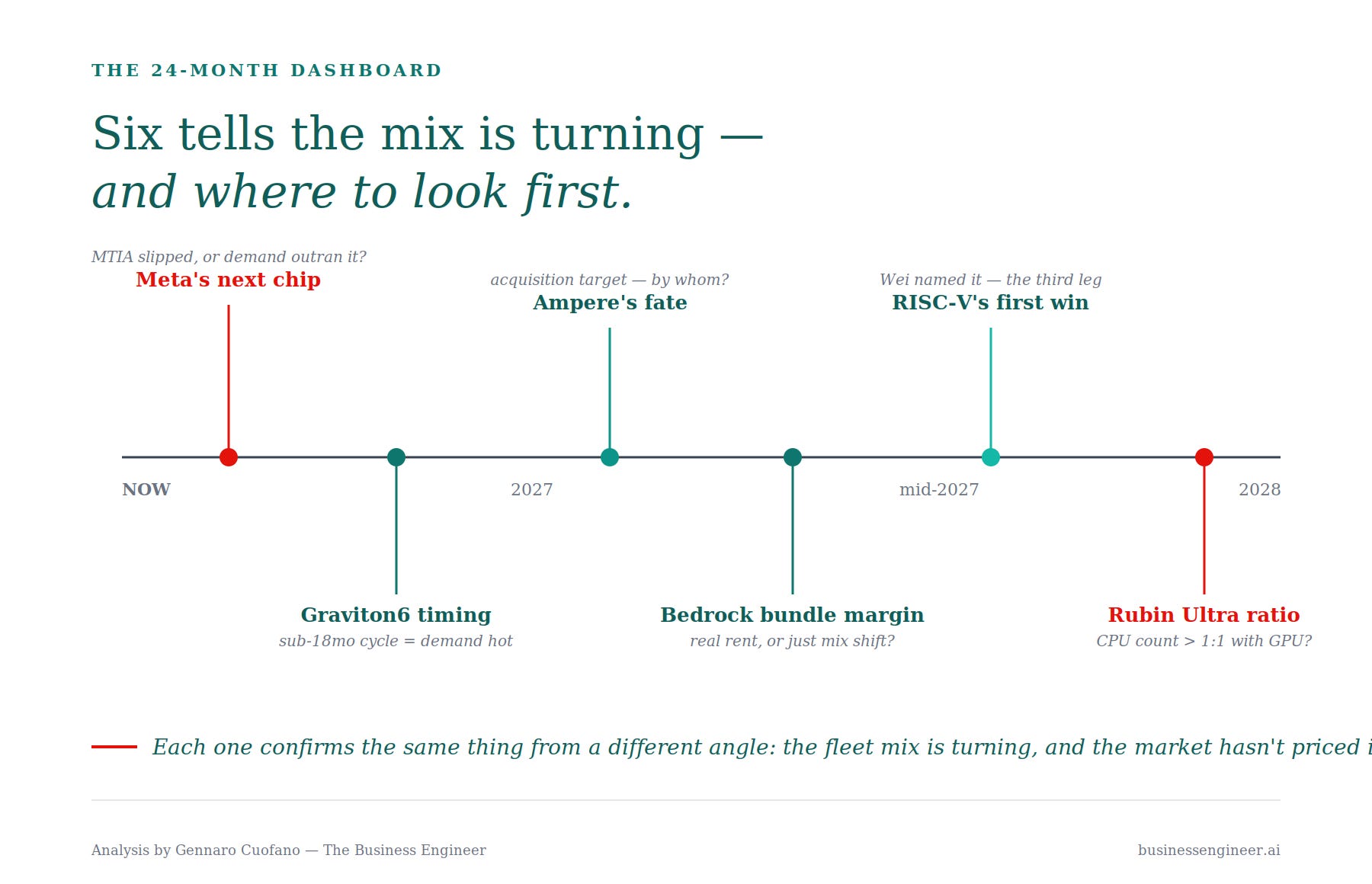
If the agentic CPU turn is real — and every physical-layer signal now suggests it is — then here are the specific indicators worth tracking.
Rubin Ultra timing and CPU ratio (H2 2027). The Kyber NVL576 rack architecture takes 576 GPU compute dies per rack. Does the CPU count scale linearly, superlinearly, or sublinearly? If it scales faster than 1:1, that is Nvidia confirming the CPU-per-GPU ratio needs to keep climbing.
Graviton6 announcement. If AWS announces Graviton6 within 18 months of Graviton5 — a shorter cycle than the historical 2-year cadence — it is because the internal demand signal is running hotter than the current chip can service.
Ampere Computing’s fate. The one independent Arm server chip maker, at 192 cores, with a serious business but no hyperscaler home. Acquisition target — the question is by whom. If Nvidia buys them, Nvidia is doubling down on being the CPU platform. If a hyperscaler buys them, the winner is one that decides it needs Ampere’s IP faster than it can develop its own second generation.
RISC-V’s first hyperscaler design win. Wei explicitly named RISC-V in the same sentence as x86 and Arm — “they are almost all TSMC’s customers.” That is not accidental. The first serious hyperscaler-committed RISC-V design will signal a third leg forming in the CPU market. Watch Meta, watch Alibaba, watch Tencent.
Bedrock + Trainium + Graviton reported margin in AWS Q3/Q4 earnings. If AWS starts breaking out the agentic AI stack as a segment — or if analysts start reconstructing the margin from customer disclosures — the numbers will tell you whether the vertically integrated agent-shaped bundle actually earns economic rent, or whether it just shifts the mix without changing the total.
Meta’s next silicon disclosure. Meta buying AWS Graviton is a very odd move for a company that has historically built everything itself. Either Meta’s own MTIA program has slipped, or the demand curve got so steep that even Meta can’t build fast enough. Either interpretation is a Supercycle signal.
Key mental models
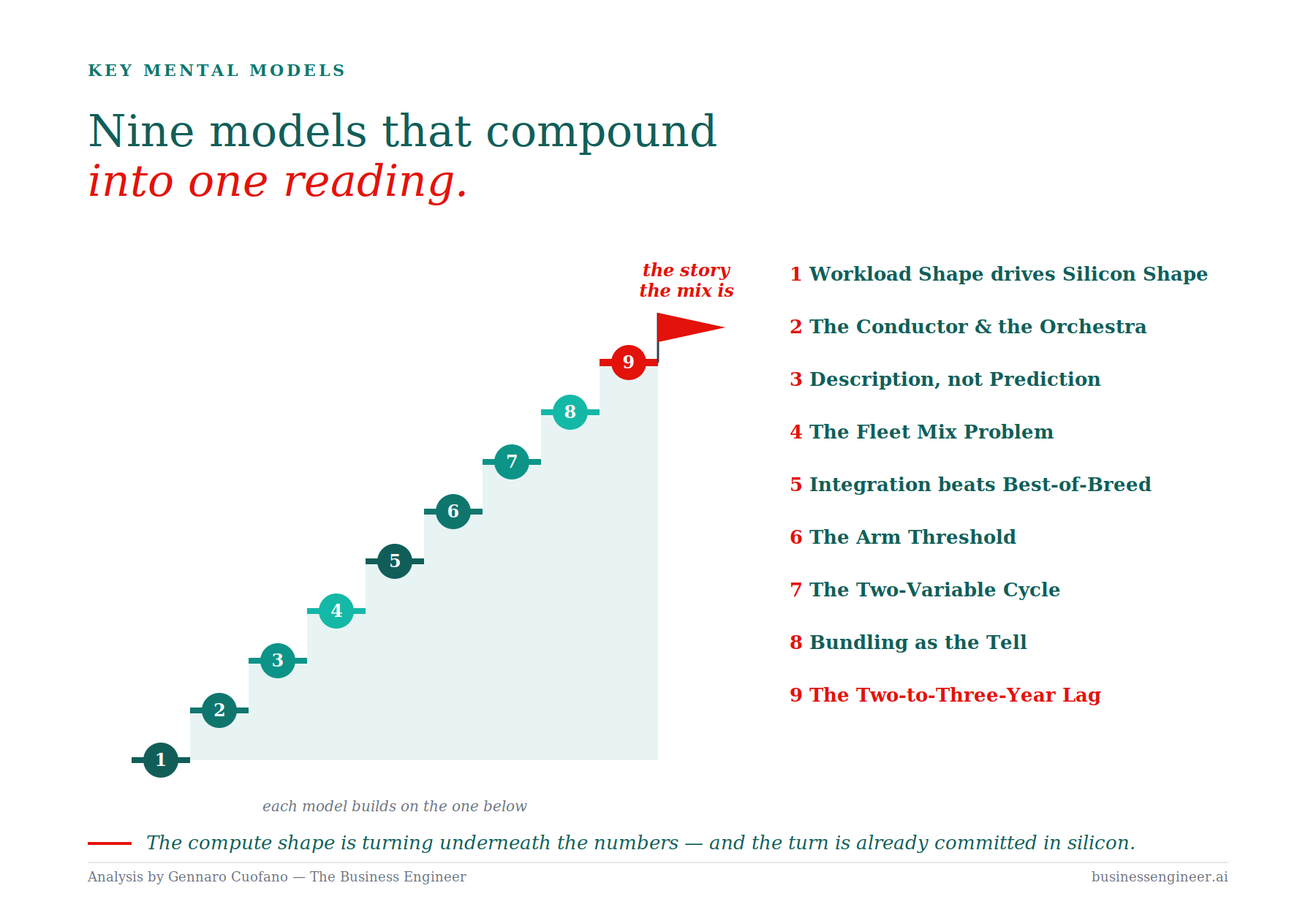
Workload Shape Drives Silicon Shape. Every compute regime is defined by a dominant workload shape. Training and chat inference are matrix-bound and GPU-shaped. Agents are orchestration-heavy and CPU-shaped. When the dominant workload changes, the silicon mix changes with a two-to-three-year lag. That lag is the fundamental clock speed of the AI industry.
The Conductor and the Orchestra. The GPU is the muscle; the CPU is now the conductor. In a chat workload, the conductor is doing almost nothing. In an agentic workload, the conductor is running a full orchestra. You do not scale an orchestra by hiring more percussionists.
Description, Not Prediction. When a physical-layer executive — foundry chairman, chip designer CEO — describes a demand shift, they are describing an order book that has already committed silicon. That is the strongest possible signal, because it comes with sunk capital behind it. Wei’s CPU comment was a description of Nvidia’s Vera, AWS’s Graviton5, AMD’s Verano, Google’s Axion, Microsoft’s Cobalt, and Arm’s AGI CPU — all of which are already in the wafer queue.
The Fleet Mix Problem. The Supercycle’s first phase mismatch. Hyperscaler fleets built in 2024–2026 are GPU-heavy relative to the workload shape that will run on them in 2027–2028. This mismatch — underutilized GPUs alongside constrained CPUs — is likely to be the first localized “bubble deflation” the AI economy experiences. It will not look like the .com bust. It will look like a phase transition inside a single stack layer.
Vertical Integration Beats Best-of-Breed. In the agentic era, the vendor with the most coherent CPU + GPU + interconnect + memory + software bundle wins over the vendor with the best single component. Nvidia understands this — Vera Rubin is sold as a rack, not as chips. AWS understands this — Bedrock + Trainium + Graviton is one story. The chip designers still competing on individual best-chip specs are already fighting the last war.
The Arm Threshold. Arm crossing 50% of hyperscaler CPU share at Computex 2026 is the moment the x86 era ended in the data center. This is a structural, not cyclical, shift — nobody is walking $200M–$1B chip investments back. Every serious hyperscaler CPU roadmap through 2030 is Arm-based. The interesting competition is now within the Arm ecosystem: custom silicon vs. Nvidia Vera vs. reference AGI CPU vs. Ampere.
Two-Variable Cycle. The AI Supercycle is no longer just about how much compute the industry can build. It is about how much and in what mix. Every CapEx, revenue, elasticity, and depreciation-headroom model built in 2024–2025 assumed a single-variable framing. Every model built from here on has to solve for two.
Bundling as the Tell. When every major vendor is trying to sell you the CPU and the GPU as a unit — Vera Rubin, Helios, Bedrock + Trainium + Graviton, Axion + TPU — the vendors themselves are telling you the mix is the strategic variable. If the mix didn’t matter, they’d sell the components separately at maximum-margin prices for each. The bundling strategy is the strategy.
The Two-to-Three-Year Lag. From foundry decision to consumer application. What TSMC and Nvidia decided in early-to-mid 2026 shows up as CPU capacity in hyperscaler fleets in 2027, shows up as agent-shaped software architecture in 2028, and shows up as end-user product economics in 2029. If you are building an agent product now, you are building for a stack that has not yet been fully deployed. That is an execution risk and a positioning opportunity.
The bottom line
Follow me on The AI Supercycle as well!
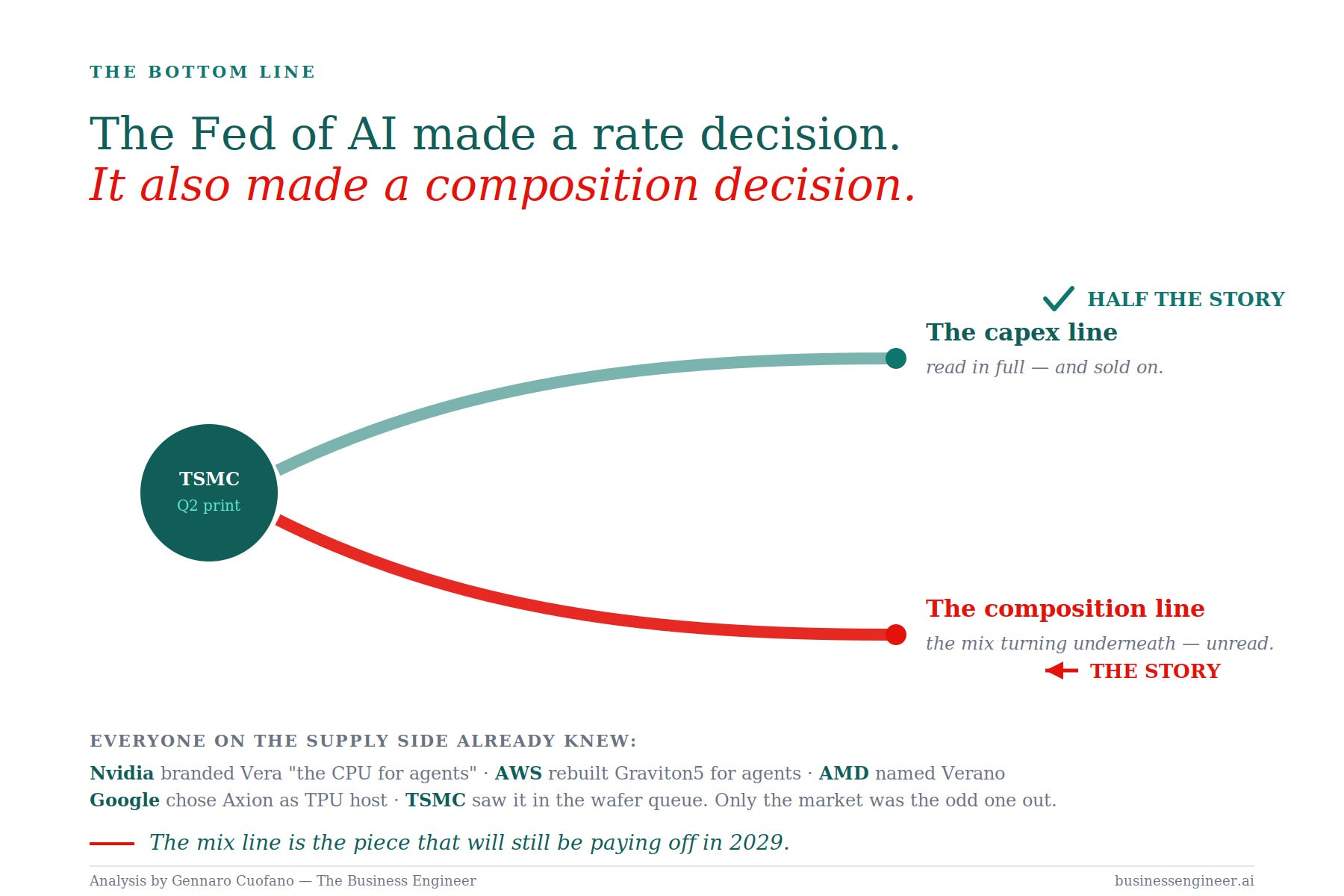
Last week’s TSMC earnings had two disclosures. The one everyone covered was the CapEx. The one that matters more was the composition — the workload shape of the next AI cycle, ratified by silicon commitments across every major hyperscaler and chip designer, and confirmed on the receiving end by the foundry that manufactures for all of them.
The AI Supercycle just changed compute shapes without changing size. The bill for the next three years is still the same magnitude, or larger. But the mix of what gets built to service it — what the fleet actually looks like on the racks — is different from what any 2024 model assumed.
Nvidia knew this in May, when it branded Vera “the CPU for agents.”
AWS knew this in June, when it launched Graviton5 “rebuilt for agentic AI.”
AMD knew this before that, when it named its post-Venice x86 CPU after the word “Verano” and marketed it explicitly for agent workloads.
Google knew this when it decided the next TPU host processor would be Axion, not any general-purpose part.
TSMC knew this from the wafer allocation requests it was receiving, which is why Wei made the comment in the first place.
Which leaves the market, the analysts, and most of the AI industry commentary the odd person out — still reading the capex line while missing the mix line entirely.
The mix line is the story.
If you got the TSMC piece last week and thought the takeaway was “AI infrastructure demand is real and multi-year” — that was half of it. The other half is that the shape of that demand is turning underneath the numbers. And the turn is already priced into the silicon, already committed at 2nm and 3nm, already loaded into the wafer queues that Wei’s audit process governs.
The Federal Reserve of AI made a rate decision last week. It also, and more consequentially, made a composition decision. The market has read half of it.
The other half is the piece that will still be paying off in 2029.
Recap: In this issue!
Agentic AI is changing the architecture of compute
The next phase of AI is defined less by larger models and more by autonomous agents.
Unlike chatbots, agents continuously plan, execute, coordinate tools, manage memory, and adapt over long-running tasks.
This changes not only how much compute is required, but the type of compute required.
CPUs are becoming a strategic component of AI infrastructure
TSMC highlighted that agentic AI is driving renewed demand for CPUs inside AI data centers.
GPUs remain the engine for training and inference, while CPUs increasingly orchestrate workflows, memory, scheduling, communication, and tool execution.
Future AI systems will rely on balanced CPU-GPU architectures rather than GPU-centric designs alone.
The transition is already underway
Every major AI infrastructure provider has redesigned its roadmap around agentic workloads:
NVIDIA → Vera
AWS → Graviton5
Google → Axion
Microsoft → Cobalt
AMD → EPYC Venice
Arm → AGI CPU
These are already funded silicon programs, suggesting the industry has committed to this transition well before it becomes visible in software adoption.
AI workloads are becoming orchestration-heavy
Traditional AI applications mainly execute matrix computations on GPUs.
Agentic systems require continuous:
Planning
Memory management
Tool execution
State persistence
Multi-agent coordination
Error handling
As AI applications become more autonomous, orchestration becomes an increasingly large share of total compute.
The strategic question is now compute mix
The next AI cycle is no longer defined simply by expanding compute capacity.
Instead, success depends on optimizing:
GPU utilization
CPU orchestration
Memory bandwidth
Networking
Workload allocation
The industry is shifting from maximizing compute to optimizing the composition of compute.
AI platforms are replacing standalone chips
Leading vendors are increasingly competing with integrated platforms rather than individual processors.
Examples include:
NVIDIA Vera + Rubin
AWS Graviton + Trainium
Google Axion + TPU
AMD Venice + Instinct
Competitive advantage increasingly comes from the coordination of the entire platform rather than peak chip performance alone.
Arm has become the new hyperscaler standard
Arm now powers more than half of new hyperscaler CPU deployments.
AWS, Google, Microsoft, and NVIDIA have all adopted custom Arm-based designs.
The report argues the competitive landscape is no longer x86 versus Arm, but which Arm ecosystem delivers the best integrated AI platform.
AI infrastructure may face a compute imbalance
Most AI infrastructure deployed over the past several years was optimized for GPU-heavy workloads.
Agentic AI increases CPU demand much faster than previously expected.
This raises the possibility that future AI data centers become constrained by orchestration capacity rather than accelerator capacity.
Vertical integration becomes the competitive advantage
Companies that control multiple layers of the AI stack—from CPUs and GPUs to networking and software—are positioned to optimize workload distribution, reduce costs, and improve system efficiency.
The report suggests the next competitive battle will be won by integrated AI platforms rather than by individual hardware components.
The indicators to monitor
The report highlights several signals that will reveal how quickly this transition unfolds:
CPU-to-GPU ratios in next-generation AI systems
Adoption of custom hyperscaler CPUs
Continued growth of Arm in data centers
Economics of integrated AI platforms
CPU utilization within agentic workloads
The broader takeaway
The report argues that the next AI cycle is not simply about building more compute—it is about building the right mix of compute.
The industry has already committed billions of dollars toward architectures optimized for agentic AI. As autonomous systems become more common, competitive advantage will increasingly depend on the ability to integrate CPUs, GPUs, networking, memory, and software into a single optimized platform rather than maximizing GPU performance alone.
With massive ♥️ Gennaro Cuofano, The Business Engineer