

I have been working with AI in one form or another since around 2015, when much of what we called AI in practice was still narrow machine learning and natural-language processing. Back then, getting machines to understand language meant stitching together specialized libraries, classifiers, entity extraction, rules, and carefully structured data.
Around 2017 and 2018, I remember working on ways to make websites “talk”: turning their content into structured data that machine interfaces and voice assistants could actually consume. It worked, but it was incredibly clunky. You could see the direction of travel, but much of what we imagined still felt decades away.
Then the underlying technology began to change. The arrival of transformer-based models, Google bringing systems such as BERT into search, and the rapid evolution of the GPT family between 2018 and 2020 made it increasingly obvious that we were crossing into something different.
These systems were becoming dramatically more general. Instead of building a separate narrow pipeline for every language task, you could increasingly place different problems in front of the same underlying model.
At first, I was not particularly impressed by the outputs themselves. As an author, analyst, and writer, I could still do things these systems simply could not do well. The important signal for me was elsewhere: the rate at which the boundary was moving.
Things that a few years earlier I had mentally placed ten or twenty years into the future were suddenly becoming plausible within a product cycle. The clunky interfaces we had spent years engineering around narrow NLP were beginning to collapse into much more general systems.
By the early 2020s, a large part of my day-to-day work had consequently become figuring out how to bring this new generation of AI into the enterprise stack. And that is where I started to see a second problem emerge.
The hard part was increasingly not getting the technology to do something impressive. It was getting the impressive thing through the long journey from prototype to production, and then from one production deployment to something that could actually scale across an organization.
Back in 2023, when almost everyone was caught off guard by the first major generative-AI wave, one thing was therefore already clear to me: the enterprise had moved to the center of the AI story. The question was no longer simply whether large companies would adopt AI. It was whether they would accept what adoption really implied. AI was not going to remain another piece of software layered onto the existing organization. Eventually, it would require a change to the core of the organization itself.
Fast-forward to 2026 and most enterprises have, in one form or another, crossed the adoption threshold. This year they have spent aggressively on models, tokens, copilots, agents, and the infrastructure required to run them, racing from experimentation into the agentic era. Enterprises have consumed enormous amounts of intelligence. Employees are using AI. Developers are building with it. Business units are launching agents. In that sense, usage is no longer the main constraint.
And that is precisely what makes the current moment so revealing. Once usage becomes abundant, you can finally see where the real bottleneck sits. It is not access to intelligence. It is not even willingness to use it. It is the translation of all that intelligence into deployed business outcomes across the enterprise.
A company can have thousands of employees using AI every day, spend heavily on inference, launch dozens of pilots, and still struggle to answer the questions that ultimately matter. Where did margin improve? Which workflow was fundamentally redesigned? What can the organization now do that it could not do before? Which capability is compounding rather than simply making an employee faster?
I have spent much of my professional life at the intersection of customers, technical teams, and commercial organizations, and this is what feels fundamentally different from previous software waves. Historically, adoption itself was often the hard part: buy the system, integrate it, get people into it, drive usage. With AI, usage can spread almost by itself. The friction appears one level higher, when the company attempts to turn thousands of local productivity gains into one coherent operating model.
Who decides which workflows should actually be automated? Where does human judgment remain? Which agents may take which actions? Which models may touch which data? Who owns the evaluation sets, corrections, and decision history those systems generate? What happens when a model changes underneath a production workflow? How does one successful experiment become a company-wide standard rather than the forty-third isolated AI tool inside the company?
These are fundamentally governance questions. Yet governance is almost always treated as the thing that comes after innovation. First experiment. First prove something. First let teams move quickly. Then bring in security, legal, procurement, architecture, data governance, and the operating model once the technology has demonstrated its value.
I think AI turns that logic upside down.
Governance is not the layer that follows the transformation. It is the mechanism through which the transformation compounds.
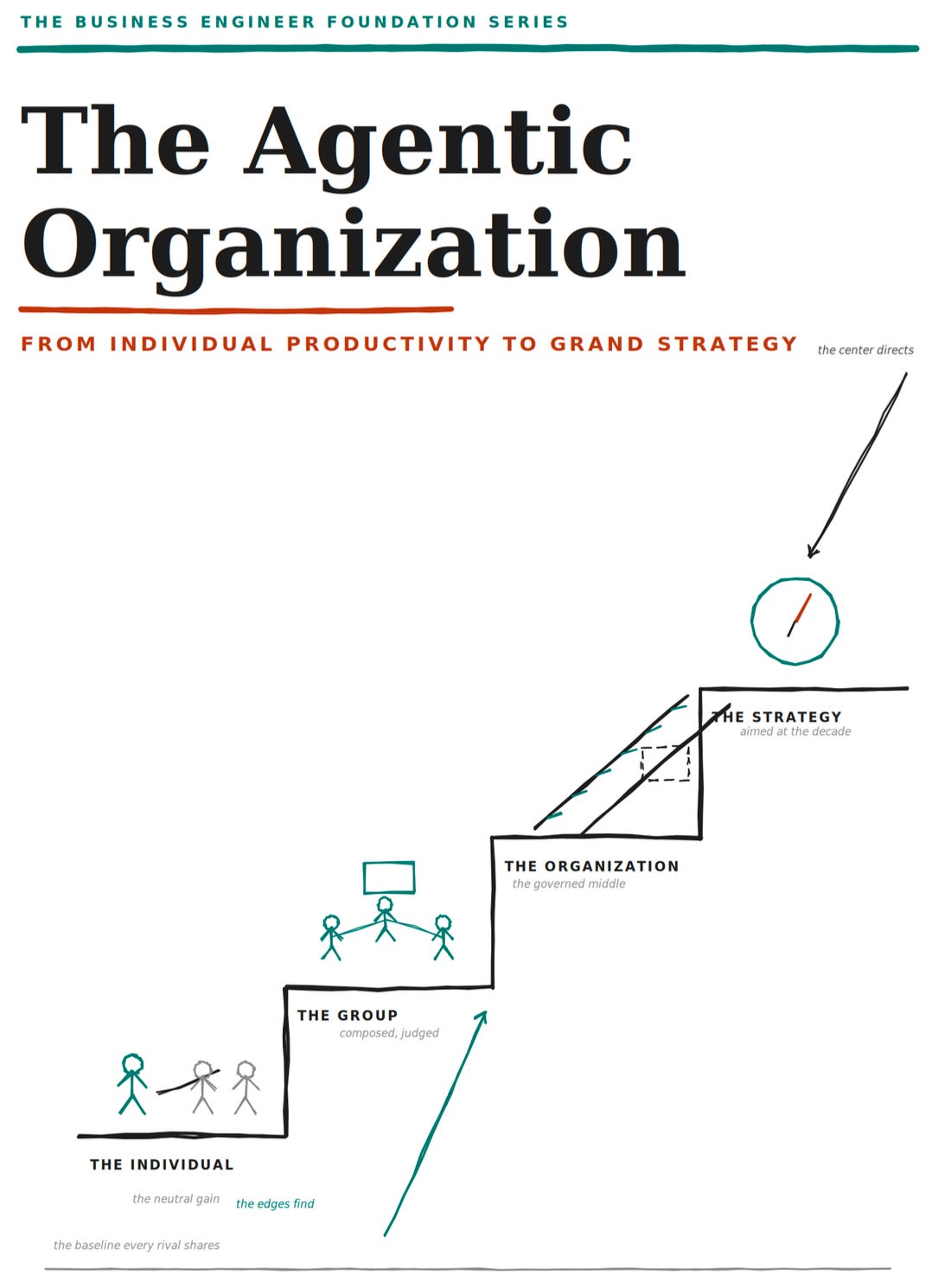
Without it, the enterprise can produce extraordinary activity at the edges while accumulating remarkably little at the center. Every employee becomes faster. Every department launches agents. Every productivity dashboard turns green. Yet the knowledge generated by those systems remains fragmented, the workflows remain structurally unchanged, and the company can end up in approximately the same competitive position because its rivals bought access to the same intelligence in the same quarter.
That is the tension this piece is trying to unpack. The enterprise AI challenge is no longer principally one of adoption. It is one of organization: how individual gains become coordinated systems, how local discoveries become institutional standards, how the knowledge generated by humans and agents remains with the firm, and how all of this is ultimately aimed at a strategic position competitors cannot reproduce simply by purchasing the same models.
The technology moved faster than I expected when I was working with those narrow NLP systems a decade ago. But that has only made the organizational problem more visible.
The transformation does not end when the enterprise adopts AI. That is where the difficult part begins.
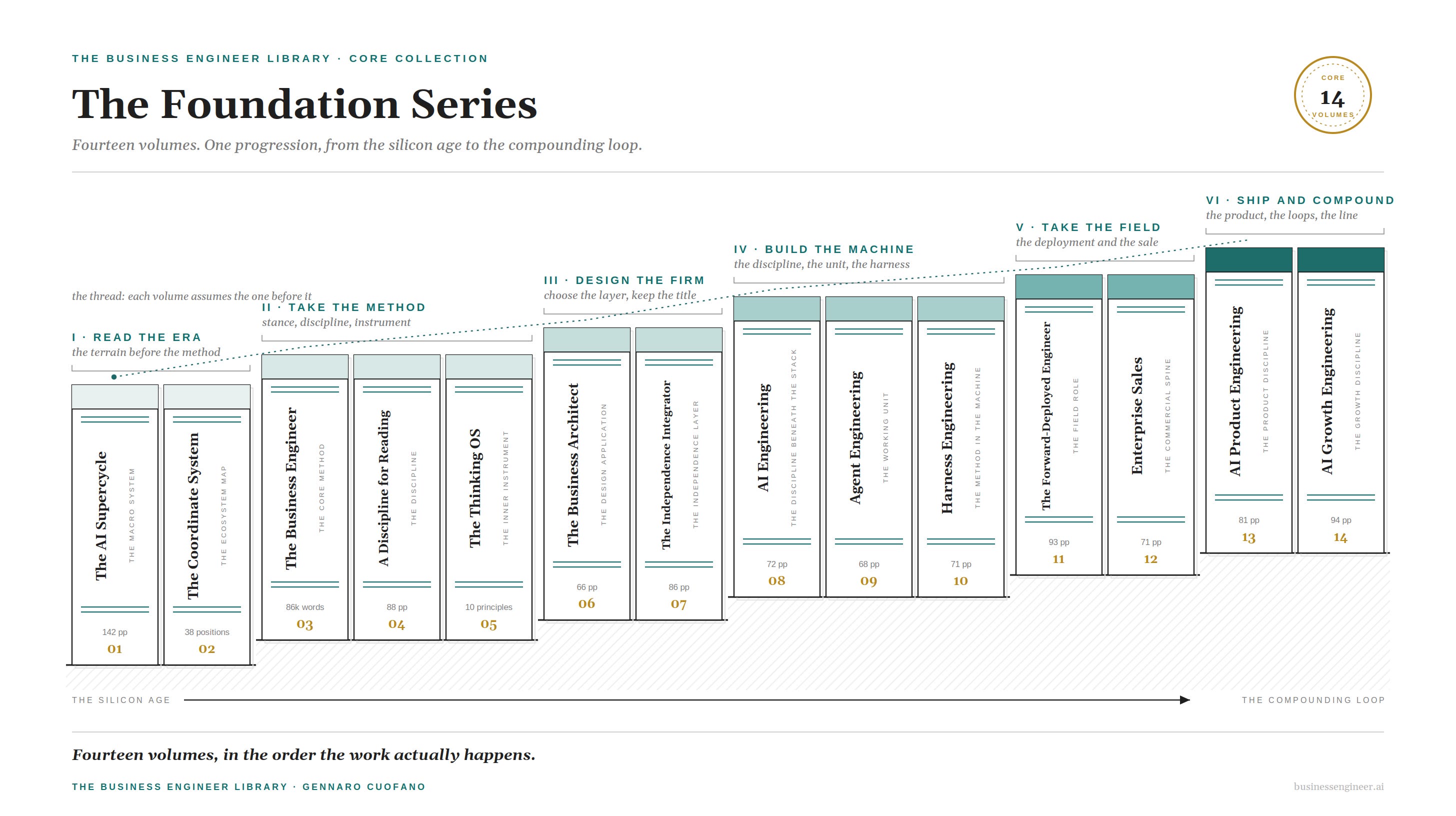
For the last three years, I’ve been rebuilding the Business Engineer’s curriculum from the ground up. That curriculum has now become the foundation of a new discipline, with the entire series taking shape around it.
If you’re already a paid member, simply reply to this email, and we’ll send it your way.