

I have always been a student of history, and history has a strange property: the deeper you dig, the less clean its lessons become. You start looking for simple explanations and instead find contingencies, accidents, incentives, technologies, personalities, and decisions interacting with each other. Yet that is precisely why history matters. It cannot tell us what will happen next, but it can prevent us from repeatedly walking into the same traps.
Working in technology added another intellectual habit to that historical one: Silicon Valley’s obsession with first-principles thinking. It is a powerful idea, but also one surrounded by mythology. We all like to imagine ourselves stripping a problem down to fundamental truths and rebuilding it from scratch. Reality is less flattering. Almost all of us borrow from each other. Most innovation is recombination. Only a tiny number of people in any field genuinely redefine its first principles.
For the business person, that is not necessarily a disadvantage. In fact, one of the most valuable skills a generalist can develop is the ability to move across disciplines without becoming overly loyal to any of them. Specialization creates extraordinary depth, but it also creates boundaries. Finance speaks to finance. Computer science to computer science. Economics to economics. Organization theory to organization theory. The operator does not have that luxury because reality does not respect departments.
This is also why the best entrepreneurs often remind me more of scientists than of academics at their most specialized. The scientist has a hypothesis and eventually has to surrender it to reality. The entrepreneur does too. The business either works or it does not. Customers either care or they do not. The unit economics eventually show up. Reality has very little respect for ideological purity.
And many of the largest technological breakthroughs come from precisely this violation of disciplinary boundaries. Modern AI is a good example. It would be inaccurate to say that everything we call agentic AI today is formally neuro-symbolic AI. It is not. But the most capable systems increasingly combine things that once belonged to different intellectual worlds: neural models with search and retrieval, structured knowledge, deterministic code, tools, rules, memory, permissions, evaluators, and traditional software systems.
The progress comes from the combination. The model alone is not the system.
That brings us to the agentic Web, because one of the greatest mistakes technical people make is assuming that solving the technology also solves the business.
Very intelligent people can reason brilliantly from first principles inside their own discipline and then become strangely simplistic when they cross into business models. Technology may tell you what can exist. It does not tell you who pays for it, why they pay, how distribution works, which incentives emerge, or what happens when billions of ordinary users behave differently from the elegant model in your head.
One of my favorite examples is Google.
In 1996, Larry Page and Sergey Brin were Stanford graduate students working on a research project that became BackRub. Their key insight grew partly from academic citation analysis: a document should not be judged merely by whether it contains a keyword, but also by which other documents point toward it and how important those documents themselves are. That logic became PageRank and ultimately the foundation of Google Search.
The technology was extraordinary. But the business model was not obvious.
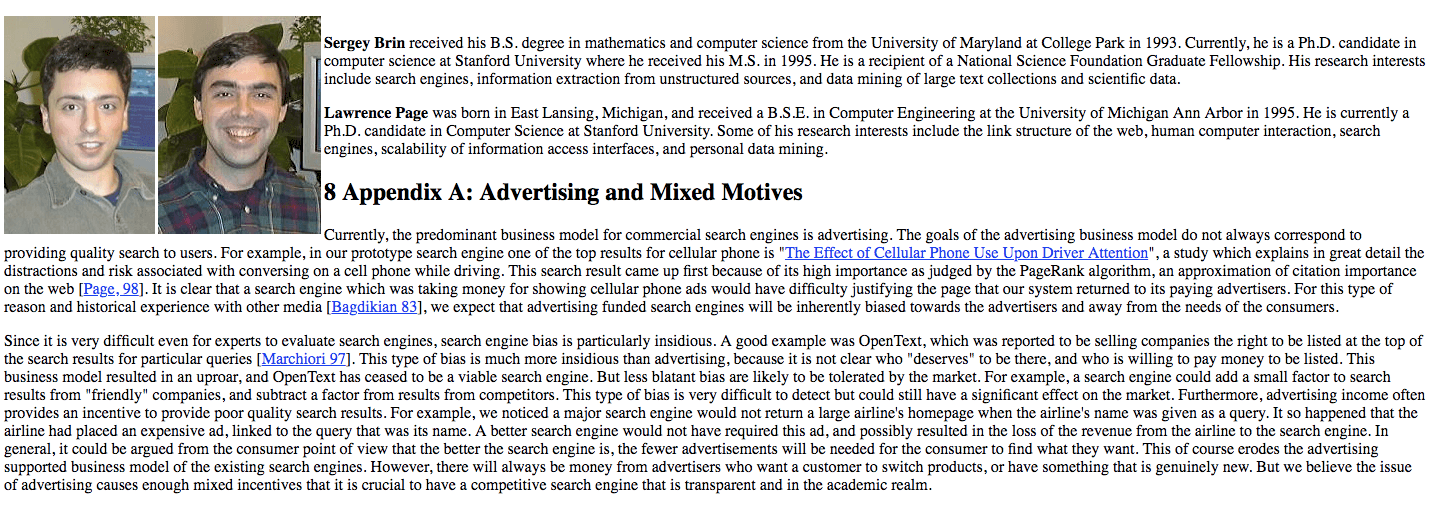
In their 1998 paper The Anatomy of a Large-Scale Hypertextual Web Search Engine, Brin and Page were explicitly skeptical of advertising-funded search. Their concern was legitimate: if advertisers pay the search engine, commercial incentives can conflict with the goal of returning the best possible information. They wrote that advertising-funded search engines could become “biased towards the advertisers and away from the needs of the consumers.”
Think about the irony.
The founders of what would become one of the greatest advertising businesses in history initially wrote an academic paper explaining why advertising was structurally dangerous for search.
They were not stupid.
They were not hypocrites.
And they did not suddenly become evil.
They encountered reality.
Search was expensive to build and operate. Users expected it to be free. The better Google became, the more people used it, and the more infrastructure it required. Somewhere, an economic engine had to finance that system.
At roughly the same time, Bill Gross and GoTo.com, later renamed Overture, were discovering something important: search intent had enormous commercial value. Instead of selling generic display advertising, advertisers could bid for keywords and pay when users actually clicked. GoTo pioneered the auction-driven pay-per-click model in 1998. Google initially took another route when it launched AdWords in 2000, but by 2002 it had moved to cost-per-click auctions as well. The crucial Google twist was to incorporate user response into ad ranking rather than simply allowing the highest bidder to win, helping align commercial value with relevance.
This is the part of the story I find fascinating.
Google did not resolve the conflict between advertising and search by pretending the conflict did not exist.
It redesigned the mechanism.
An irrelevant advertiser willing to pay more could not automatically deserve the best position if users consistently ignored the ad. Bid mattered, but relevance increasingly mattered too. Economics and product quality were made to reinforce each other more than they had in the earlier paid-search systems.
By the time Google went public in 2004, Larry Page could write something that would have looked almost absurd beside the 1998 paper: advertising was now Google’s principal source of revenue, while arguing that its ads could be relevant and useful rather than intrusive.
That business model financed free search and an expanding suite of consumer services at enormous scale.
Not the Internet itself. Users still paid telecom operators and ISPs for access, and publishers still financed the creation of content. But advertising allowed Google to put an extraordinarily expensive information-retrieval system in front of billions of users without charging them each time they searched.
And that economic decision helped shape the Web for the next quarter century.
This is why I become skeptical whenever a new technological paradigm begins with moral certainty about its future business model.
We hear versions of the same claim today around AI and the agentic Web: advertising was the disease of the old Web; subscriptions will create a cleaner one; perhaps micropayments will finally allow information to be priced correctly; perhaps agents will simply pay other agents per call and the whole advertising economy can disappear.
Maybe.
But consumer economics is brutally difficult.
Neeva is a useful warning. It launched with an appealing proposition: a subscription-funded, ad-free alternative to Google. Yet in 2023 its founders concluded there was no sustainable path for its consumer search business, shut the service down, and the company was acquired by Snowflake, where its technology moved into the enterprise data world.
Perplexity offers another, more nuanced example. It built around direct answers and paid subscriptions, but later began experimenting with advertising. Its own explanation was revealing: subscriptions alone did not generate enough revenue to create a scalable publisher revenue-sharing program. As of 2026, the company operates a mixture of free access, consumer subscriptions, enterprise plans, APIs, and other monetization surfaces rather than betting the company on one perfectly pure model.
None of this proves advertising wins again.
That would be exactly the kind of linear historical reasoning I am arguing against.
The agentic Web has fundamentally different economics. An agent does not need to look at a banner. It can call an endpoint directly. A machine can economically make micropayments that would be absurd for a person. Commerce can move from clicks toward transactions. Publishers can potentially meter machine access. Software can charge per call, task, or outcome. Payment protocols can make transactions almost invisible.
But someone still has to finance the system.
The models cost money.
Inference costs money.
Search and crawling cost money.
Publishers need incentives to continue creating information.
Merchants need margins.
Agent surfaces need economic engines.
And billions of consumers have repeatedly demonstrated that their theoretical enthusiasm for paying subscriptions is much greater than the number of subscriptions they actually want to maintain.
So the interesting question is not whether advertising is morally good or bad, nor whether subscriptions, micropayments, transactions, or licensing are intellectually cleaner.
The interesting question is:
What economic architecture can actually finance an agentic Web used by billions of people?
My suspicion is that the answer will be messy.
Advertising may migrate from the page into the answer or recommendation layer. Subscriptions will finance premium usage. Commerce will finance transactional agents. Enterprises will pay for productivity. Micropayments may finance individual calls and high-value information. Publishers will license some assets, expose others, fence others, and build endpoints around the rest.
In other words, the future probably will not emerge from one pristine business model.
It will emerge from the interaction of several.
And this is where history and first-principles thinking should meet.
First principles help us ask which assumptions of the old Web no longer hold.
History reminds us not to assume that the business model we find aesthetically attractive is the one reality will choose.
Google’s founders began with a technically brilliant search engine and a principled argument against the business model that ultimately financed it. Their real achievement was not merely changing their minds. It was discovering a mechanism through which the economics could be redesigned around the product.
The agentic Web is at a similar moment.
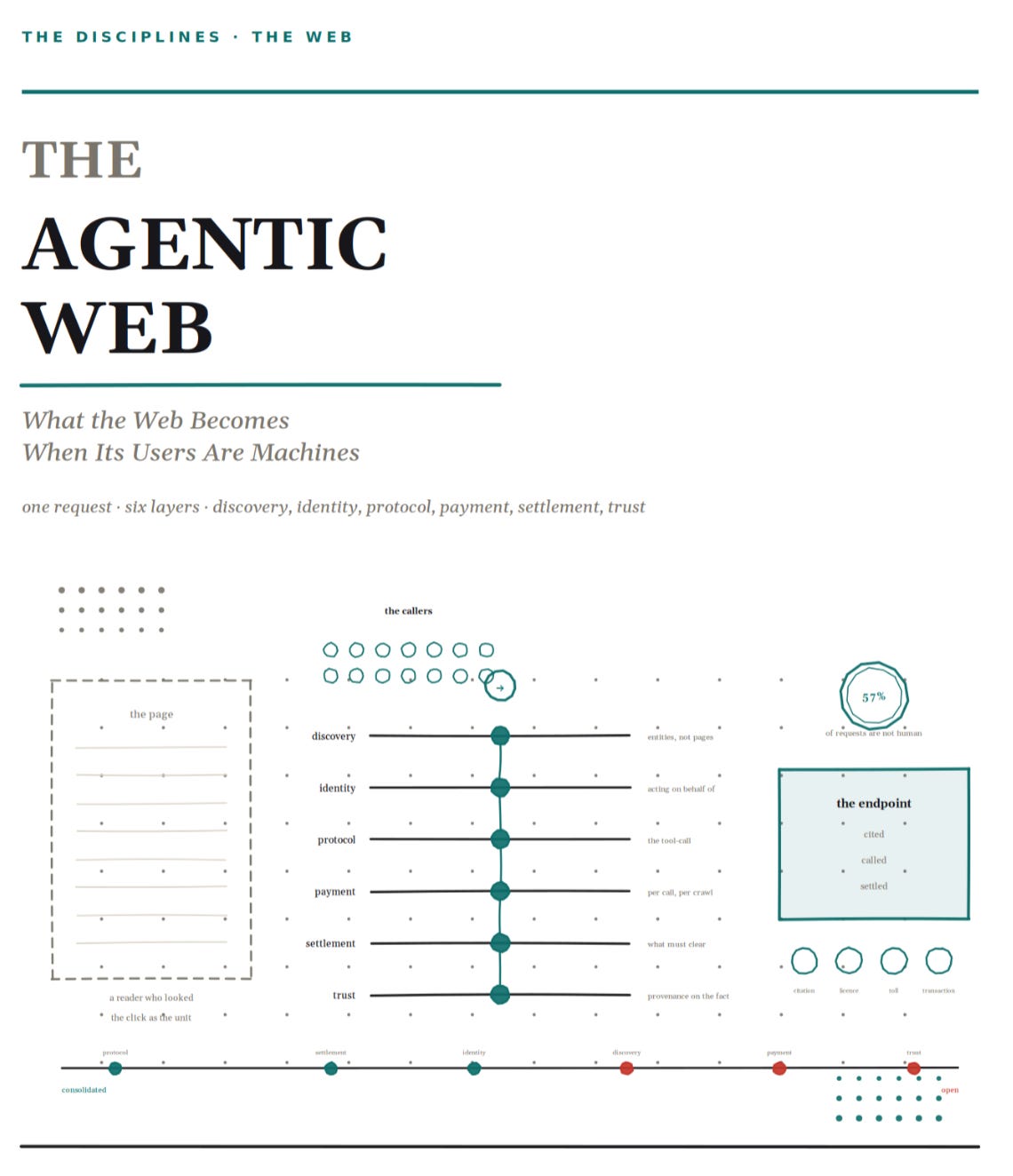
We can already see much of the technical architecture taking shape: the fact replacing the page, the call replacing part of the click, delegated identity, agent protocols, machine payments, settlement rails, provenance.
What we do not yet know is which combination of those layers will finance the system at global scale.
That is the question worth studying.
Not what the ideal Web should look like.
What business model reality will force it to become.
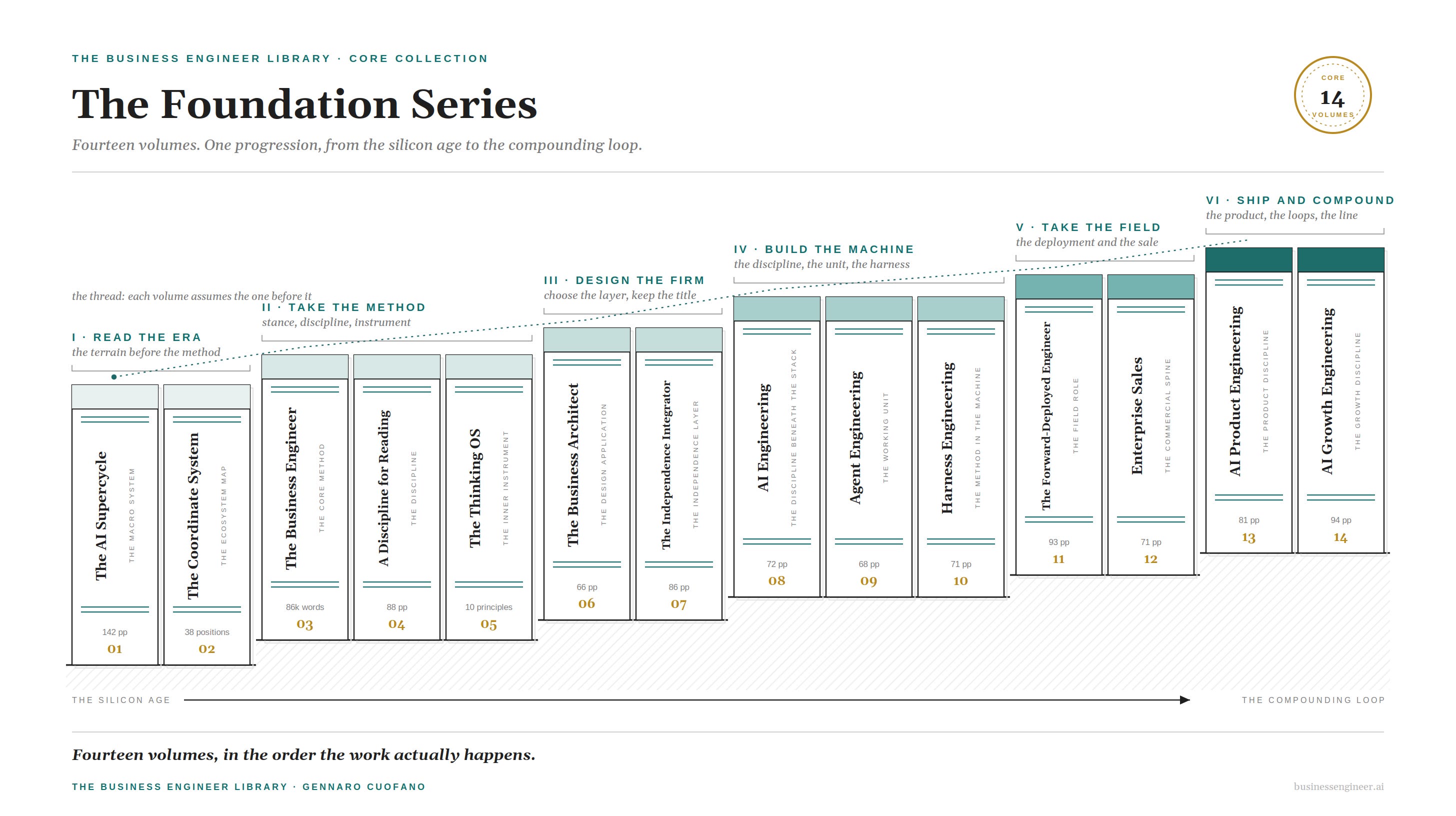
For the last three years, I’ve been rebuilding the Business Engineer’s curriculum from the ground up. That curriculum has now become the foundation of a new discipline, with the entire series taking shape around it.
If you’re already a paid member, simply reply to this email, and we’ll send it your way.