

One of the subjects I loved most during my business studies was corporate finance. I was fortunate to have excellent professors, and one reason I eventually landed at the University of San Diego School of Business in my early 20s was the opportunity to study with Thomas Copeland, one of the scholars whose work helped shape modern thinking on corporate finance and valuation.
I became so fascinated with the discipline that I made it a major emphasis of my MBA. At the time, I had a relatively simple belief: if you could truly master corporate finance, you could build an extraordinary professional advantage. Finance appeared to offer something close to a science of business, a rigorous framework through which almost any company, investment, or strategic decision could ultimately be understood.
Little did I know that corporate finance would teach me almost the opposite lesson.
Finance is extraordinarily powerful precisely because it deals with uncertainty. But that also means it can never be the hard science I once imagined it to be. Its models are abstractions of a world that is nonlinear, reflexive, path-dependent, and filled with variables that cannot be known in advance.
That tension became one of the intellectual foundations behind The Business Engineer.
One reason I started writing about business was to help more people understand a lesson I had first encountered through finance: a model is useful because it helps you think, not because it gives you the truth.
A discounted cash flow is a perfect example. It can be an extraordinarily powerful instrument. But there is no serious DCF without a view on the discount rate, and no serious estimate of the cost of equity without assumptions about things such as the risk-free rate and the equity risk premium. Of course, you can simply use whatever rate has become conventional in the market. But then what exactly are you analysing?
The arithmetic may be precise while the underlying assumptions remain deeply uncertain.
That is not a weakness of corporate finance. It is actually where its greatest usefulness begins.
Corporate finance gave me a toolbox that forced me to connect the micro and the macro: the economics of an individual company with interest rates, capital markets, risk, incentives, competitive dynamics, and expectations about the future. Properly used, those tools expand your thinking. They force you to expose assumptions, test scenarios, and make explicit what would otherwise remain intuition.
The problem begins when the toolbox becomes the worldview.
Too often, financial models are treated not as instruments for thinking but as representations of reality itself. Once that happens, the apparent precision of the model can hide the uncertainty of its assumptions. And some of the largest mistakes in business come from exactly this inversion, both on the upside and the downside: companies that look worthless because a model cannot capture what is compounding beneath the surface, and companies that look extraordinarily valuable because a spreadsheet extrapolates temporary economics indefinitely into the future.
I say this as someone who genuinely idolised finance.
As a teenager, one of my intellectual heroes was Federal Reserve Chairman Alan Greenspan. Years later, as the 2008 financial crisis propagated through the global economy and into the 2010s, I followed Ben Bernanke’s explanations of the crisis and monetary system with enormous attention, including his 2012 lectures on the Federal Reserve and the financial crisis.
I was fascinated by the idea that sufficiently sophisticated financial and economic models might allow us to understand an extraordinarily complex system.
Over time, however, finance itself taught me the limits of that belief.
The deeper lesson of the financial crisis, and of many of the business cycles that followed, was not that models were useless. It was that a discipline becomes dangerous when it develops the presumption that its models can explain the whole world.
Finance is not the worldview.
It is one tool inside a much larger toolbox.
That toolbox also needs technology, strategy, economics, history, psychology, organisational behaviour, geopolitics, systems thinking, and the accumulated judgment that comes from watching real businesses behave in ways no spreadsheet predicted.
The goal is not to abandon models. It is to combine them into a stronger first-principles approach: use models to decompose reality, expose assumptions, identify mechanisms, and understand what would need to be true for a thesis to hold, without ever confusing the model with reality itself.
Finance was my first intellectual love in business, and for that reason I will probably never stop loving it.
But I can no longer reconcile myself with the limitations it creates when used carelessly, particularly when tools designed for one economic regime are carried unquestioningly into another.
This book in the Business Engineer Foundation Series is dedicated to that problem.
To taking the extraordinary toolbox corporate finance gave us, understanding where it still works, identifying where its assumptions have broken, and rebuilding it for a world in which the assets, economics, capital structures, and companies themselves are changing faster than the models traditionally used to value them.
The purpose of finance should not be to shrink reality until it fits the model. It should be to give us better tools for thinking about a reality that will always remain larger than the model.

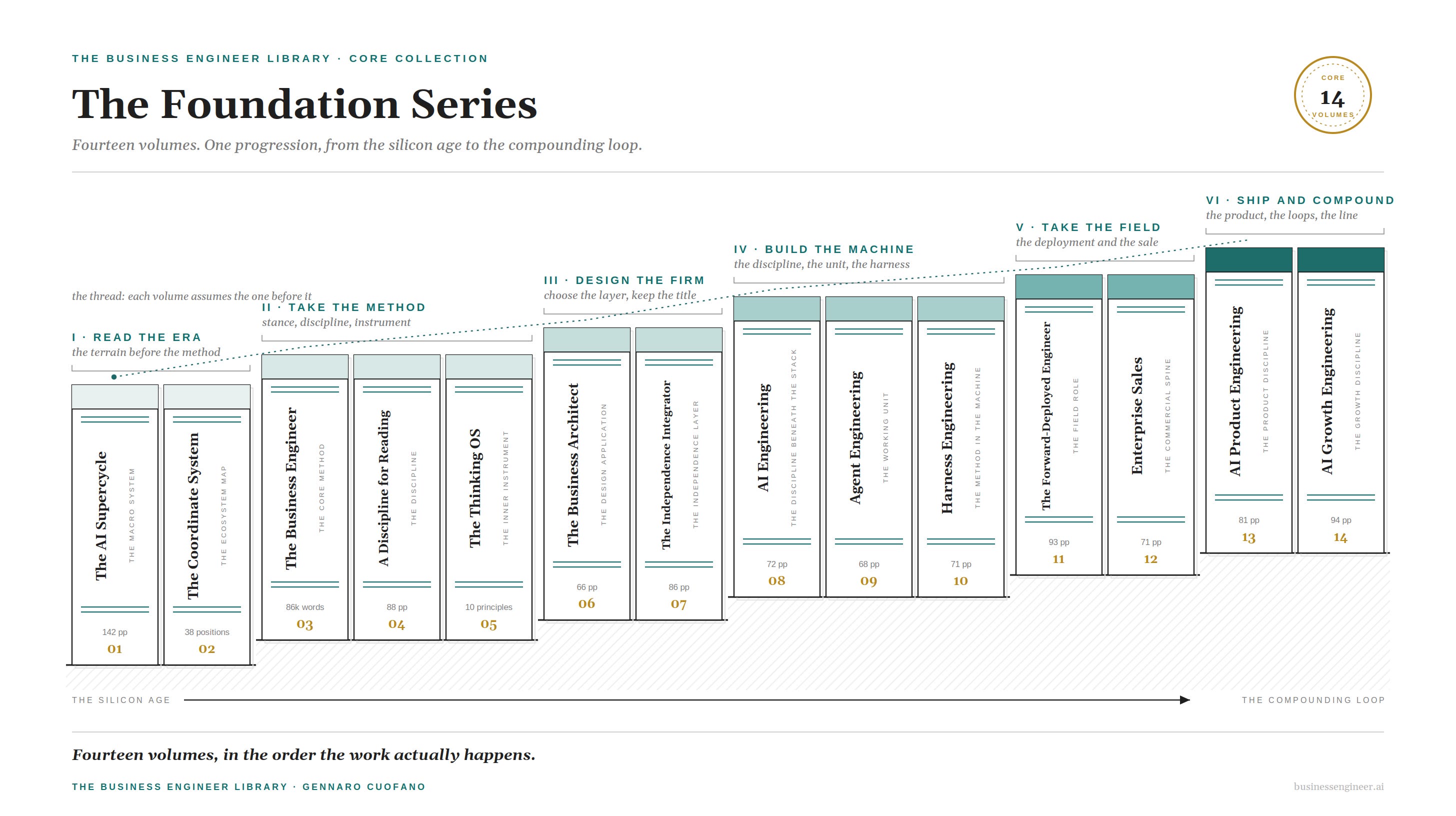
For the last three years, I’ve been rebuilding the Business Engineer’s curriculum from the ground up. That curriculum has now become the foundation of a new discipline, with the entire series taking shape around it.
If you’re already a paid member, simply reply to this email, and we’ll send it your way.