

Every major technology platform transition in history has followed the same structural pattern. A new capability emerges. Companies rush to build at the most visible layer — the user-facing application — because that is where attention flows and where early revenue is easiest to see. But over time, value doesn’t stay at the top. It migrates down. The companies that win are rarely the ones that built the best application. They are the ones who owned the layer beneath it.
We saw it in the PC era. WordPerfect and Lotus built great applications. Microsoft built the operating system underneath them. Thirty years later, every application developer was paying Microsoft’s tax.
We saw it in the web era. Yahoo and AOL built the best portals. Google built the distribution layer — search — beneath them. Every web business that came after paid Google for traffic. Mobile was the same: tens of thousands of app developers competed ferociously on thin margins while Apple and Google took 30% of every transaction from the platform layer below.
Cloud repeated the pattern: SaaS companies built brilliant products on infrastructure they didn’t own, and AWS extracted its margin quietly from every one of them.
The AI era is running the same script. Only faster. And with more layers simultaneously contested.
Understanding why requires three structural laws that appear across every platform transition — and then applying them to where AI actually stands in 2026.
The Three Laws That Govern Every Layer War
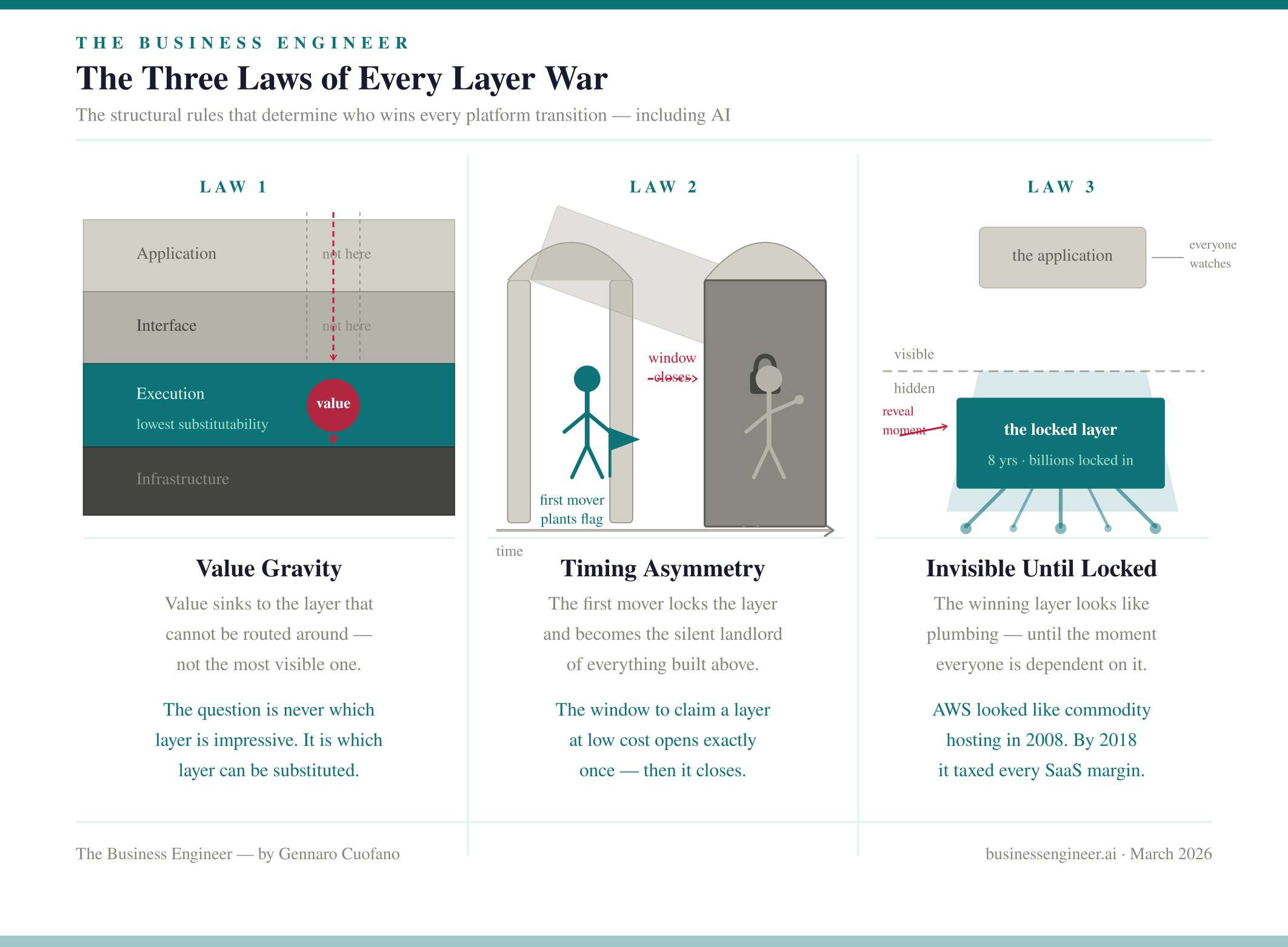
Law 1: Value Gravity. Value always migrates toward the layer with the lowest substitutability — not the most visible one. Applications are visible. Platforms are less visible. Infrastructure is nearly invisible. And yet infrastructure consistently captures the highest long-run margins, because it cannot be replaced without rebuilding everything above it. The key question in any platform era is never “which layer is most impressive?” It is “which layer cannot be routed around?”
Law 2: Timing Asymmetry. The first layer establishes the rules for all layers above. Once Microsoft owned the OS layer, every application had to comply with Windows APIs. Once Google owned search distribution, every web business had to optimize for PageRank. Once AWS owned cloud infrastructure, every SaaS company’s cost structure was partly determined by AWS pricing decisions. The first mover to lock a layer becomes the silent landlord of everything built on top of it. Second movers pay rent. The window to claim a layer at low cost is open exactly once — before it becomes the binding constraint.
Law 3: Invisible Until Locked. The winning layer always looks like plumbing from the outside, right up until everyone realizes they are completely dependent on it. AWS looked like commodity hosting in 2008. By 2018, it was the most profitable division in enterprise technology, and every startup’s pitch deck included “infrastructure costs” as a line item that went straight to Amazon. The pattern repeats because attention naturally flows upward — to the application, to the interface, to the model — while the foundational layer is quietly consolidated beneath notice.
These three laws have a direct structural implication for AI: the battle that matters most right now is not being fought at the model layer. It is being fought at the layer below it.
The Executive Plan now includes the Claude OS Skill embedded!