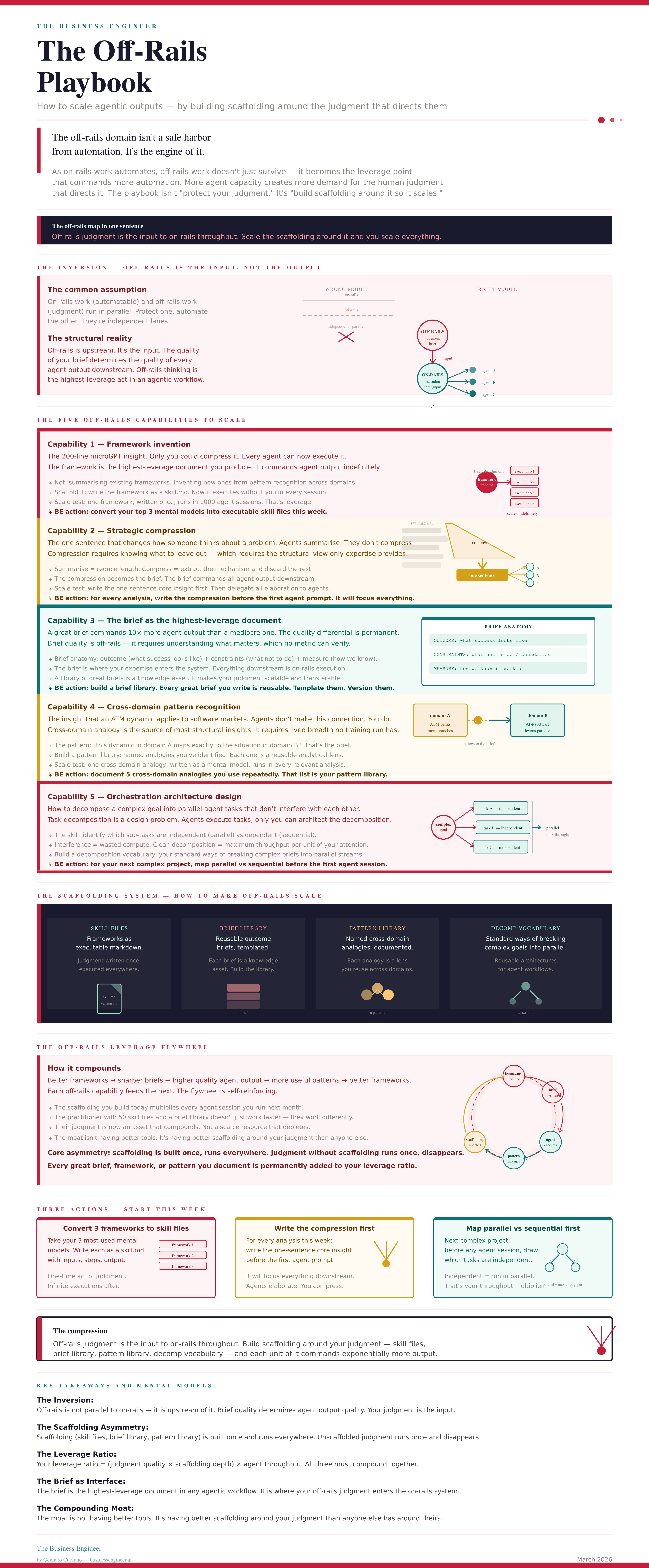

There is a fundamental distinction that determines whether a human is automated by AI or augmented through it—and it connects directly to the five off-rail capabilities.
This distinction is not about the model itself, but about how agency is distributed between human and system. When AI operates within tight, predefined boundaries, it tends to automate tasks by replacing human input. But when it can operate off-rail—accessing tools, memory, and execution layers—it shifts toward augmentation, extending human capability rather than removing it.
In Karpathy’s Map, we’ve seen the new playbook of the AI Engineer and how it translates to the business engineer.
Karpathy's Map: The New Playbook for the AI Engineer

This piece is inspired by a recent conversation that Andrej Karpathy had with Sarah Guo on No Priors, Code Agents, AutoResearch, and the Loopy Era of AI.
Most practitioners who understand the on-rails/off-rails distinction treat the off-rails side as a list of things to protect rather than a system to build. The result: judgment exercised in a session that ends, insight produced that doesn’t compound, expertise that depletes rather than accumulates.
The difference between a practitioner who compounds and one who doesn’t isn’t the quality of their judgment in any given moment. It’s whether that judgment gets scaffolded — made executable, reusable, and improvable — or whether it evaporates when the session closes.
This piece goes deep into each of the five capabilities: what they actually are, how they differ from what agents can do, and, critically, what the scaffolding infrastructure looks like for each.