

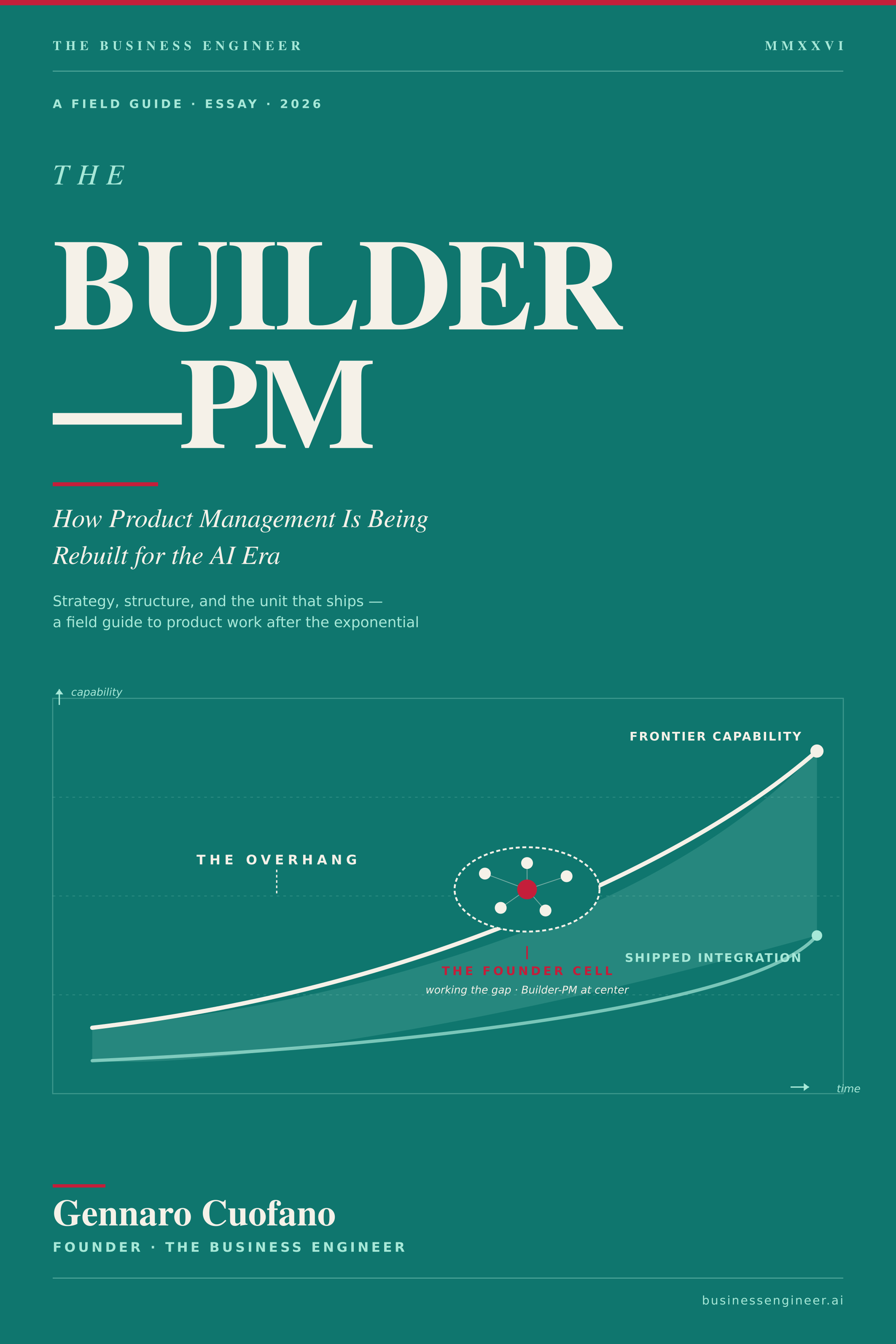
This book consolidates and extends three editorial pieces published on businessengineer.ai in early 2026 — the Anthropic Labs founder-cell analysis, The Product Overhang Doctrine, and The Anatomy of a Founder Cell. The trilogy is reframed here around the role at the center of the AI-era product organization: the Builder-PM.
Two new chapters anchor the structure. Part IV anatomizes the role in operating detail. Part V is the transition — written for individual PMs, PM leaders at incumbents, and founders hiring into AI-native cells. An appendix compiles the named mental models from the full work into a single field guide.
How to read this book
The book is built to be read straight through, but each part stands alone.
Individual PMs may want to start with Part IV (the role) and Part V (what to do Monday).
PM leaders at incumbents will find Part III (the operating environment) and Part V the most actionable.
Founders should read in order — the strategic frame in Part II will be the most expensive to skip.
PROLOGUE
The Discipline That Just Got Rewritten
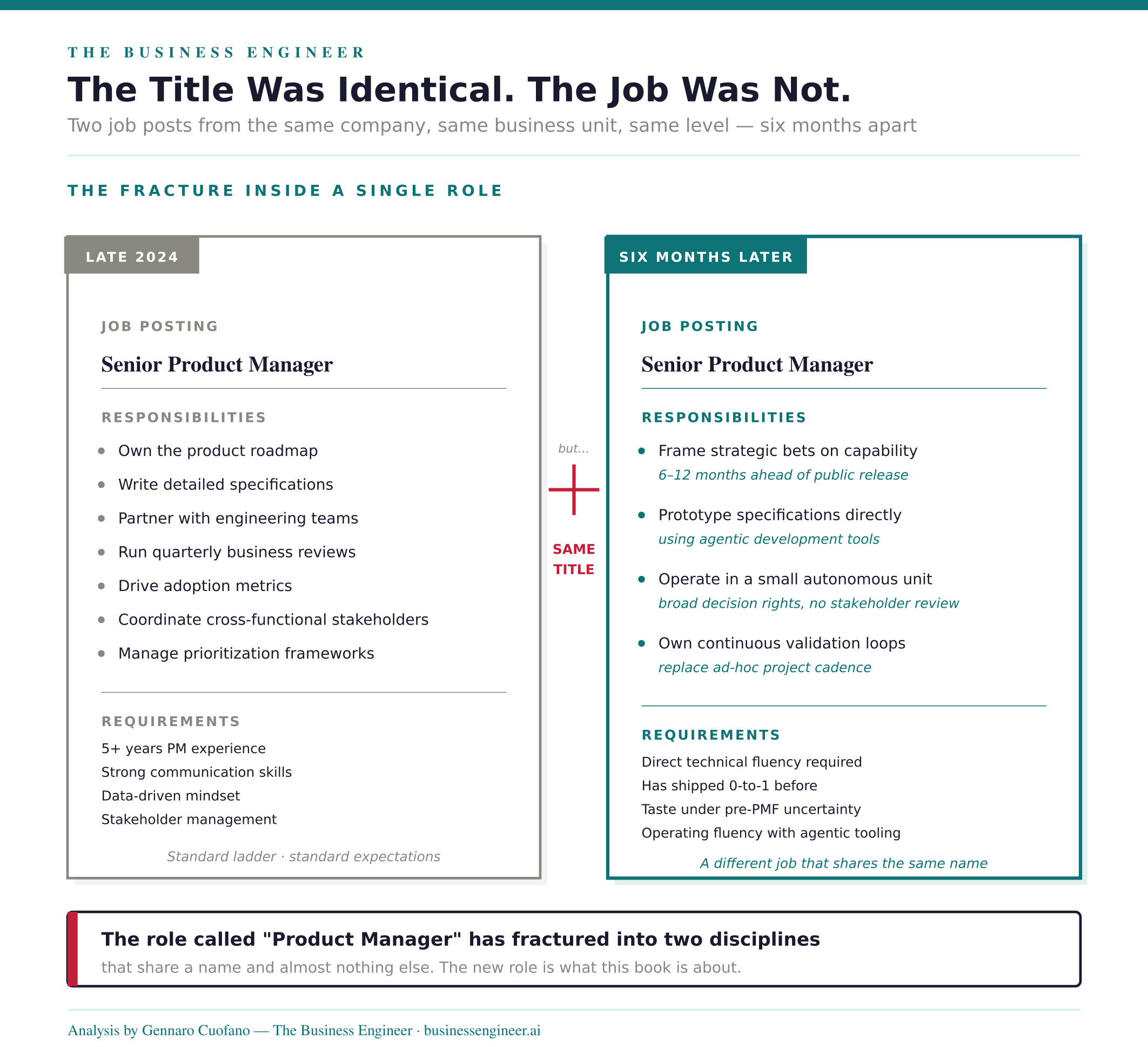
In late 2024, a tech company posted a Senior Product Manager job. The description was standard: own roadmap, write specs, partner with engineering, run quarterly business reviews, drive adoption metrics. Standard ladder, standard expectations, standard interview loop.
Six months later, the same company — same business unit, same level — posted a role with the same title. The description had changed almost beyond recognition. Frames strategic bets on capability that is six to twelve months ahead of public release. Prototypes specifications directly using agentic development tools. Operates inside a small, autonomous unit with broad decision rights. Direct technical fluency required.
The title was identical. The job was not.
This is not a story about one company. The pattern is now visible across every AI-native employer and a growing share of incumbents — the role called “Product Manager” has fractured into two distinct disciplines that share a name and almost nothing else.
One is the role product management has been for the past fifteen years — scoped around discovery, delivery, stakeholder coordination, and the translation function between engineering and the rest of the company. The other is something new. It writes specifications by running them. It operates inside a unit with no roadmap document, no stakeholder review, no quarterly KPI envelope. It ships product against capability that does not yet exist in any public model. It reports outside the conventional product org because the conventional product org would kill it within a quarter.
The new role is what this book is about.
Three eras of product management
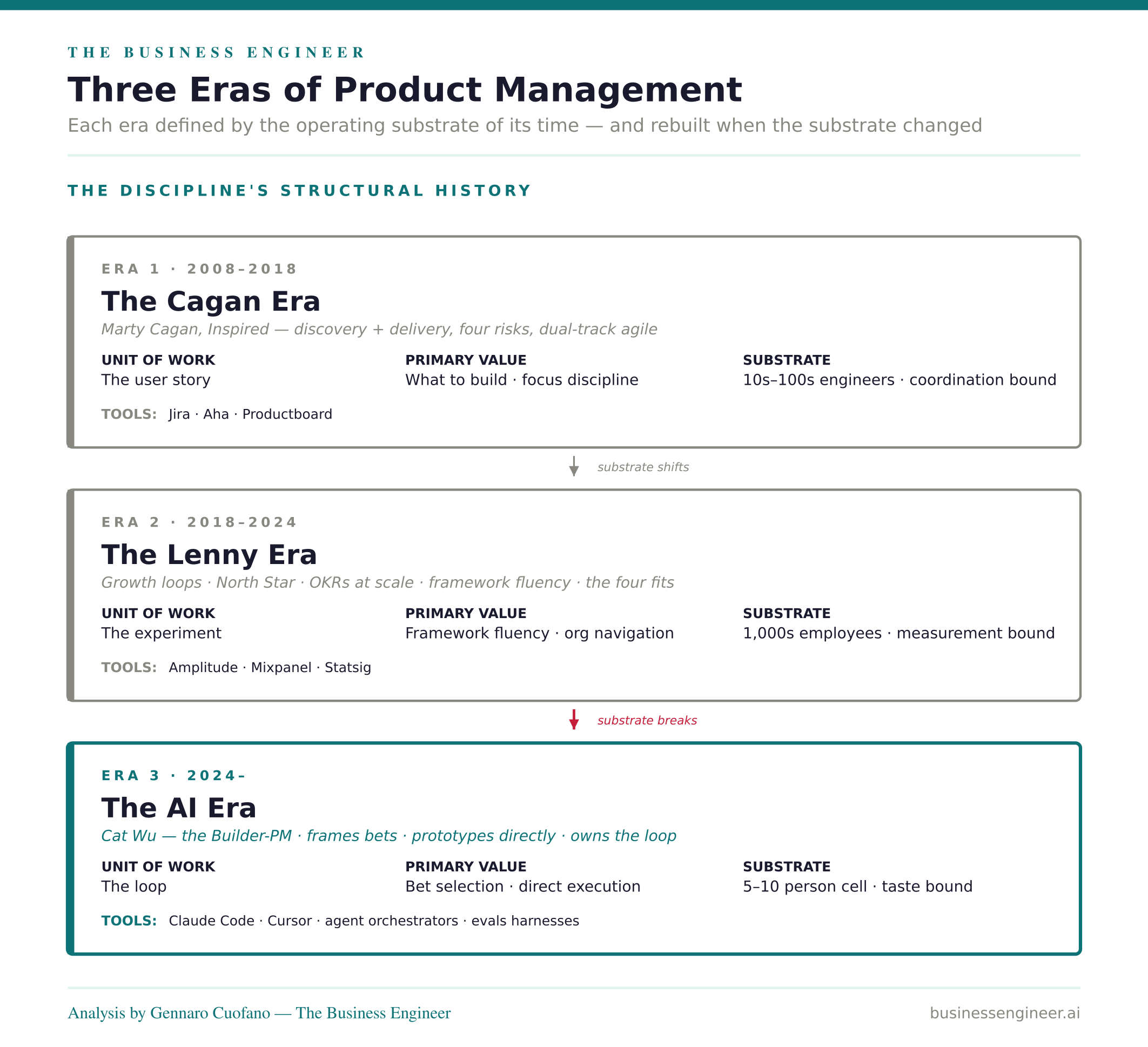
The cleanest way to see the change is through a historical lens. Product management, as a recognized discipline, has gone through two prior eras, each defined by the operating substrate of its time. The AI era is the third, and it is restructuring the substrate underneath the role.
The Cagan era — roughly 2008 to 2018. Marty Cagan’s Inspired codified the modern PM role as a four-risk function: value, usability, feasibility, viability. Dual-track agile separated discovery from delivery. The job was to find the right thing to build through structured customer research, validate it with prototypes, and partner with engineering to ship it.
Unit of work: the user story.
Primary value: judgment about what to build and the discipline to keep the team focused on it.
Tools: Jira, Aha, Productboard.
Substrate: a product organization growing from tens to hundreds of engineers, where coordination was the binding constraint.
The Lenny era — roughly 2018 to 2024. Lenny Rachitsky’s newsletter became the canonical reference, alongside an explosion of frameworks: growth loops, North Star metrics, retention curves, the four fits, jobs-to-be-done refinements, OKRs at scale. The job was to drive measurable outcomes — typically activation, retention, monetization — through a combination of strategic prioritization, growth experimentation, and operational coordination across function-specialized teams.
Unit of work: the experiment.
Primary value: framework fluency and the ability to operate inside an increasingly specialized org.
Tools: Amplitude, Mixpanel, Statsig.
Substrate: the consumer-software and SaaS organization, scaling toward thousands of employees, where measurement and alignment were the binding constraints.
The AI era — 2024 onward. Cat Wu’s March 2026 essay for Anthropic, Product management on the AI exponential, named the shift in operating terms that the role had begun absorbing. The Builder-PM frames strategic bets on capability ahead of release, prototypes specs directly with agentic tools, and owns continuous validation loops that replace ad-hoc project cadence.
Unit of work: the loop.
Primary value: bet selection and direct execution capacity — the ability to spec, build, and validate without the handoffs and translation layers that defined the prior eras.
Tools: Claude Code, Cursor, agent orchestrators, evals harnesses.
Substrate: the founder cell — a five-to-ten-person autonomous unit reporting outside the scaled product org.
Binding constraint: no longer coordination or measurement. It is taste: choosing what to bet on, given that the constraint of building is collapsing.
The substrate, not the title
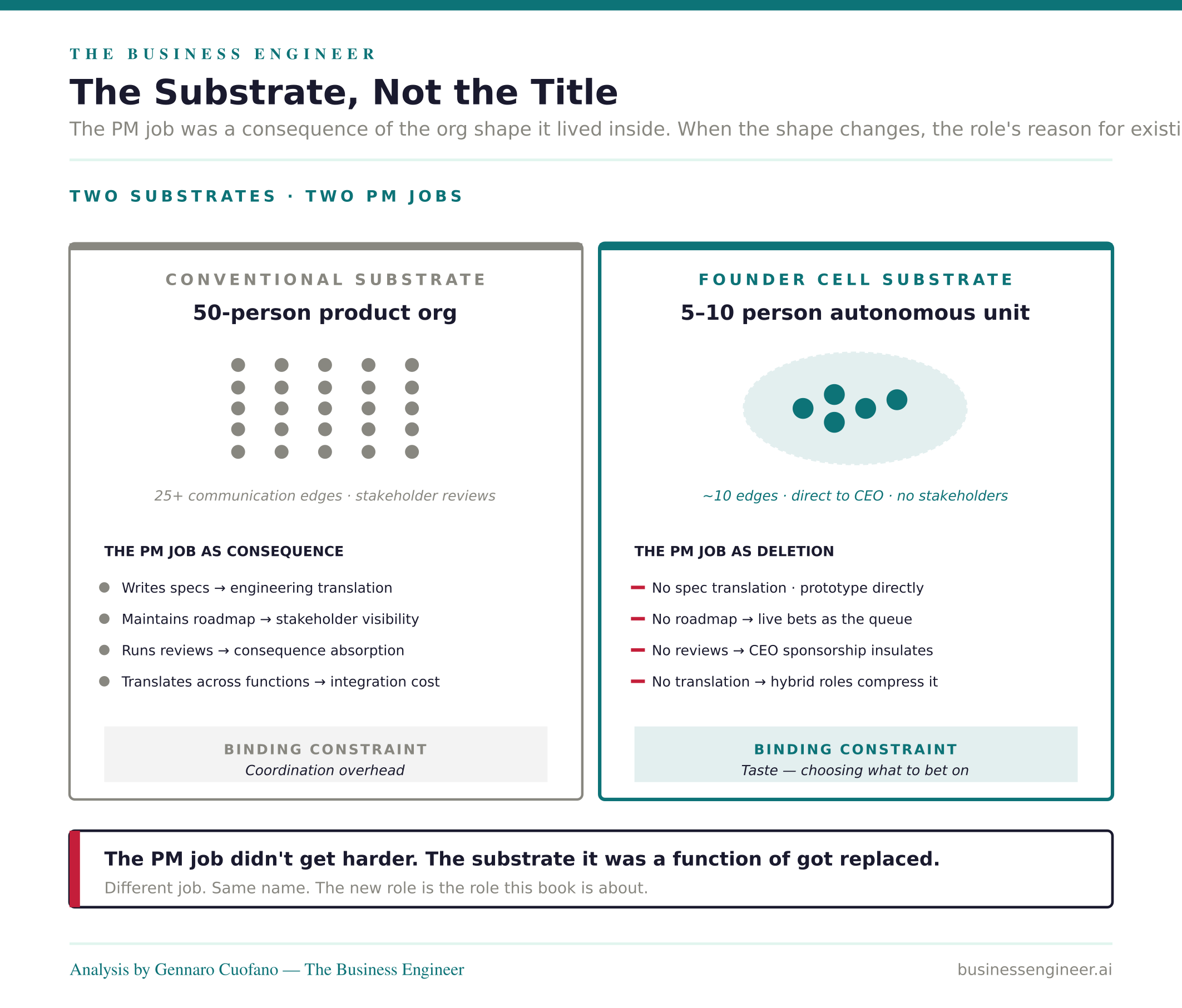
The temptation, when looking at the new role, is to assume what has changed is the seniority bar — that the Builder-PM is just a higher-skilled PM, the same job done better. This reading is comfortable and almost entirely wrong. What has changed is not the bar. The substrate the role sits on has changed.
The conventional PM existed because a software organization above a certain size produced a coordination problem that needed a dedicated function to absorb.
Specs had to be written because engineers and designers spoke different languages and operated on different cycles.
Roadmaps had to be maintained because stakeholders across the company needed visibility into a shared queue.
Stakeholder reviews had to be run because the consequences of building the wrong thing — at the scale of a 50-person product org — were too expensive to absorb informally.
The PM job was a consequence of the org shape it lived inside. When that org shape changes, the role’s reason for existing changes with it.
The founder cell described later in this book has different structural properties than the scaled product org:
Five to ten people instead of fifty.
Direct reporting to the CEO or President, instead of through a five-layer hierarchy.
Broad unilateral decision rights, instead of a stakeholder-driven roadmap process.
Communication overhead of roughly one-tenth that of a comparably-staffed conventional unit.
Inside that envelope, the conventional PM job has nothing to do. There is no stakeholder layer to translate to. There is no roadmap document to maintain because the roadmap is the live set of bets the unit is running. There is no spec to write upstream of engineering because the engineering capacity is built into the role and the spec is a working prototype by end of day.
What replaces the conventional PM job is not a more senior or more technical version of it. It is a different job that happens to share the same name.
Who this book is for
Three readers will get the most out of it.
The individual PM — particularly the experienced one with five to fifteen years in the conventional discipline — who can sense the discipline shifting underneath them and wants a clear-eyed account of what’s happening and what to do about it. The book is not an optimistic pep talk. It is also not a doom narrative. It is a structural account of a role being rebuilt, with practical implications for what to learn, what to unlearn, and what career bets to make.
The PM leader at an incumbent company — VP of Product, CPO, Head of Product — who is responsible for an organization that is increasingly the wrong shape for the work that is now possible to do. The book is honest about the difficulty of carving founder cells inside scaled product orgs without triggering organizational immune responses, and it offers specific structural moves that have been demonstrated to work.
The founder or CEO — particularly at AI-native startups, but also at incumbents pursuing AI-native bets — who is making decisions about hiring, organizational design, and strategic frame at a moment when conventional product organization advice will produce predictable underperformance. The book is the operating manual for a unit shape that did not exist as a standard pattern five years ago and now defines the product velocity of the companies that are pulling ahead.
The argument in one paragraph
Product management is being rebuilt by a structural change in the AI capability curve. The gap between what frontier models can do and what is shipped into products has widened into a sustained product overhang, which rewards a different strategic posture (building for capability that does not yet exist) and selects for a different operating environment (the founder cell — small, dense, reporting outside the scaled product org) and a different role inside it (the Builder-PM — direct execution, agentic tools, bet selection, loop ownership).
Part II addresses the strategic frame. Part III addresses the operating environment. Part IV addresses the role itself. Part V addresses the transition, for individuals and organizations both. The appendix compiles the named mental models into a reference field guide.
The discipline is not dying. It is being rewritten. The remainder of this book is the rewrite.
Join Yearly Premium Membership To Get The Builder-PM
Or