

Over the last few years, I’ve spent hundreds of hours consolidating my work across a few foundational disciplines that have become part of The Business Engineer’s core curriculum.
Now that AI has dramatically accelerated this process, I felt it was time to launch the Foundation Series.
The Business Architect is another book in that series.
Before a company can be managed, optimized, or analyzed, somebody has to make a more fundamental set of decisions. Where in an industry should we sit? What should customers actually pay us for? Which assets deserve to be owned? Which dependencies are safe to rent? What economics should the business produce when it reaches maturity? And, perhaps most importantly, what part of the design should still make sense when the environment around it changes?
Those are not operating questions. They are design questions. Analysis explains the system that exists. Operations make that system run. Architecture decides what system should exist in the first place.
That distinction matters because architecture is not free-form strategy. It has constraints, materials, structural loads, failure modes, and trade-offs. And the materials available to the business architect are now changing unusually fast.
This book is an attempt to build a discipline around that problem. The trilogy can therefore be stated simply: the engineer reads the system, the orchestrator runs it, the architect designs it.

If you’re already a paid member, simply reply to this email, and we’ll send it your way.
The design problem — building on ground that moves
Every company is built around assumptions about its environment. Some are obvious: the cost of capital, the availability of technology, the strength of a distribution channel. Others are buried more deeply inside the business model: how expensive it is to serve another customer, which supplier has bargaining power, where scarcity sits in the value chain, how long an asset remains differentiated.
For long periods, those assumptions can look like facts. Then the environment moves.
The AI buildout has made this unusually visible. Its limiting factor has already migrated several times: advanced packaging, high-bandwidth memory, lithography, electrical power, financing. Each shift changes who captures the economics of the cycle. A layer that looked structurally advantaged can become ordinary once capacity catches up. Another layer can suddenly acquire pricing power because everything else is waiting on it.
Nothing about this mechanism is unique to AI. Railroads repeatedly moved the bottleneck between iron, land, financing, construction, and traffic. Electrification moved it from generation to transmission to distribution and eventually to demand. Industrial systems have always developed through sequences of constraints.
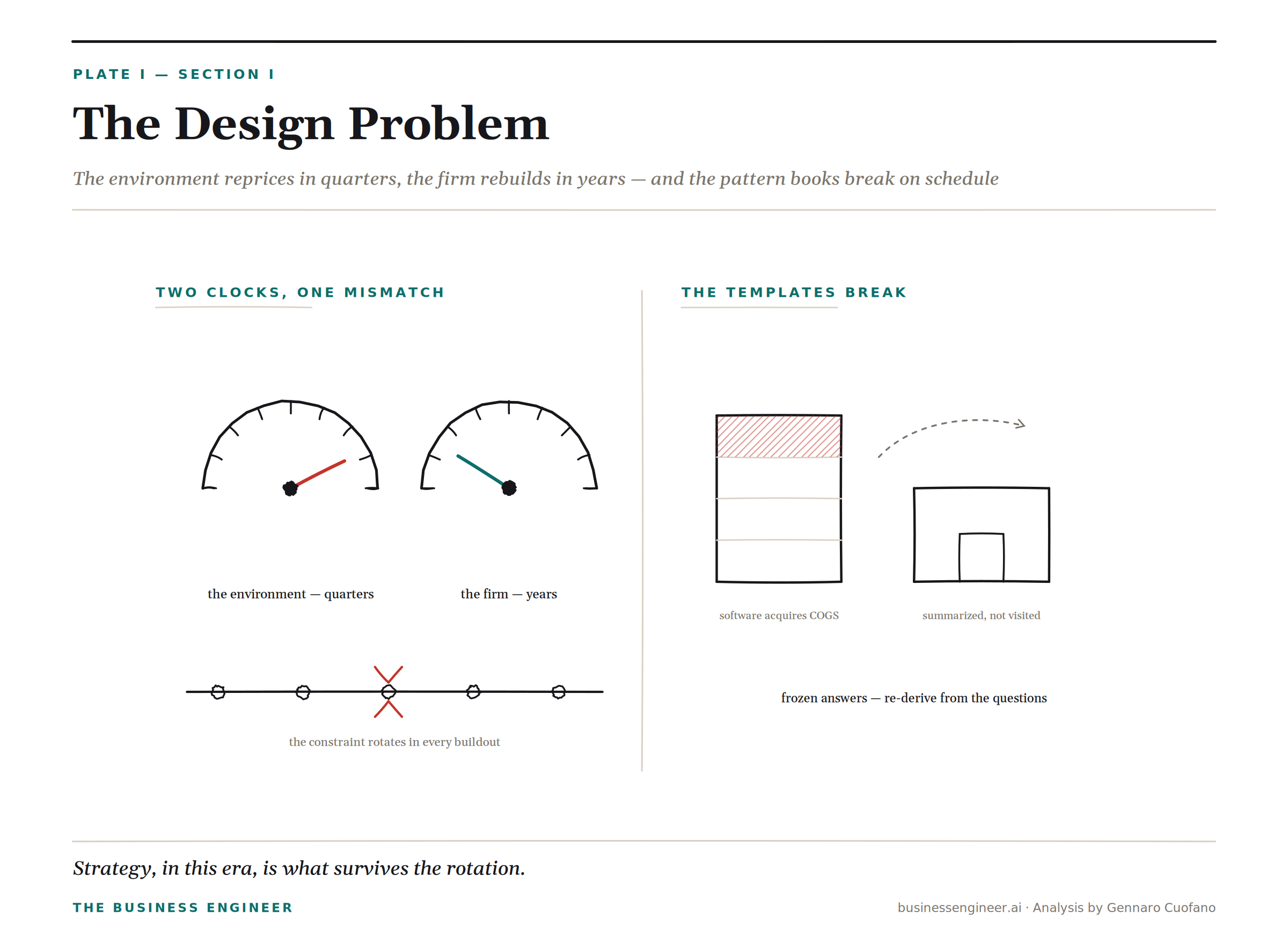
What has changed is the clock speed. A constraint can now rotate in quarters while the company exposed to it may need years to change its factories, contracts, organizational capabilities, channels, or capital structure. That creates the architect’s central problem: the environment can reprice faster than the firm can redesign itself.
The obvious response is to predict the next bottleneck. It is also usually the wrong one. Architecture should not depend on repeatedly guessing which constraint comes next. It should be built around the deeper structure of the system: where constraints are likely to travel, which functions remain necessary across different states, where flows repeatedly reconverge, and which parts of the stack can be substituted when their economics deteriorate.
In practical terms, this means owning what multiple future states require and renting what future states may commoditize. It also means distrusting inherited templates.
Business playbooks work until the assumptions that produced them disappear. The conglomerate was rational under one capital-market structure. Vertically integrated computing was rational under another technological structure. Packaged software reflected the economics of another distribution model.
SaaS became the dominant software architecture because one economic fact overwhelmed almost everything else: once the product had been built, serving another customer cost almost nothing. That assumption shaped the entire system. High gross margins justified aggressive acquisition spending. Revenue growth created extraordinary operating leverage. Infrastructure costs became negligible relative to software value. Scale was therefore overwhelmingly beneficial.
Generative AI changes that equation. Inference has a real variable cost. The more intensely a customer uses an AI product, the more expensive that customer may become to serve. Product adoption and gross margin can therefore move in opposite directions.
This does not make AI software unattractive. It makes its architecture different. A company being designed now needs answers that the classic SaaS playbook never required. What does the mature cost of intelligence look like? Who controls it? Does falling model cost accrue to the supplier, to the customer, or to us? Can usage grow without destroying the unit economics? Which parts of the stack become more valuable as intelligence becomes cheaper?
These are architectural questions because they cannot be fixed with better quarterly execution. They have to be designed into the company.
The four choices — VTDF, run forward
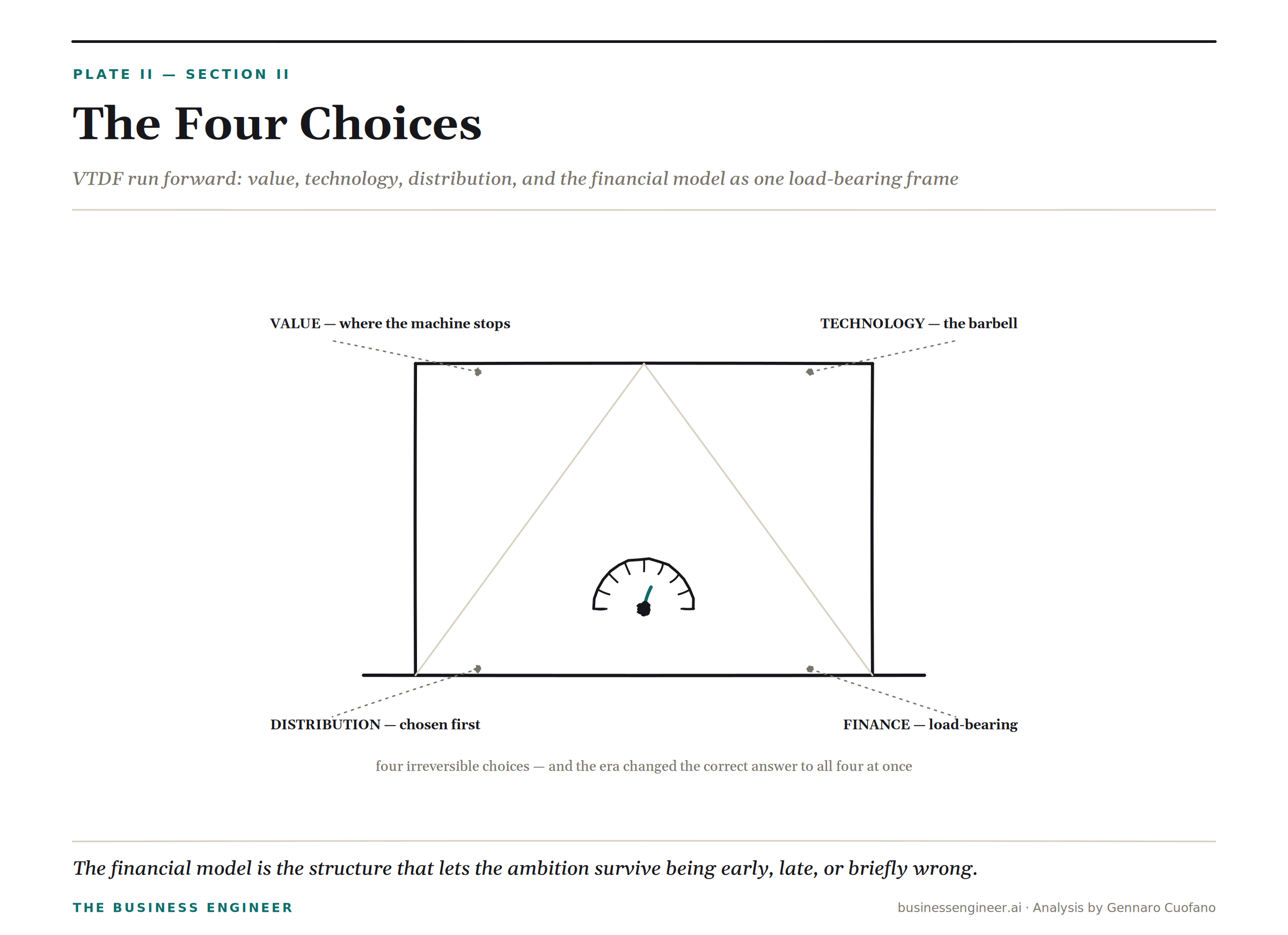
At the highest level, a business can be reduced to four interdependent choices: Value. Technology. Distribution. Finance.
What are we creating? What system produces it? How does it reach the market? What financial structure makes the other three sustainable? The sequence matters because changing one often changes the others.
Value. The first useful question in an AI economy is not what can now be produced. It is what can no longer be charged for.
Anything that becomes abundant tends to migrate downward in the value chain. Drafting, summarization, basic analysis, generic code generation, and routine answers are becoming dramatically cheaper. A product whose value consists entirely of producing one of those outputs is standing on a shrinking piece of economic ground.
So begin with subtraction. Remove what increasingly capable models can generate on demand. Then inspect what remains. Usually, the durable value sits closer to consequences than to outputs.
A transaction that must settle. A result someone is accountable for. A proprietary context that has to be governed correctly. A decision that carries liability. Access to scarce infrastructure. A trusted counterparty. A brand someone deliberately chooses even when alternatives are technically adequate.
AI cheapens capability much faster than it cheapens commitment. That distinction should shape the value architecture.
Technology. For years, companies asked whether they should build or buy. The better question now is what must remain under your control and what should remain deliberately replaceable.
Models are improving too quickly to treat today’s winner as permanent infrastructure. The default position should therefore be to rent commodity intelligence behind interfaces clean enough that suppliers can be changed. But portability is not an excuse to own nothing.
If a technological component determines the company’s differentiation, accumulated learning, customer context, or long-term cost structure, outsourcing it can mean outsourcing the economics of the company itself. The architecture is therefore asymmetric: rent where competition among suppliers works in your favor; own where control compounds.
And when the price of intelligence falls, do not treat the entire decline as a margin opportunity. Part of it should be reinvested into capability. If an operation becomes ten times cheaper, the more interesting question may be what becomes possible when you can perform it ten times.
Distribution. Distribution is often treated as a go-to-market decision that comes after the product. Architecturally, it comes before it.
A business built around an owned endpoint is a different company from one built around a marketplace, an API, a payment rail, a cloud platform, or an agent interface. The channel determines what data you receive, what margins you retain, how customers perceive you, what bargaining power you accumulate, and how easily someone else can stand between you and demand.
There are three broad positions. The first is an owned endpoint: the application, brand, interface, or destination the customer deliberately seeks. The second is a rail: infrastructure that activity must pass through whether or not the end user thinks about it. Payments, identity, settlement, deployment, and other coordination layers can acquire this character. The third is a rented door: somebody else controls the route to the customer.
Rented distribution is not inherently bad. It can be the fastest and cheapest way to acquire reach. The danger is confusing access with ownership. If another company controls discovery, ranking, access rules, pricing, and the interface with your customer, your distribution is not an asset. It is a dependency.
And AI adds another complication: businesses are increasingly distributing information not only to humans but also to machines acting for humans. APIs, structured data, identity, provenance, protocols, and machine-readable product information are becoming part of distribution architecture. Being understandable to software may become as basic to commerce as being indexable became to the web.
Finance. Finance is where the architecture reveals whether it can carry its own weight. The relevant question is not simply whether the company can generate accounting profit. It is whether its capital structure, margin structure, and cash profile match the position it is trying to occupy.
Start with the mature margin. Not next quarter’s gross margin. Not the temporary economics created by subsidies, scarcity, or aggressive pricing. What should this business earn once the market has normalized?
That terminal margin is one of the clearest expressions of the company’s actual strategic position.
Then decide how much capital the position deserves. AI has produced businesses inside the same broad technological cycle with radically different capital requirements. Some coordinate enormous flows while owning little physical infrastructure. Others require tens of billions of dollars simply to remain competitive.
Neither model is inherently superior. But the capital intensity has to be justified by the durability of what it buys.
Finally, build enough financial resilience to survive being temporarily wrong. In a fast-moving environment, almost every company will eventually mistime a constraint, overestimate demand, underestimate a transition, or invest before the market is ready. The balance sheet determines whether that mistake becomes information or extinction.
The positions — the map as a site plan
Once the four choices are clear, the next question is where the company actually sits.
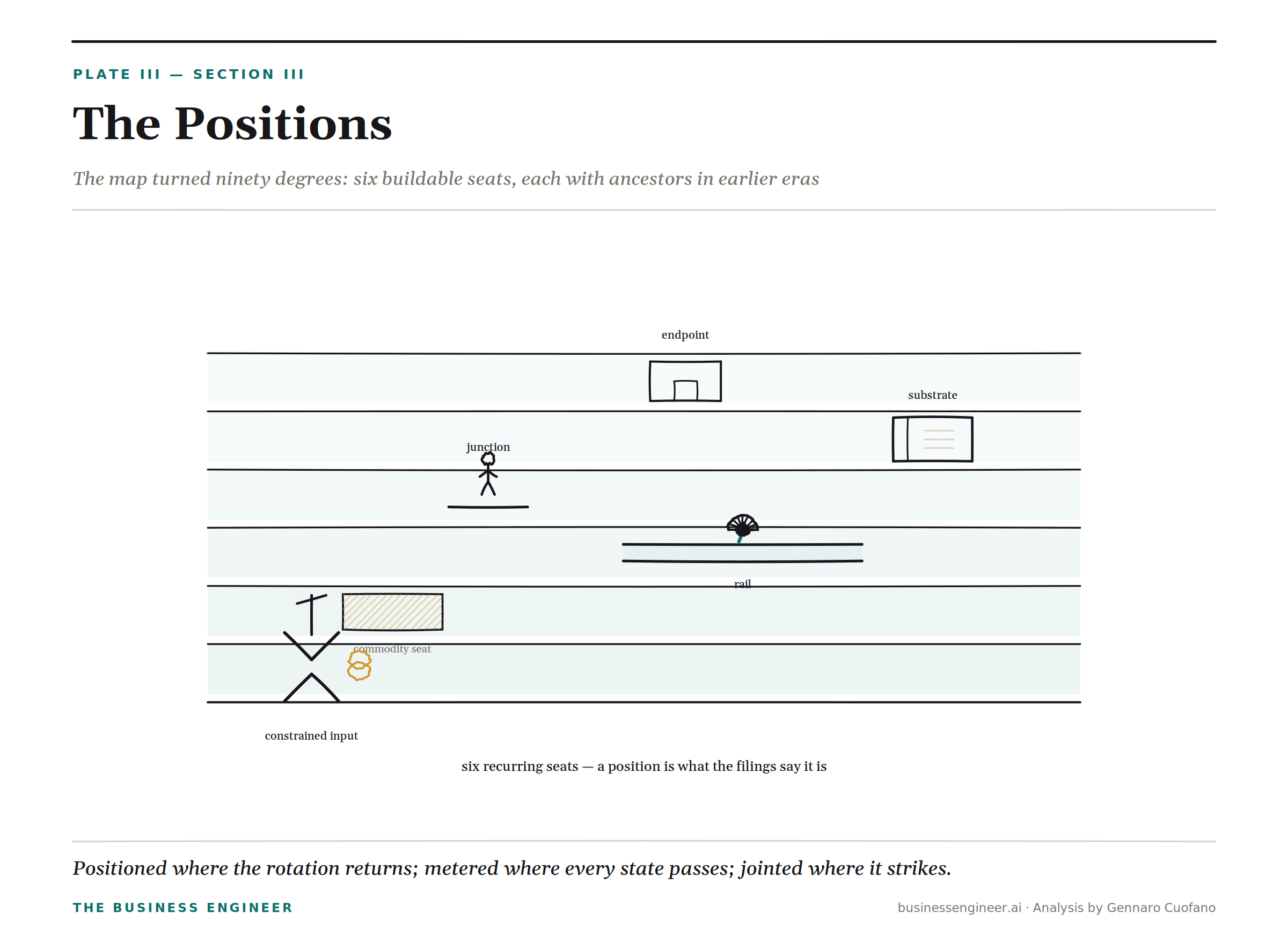
Think of an industry map as a site plan. Different locations produce different economics because they have different relationships to scarcity, customers, capital, and dependency.
Six positions recur often enough to be useful.
The constrained input supplies whatever the system cannot currently obtain fast enough. It can generate extraordinary returns while scarcity lasts, but often requires heavy capital and carries direct exposure to the rotation of the bottleneck.
The junction sits where valuable context, demand, or workflows meet the broader infrastructure. It does not necessarily own the expensive machinery underneath it. Its advantage comes from controlling the point of coordination.
The rail performs a function the flow has to pass through. Payment networks and clearing systems are classic examples. Rails become powerful when routing around them is more expensive than using them.
The substrate is where activity accumulates. Databases, operating systems, ERP systems, cloud platforms, and systems of record have all occupied versions of this position. Their strength comes from residence: once important work lives there, the surrounding ecosystem begins to organize around it.
The endpoint owns the relationship with the user. Brand, habit, convenience, identity, and direct distribution matter most here.
And then there is the commodity seat. Most businesses occupy it. That is not an insult. Commodity positions can become enormous businesses. But their economics are different. They compete primarily on price, execution, availability, or scale while structurally advantaged neighbors capture a disproportionate share of the value.
The mistake is not sitting in a commodity position. The mistake is believing you occupy a chokepoint when your economics say otherwise.
The test is empirical. Look at margins. Capital intensity. Customer concentration. Supplier power. Switching behavior. Dependency. Pricing authority.
The real position is the one visible in the economics, not the one described in the strategy deck.
From there, separate two sources of extraordinary returns.
The first is tightness rent. A temporary constraint creates scarcity and therefore pricing power. Capacity eventually arrives, technology changes, customers adapt, or the constraint moves. The rent disappears with it.
The second is monopoly rent in the broader economic sense: returns derived from a structurally difficult-to-bypass position.
The distinction matters because both can look identical during a boom. A company earning exceptional margins because the world is temporarily short of something may appear to possess a moat. The architecture becomes visible only when supply catches up.
Sophisticated incumbents understand this. When they believe scarcity will not last forever, they attempt to convert temporary economics into longer-lived structure: contracts, standards, ecosystem dependencies, installed base, take-or-pay commitments, integration costs. They use the period of tightness to construct something that survives after tightness.
That leads to a useful architectural question: where does the constraint return?
The most valuable position is often not the asset temporarily receiving the bottleneck, but the layer that remains necessary as the bottleneck migrates elsewhere. The architect therefore designs for the path of the system, not merely its current state.
The moats — what compounds, and what quietly stopped
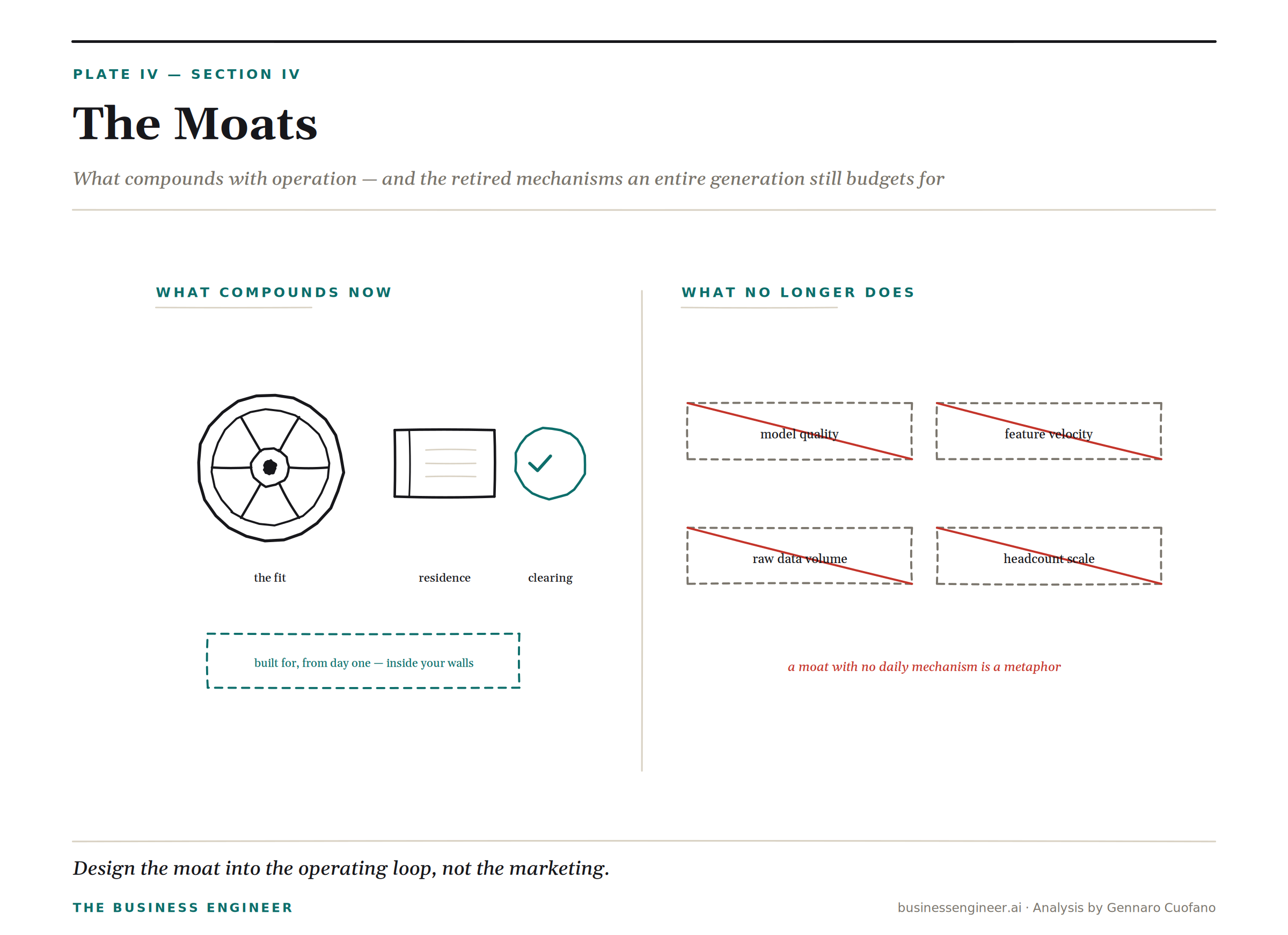
A moat is easier to reason about once the metaphor is removed. It is an asset, position, or mechanism whose defensive value grows through ordinary operation.
That final clause matters. If the alleged advantage does not become stronger as the business does its daily work, it probably is not a moat. It may still be an advantage, but it is not compounding.
AI is changing which mechanisms compound.
One of the most important is accumulated fit. A model by itself is replicable. A workflow by itself is replicable. A prompt library is replicable. But a system that has repeatedly adapted itself to a specific company’s data, exceptions, terminology, policies, feedback, users, and operating context becomes much harder to copy.
The advantage does not live in any single component. It lives in the interaction among them. The model learns how the context is structured. The context improves through repeated use. Corrections become institutional knowledge. The workflow adapts around real exceptions. Human judgment becomes encoded in the system.
Thousands of these small adjustments can produce something no competitor can reproduce merely by buying the same underlying model. That is accumulated fit.
Residence can compound in a similar way. The more important work accumulates inside a system, the more expensive it becomes to remove that system from the organization. This is one reason systems of record have produced unusually durable businesses.
AI may strengthen rather than weaken this dynamic. If agents increasingly act on enterprise context, then the place where that context is governed, updated, and permissioned becomes strategically important. Paradoxically, easy export can strengthen residence. Customers are more willing to consolidate around a system they know they can leave.
Clearing and standing also become more valuable when production becomes cheap. If producing plausible content, software, recommendations, or transactions becomes almost costless, the scarce element shifts toward knowing who stands behind the output.
Identity, verification, settlement, accountability, reputation, and liability therefore gain weight as generated supply expands.
Standards can compound too. A successful standard makes coordination cheaper for everyone else while increasing the strategic importance of the infrastructure around it. The language is open; the position created by adoption may not be.
And physical scarcity remains real. AI does not repeal physics. Land, energy, fabrication capacity, logistics, and other constrained physical assets can still produce durable power when scarcity is genuinely structural rather than temporary.
Other familiar moats are becoming weaker. Superior access to a frontier model does not last long when the frontier moves every few months. Feature velocity loses defensive value when competitors can reproduce functionality in weeks. Raw data volume is frequently overrated. A large pile of information is not equivalent to proprietary, corrected, permissioned context embedded in a working system.
Headcount is less defensible when small teams can operate with dramatically greater leverage. And aggregated attention around information that can be summarized elsewhere becomes fragile when another interface controls discovery.
The useful test is simple: What does the company do every day that makes it harder to compete with tomorrow?
If there is no concrete answer, the moat probably exists mainly in language.
The architect’s five moves
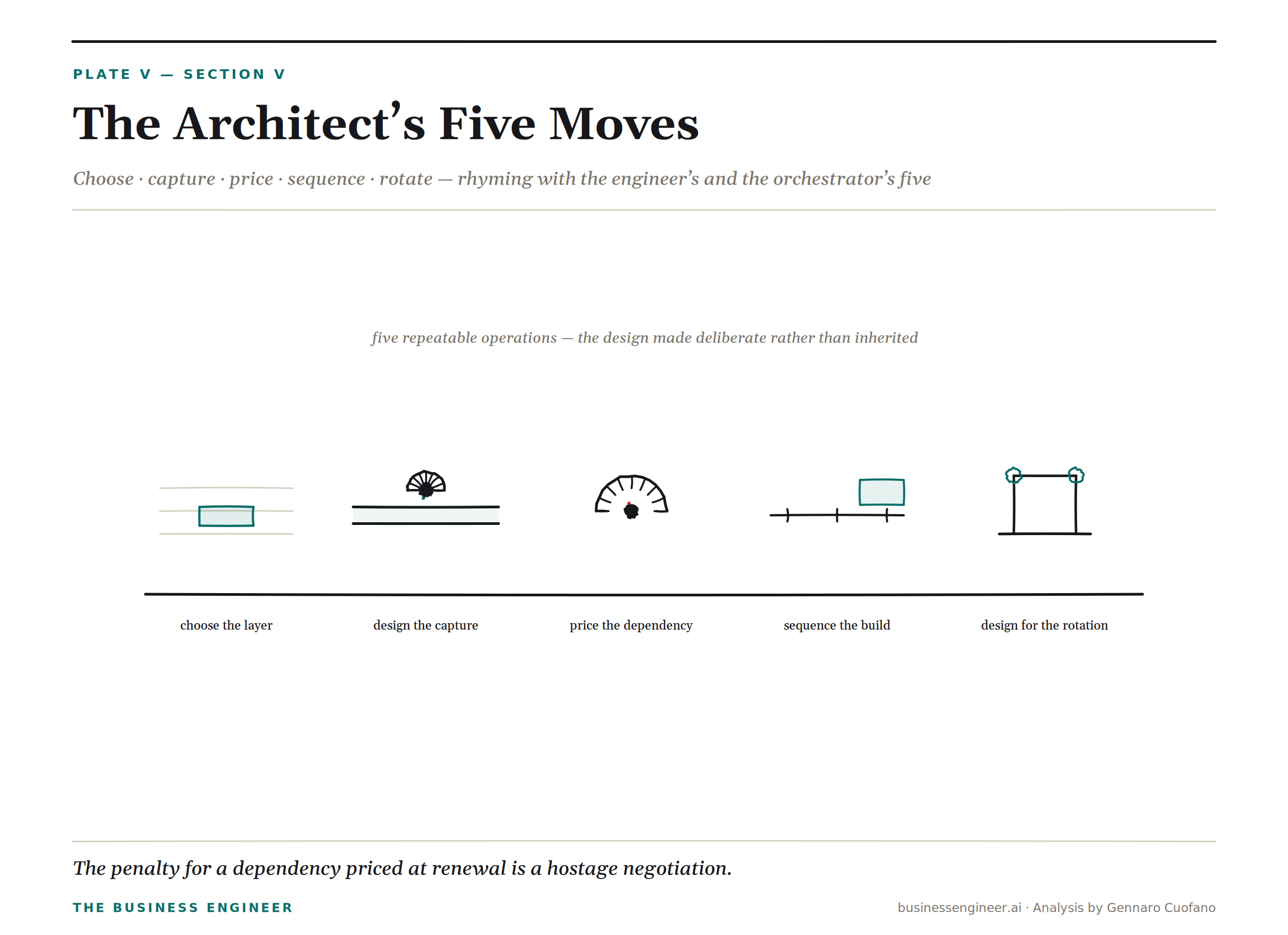
Choose the layer. Do not begin by deciding what company you would like to resemble. Begin with the economic position available to you.
Map where value enters the system, where it accumulates, where scarcity appears, who controls distribution, and which functions cannot easily be bypassed. Then place the company on that map using its actual economics.
The important second step is matching the position to the company’s endowments. A technically attractive layer may still be the wrong one for a firm without the capital, credibility, channel, installed base, or regulatory standing required to win there.
Architecture begins where aspiration meets constraint.
Design the capture. Creating value and capturing value are different acts. A business can become essential to an ecosystem while allowing somebody else to monetize most of the value it creates.
The architect therefore has to place the meter. Where does payment occur?
The strongest meters tend to sit close to moments that are difficult to abstract away: settlement, commitment, consumption, access, residence, scarce capacity, or a measurable outcome. The weakest often sit several layers upstream, attached to activities that technology can reproduce or intermediaries can bundle away.
A good capture point has another property: it produces information. When pricing is attached directly to economically meaningful activity, revenue becomes a sensor. It tells the company how the system itself is changing.
The meter is therefore not only a monetization mechanism. It is also an instrument panel.
Price the dependency. Every architecture contains dependencies. The objective is not to eliminate them. That would usually be absurdly expensive. The objective is to know what kind of dependency you are accepting.
For each major supplier, model, cloud provider, marketplace, API, channel, or infrastructure partner, price three forms of exposure.
The toll: what happens if the counterparty raises the price?
The gate: what happens if access is restricted or withdrawn?
The learning: what does the counterparty learn from the activity flowing through it, and can that learning eventually be used against you?
The third is the easiest to ignore because it rarely appears on an invoice.
Once the exposure is understood, design the joints accordingly: alternative suppliers, portable data, modular interfaces, contractual protections, separation of proprietary learning, rehearsed migration paths.
A dependency deliberately accepted at design time is leverage. The same dependency discovered during a contract renegotiation is leverage held by somebody else.
Sequence the build. Architecture is temporal. Two companies may want to reach the same destination and require completely different sequences to get there.
Some assets become disproportionately expensive to acquire later: trust, ecosystem neutrality, customer permission, standards influence, proprietary context. Those may deserve early investment.
Other capabilities should initially be rented precisely because the company does not yet know enough to justify owning them. The architecture should therefore contain explicit conversion points.
Rent while learning. Own when control begins to matter. Integrate vertically only when the economics, learning, or strategic risk make ownership worth the additional capital.
The destination matters. The order in which you build toward it often matters more.
Design for the rotation. Finally, assume that some important part of the environment will change. Do not pretend to know which one.
Instead, locate the joints where change is most likely to hit the business. Can the model provider be replaced? Can the distribution channel disappear? Can compute costs rise? Can the regulatory regime change? Can a current bottleneck become abundant? Can the layer immediately above or below you integrate into your position?
Then decide which parts of the architecture need reversibility.
Modularity has a cost. Redundancy has a cost. Optionality has a cost. Treat those costs explicitly as insurance premiums rather than inefficiencies to be optimized away.
And write down the assumptions carrying the structure. Every important architectural assumption should have a corresponding observable that would cause the company to reconsider it.
Otherwise companies do not update when the evidence changes. They update when the pain becomes impossible to ignore.
The practice — and a dated reading
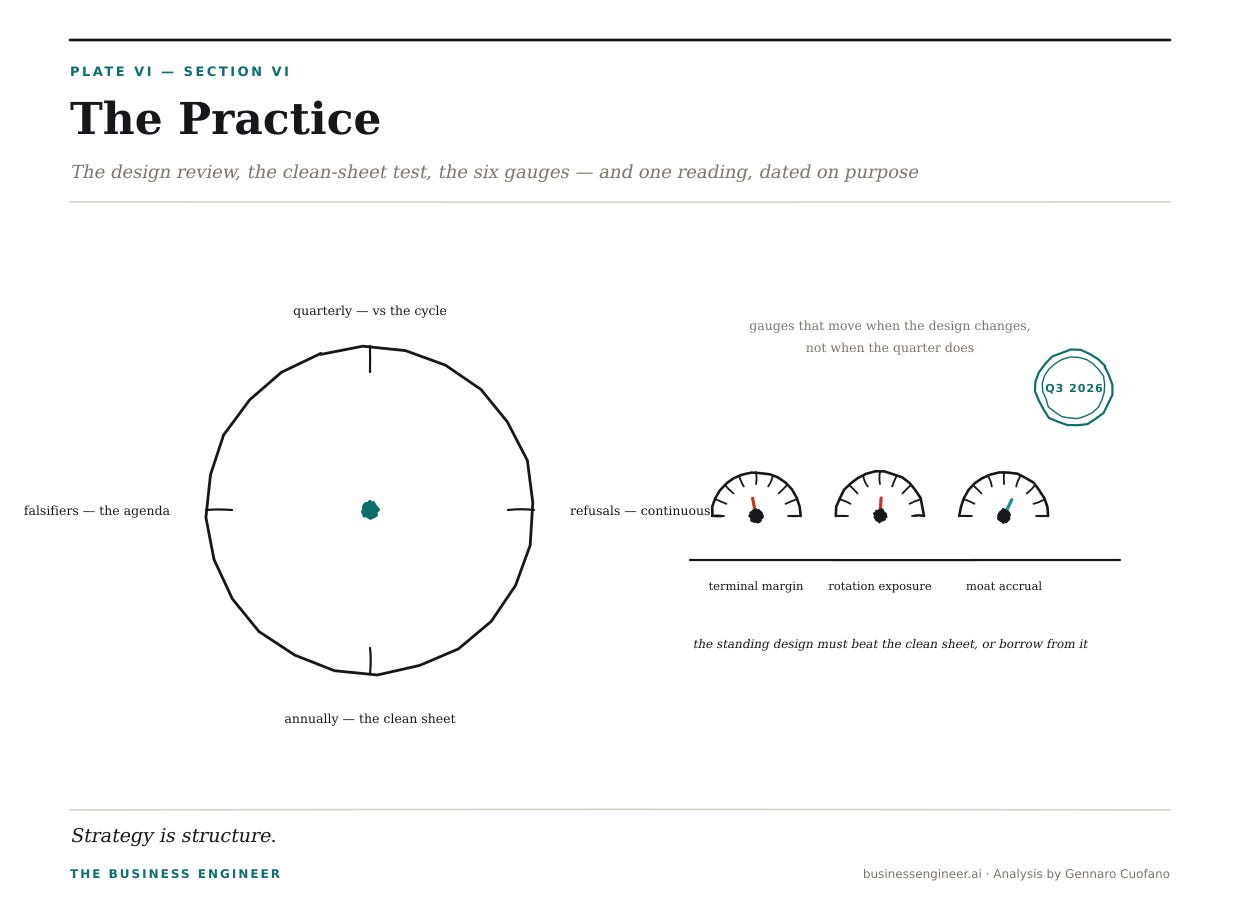
Architecture is not a founding exercise. It is a continuing practice.
A company gradually accumulates decisions made for conditions that no longer exist. A distribution agreement becomes sacred because it has always been there. A technology choice becomes identity. A business line acquires political protection. A temporary market condition quietly becomes embedded in the financial plan.
None of this requires incompetence. It is simply what organizations do.
Architectural discipline therefore needs a cadence.
Quarterly, revisit the assumptions supporting the design. Not every assumption. Only the ones that would materially change the architecture if they stopped being true.
Ask: What did we learn this quarter that weakens one of the assumptions on which this business was designed?
Once a year, go further. Run the clean-sheet test.
Imagine the company did not yet exist. Given today’s technology, customers, competitors, capital costs, channels, and constraints, what would you build?
Then compare that design with the company you actually have.
The existing company does not need to match the clean-sheet version. Incumbents possess assets a startup does not: customers, trust, cash flow, infrastructure, data, capabilities. But the difference between the two designs should be explainable.
If the only argument for the existing architecture is that changing it would be inconvenient, the exercise has found something important.
Keep a record of the options deliberately rejected as well. Companies remember what they chose. They are much worse at remembering what they considered and declined.
Yet those refusals contain some of the most useful information about management judgment. Years later, they make it possible to distinguish a bad decision from a reasonable decision made under different information.
The operating panel for the architect should therefore be small. Track whether capture is strengthening or leaking. Track whether mature margins are moving toward the architecture’s original thesis. Track dependency concentration. Separate profits produced by temporary tightness from profits produced by structural advantage. Measure whether the mechanisms described as moats are actually accumulating. And track whether the options required to survive adverse states are still alive.
A dated reading of the AI cycle in the third quarter of 2026 would say that the market is rewarding positions close to unavoidable flows and scarcity while putting pressure on layers where value creation is easier to reproduce than value capture.
That reading will expire. It is supposed to.
The purpose of an architectural framework is not to preserve today’s answer indefinitely. It is to preserve the method that allows the answer to change without losing coherence.
That is the distinction between a strategy and a story.
A story describes why the current configuration makes sense. Architecture explains why the structure should survive when the configuration changes.
Which brings us to the central claim of the book: strategy, in a rotating environment, is structure.
Not rigidity. Structure.
A clear position in the system. A deliberate point of capture. Dependencies understood before they become constraints. Joints designed where change is likely to strike. A financial model capable of carrying the load. And a discipline for revisiting the assumptions before the environment revisits them for you.
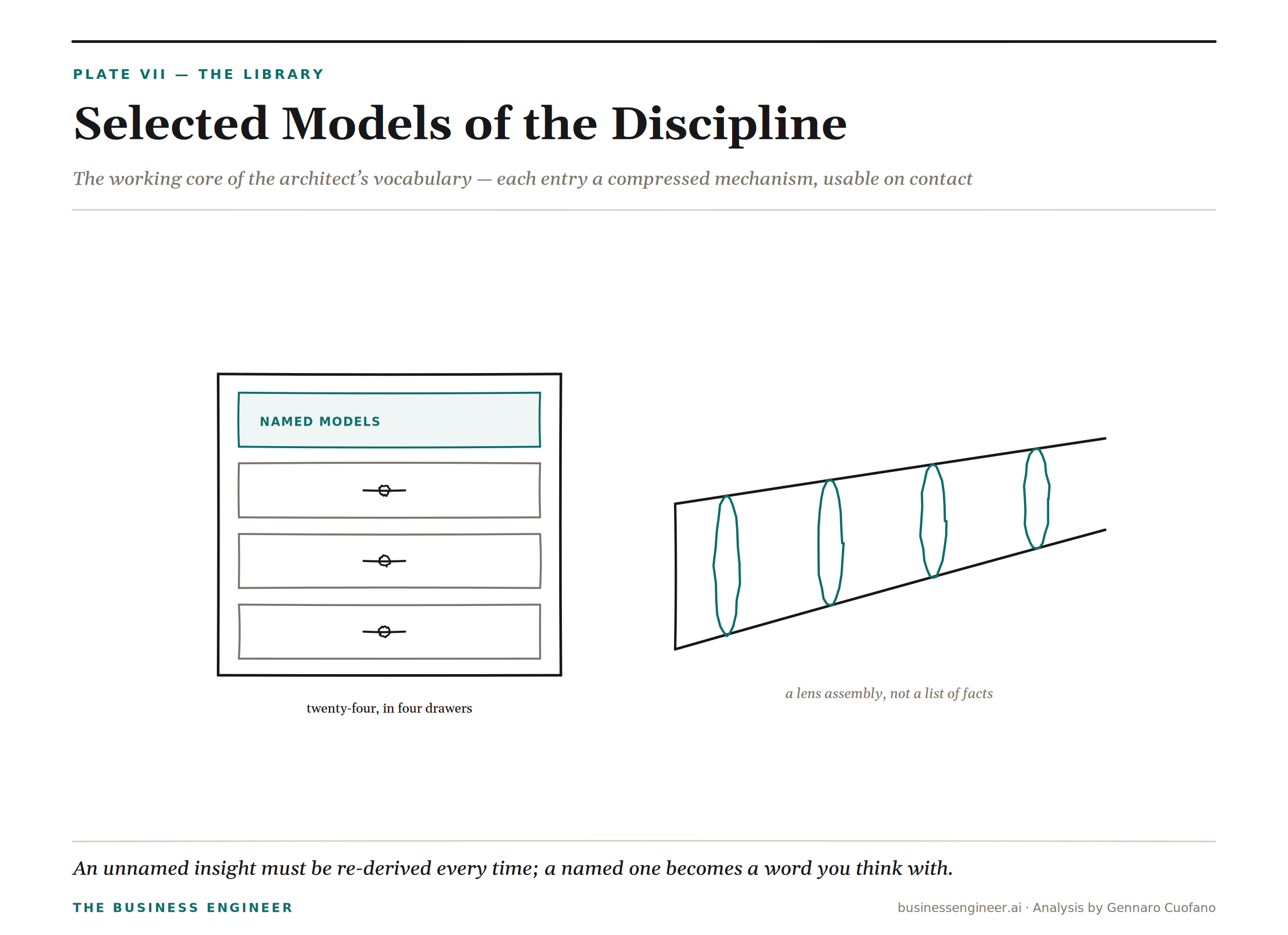
The library: selected models of the architect’s discipline
On the environment
The Rotation Mismatch — markets can reprice faster than companies can rebuild. Design around the movement of constraints, not the location of today’s bottleneck.
Templates Are Frozen Answers — every business playbook encodes assumptions about a particular technological and economic era. When those assumptions move, return to the questions rather than defending the template.
Stories Expire With Constraints — the narrative surrounding an industry is often strongest precisely when the conditions producing it are closest to changing.
Software Acquires a Cost of Goods — AI gives software a meaningful variable cost. The architecture must therefore include a mature-margin thesis and control over the forces that determine it.
On the four choices
The Value Subtraction — remove what cheap intelligence makes abundant. Look for economic value closer to commitment, context, clearing, trust, accountability, and desire.
The Design Barbell — rent rapidly commoditizing technology; own the components that determine differentiation, accumulated learning, strategic control, or long-term economics.
Distribution First — the channel shapes the product, customer relationship, economics, and data flows. Choose it as part of the architecture, not as an afterthought.
The Rented Front Door — third-party distribution provides reach in exchange for dependency. Treat it accordingly.
Capital Intensity Is a Choice — capital should buy a position durable enough to justify the balance-sheet exposure it creates.
The Terminal Margin Is the Whole Position — mature economics reveal where the company actually sits in the value chain once temporary distortions disappear.
On positions and moats
The Site Plan — constrained input, junction, rail, substrate, endpoint, commodity seat: recurring positions with different relationships to scarcity, capital, customers, and capture.
Tightness Rent vs. Monopoly Rent — distinguish returns created by temporary scarcity from returns created by a position that remains difficult to bypass.
Own the Station the Constraint Returns To — the strongest architecture often sits where flows reconverge after the bottleneck moves.
Rent-to-Contract — temporary scarcity can be converted into more durable economics through contracts, standards, installed base, and ecosystem structure.
The Accumulated Fit — defensibility emerges from the repeated adaptation among models, context, workflows, corrections, and human judgment.
Residence — the place where important work and context accumulate becomes progressively harder to remove from the system.
The Retired Moats — model access, feature velocity, raw data volume, headcount, and intermediated attention provide less protection when their underlying scarcity disappears.
The Daily-Mechanism Test — if ordinary operation does not strengthen the claimed advantage, it is not a compounding moat.
On the moves and the practice
The Meter — place monetization close to economically irreducible activity and use it as a sensor for how value is moving through the system.
Priced Dependency — measure toll, gate, and learning exposure before committing the architecture to an external counterparty.
Sequence Beats State — rent while learning, own when control matters, and acquire early the assets that become difficult to add later.
Design for the Rotation — build modularity, reversibility, options, and explicit falsification points into the structure.
The Clean-Sheet Test — periodically compare the inherited company with the one you would build today and force the differences to justify themselves.
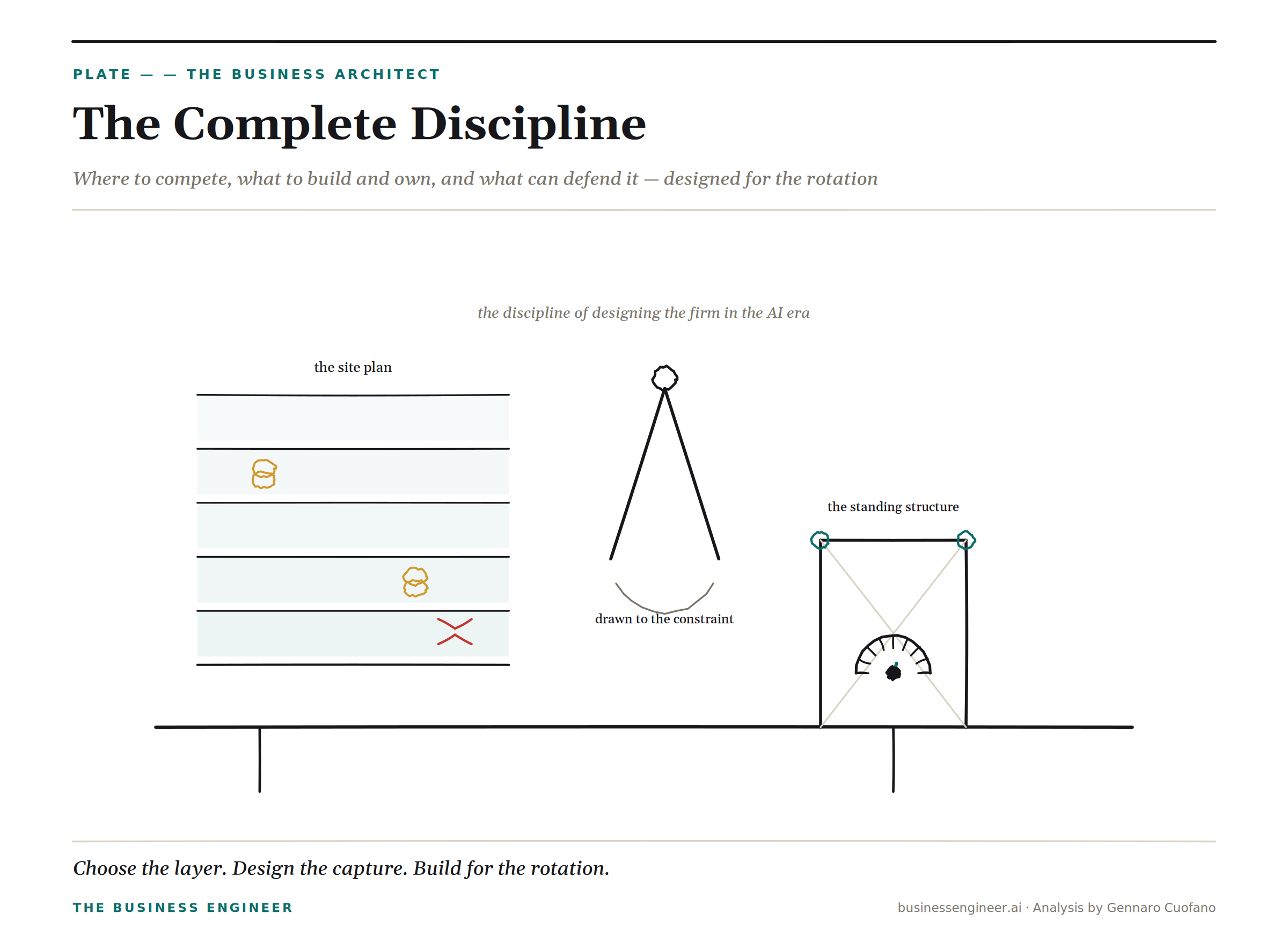
The Standing Structure — strategy is the part of the design that continues to make sense after the environment changes.
With massive ♥️ Gennaro Cuofano, The Business Engineer