

Where does advantage come from now that the technology everyone is betting on is becoming a commodity? Which layer of this industry should we compete at, and which should we deliberately concede? What should we build and what should we rent — and what does that choice cost us in control five years out? What do our customers actually pay us for, and would they keep paying if a rival gave the rest away? And where, after all the spending, does the value in this cycle finally settle?
These questions are being asked in every boardroom in the economy, and the coverage — for all its volume — does not answer them. Every earnings print is summarized within the hour; every launch collects a hundred takes by nightfall; every capital figure circulates until it feels familiar. Familiarity is not understanding. It is entirely possible to know every headline of the AI buildout and still be unable to read it, and the divergence has a specific cause.
The explanation is not a shortage of information — the filings are public and identical for everyone — but a shortage of method. Two readers with the same access produce two different objects from the same quarterly report. One produces a story: a judgment about momentum and sentiment. The other produces a structural reading: a statement about what changed in the system that generated the numbers, and what that change means for the choices ahead. The difference between them is not talent. It is a set of installed procedures, and procedures can be taught.
I call the set of procedures business engineering.
Its object is business strategy in the oldest sense of the term — where to compete, what to build, what to own, whom to serve, when to move. Financial statements will appear throughout what follows, and their role should be fixed at the start: they are evidence, not subject. A strategy is a set of choices, and the ledger is where choices stop being words and become arithmetic — the one place a company cannot help telling the truth about what it has actually decided. The discipline reads numbers the way a strategist reads terrain: not because the terrain is the campaign, but because no campaign survives being wrong about it.
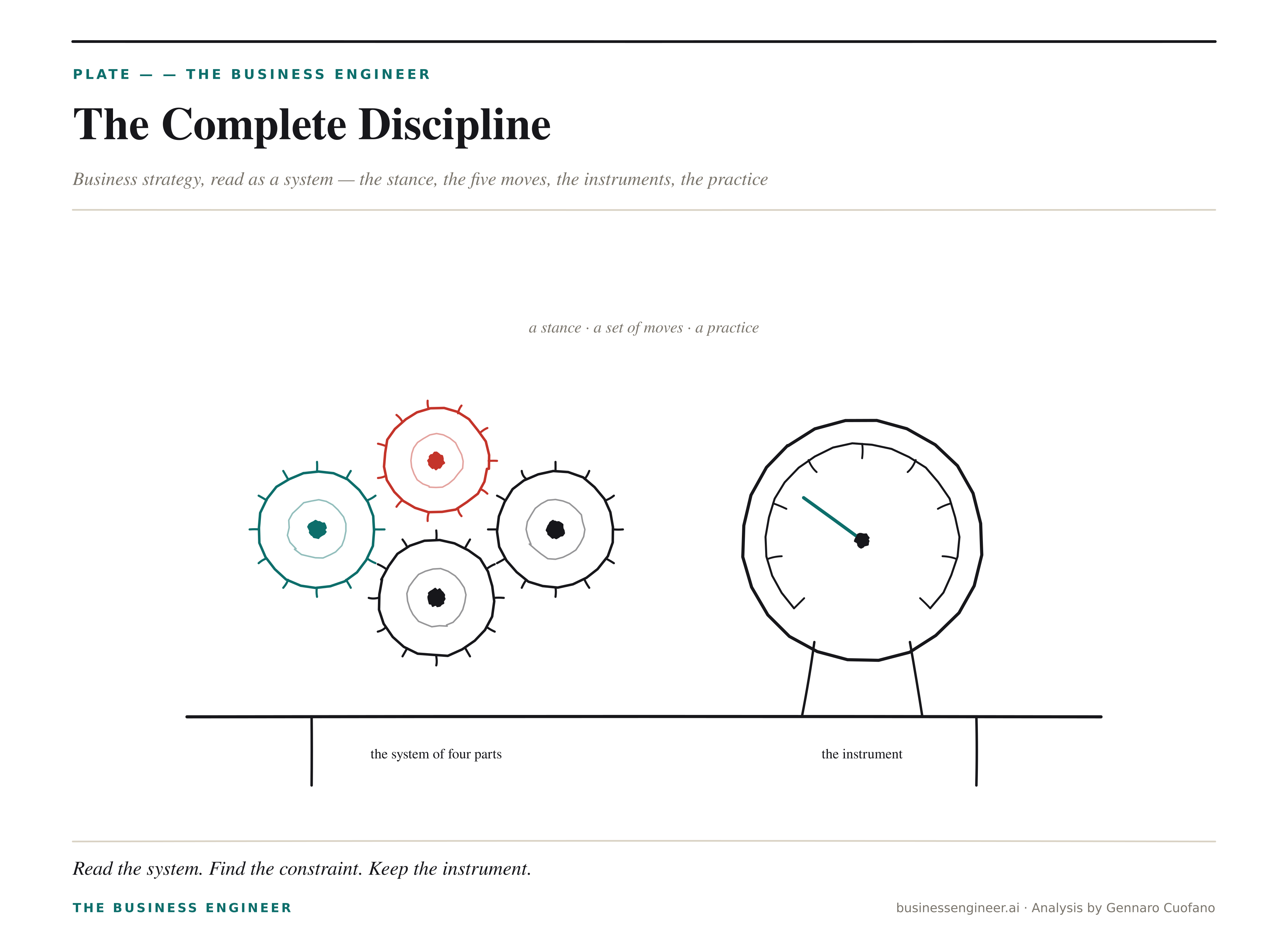
A discipline, properly speaking, is three things joined together — and most of what is taught as business strategy has only fragments of one. It is a stance: defaults about what to look at and what to refuse. It is a set of moves: repeatable operations that convert raw material into understanding. And it is a practice: a cadence of live application that keeps the stance honest and the moves sharp. Medicine has all three. Engineering has all three. A shelf of frameworks detached from stance and practice has none of them — which is why a person can collect frameworks for years and still misread every company they meet.
What follows is the full structure: where the discipline’s tools came from, the stance, the thinking system underneath it, the five moves, the instruments they build, the practice that runs them — and, at the end, what the apparatus currently reads, plus the working library of models it thinks with.

Where the toolkits came from, and why they fail here
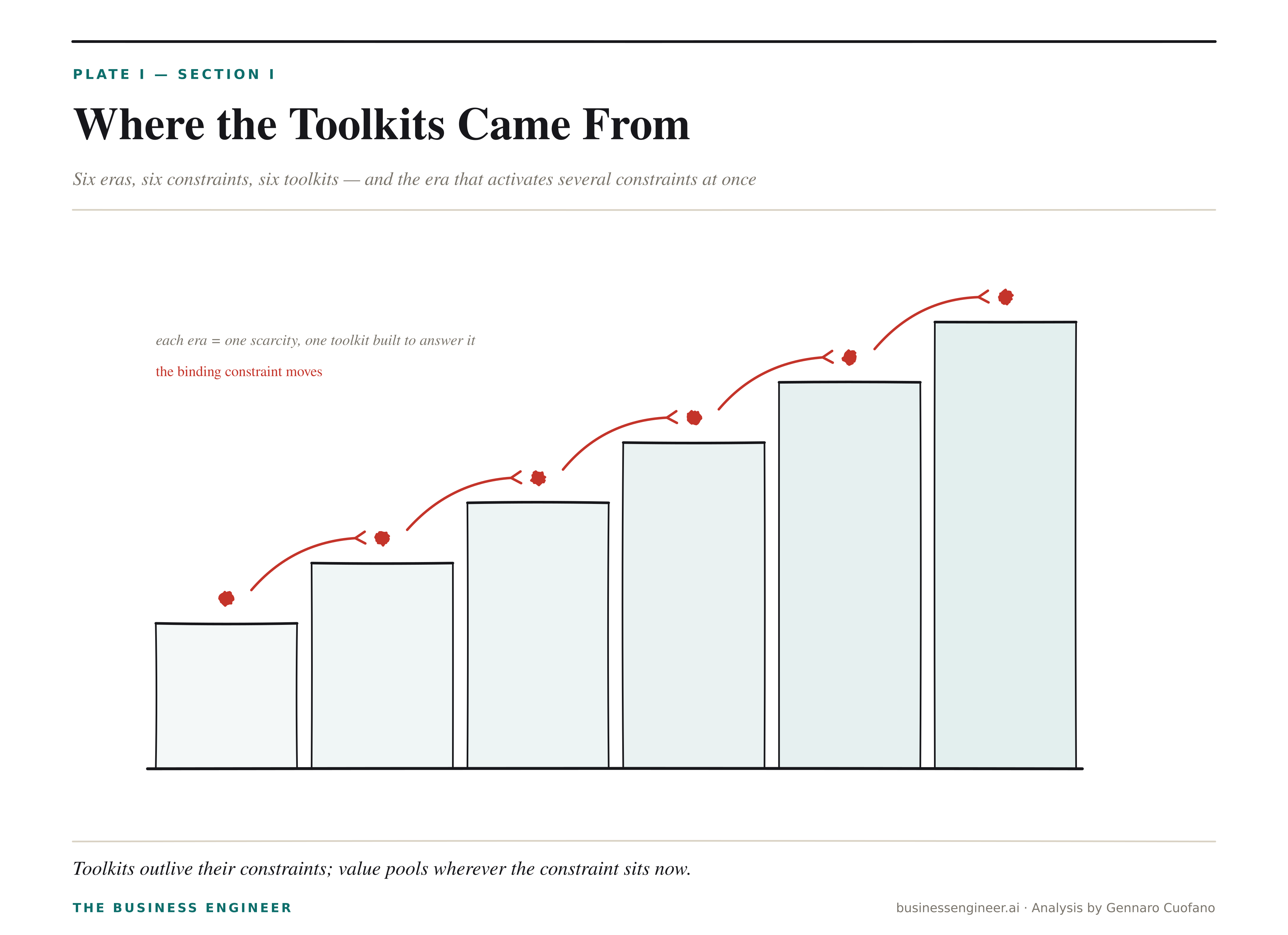
The methods most professionals carry were each forged by one era’s scarcity, and their origins explain their present failures. Read the history of management not as a parade of thinkers but as a sequence of environments — each with one binding constraint, each selecting for the toolkit that answered it.
The assembly line answered the era whose constraint was production itself. Lean manufacturing answered waste, once volume was solved. The leveraged buyout answered an era whose scarce skill was financial structure — the first in the sequence in which the winning method had nothing to do with making anything. Blitz financing answered the internet land-grab, whose constraint was capital deployed at speed, and whose cautionary specimen — a correct grocery-delivery idea executed with nearly a billion dollars against a market that did not yet exist — established that capital cannot manufacture demand. The lean startup answered the inversion that followed: once software could ship unfinished at negligible marginal cost, the binding risk moved to the demand side. The platform era then moved the unit of competition from the product to the network.
Three observations from this sequence carry the strategic load.
First, toolkits outlive their constraints — every era’s method persists into the next as professional habit, so at any moment much of the profession runs one era behind.
Second, the location of the binding constraint predicts where returns pool — each era’s economics accrued to whoever held its scarce input.
Third, the AI buildout is the first environment to activate several historical constraints at once: a demand-side question, a capital-structure event of record scale, a physical-capacity problem with construction lead times, and a platform contest — running simultaneously, with the binding constraint rotating within the cycle rather than holding for a generation.
The consequence is mechanical. The demand-side toolkit alone reads a product race and cannot explain why the best models capture so little value. The growth-capital toolkit prices the cycle like 1999 and carries no gauge for how a buildout is funded. The platform toolkit has no physical layer — and this cycle’s defining fact is that software met a wall of matter for the first time in forty years. Even the financial toolkit fails alone: it prices the obligations without the technology clock that decides whether the financed assets will be productive or stranded.
An environment that defeats every partial toolkit selects for a method that reads all the layers as one system and tracks which one binds now.
The stance: the system, not the story
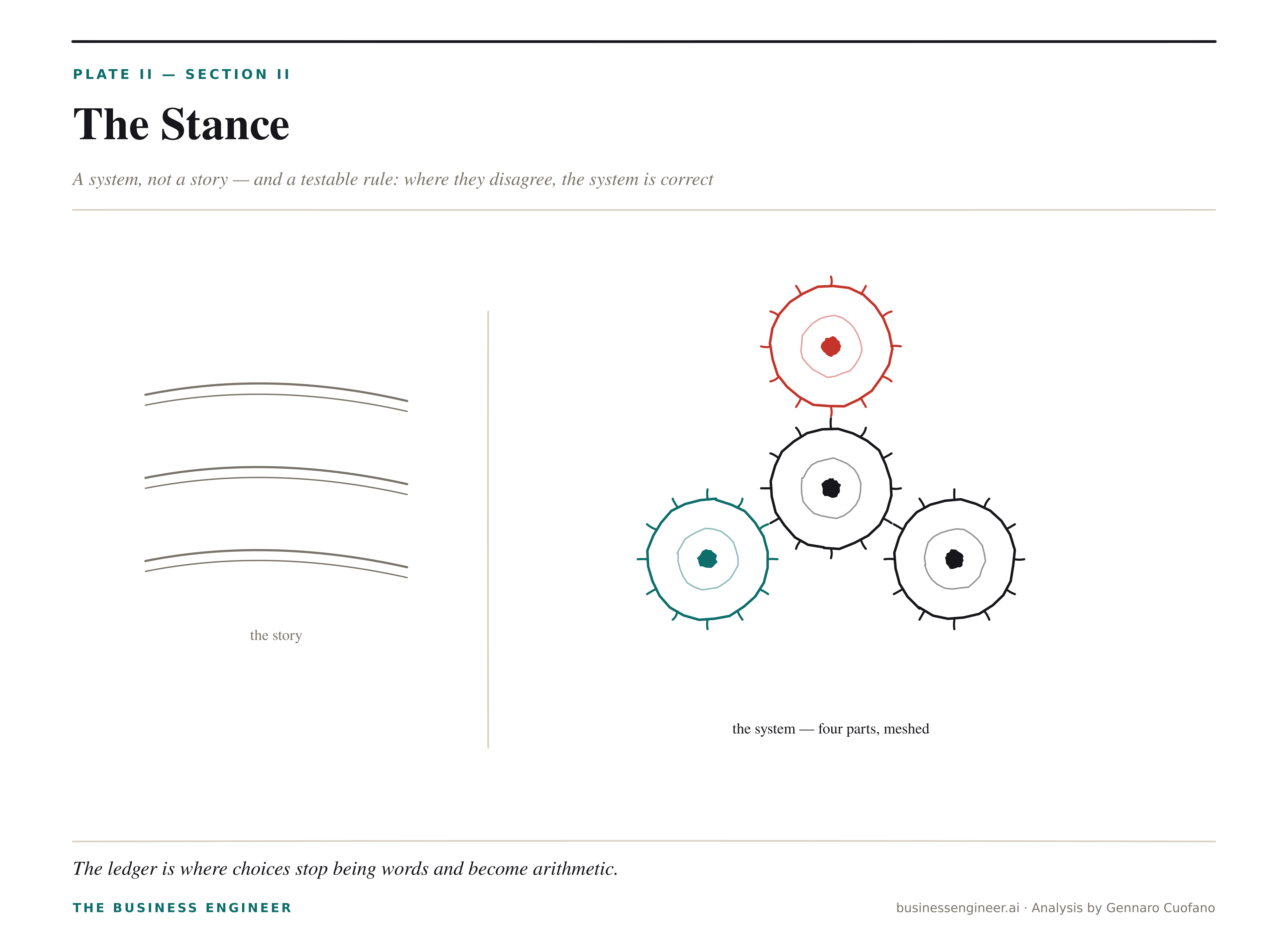
The discipline’s first commitment is a refusal. A company is not read as a narrative — founder, vision, momentum, turnaround — but as a system of four interacting parts.
The value model: what is created, for whom, at what willingness to pay. The technological model: how the value is produced, and whether the firm funds both the sustaining engineering and the discontinuous bets that could obsolete it. The distribution model: how value reaches the customer — the part narrative reading most reliably ignores, despite a finding that recurs across thousands of examined business models with the regularity of a law: a good product does not make a successful company; a product multiplied by its distribution does. And the financial model: how the ambitions of the other three are funded and what they cost — where every strategic choice eventually appears, priced.
The four parts constrain one another, which is what makes the lens diagnostic. A value proposition is only as real as the distribution delivering it; a technology bet only as serious as its financing; and the financial model, because it must reconcile, functions as the confession booth of the other three. This yields the stance’s testable rule: where the story and the system disagree, the system is correct.
The rule earns its keep on the cycle’s most instructive specimen. In a recent quarter, the search incumbent — the most profitable distribution business ever constructed — reported results its own narrative described as excellent: record revenue, cloud growth above eighty percent, earnings ahead of expectations. The same filing recorded four structural facts without emphasis. Free cash flow was negative for the first time in the company’s modern history. The twenty-year share buyback had stopped. Roughly seventy billion dollars had been raised. Capital spending was running at about six times depreciation.
None of these is a scandal. Together they are a classification change — a company organized for two decades around returning surplus cash had converted itself, deliberately and in plain sight, into an infrastructure builder. The scale of the financial reversal is the most honest available measurement of the scale of the strategic bet — a measurement the format “strong quarter, AI momentum” is structurally incapable of expressing.
Two further commitments complete the stance. The business environment is predominantly a domain of uncertainty rather than risk — the set of outcomes is itself unknown, which is where models fail while emitting confident numbers — and in uncertain domains the ordering is fixed: secure survival before pursuing optimization, because losses compound asymmetrically and some exposures have no next round. And analysis is not complete at the first order, because complex systems answer back — competitors adapt, customers relearn, incentives shift — and the record of expensive strategic error is disproportionately composed of first-order successes whose second-order consequences were never priced.
The engine: how the analysis is performed
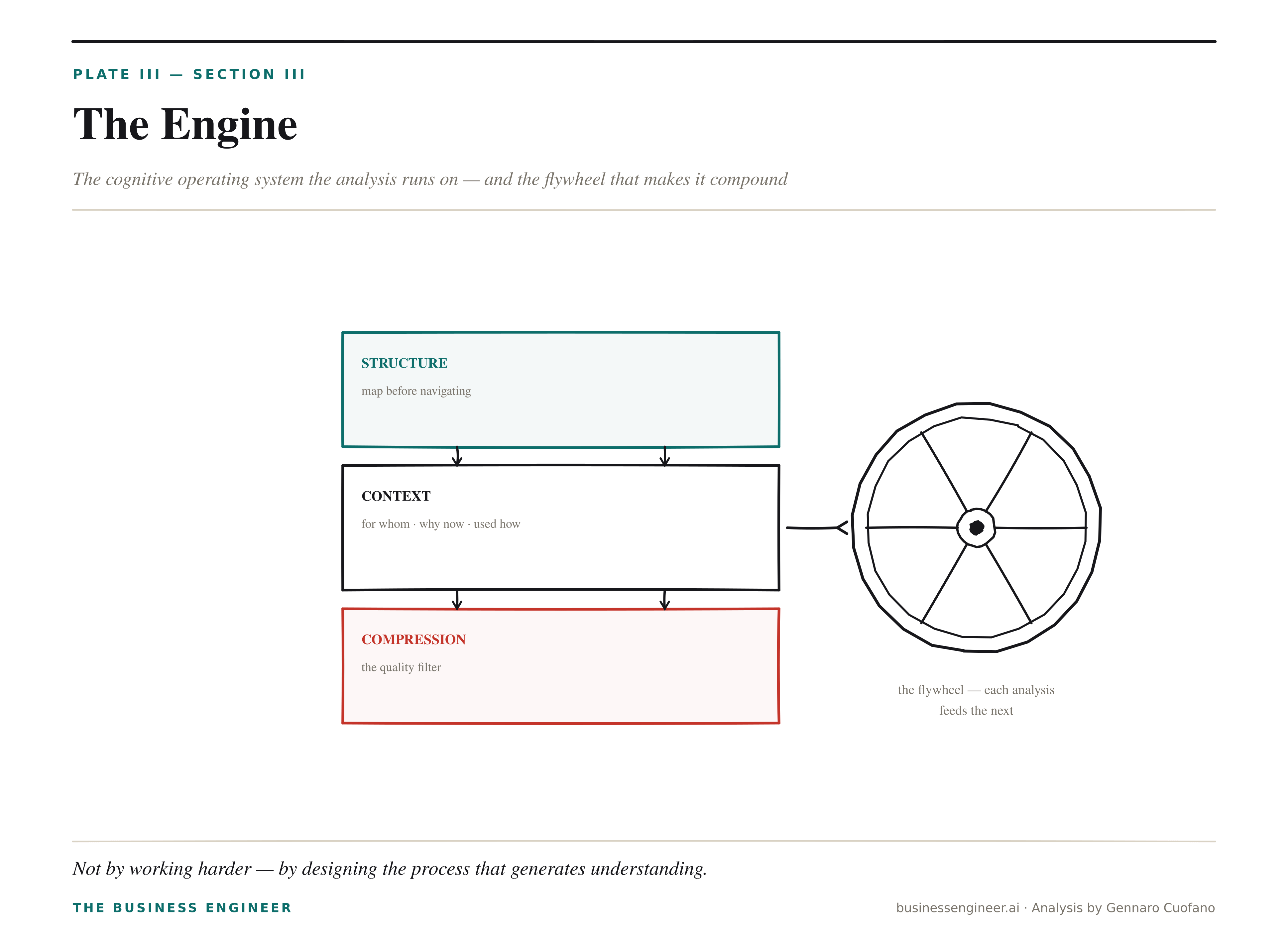
Beneath the stance sits a layer most methods never make explicit — the cognitive operating system the analysis runs on. Three principles do most of the work.
Structure before content. Never ask for an answer; ask for the three-to-five-part structure that makes the situation intelligible, because a territory that cannot be mapped cannot be navigated.
Context before work. Fix who the analysis is for, why it matters now, and how it will be used, before beginning. An analysis without a “why now” is an encyclopedia entry.
Compression as the quality filter. The value of an insight is its ability to be absorbed, retained, and deployed — and the filter cuts inward: an insight that cannot be compressed without losing its essence is not crystallized yet.
Run these with precision calibrated to the decision rather than worshipped for its own sake, a standing search for what consensus is missing, and every output built as a reusable module — and the work begins to compound: each analysis leaves behind models applicable to the next one. That flywheel is how a single practitioner keeps pace with an industrial cycle: not by working harder, but by designing the process that generates understanding.
The five moves
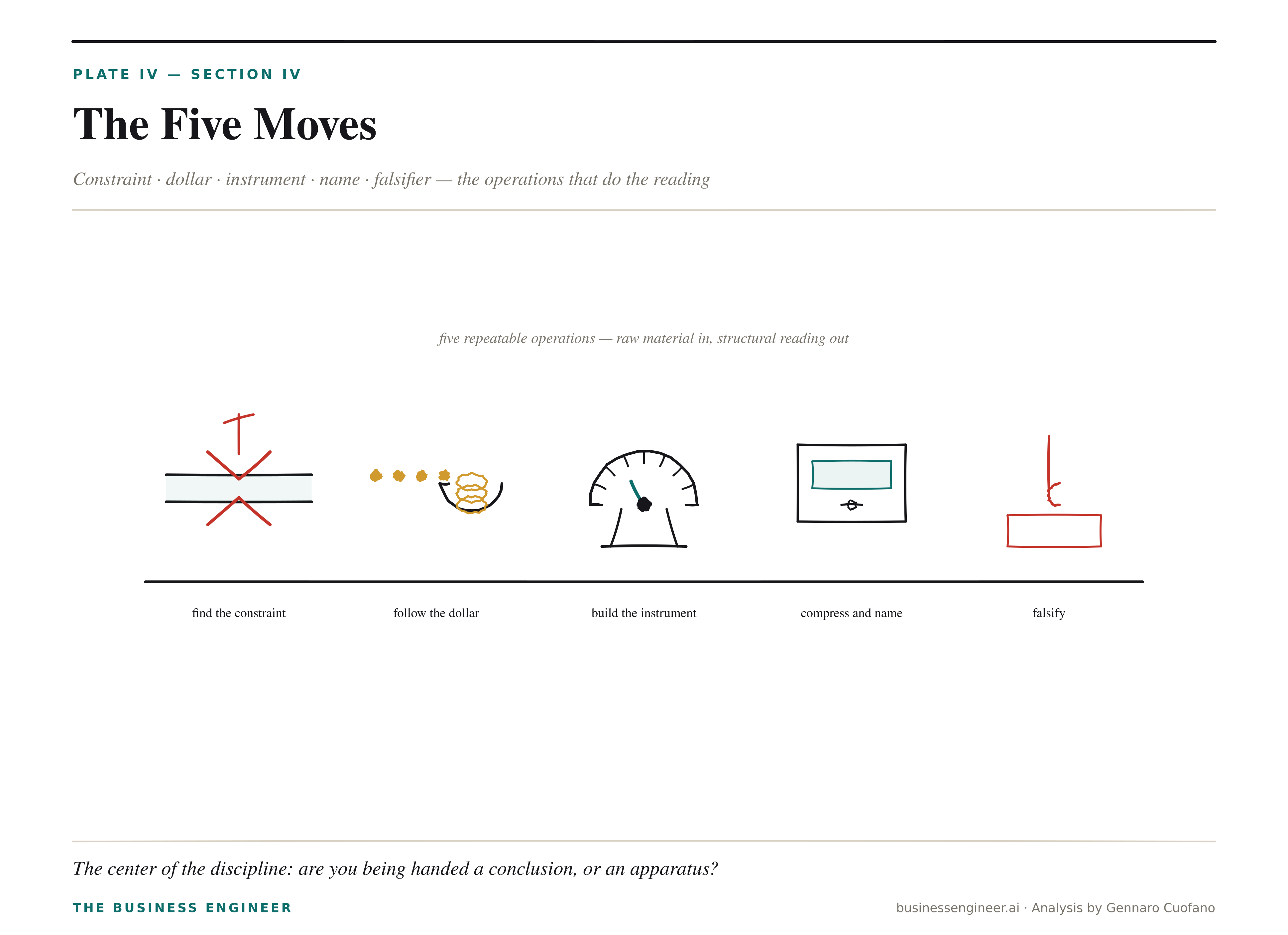
Find the constraint. A business system is not uniformly tight; one station sets the pace of the whole, and the system’s economics organize around it. The procedure: map the flow, then walk the chain applying one test per station — if this station’s capacity doubled, would system output rise? Only at the binding constraint is the answer yes. Confirm with prices, because constraints announce themselves economically: margins expand at the binding point, queues form ahead of it, its suppliers gain pricing power.
Applied to the present cycle, the procedure returns a result at odds with most coverage. Serving a large model is dominated by data movement, not computation — each generated token requires the model’s full weights to traverse memory — so the binding stations are high-bandwidth memory, advanced packaging, and leading-edge fabrication, all sold out years forward at expanding margins. The station most narratives treat as decisive, the model itself, fails the capacity test, because the system is not waiting on models.
The move’s second half carries the strategy: constraints rotate. This cycle’s has moved through packaging, memory, lithography, and power, and has lately been joined by credit — two binding at once for the first time. So the valuable question is always forward: given how the workload is changing, where does the constraint migrate next, and who owns that station while the market still prices it as slack.
Follow the dollar. A spending announcement is the start of a path, not a fact about the announcer. Decompose it: what the spend purchases and from whom; what each recipient keeps as margin versus passes to its own suppliers; iterate until the dollars stop moving. They rest at the stations with pricing power — which are the constraints.
Two findings generalize. Incidence diverges from narrative systematically, not occasionally: coverage assigns the cycle’s value to its protagonists, while the trace finds the protagonist operating as a conduit, the dollar settling one or two stations upstream at firms the coverage rarely names. And the same decomposition run in reverse — where did the dollar originate — determines behavior under stress, since a buildout funded from operating cash absorbs a downturn while the identical buildout funded from external raises transmits one. The spending trace identifies who is enriched; the funding trace identifies who is exposed.
Separate the reading from the instrument. This distinction is the center of the discipline. A reading is a measurement at a moment — a margin, a spread, a score — and it depreciates from the day its inputs do. An instrument is the apparatus that produced it, and a complete one has five components, each closing a specific failure mode: a question fixed in advance, phrased so evidence can answer it; gauges with defined scales, so this quarter is commensurable with last and mood cannot move the needle; counting rules written once and obeyed even when they weaken the story — above all against the largest silent error in business analysis, revenue counted repeatedly as it echoes up a supply chain; confidence grades carried from source to conclusion; and stated limits, because readings from an instrument of unknown limits have unknown meaning.
The distinction converts into a daily rule: for any analysis encountered, determine whether you are being handed a conclusion or an apparatus. The first ages on the schedule of its inputs; the second can be pointed at next quarter’s filings by its recipient, indefinitely. It is also the discipline’s production standard: work is not finished when the conclusion is reached, but when the apparatus that reached it can be run by someone else.
Compress and name. Beneath any deep analysis is a structure that recurs elsewhere, and extracting it converts analysis from an expense into an accumulating asset. Strip the particulars and observe what survives — if nothing does, the work was reportage. State the surviving mechanism as cause and effect with explicit operating conditions. Then locate a second instance, because a mechanism observed once is a hypothesis; the second instance is what certifies transferability.
The final step is naming, and it is not cosmetic: an unnamed insight must be re-derived at every use, while a named one becomes a unit of thought — and, once defined for a team, a unit of shared thought. A maintained library of such models functions as a lens assembly: new situations are read through the accumulated mechanisms in seconds, and whatever matches nothing becomes the next entry. The loop — analyze, compress, name, reuse — is why the method’s cost per insight falls the longer it runs.
Falsify. A confident method transfers its confidence to its errors, so the last move is the organized exposure of one’s own claims. Every load-bearing claim is published with its falsifier — the named observable that would prove it wrong — because a claim without one is not analysis but identity, and identities do not update. Every framework carries a dated statement of why it is timely now, so the claim visibly comes up for review when conditions lapse. Composite examples are marked as composites. Claims used but not argued point to where they were argued. And the discipline keeps a refusal log — figures declined, questions ruled not yet decidable — because that record is the only calibration data an analyst has on their own doubt.
The apparatus: what the moves build
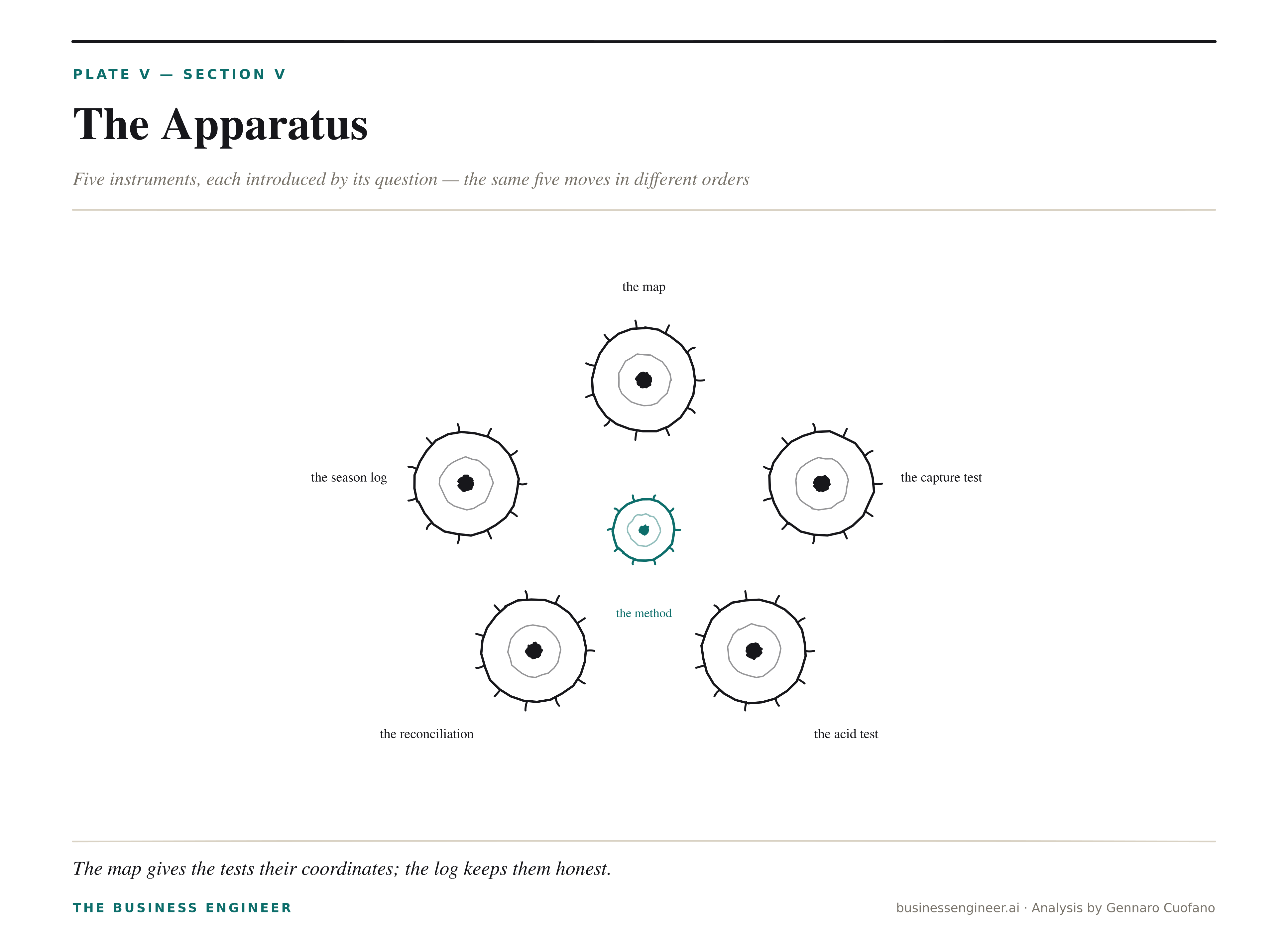
A discipline should be judged by what it constructs, and the five moves, run repeatedly on one industry, have produced a working shelf of instruments — each introduced by the question it exists to answer.
The layered map: where does any firm sit in the machine, from the physical floor through equipment, fabrication, silicon, networking, compute, models, the agentic layer, and distribution — the coordinate system every other instrument depends on. The capture test: after adopting the era’s technology, what does an enterprise still own — which of the junctions where its data, decisions, and customer relationships live remain under its title, and what would leaving cost. The financing acid test: is the buildout’s capital structure sound — gauged, scored, and banded, so this quarter’s answer is commensurable with last quarter’s. The reconciliation: does the revenue justify the capital — under counting rules that count each end-customer dollar once. And the season log: what did the machine report this quarter, recorded so the readings become a series.
The instruments are not five frameworks; they are the same five moves in different orders, pointed at different questions. And they interlock: the map gives the tests their coordinates, the tests give the map its depth, the reconciliation disciplines them all, and the log keeps them honest.
The practice — and the harness
A method exists only in its running. The discipline’s laboratory is the earnings season: four times a year, at every layer of the stack, dozens of firms publish audited measurements of the same machine from different positions.
The protocol: read in layer order, from the floor upward, so each report arrives with its context established; reduce each to its positional reading — constraints, funding, incidence; then reconcile across positions, because the season’s findings live between the reports rather than inside them — one firm’s capital expenditure is another’s backlog, one’s margin expansion is another’s toll paid — and where claims that must agree refuse to, the refusal is the finding.
Between seasons, the vocabulary is maintained like capital: models merged when two names prove one mechanism, demoted when the second instance never arrives, re-tested on contact rather than stamped on. And everything ships visual, because a drawn structure is the densest honest encoding of a system — an analysis that cannot be drawn is usually not finished.
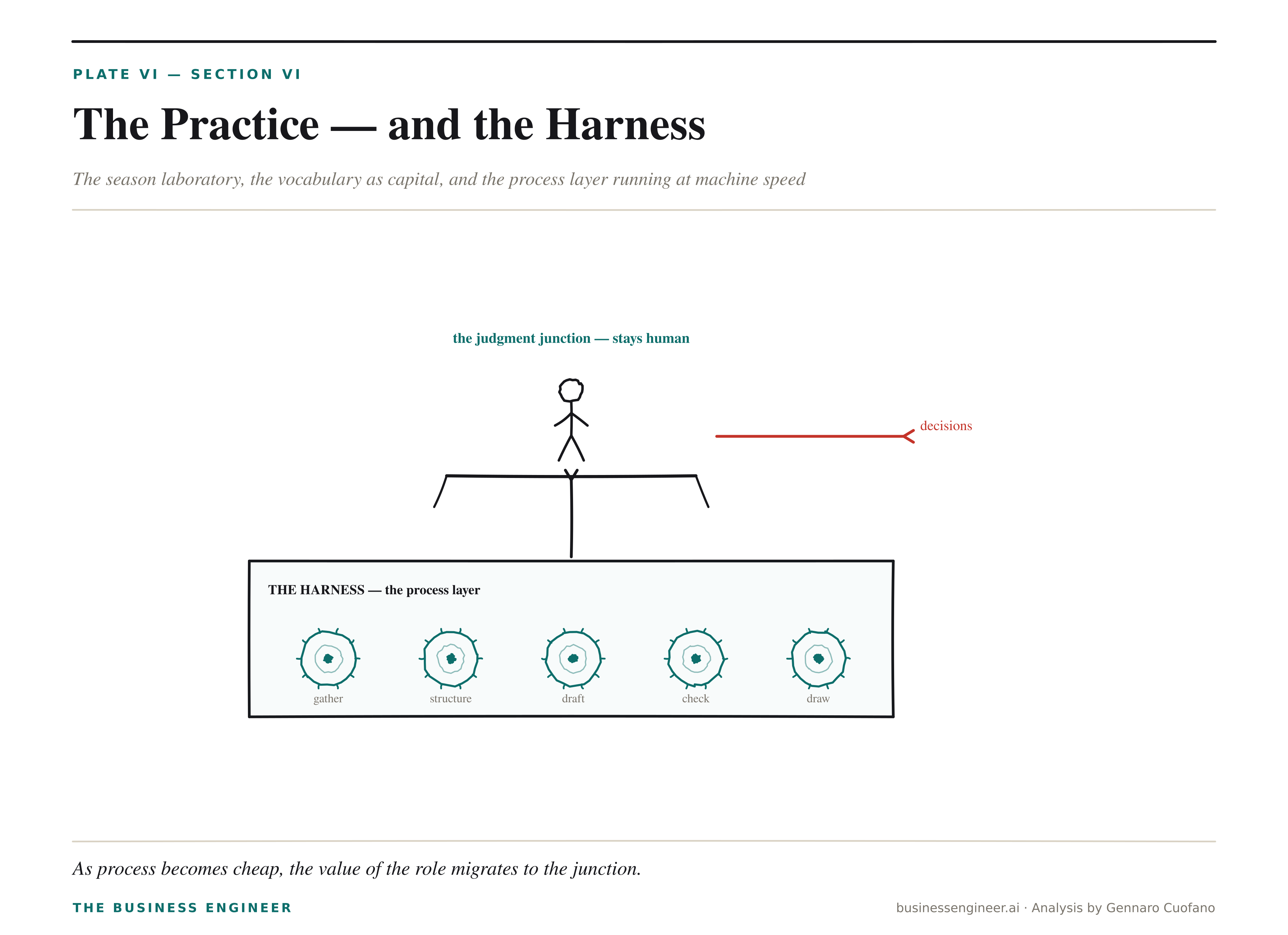
One development belongs in the discipline’s own terms rather than as a footnote. The method, encoded, now runs substantially inside an agentic AI harness — the process layer executing at machine speed — and the discipline’s own incidence analysis predicts exactly what follows: as process becomes cheap, the value of the role migrates to the judgment junction — which constraint to believe, which falsifier to respect, which bet to size — and that junction stays human. The practitioner’s job does not disappear into the harness; it concentrates at the one station the harness must pass through.
The library: selected mental models of the discipline
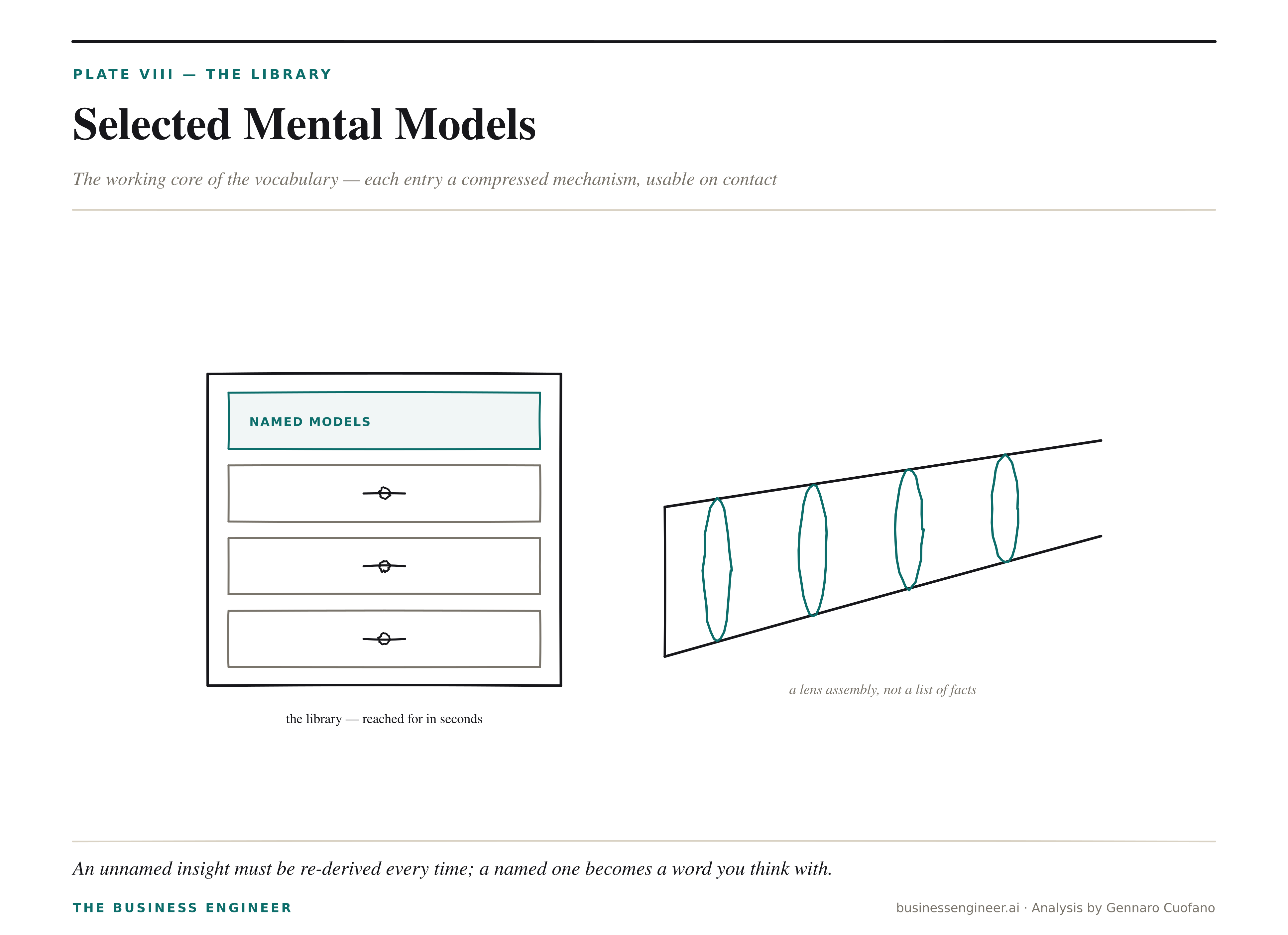
The discipline thinks in named models. The full vocabulary runs past a hundred and thirty entries; the working core below is enough to read most situations, and each entry is a compressed mechanism, not a slogan — usable the moment it is understood.
On reading companies
The Four-Part System — a company is value, technology, distribution, and finance in interaction; the unit of analysis is the joint between them, not any single part.
The Distribution Law — a good product does not make a successful company; a product multiplied by its distribution does.
The Honest Ledger — whatever the story omits, the financial statements eventually state; the size of a financial reversal measures the size of the strategic bet behind it.
Two Engines — reported net income mixes the operating engine with revaluation marks; strip the marks and read the operating line, because only one of the engines repeats.
Survival First — in uncertain domains, secure survival before optimizing; losses compound asymmetrically and some exposures have no next round.
The Second Order — the system answers back; judge a move by what competitors, customers, and incentives do in response, not by its first effect.
On reading systems and cycles
The Binding Constraint — one station sets the pace of the whole system; find it with the capacity test: would doubling this station raise total output?
Constraint Rotation — the clamp moves; the durable strategy is owning the station the constraint returns to, not the one it is visiting.
Toll Booths vs. Tourists — in any buildout, distinguish positions that must be paid regardless of who wins from positions merely present at the scene.
Incidence vs. Narrative — value settles where the trace says, not where the story points; the protagonist is usually a conduit.
Enriched vs. Exposed — the spending trace identifies who is enriched; the funding trace identifies who is exposed; run both.
Tightness Rent vs. Monopoly Rent — margin from a visiting constraint is cyclical; margin from a structural chokepoint is durable; price them differently.
The Rotating Bottleneck — this cycle’s constraint sequence: packaging, memory, lithography, power, credit — with two now binding at once.
The Four Clocks — physical (years), financial (quarters), efficiency (fastest), adoption (telemetry); most cycle risk is clocks desynchronizing, not demand failing.
Capex Is a Placement Decision — the capex line measures what a firm chose to own, not what got built; the rest sits in leases, commitments, and other entities’ books.
The Footnote Compounds Faster — off-balance-sheet obligation is the marginal financing channel; its ratio to visible capex is a stress gauge, not an accounting curiosity.
The Amplifier, Not the Bubble — financing structures rarely cause the shock; they determine how far a shock travels.
On the method itself
Reading vs. Instrument — a reading is a dated measurement; an instrument is the apparatus that produced it; hand over the apparatus.
The Counting Rule — count each end-customer dollar once, at the tier where it transacted; most inflated market numbers are the same dollar echoing up a supply chain.
Meta-Compression — if an insight cannot be compressed without losing its essence, it is not crystallized yet; compression is the quality filter, not a summary step.
The Second Instance — a mechanism observed once is a hypothesis; the second instance, in a different domain, certifies transferability.
The Naming Contract — first use defines a model; every later use leans on the anchor; an unnamed insight must be re-derived every time.
The Falsifier Rule — a claim with no named falsifier is not analysis but identity, and identities do not update.
The Refusal Log — the record of what the method declined to conclude; the only calibration data an analyst has on their own doubt.
The Judgment Junction — as encoded process becomes cheap, the role’s value migrates to the junction that stays human: which constraint to believe, which falsifier to respect, which bet to size.
The Evergreen Rule — the readings expire; the instrument does not; build every deliverable so its dated matter is marked and its apparatus outlives it.
With massive ♥️ Gennaro Cuofano, The Business Engineer