
The Business Engineer's OS in Your Claude

Every methodology has the same failure mode in an LLM session. You open a fresh context, type a request, and whatever mental models you spent years building have to be re-summoned from scratch — prompt by prompt, frame by frame.
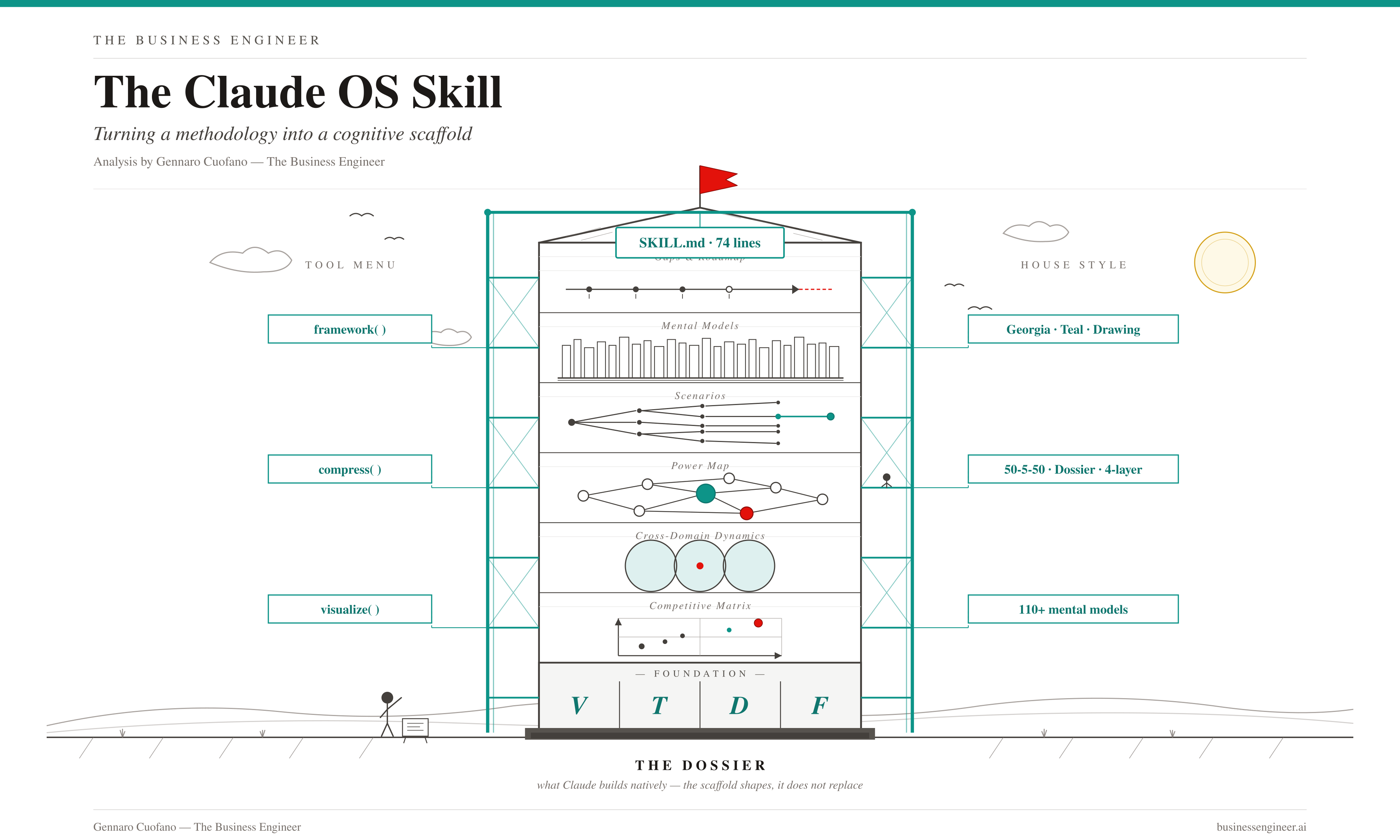
The conversation ends, the scaffold collapses, and the next session starts from zero. Prompts are ephemeral. Skills are durable. The Claude OS Skill for The Business Engineer is the methodology made executable — an always-on cognitive scaffold that Claude can invoke on demand.
Or purchase as a standalone product, in three installments!
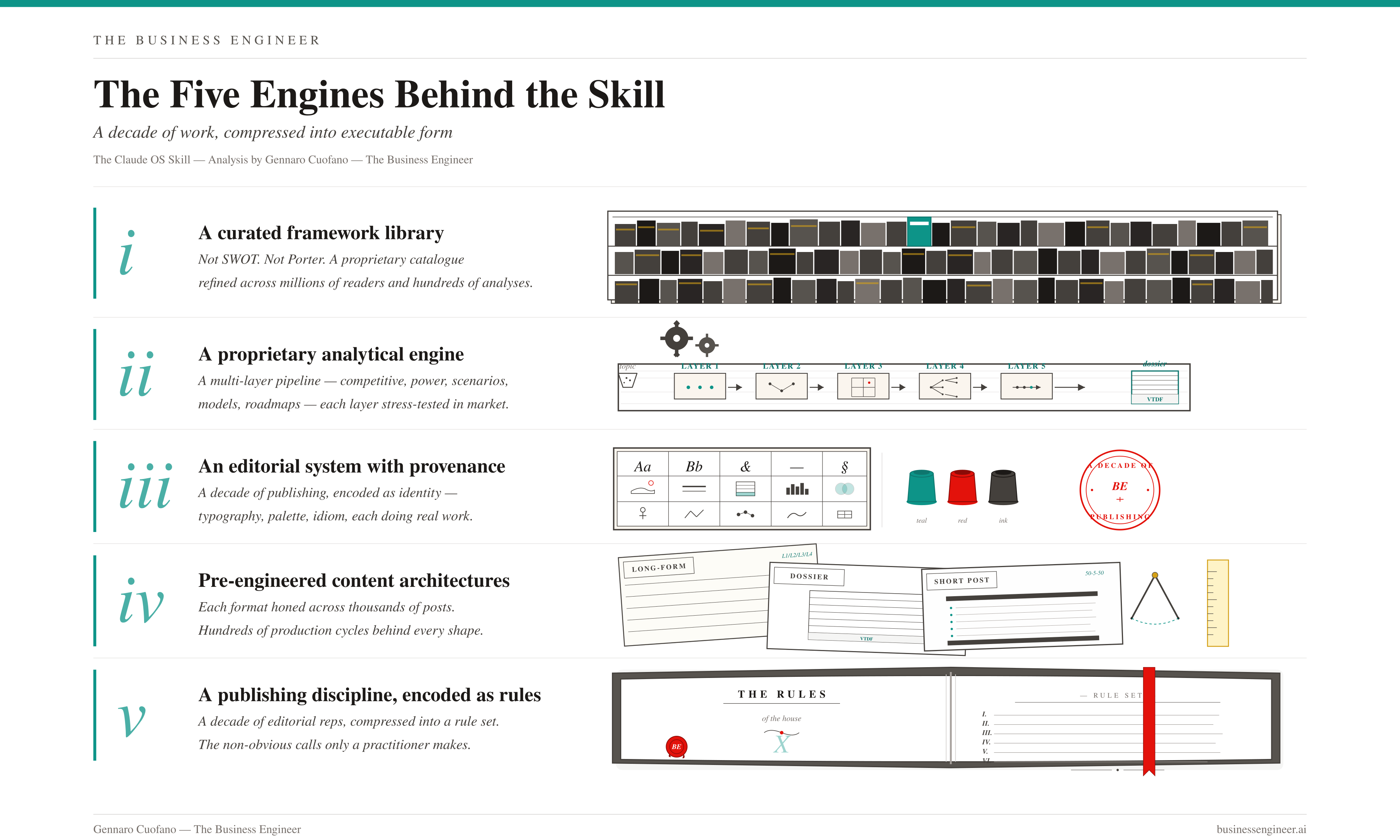
The five things the skill encodes
Or purchase as a standalone product, in three installments!
A curated framework library, not a default one: Behind the skill sits a decade of proprietary strategic models — refined across 4M+ readers, dozens of enterprise engagements, and hundreds of published analyses. Where generic AI reaches for SWOT or Porter, this reaches into a catalogue built from years of pattern-matching across AI infrastructure, platform economics, and enterprise transformation. The engine is the library itself — every output is the result of picking the right lens from dozens that have been tested in market.
A proprietary analytical engine: Every deep analysis runs through a structured, multi-layer analytical pipeline that took years to develop and stress-test. Competitive dynamics, power maps, cross-domain analogies, scenario modeling, mental model selection, strategic roadmapping — each layer is its own engine, and they compose. What looks like a clean finished dossier is the output of a full analytical stack running in sequence, producing results that are both rigorous and comparable across topics.
An editorial system with real provenance: The visual identity isn’t cosmetic — it’s a system refined over a decade of publishing, where typography, palette, illustration idiom, and attribution conventions encode trust signals and cognitive shortcuts for the reader. Every deliverable inherits that system automatically. The engine is the brand itself, and it’s doing real work: making the analysis recognizable, scannable, and citable.
Pre-engineered content architectures: Behind each format sits a tested content architecture — developed across thousands of posts and honed against what actually reads, scales, and converts. Short posts, long-form analyses, visual one-pagers, closing sections — each has an engine tuned to its purpose. You don’t reinvent the shape because the shape has already been through hundreds of production cycles.
A publishing discipline encoded as rules: The non-obvious editorial rules that separate genuinely analytical writing from generic AI output — the distinctions only a practicing strategic analyst would know to enforce — are pre-loaded as invisible constraints. Every subtle judgment about rigor, structure, narrative vs. mechanics, and intellectual honesty runs automatically. The engine here is a decade of editorial reps, compressed into a rule set that holds across every session.
Skills versus prompts: what actually changes
Or purchase as a standalone product, in three installments!
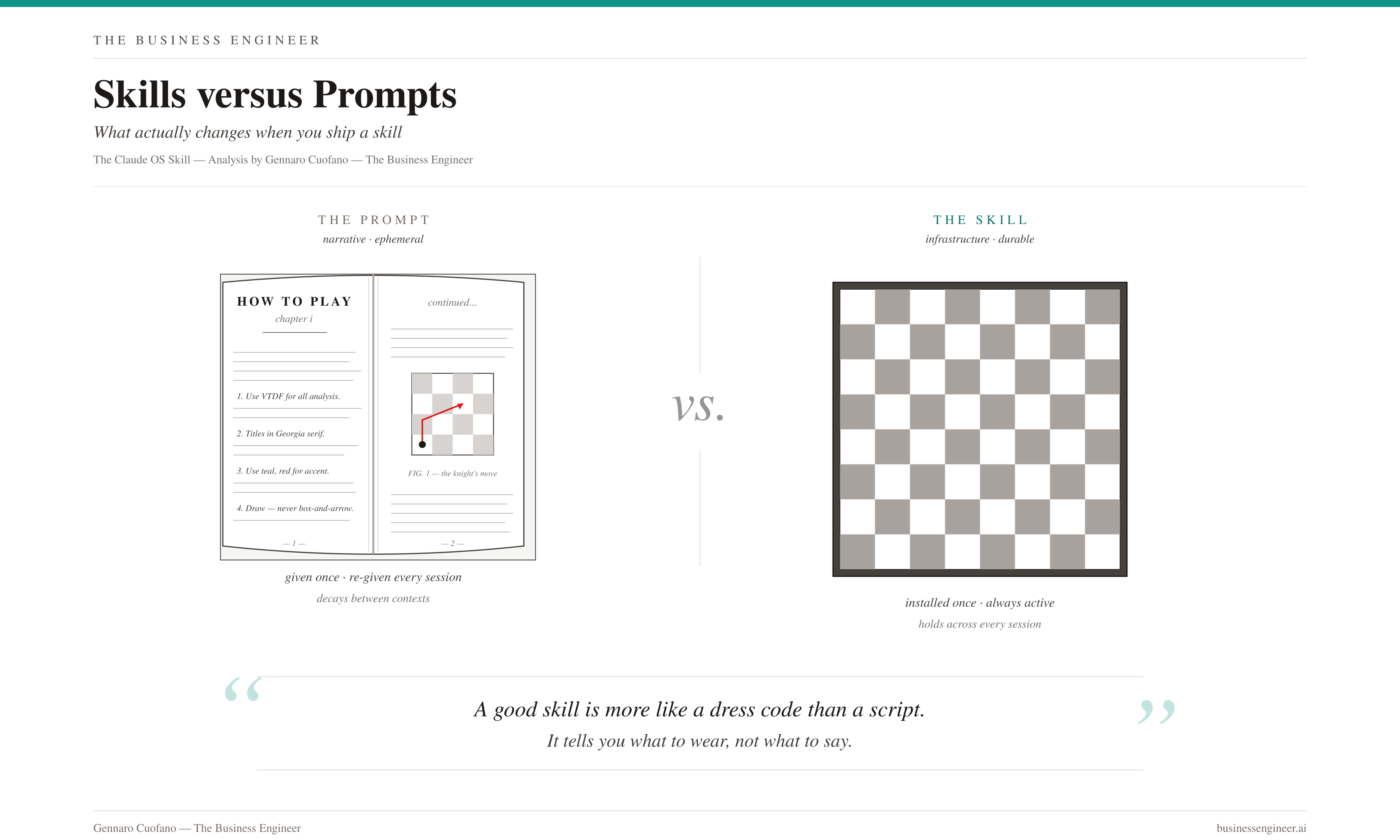
Prompts are instructions you give once. Skills are instructions Claude gives itself, every time, at the moments they’re relevant. The difference is the difference between telling someone how to play chess and handing them a chessboard — one is narrative, the other is infrastructure.
The Claude OS Skill is a single SKILL.md file. Seventy-four lines. It’s not a prompt library. It’s not a document dump. It’s a tool menu: when the user asks for a VTDF, here’s how to run it. When the user asks for an SVG series, here are the brand tokens. When the user asks for a mental model, here’s the catalogue to pull from.
The architectural decision underneath it: Claude generates the analysis natively; the skill serves as cognitive scaffold only. The skill doesn’t try to replace reasoning with lookups. It doesn’t try to pre-compute outputs. It constrains the shape of the thinking and then gets out of the way.
This matters because the failure mode of most “skill” or “custom GPT” designs is the opposite — they stuff the context with examples, force a template, and end up with rigid, brittle outputs that feel produced rather than thought. A good skill is more like a dress code than a script. It tells you what to wear, not what to say.
The architecture in one frame
Or purchase as a standalone product, in three installments!
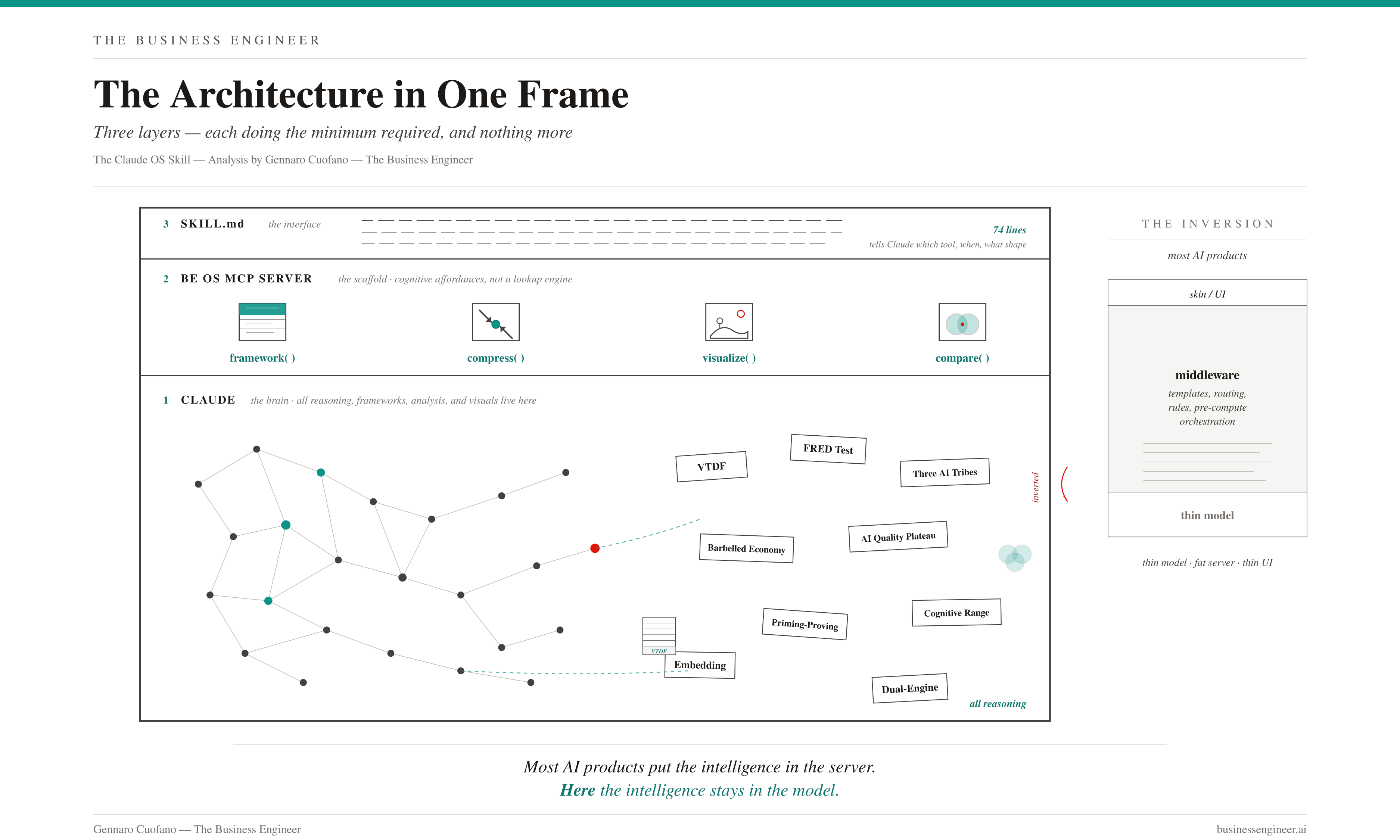
The Business Engineer stack has three layers, and the skill sits at the top:
Claude (the brain): does the reasoning, runs the frameworks, generates the analysis and the visuals.
The BE OS MCP server (the scaffold): exposes
framework,compress,visualize,comparetools — cognitive affordances that Claude can call when useful. Not a lookup engine. A prompt-shaping utility.The Claude OS Skill (the interface): 74 lines of
SKILL.mdthat tells Claude which tool to reach for, when, and in what shape.
The inversion worth noticing: most AI products put the intelligence in the server. Here the intelligence stays in the model, and the server is deliberately thin. The skill is thinner still. The whole system works because each layer is doing the minimum required and nothing more.
What it feels like to use
Or purchase as a standalone product, in three installments!
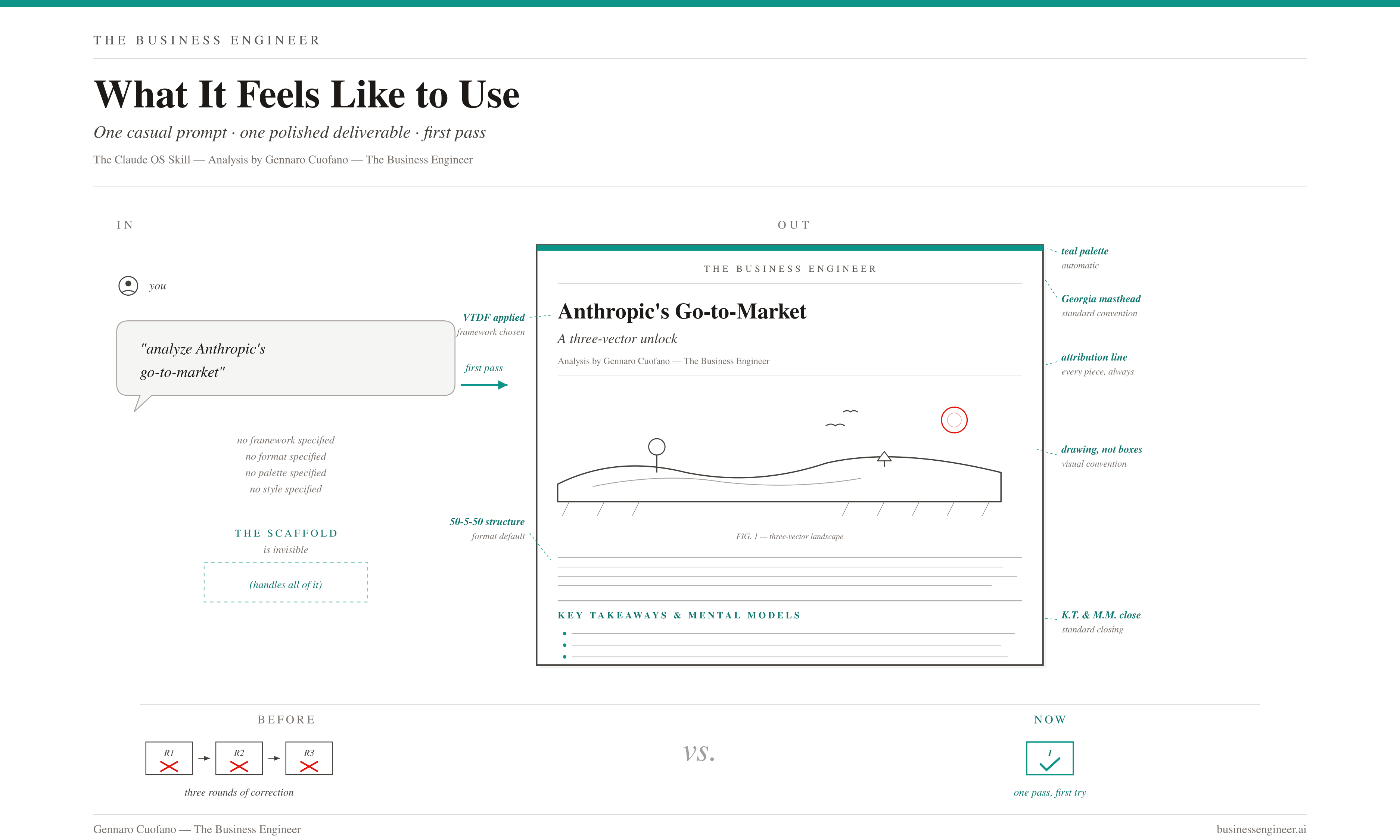
You open a session. You ask for an analysis of — pick one — Anthropic’s GTM, the AR interface landscape, the agentic commerce paradox, the Google compute flywheel. You don’t specify the framework. You don’t specify the format. You don’t explain the brand palette or the attribution line or the fact that you want an SVG series rather than a box diagram.
The skill handles all of it. The analysis comes back in the right shape, with the right mental models applied, in the right visual idiom, closing with the right section header. What used to take three rounds of correction now lands on the first pass. The scaffold is invisible; the output is consistent.
That consistency is the whole point. A methodology that only works when you personally sit at the keyboard isn’t a methodology — it’s a habit. A methodology that survives the handoff, the session break, the context switch, the collaborator — that’s infrastructure.
Why this changes the unit of intellectual capital
Or purchase as a standalone product, in three installments!
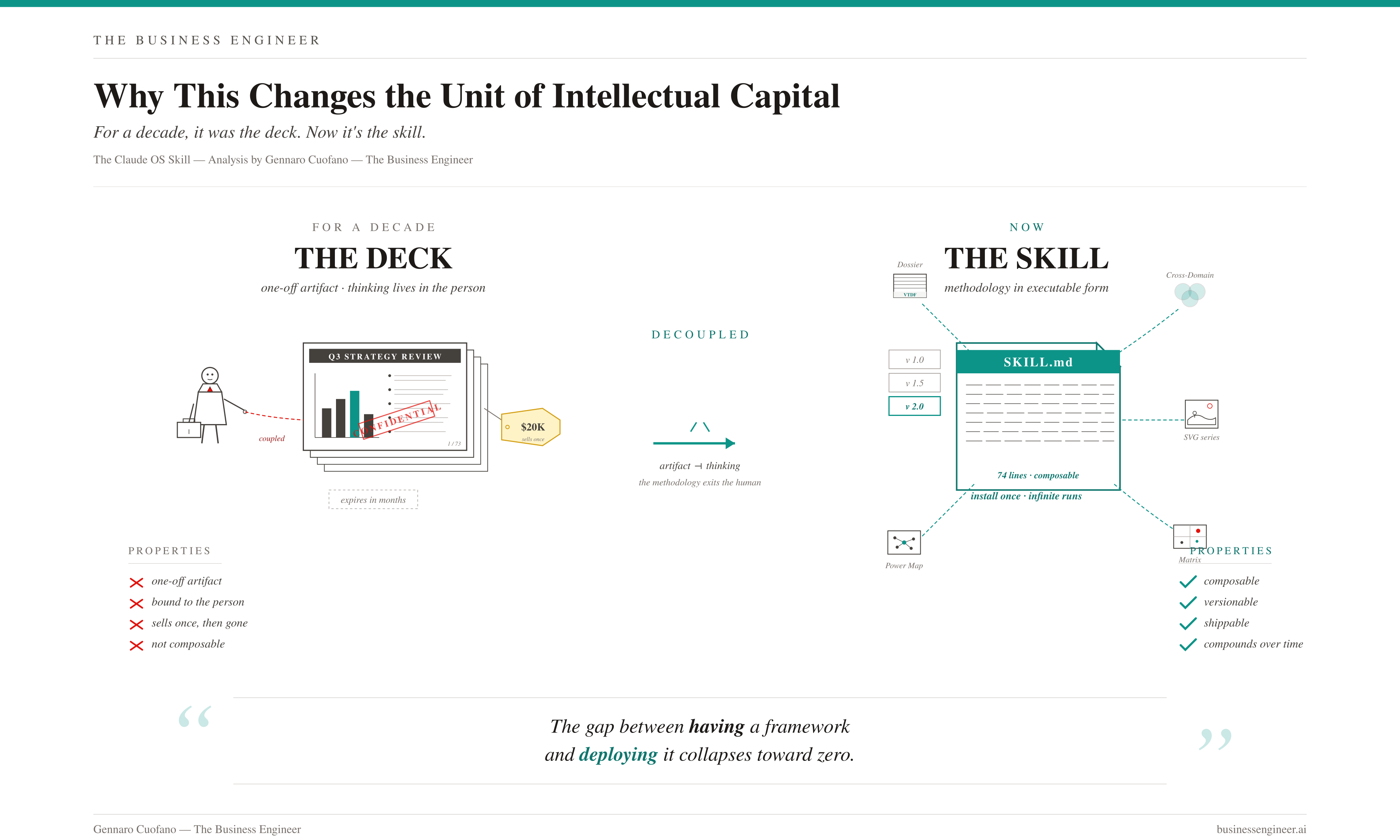
For a decade, the unit of intellectual capital in consulting and strategy work has been the deck. Slides are what get shipped, what get sold, what get cited. The deck is the artifact; the thinking lives inside the person who built it.
With skills, the artifact and the thinking decouple. The skill is the methodology in executable form — composable, versionable, shippable. You don’t hire a Business Engineer; you install the Business Engineer Skill. You don’t commission a dossier; you run the dossier tool. The gap between having a framework and deploying it collapses toward zero.
This is not a replacement for human judgment — the skill is a scaffold, not an oracle. But it does change what’s worth owning. Frameworks that used to live in books, courses, and billable hours can now live as skills. The ones that are genuinely composable, genuinely rigorous, genuinely better than the defaults — those become durable intellectual capital. The ones that were really just personal style get exposed.
Key Takeaways & Mental Models
Or purchase as a standalone product, in three installments!
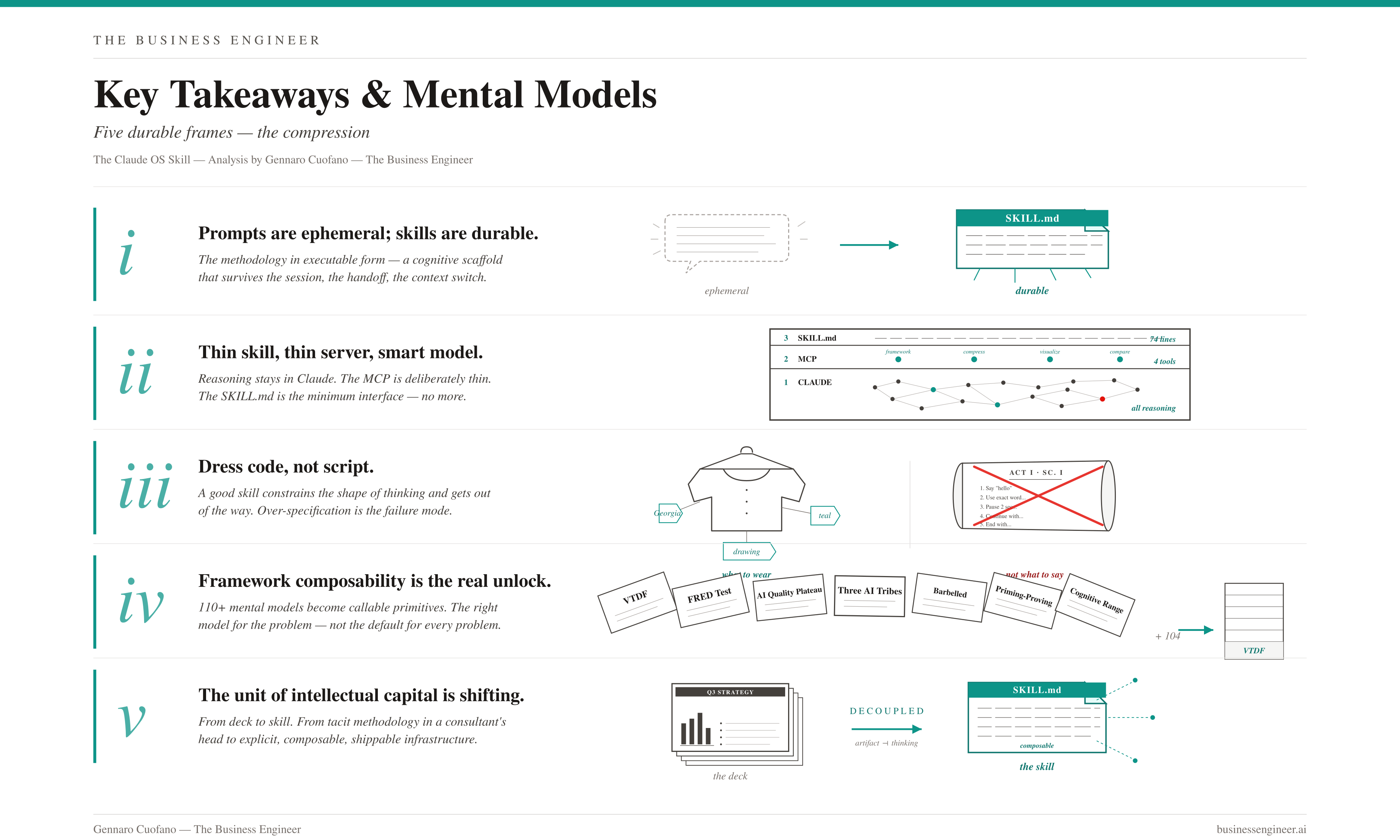
Prompts are ephemeral; skills are durable. The skill is the methodology in executable form — a cognitive scaffold that survives the session, the handoff, and the context switch.
Thin skill, thin server, smart model. The architectural bet is that reasoning stays in Claude, the MCP server is deliberately thin, and the
SKILL.mdis the minimum interface that shapes behavior without scripting it.Dress code, not script. A good skill constrains the shape of the thinking and gets out of the way. The failure mode is over-specification — stuffing context with templates until the output feels produced rather than thought.
Framework composability is the real unlock. 110+ mental models become callable primitives. The right model for the problem, not the default model for every problem.
The unit of intellectual capital is shifting. From deck to skill. From tacit methodology in a consultant’s head to explicit, composable, shippable cognitive infrastructure.
With massive ♥️ Gennaro Cuofano, The Business Engineer
