

Let me tell you the story of how The Business Engineer came about.
Let me start by saying, this is not a framework.
It is a complete grand-strategic apparatus, built over the last decade, that stacks four layers on top of each other: a philosophy about what reality is and how it can be known, a theory about how complex systems in the AI business era actually behave, a method for producing structural understanding of specific domains, and a set of frameworks that are outputs of the method rather than the substance of the practice.
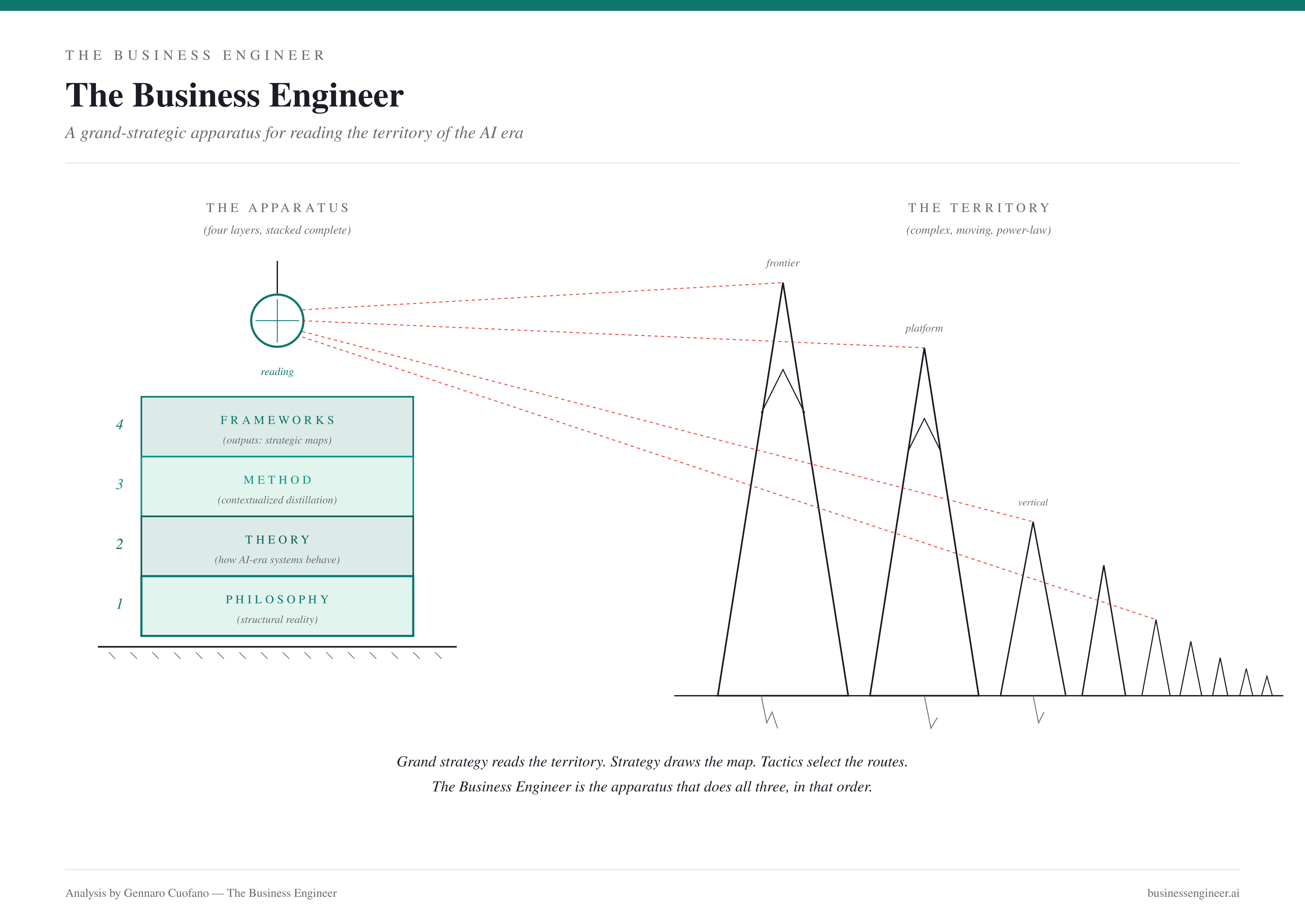
Most of what gets called strategic analysis in the AI economy occupies only the fourth of those layers — a framework, imported from somewhere, applied to whatever domain the analyst is looking at. The Business Engineer occupies all four, and the value comes from the stack being complete.
This piece is the description of that stack. What sits at each layer? Why does the stack have to be complete for any layer to work? And why it matters that the whole apparatus operates at the grand strategy altitude — reading the territory — rather than at the strategy or tactics altitudes, where most business analysis lives.
Follow me also on The AI Supercycle!
Grand strategy, strategy, tactics — and why the confusion is expensive
Follow me also on The AI Supercycle!
I have written about this before and I will repeat the frame here because it is foundational for everything that follows.
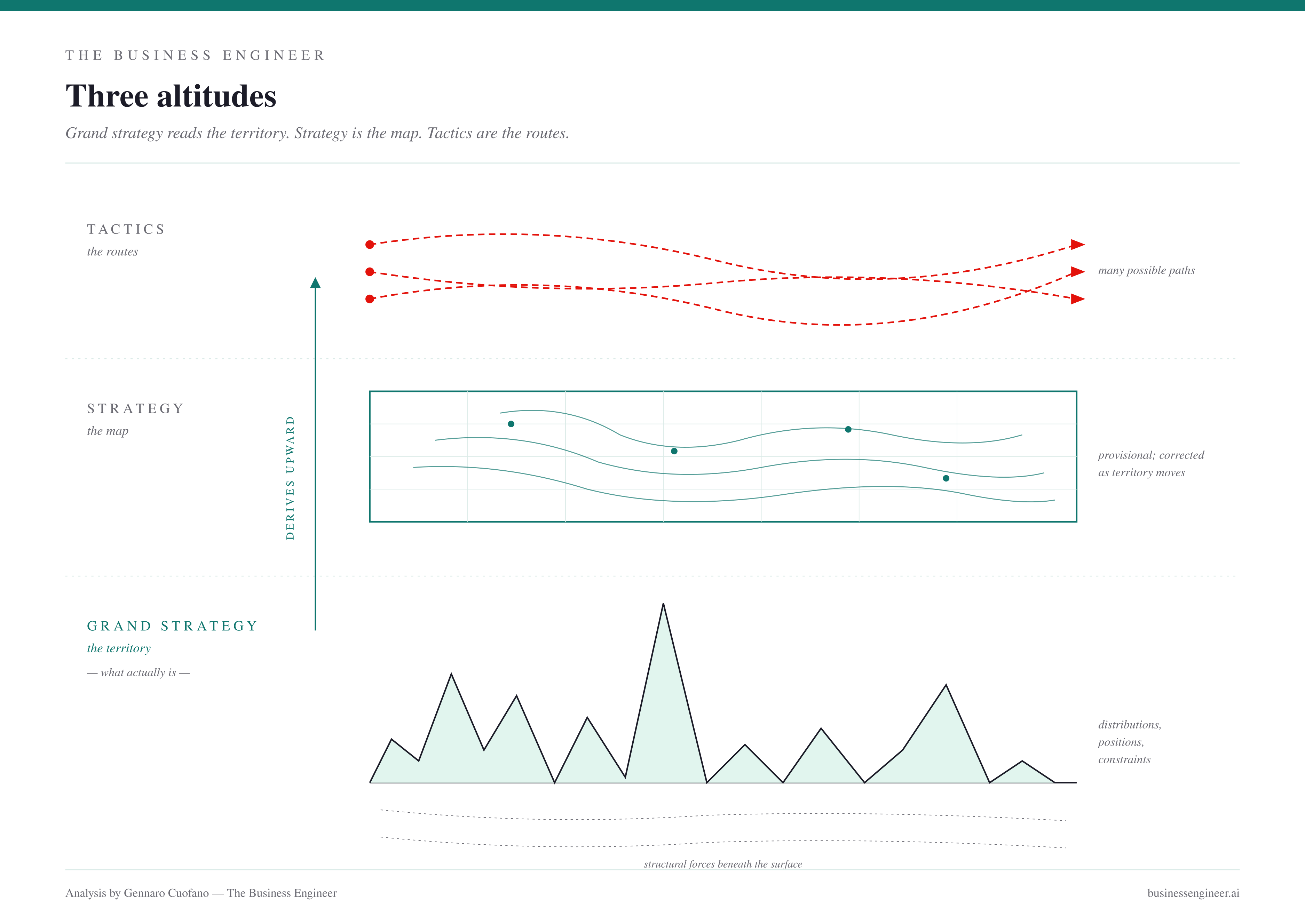
Grand strategy is reading the territory. It is understanding the underlying structure of the reality you are operating in — the distributions, the forces, the constraints, the dynamics that determine what is possible and what is not. Grand strategy is upstream of everything else. It is the layer where you look at the world and try to see what it actually is, before you decide what to do about it. Without grand strategy, everything downstream is guessing.
Strategy is the map. It is what you draft after you have read the territory — a working representation of the terrain that you can use to plan movement. The map is provisional; it is corrected when the territory turns out to be different from what the map showed. But the map is always derived from the territory. Any map that is not derived from a proper reading of the territory is not a strategy — it is a fiction being applied to a situation that does not match it.
Tactics are the routes. Given the territory and the map, tactics are the specific paths you can take. Many paths are possible. Some lead where you want to go. Most of what people call “strategy” in business is actually tactics — the selection of specific paths — dressed up in strategic language.
The confusion between these three altitudes is one of the most expensive mistakes in business, and it is the specific mistake most strategic analysis is currently making in the AI era.
People are producing tactical outputs, calling them strategy, and skipping grand strategy entirely — which is to say, they are drawing maps and selecting routes without ever having read the territory.
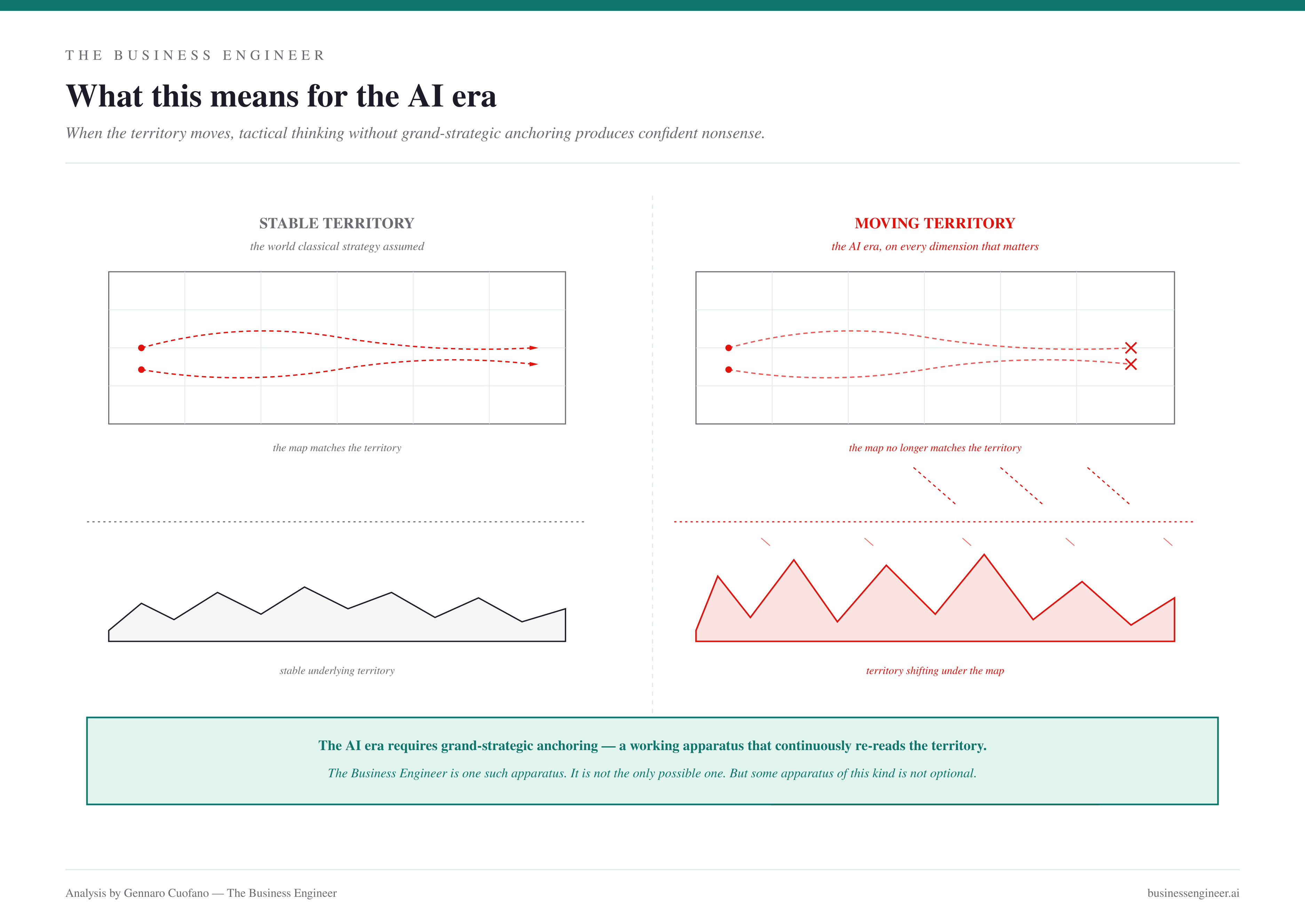
In a stable environment, this can be gotten away with; the territory doesn’t move fast, and old readings still roughly hold. In the AI era, the territory is moving faster than any map can keep up with, and any strategy or tactics not derived from continuous fresh reading of the territory becomes obsolete before it can be executed.
The Business Engineer is, first and foremost, an apparatus for reading the territory. That is what makes it grand-strategic rather than strategic or tactical. Everything else — the strategies it derives, the tactics it enables — is downstream of this. The apparatus is designed to do the grand-strategic work that most business practice skips, and to do it repeatedly, at scale, against the specific class of complex systems that define the AI era.
The philosophy
Follow me also on The AI Supercycle!
Every apparatus that reads territory operates on a philosophy — a set of underlying commitments about what reality is, what can be known about it, and what counts as knowing. Most strategic frameworks skip the philosophy layer entirely, which is why they produce outputs that are internally consistent and externally wrong when the underlying reality doesn’t match the framework’s implicit metaphysics.
The Business Engineer has an explicit philosophy, and it is worth naming because everything else derives from it.
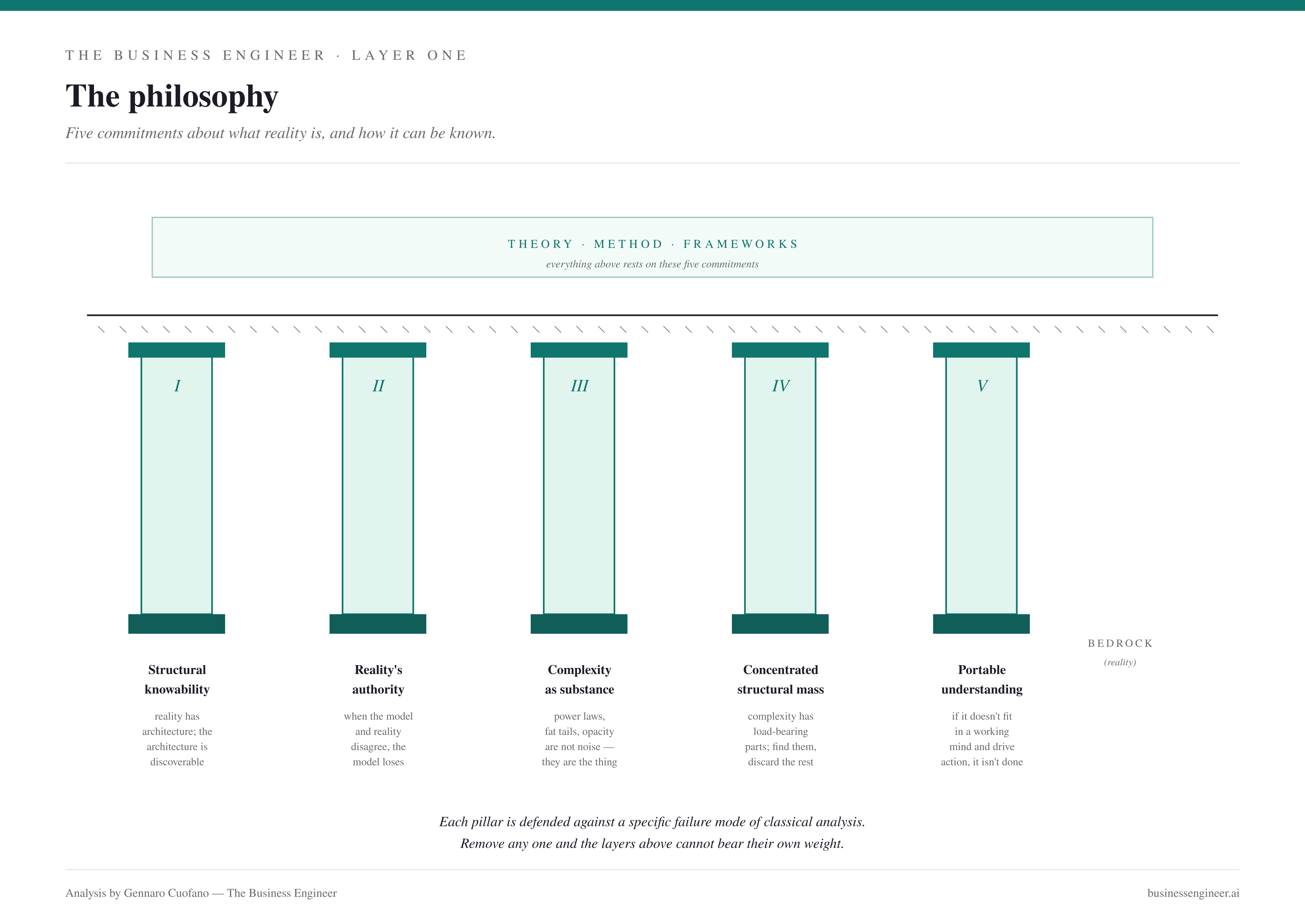
Reality is structural and structurally knowable. The world is not a collection of narratives, opinions, or perspectives. It has underlying architecture — distributions, forces, positions, constraints — that determines what is possible in it. This architecture is knowable, not in the sense of being fully specifiable, but in the sense of having foundational properties that can be identified, tested, and used to make decisions. Structural knowability is the first commitment. Without it, no analytical apparatus can be evaluated as right or wrong, only as more or less persuasive.
Reality is authoritative over the analyst. When the analyst’s model and reality disagree, reality wins. This sounds trivial and is not, because most analytical frameworks are structured in practice to be defended against disconfirming evidence rather than corrected by it. The Business Engineer’s second commitment is that the apparatus exists to be corrected by reality, not to survive against it. Any framework that cannot be wrong, cannot be right either; falsifiability is the property that makes structural knowledge distinguishable from ideology.
Complexity is a property of reality, not a failure of analysis. Most classical business analysis treats complexity as noise to be filtered out on the way to a clean model. The Business Engineer treats complexity as the substance of the phenomenon. Power-law distributions, fat tails, non-stationary dynamics, opaque causal chains, unbounded competitive fields — these are not analytical inconveniences. They are properties of how the AI economy actually behaves, and any apparatus that filters them out to produce a clean model has produced a clean model of something that isn’t there. Complexity-as-substance is the third commitment. It changes what “understanding” means.
Compression is possible without loss of foundational structure. Even in complex domains, it is possible to identify the small number of properties that carry the weight of the phenomenon — the distributions, the positions, the constraints that determine the domain’s behavior. The rest can be discarded. This is what distillation means, and it is a philosophical commitment before it is a methodological one: you have to believe that reality has this property — that its complexity is not uniformly load-bearing, that some structural properties matter much more than others — in order to build an apparatus around finding them. If everything about a complex domain matters equally, no apparatus can produce a portable, actionable understanding of it. The Business Engineer’s fourth commitment is that this is not the world we are in. Complex domains have concentrated structural mass, and finding that mass is the analytical project.
Structural understanding must be portable and actionable, or it is not understanding. An analytical output that cannot be held in a working mind, cannot guide a specific decision, cannot survive the analyst leaving the analysis behind — that output has failed regardless of how comprehensive it is. Portability is the fifth commitment. It rules out the class of analytical outputs that look rigorous, take three hundred pages to communicate, and produce no consequential action.
These five commitments together — structural knowability, reality’s authority, complexity-as-substance, concentrated structural mass, portable understanding — constitute the philosophy of The Business Engineer. Every commitment is defended against a specific failure mode in classical business analysis. Every commitment shapes what the apparatus can and cannot do at the layers above. This is the deepest layer of the stack and the one most other frameworks don’t have at all.
The theory
Follow me also on The AI Supercycle!
On top of the philosophy sits a theory — a set of foundational propositions about how the specific reality of AI-era complex systems actually behaves. The theory is not the philosophy; the philosophy is about reality in general, the theory is about this reality specifically. And the theory is not the method; the theory tells you what kind of world you’re in, the method tells you what to do about it.
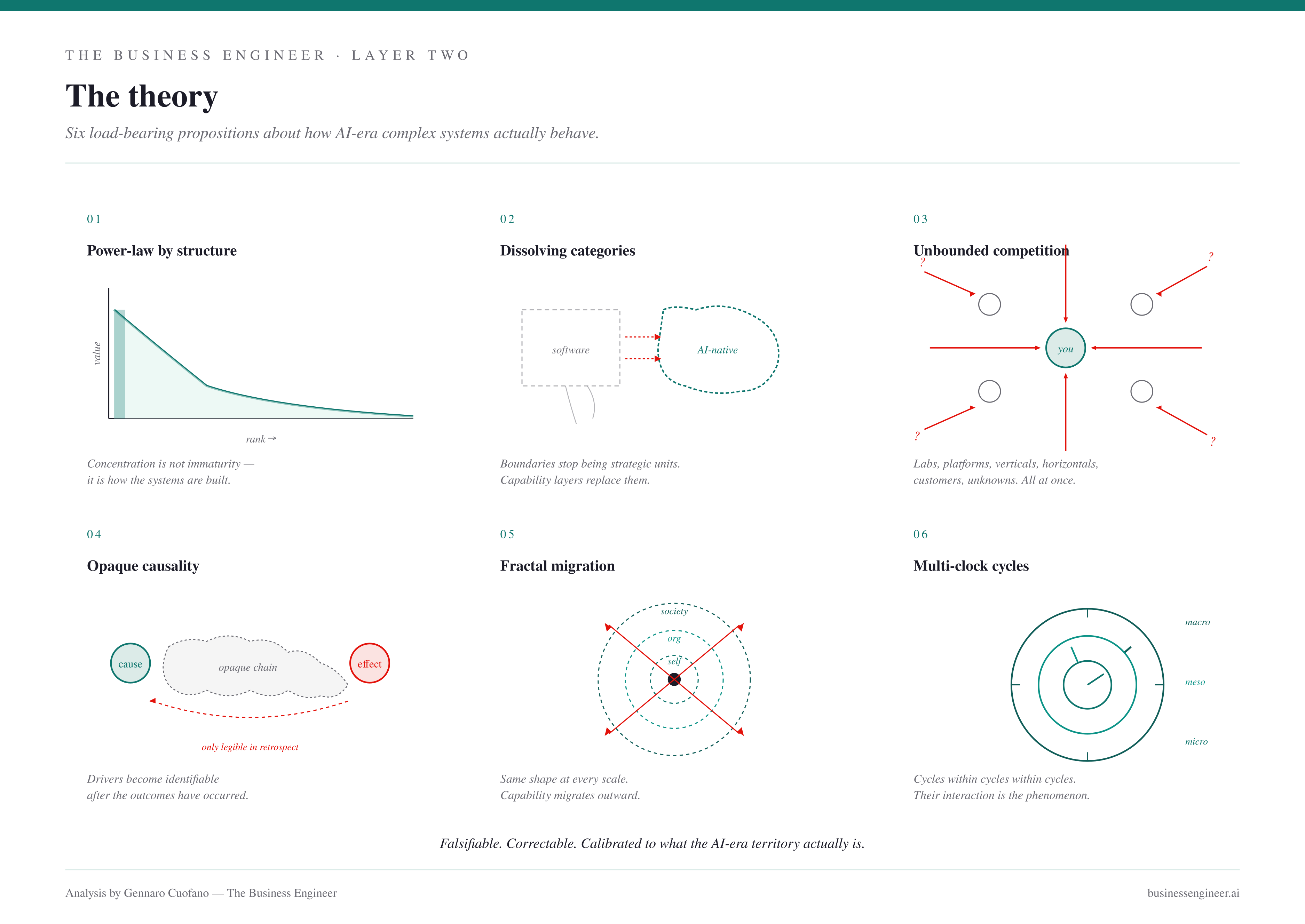
The Business Engineer’s theory, compressed to its essentials, holds that:
AI-era domains are power-law and fat-tailed by structure, not by accident. The concentration of value at the top of every distribution — labs, platforms, models, capabilities, returns — is not a temporary condition of an immature market. It is a structural property of how systems built on massive fixed capital costs, learning curves, and network effects distribute their outputs. Any analysis that treats these distributions as normal, or as convergent-toward-normal, is making a category error.
Categories in the AI economy are dissolving and reforming continuously. The industry boundaries that used to organize strategic analysis — software, media, financial services, retail, consulting — are becoming accidents of historical accretion rather than meaningful strategic units. The unit of analysis has shifted from industry to capability layer, and any framework that operates on the old units produces increasingly ceremonial outputs.
Competition is unbounded and multi-scalar. The relevant players in any domain include the labs upstream, the platforms downstream, the specialized incumbents in the vertical, the horizontal AI-native firms that could enter tomorrow, and the customers who might build their own and stop buying. Competitive analysis that identifies “the players” is producing a snapshot of who is visible today, not who will be competing tomorrow.
Causal chains are opaque in real time and legible only in retrospect. In the AI economy, the drivers of outcomes often become identifiable only after the outcomes have occurred. Cause and effect happen at inference speed. Strategic planning that assumes causal legibility in advance is assuming a property the domain does not have.
Capability migrates outward from cores to peripheries at fractal scales. This is the specific claim the Harness Trilogy developed — that in the AI era, the locus of value shifts from the model to the harness around it, and the same shape appears at the individual, organizational, and societal scales. This is a theoretical claim about how AI-era systems evolve over time, and it has predictive content that the last eighteen months have validated.
Structural transformations run on multiple nested clocks. The AI Supercycle framework specifies this: there are cycles within cycles within cycles, each running on its own clock, and the interactions between the clocks determine what looks like a bubble, what looks like a supercycle, and what actually is happening structurally. Any theory that operates on a single timescale misses the interaction effects that produce the phenomena everyone is trying to explain.
Together these propositions constitute the theory of how AI-era complex systems behave. They are not exhaustive. They are the foundational propositions — the ones that survive against reality repeatedly, produce non-obvious predictions, and structure how the method should be applied. The theory is what makes the method appropriate to this reality specifically, rather than to reality in general. A method without a theory is a technique; a theory without a method is an interpretation. The Business Engineer has both, and they are calibrated to each other.
The theory is also falsifiable, per the philosophy. Any of its propositions could be wrong. Any of them could be found not to hold in some specific domain. When that happens, the theory is corrected, and the method is recalibrated. This is what it means for the theory to sit on the philosophy: it is defended by the philosophy’s commitment to reality’s authority rather than by rhetorical defense against critique.
The method
Follow me also on The AI Supercycle!
On top of the theory sits the method — the specific practice for producing structural understanding of a given domain. The method is what most other analytical frameworks think they are; The Business Engineer’s method is one layer of a four-layer stack, not the whole thing. The method’s power comes from being anchored in the philosophy and calibrated to the theory. Detached from either, it becomes a technique that can be misapplied.
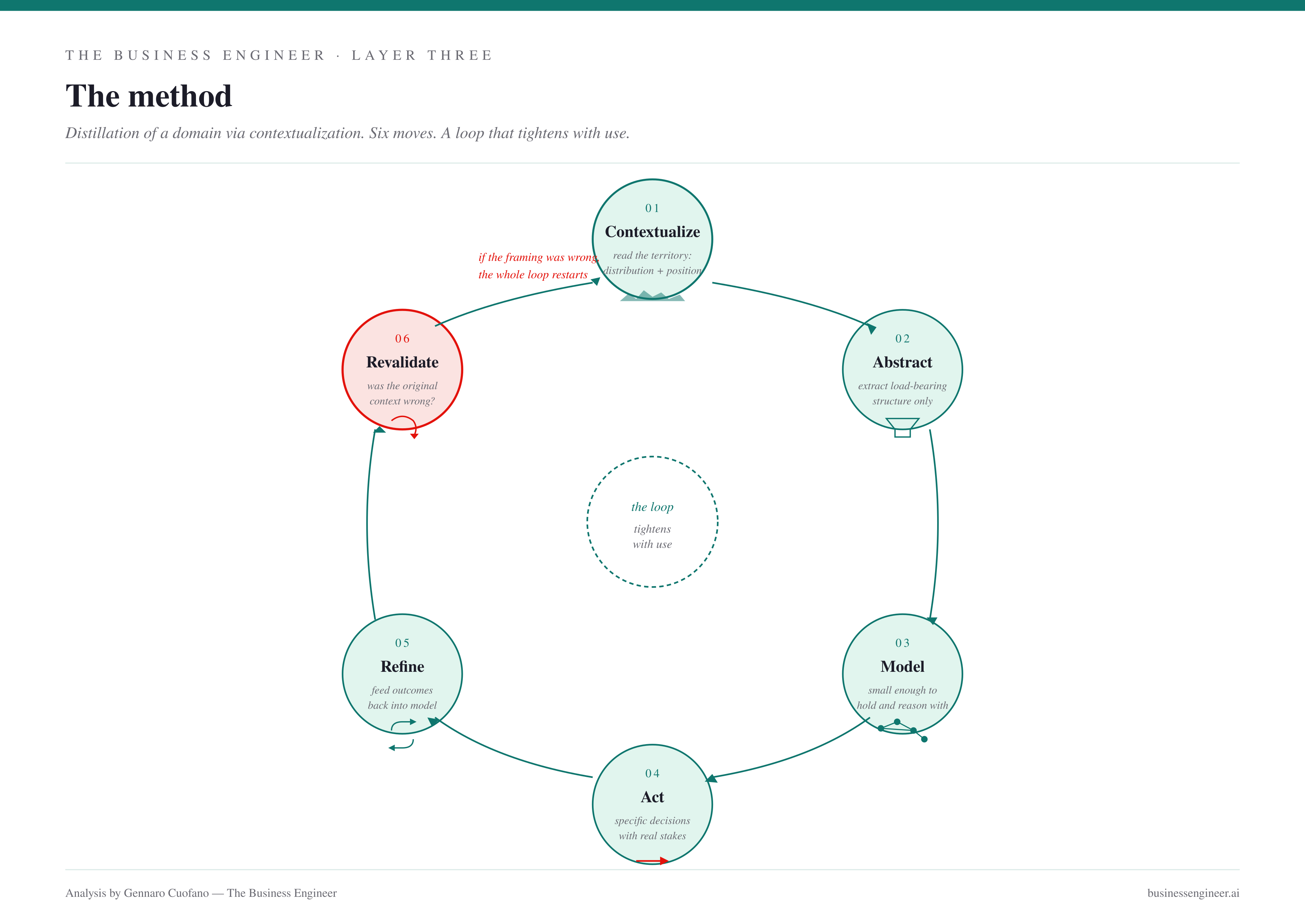
The method is what I have previously described as distillation of a domain via contextualization, and I will restate it here compactly because the previous piece walked through it in detail.
Contextualize. Identify the local distribution of the domain (power-law, fat-tailed, bimodal, normal — where does the mass sit, where are the tails) and identify where the domain sits in the broader architecture (upstream or downstream, substrate or superstrate, early or mature, regulated or unregulated). This is the grand-strategic reading of the specific territory. Everything downstream depends on getting it right.
Abstract. Extract the foundational structural properties from the context. Discard the surface. Identify what makes the domain behave as it does at the level of underlying structure.
Model. Build a working model of the domain’s dynamics that captures the foundational properties and is small enough to reason with. Not comprehensive. Distilled.
Act. Use the model to make specific decisions with real stakes and real consequences. Predictions without decisions produce no feedback.
Refine and revalidate. When outcomes arrive, feed them back. Adjust the model where the model was wrong. Adjust the abstraction where the abstraction was wrong. If the outcomes contradict the original context framing, the framing itself was wrong — go back to step one and rebuild. This is the step most methods skip, and it is the step that keeps the apparatus honest.
This is the method. Six operational moves, applied repeatedly, tightening with use. The method is what makes the apparatus a practice rather than a theory — it is what someone actually does when they are being The Business Engineer, as opposed to what they are thinking about.
But — critically — the method is not the whole apparatus. The method calibrated to a different philosophy would produce different outputs. Applied to a domain the theory doesn’t fit, it would produce wrong outputs. The method’s validity depends on the layers below it, which is why the frameworks it produces cannot be extracted from the stack and used alone. This is the specific way in which most attempts to copy analytical frameworks fail: the framework is extracted from its philosophical and theoretical context and applied in a different context, where it produces outputs that look right and are structurally wrong.
The frameworks
Follow me also on The AI Supercycle!
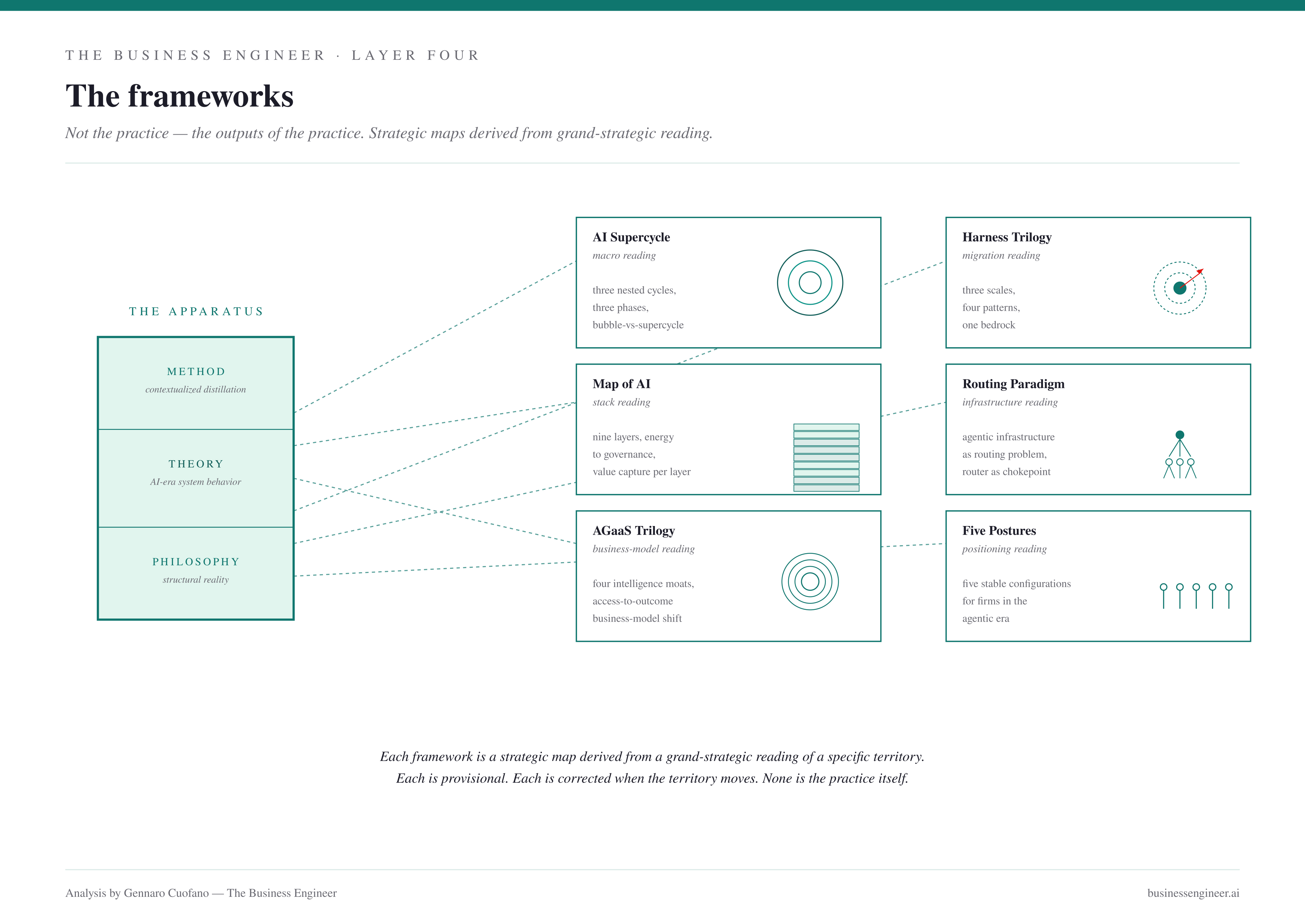
At the top of the stack sit the frameworks — the specific structural readings The Business Engineer has produced by applying the method to specific domains. These are what most readers encounter first, and they are the least fundamental layer of the practice. They are outputs, not the substance.
The frameworks include, among others:
The AI Supercycle — the reading of the AI economy as a whole, in terms of three nested cycles, three phases, and the specific ways in which the aggregate looks like a bubble and behaves like a structural transformation
The Map of AI — the reading of the AI stack as nine layers with different structural properties, distributions of return, and positional dynamics
The AGaaS Trilogy and its extensions — the reading of the shift from selling access to selling outcomes as a structural transformation, with four intelligence moats and a set of derived mental models
The Harness Trilogy — the reading of capability migration from model to harness as a fractal phenomenon at three scales, with four repeating patterns and one bedrock
The Routing Paradigm — the reading of agentic infrastructure as a routing problem with specific structural properties
The Five Postures — the reading of firm positioning in the agentic era as a set of five stable configurations with specific tradeoffs
Each of these is a strategic map — in the grand-strategy sense of the term — derived from a grand-strategic reading of a specific territory. Each is provisional; each is corrected when the underlying territory is found to have moved. Each is portable, actionable, and load-bearing in the specific senses the philosophy requires.
But these frameworks are not The Business Engineer. They are what The Business Engineer produces. Anyone who reads the frameworks without understanding the philosophy, theory, and method beneath them is holding the output without the apparatus that produced it — which means they cannot update the frameworks when the territory changes, cannot produce new frameworks for domains the existing ones don’t cover, and cannot evaluate whether a framework applies in a given case. The frameworks are the visible surface of the practice, and the invisible layers underneath are where the actual work lives.
This is why “framework” was the wrong word for the whole apparatus. Frameworks are outputs of the apparatus. The apparatus itself is the four-layer stack.
Why the stack has to be complete
Follow me also on The AI Supercycle!
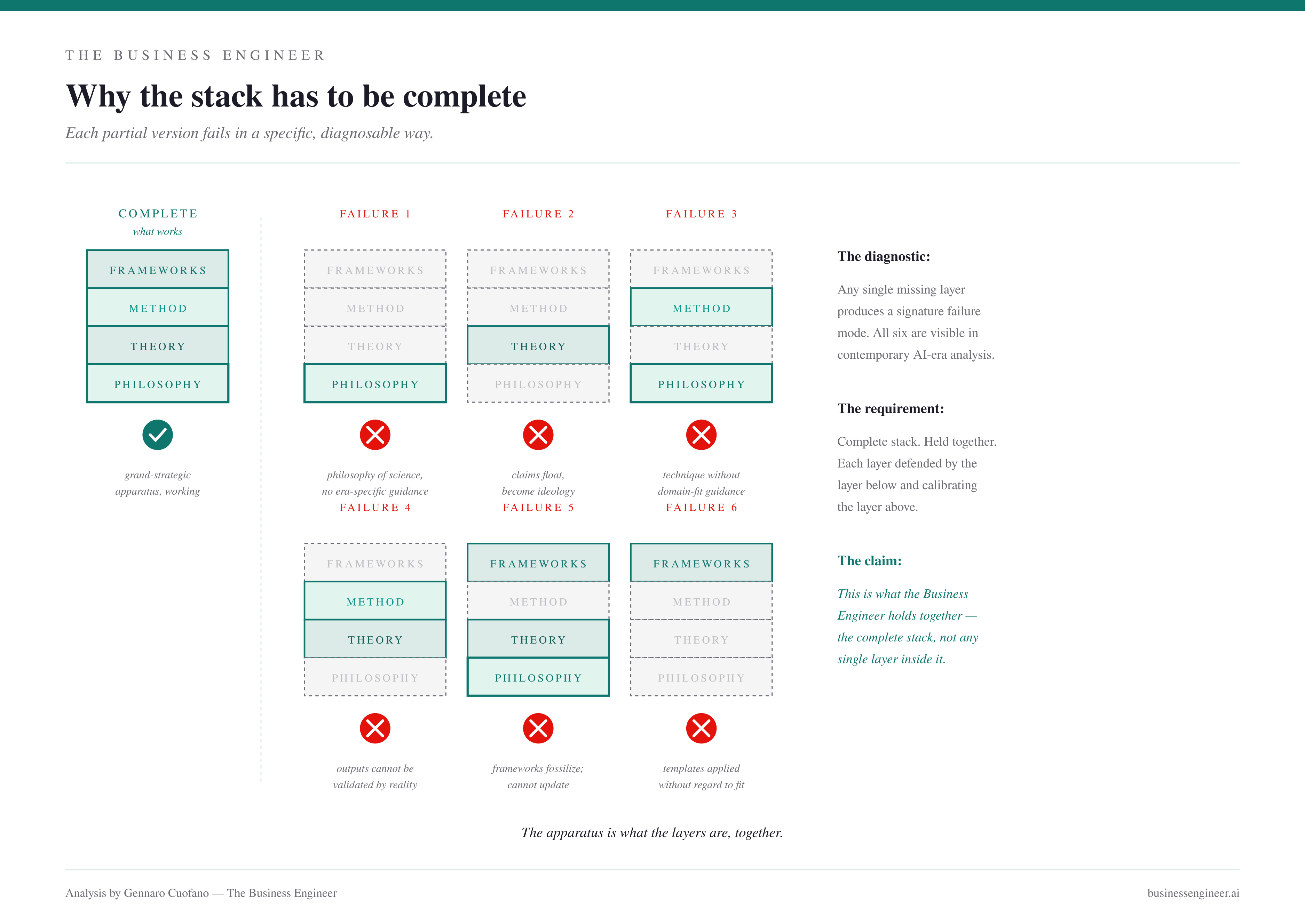
The stack could theoretically be broken. Someone could hold the philosophy without developing a theory. Someone could develop a theory without a method. Someone could apply a method without frameworks. Each partial version fails in a specific way, and enumerating the failures is worth doing because it clarifies why the complete stack is what the practice actually is.
Philosophy without theory produces a general commitment to structural reading of reality without any specific claims about the reality being read. This is philosophy of science, not applied analysis. It is not wrong, but it does not produce guidance for consequential decisions in a specific era.
Theory without philosophy produces claims about how AI-era systems behave that are not anchored in commitments about how such claims should be evaluated. This is what most AI-era analysis currently does: it makes claims about power laws, network effects, capability migration, and so on, without an underlying commitment to falsifiability and reality’s authority. The claims float, get defended, and become ideology when they should be corrected.
Method without theory produces a technique that can be applied to any domain, without a way of knowing which domains the technique is appropriate for. The method’s contextualization step becomes generic — “understand the domain” — rather than specifically targeted at the distributions and positions the theory identifies as foundational.
Method without philosophy produces a technique that can be executed but not evaluated. Outputs are produced; whether they are right or wrong becomes a matter of persuasion rather than validation. The revalidation step of the method depends on the philosophy’s commitment to reality’s authority; without it, revalidation becomes rhetorical rather than structural.
Frameworks without method produces static representations that cannot be updated. The Business Engineer’s frameworks are all provisional; they are corrected when the territory moves. Without a method that continuously reapplies contextualization and revalidation, the frameworks become fossils.
Frameworks without theory produces representations that cannot be evaluated for appropriateness to specific domains. Every framework has an implicit theory it depends on. Users who don’t hold the theory cannot know whether the framework applies in their case.
Frameworks without philosophy produces representations that are treated as doctrine rather than as tested structural readings. This is where most strategic framework use ends up: the framework becomes a template, the template is applied without regard to whether the underlying reality matches, and the outputs are treated as strategic even though they are barely tactical.
Every partial version of the stack is a specific failure mode. The complete stack is what avoids all of them. This is why The Business Engineer is a grand-strategic apparatus rather than a strategic framework. It has to occupy all four layers to do what it does. The frameworks it produces are strategic maps; the apparatus that produces them is grand-strategic; and the philosophy underneath is the deepest layer that makes anything above it possible.
What the apparatus demands of its user
Follow me also on The AI Supercycle!
An apparatus is only as good as the user operating it. Some frameworks are designed to be operated by anyone — that is one of their attractions and one of their limits. The Business Engineer is not designed to be operated by anyone. It is designed to be operated by someone willing to hold the whole stack, and holding the whole stack is itself a discipline.
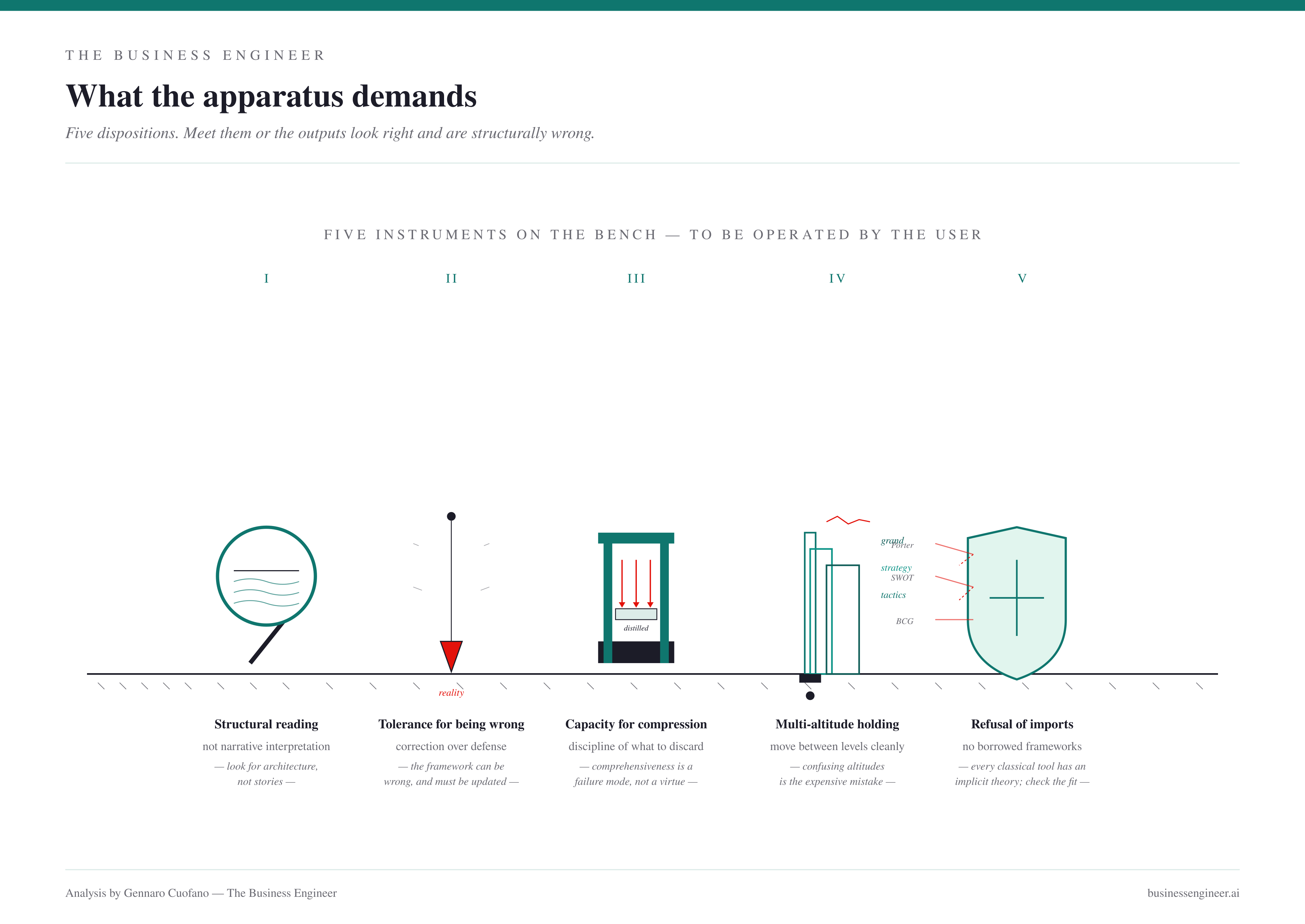
Specifically, the apparatus demands:
A commitment to structural reading over narrative interpretation. The user has to be willing to look for underlying architecture rather than for stories, personalities, or plausible-sounding explanations. This is a temperament as much as a skill, and it is not the temperament most business analysis rewards.
A tolerance for being wrong. The philosophy’s commitment to reality’s authority means the user will be corrected by outcomes, sometimes publicly, sometimes at cost. Users who cannot tolerate being wrong will defend their frameworks against correction, which converts the apparatus into ideology.
A capacity for compression. The apparatus produces distillations, not comprehensive reports. Users who cannot compress will produce outputs that miss the foundational structure while covering everything else. Compression is a discipline that takes years to develop and is rarely explicitly taught.
A willingness to hold multiple altitudes simultaneously. The apparatus operates at grand strategy, produces strategy, enables tactics. The user has to be able to move between altitudes without confusing them, which is the specific skill the grand-strategy essay identified as most valuable and most rare.
A refusal of imported frameworks. Every time the user is tempted to reach for Porter, or SWOT, or disruption theory, or any of the standard business-school toolkit, the apparatus requires them to stop and ask whether the imported framework’s implicit theory matches the domain. Almost always, it does not. The refusal is what keeps the apparatus honest; the temptation to import is constant.
These demands are why the apparatus produces the outputs it produces. They are not casual requirements. They are the specific dispositions the practice requires, and users who cannot meet them will produce outputs that look like Business Engineer work and are not.
What this means for the AI era
Follow me also on The AI Supercycle!
The AI era is going to reward the users of grand-strategic apparatuses and punish the users of tactical frameworks-dressed-as-strategy. This is a claim about the structural properties of AI-era decision-making, and it follows directly from the theory.
When the territory is stable, tactical thinking can be gotten away with; the underlying map doesn’t change, so old routes still work. When the territory moves, tactical thinking fails, because the routes lose their referent. The AI era is a moving-territory era on every dimension that matters. The distributions are shifting. The categories are dissolving and reforming. The competitive fields are unbounded. The causal chains are opaque. Under these conditions, tactical thinking without grand-strategic anchoring produces confident nonsense.
The apparatus described in this piece is one instance of a grand-strategic anchoring practice. It is not the only possible instance; there are others, some articulated, some tacit. What matters is that anyone making consequential decisions in the AI era needs some grand-strategic anchoring practice, because tactical execution alone will produce systematic errors of a kind that compound. The Business Engineer is what I have built. Whether readers use this apparatus, build their own, or find another that works — the requirement itself is not negotiable in the era we are entering.
That is what The Business Engineer actually is. A grand-strategic apparatus for reading the territory of the AI era, composed of four layers stacked completely: a philosophy of structural reality, a theory of AI-era complex systems, a method of contextualized distillation, and a set of frameworks that emerge as outputs of the method rather than as the substance of the practice. Everything I have written under this banner in the last decade is an application of this stack to a specific domain. Everything I will write is the same. The stack is the practice. The frameworks are downstream.
The correction from framework to apparatus is not cosmetic. It changes what the reader is being asked to hold, and what the practice is claiming to be. Held complete, the stack does the grand-strategic work that most business analysis skips. That is the value. That is what distinguishes it from the tactical frameworks that dominate the field. That is why the practice has held up for a decade and why it will continue to hold up as the territory keeps moving.
Key Takeaways & Mental Models
Follow me also on The AI Supercycle!
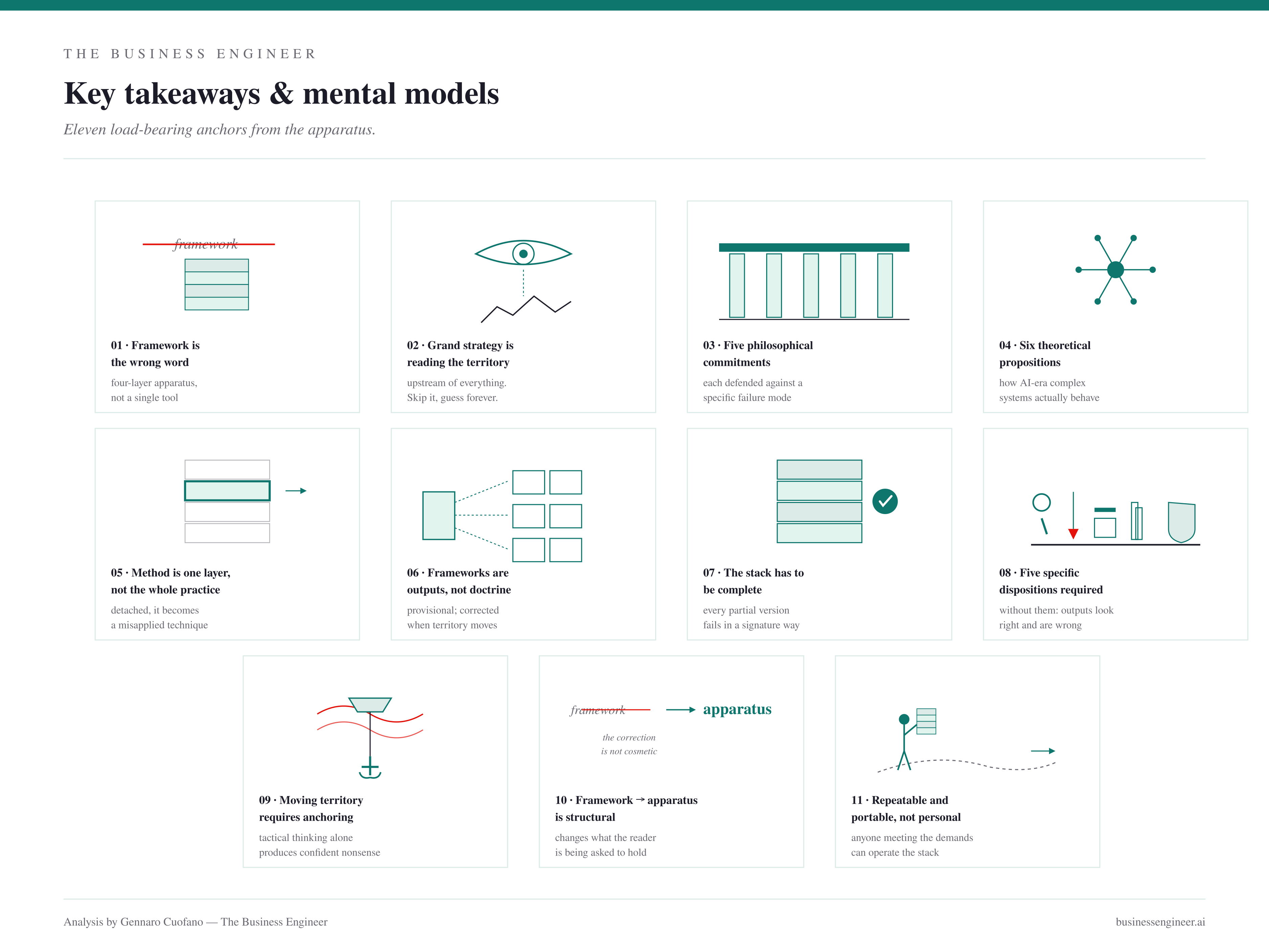
Framework Is the Wrong Word — The Business Engineer is a grand-strategic apparatus with four layers: philosophy, theory, method, and frameworks. Frameworks are outputs of the apparatus, not the apparatus itself. Most analytical practices occupy only the fourth layer, which is why they produce tactical outputs dressed as strategy.
Grand Strategy Is Reading the Territory — Not planning, not framing, not selecting routes. The specifically upstream work of understanding what reality is before deciding what to do about it. The Business Engineer operates at this altitude by design.
The Five Philosophical Commitments — Structural knowability of reality; reality’s authority over the analyst; complexity as substance not noise; concentrated structural mass in complex domains; portable and actionable understanding as the criterion of success. Every commitment is defended against a specific failure mode in classical analysis.
The Theory of AI-Era Complex Systems — Power-law distributions by structure; dissolving categorical boundaries; unbounded multi-scalar competition; opaque causal chains legible only in retrospect; fractal capability migration from cores to peripheries; multi-clock structural transformations. These are the load-bearing propositions the method is calibrated to.
The Method Is One Layer, Not the Whole Practice — Contextualize, abstract, model, act, refine, revalidate. Six operational moves. The method’s validity depends on the theory it is calibrated to and the philosophy it is anchored in. Detached from either, the method becomes a technique.
Frameworks Are Outputs, Not Doctrine — The AI Supercycle, the Map of AI, the AGaaS Trilogy, the Harness Trilogy, the Routing Paradigm, the Five Postures — each is a strategic map derived from grand-strategic reading of a specific territory. Each is provisional. Each is corrected when the territory moves.
The Stack Has to Be Complete — Every partial version of the stack fails in a specific way. Philosophy without theory is philosophy of science. Theory without philosophy is defended ideology. Method without either is a misapplied technique. Frameworks without any are fossils. The complete stack avoids each failure specifically.
The Apparatus Demands a Specific Discipline — Structural reading over narrative interpretation, tolerance for being wrong, capacity for compression, ability to hold multiple altitudes, refusal to import inappropriate frameworks. Users who cannot meet these demands will produce outputs that look like Business Engineer work and are not.
Moving Territory Requires Grand-Strategic Anchoring — When reality is stable, tactical thinking can be gotten away with. When reality moves, tactical thinking produces confident nonsense. The AI era is moving-territory on every dimension that matters. Grand-strategic anchoring is not a luxury; it is what keeps analysis oriented as the territory shifts.
The Correction from Framework to Apparatus Is Structural — Not cosmetic. It changes what the reader is being asked to hold and what the practice is claiming to be. Held complete, the stack does the grand-strategic work most business analysis skips. That is the value the practice claims and the value it can be tested against.
The Practice Is Repeatable and Portable, Not Personal — The apparatus is not a set of doctrines dependent on the person who built it. It is a repeatable stack that anyone willing to meet the demands can operate. The specific frameworks I have produced are one path through the apparatus. Others exist. The apparatus is the invariant.
With massive ♥️ Gennaro Cuofano, The Business Engineer