

Ask a serious operator the questions that now decide how a firm actually runs.
Who — or what — does the work today? Where is the work checked, and by whom? Which decisions stay human, and is that written down anywhere? And after the tools are adopted, the workflows rebuilt, the vendors installed: what does the firm still own?
These questions are live in every organization in the economy, and most writing about AI and work does not answer them. It debates headcount. It demos tools. It predicts, in both directions, with great confidence.
Meanwhile, the operating question — how should a firm be designed when machines generate, and humans judge — goes largely unaddressed, because it belongs to no one: too technical for the strategy shelf, too organizational for the engineering blog.
This is an operating-model question, and operating models have always followed one law: the firm reorganizes around whatever just became expensive. When labor was expensive, the assembly line. When coordination was expensive, the integrated corporation. When distribution was expensive, channel power. Each era’s scarce input set its winning design.
So name what just became cheap, and everything follows. What became cheap is generation — the production of competent first versions of knowledge work. Drafts, code, analyses, campaigns, contracts: the cost of a competent first version has fallen by one to two orders of magnitude in a few years, and it is still falling.
But generation was only one stage of the work. Around it sit the stages that did not get cheap: framing what is worth doing, checking whether the competent-looking artifact is actually right, and committing the firm’s name to it. Run the capacity test on any real organization — if generation doubled tomorrow, would committed, correct output double? Almost never. The queue has moved. When generation becomes cheap, judgment becomes the binding constraint of the firm — and by the old law, the firm’s economics, its scarce roles, and its power now reorganize around judgment.
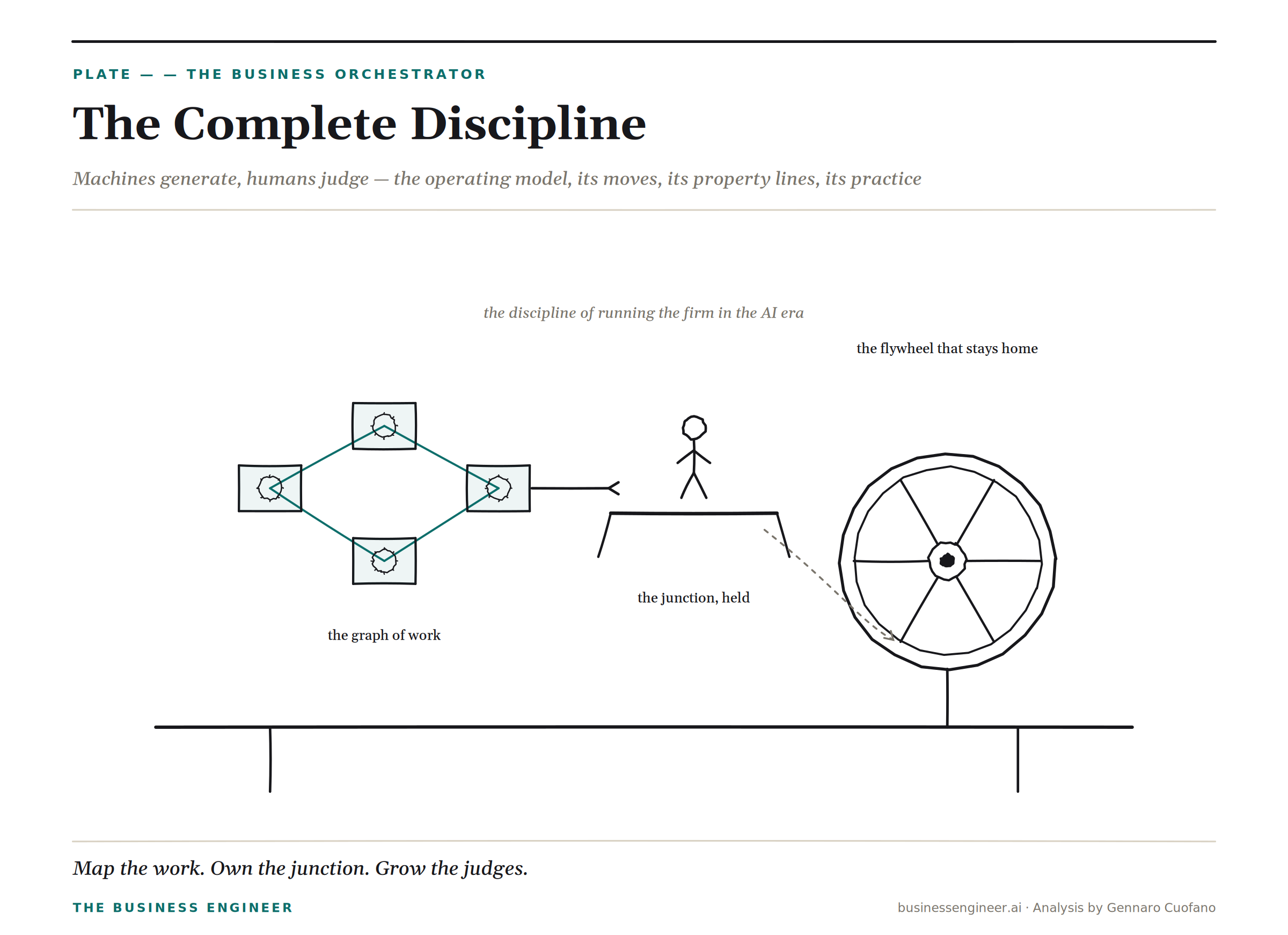
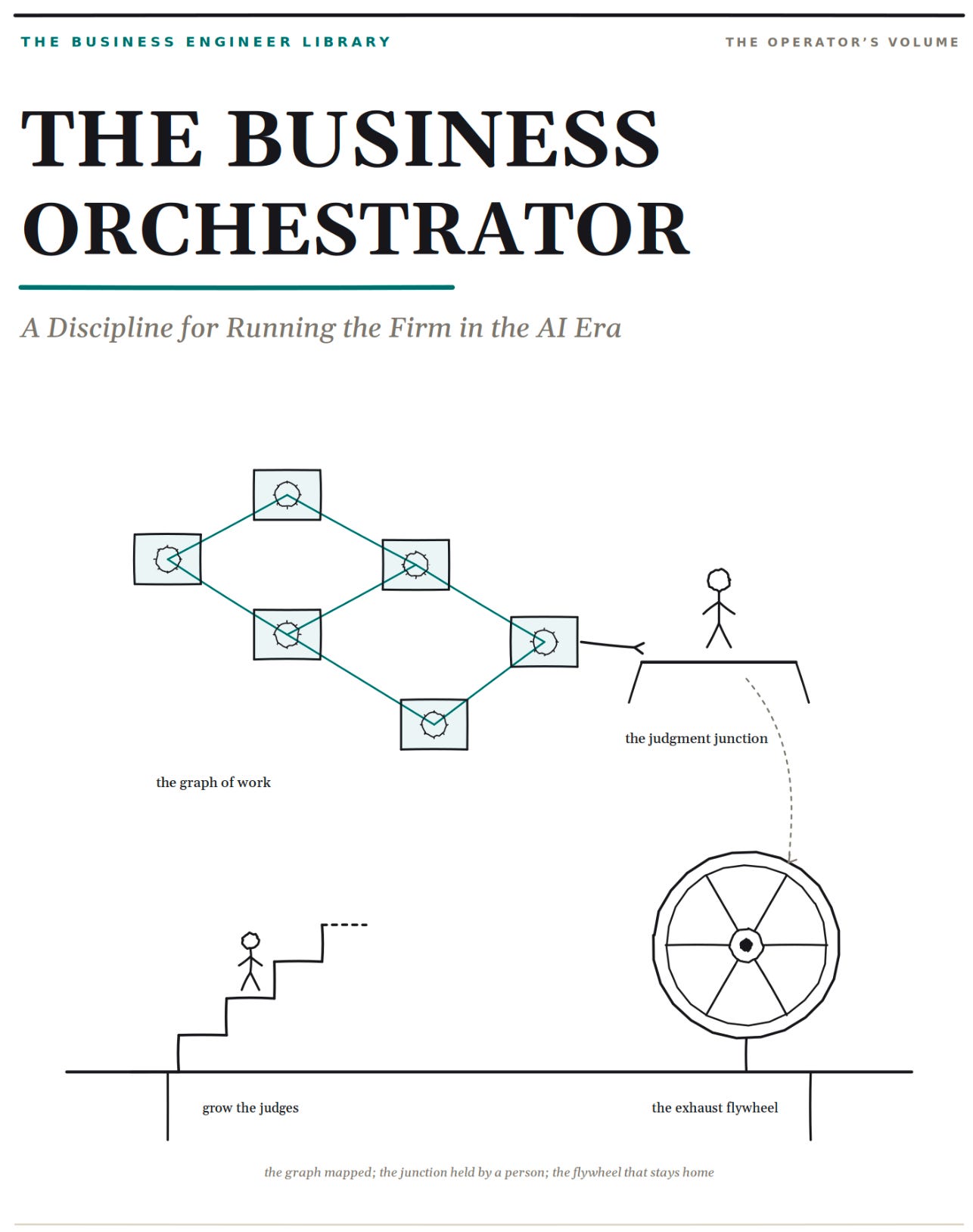
The person who runs that reorganization — who designs the workflows, holds the checkpoints, decides what is delegated and what is not — needs a name, because the role already exists everywhere even where no title has caught up with it. Call them the business orchestrator. The engineer of this Library’s Foundation Volume reads the system from outside. The orchestrator runs it from inside.
What follows is the discipline, compressed: the evidence, the unit, the organization, the five moves, the property lines, and the practice.
If you’re already a paid member, simply reply to this email, and we’ll send it your way.
The evidence — both halves of it
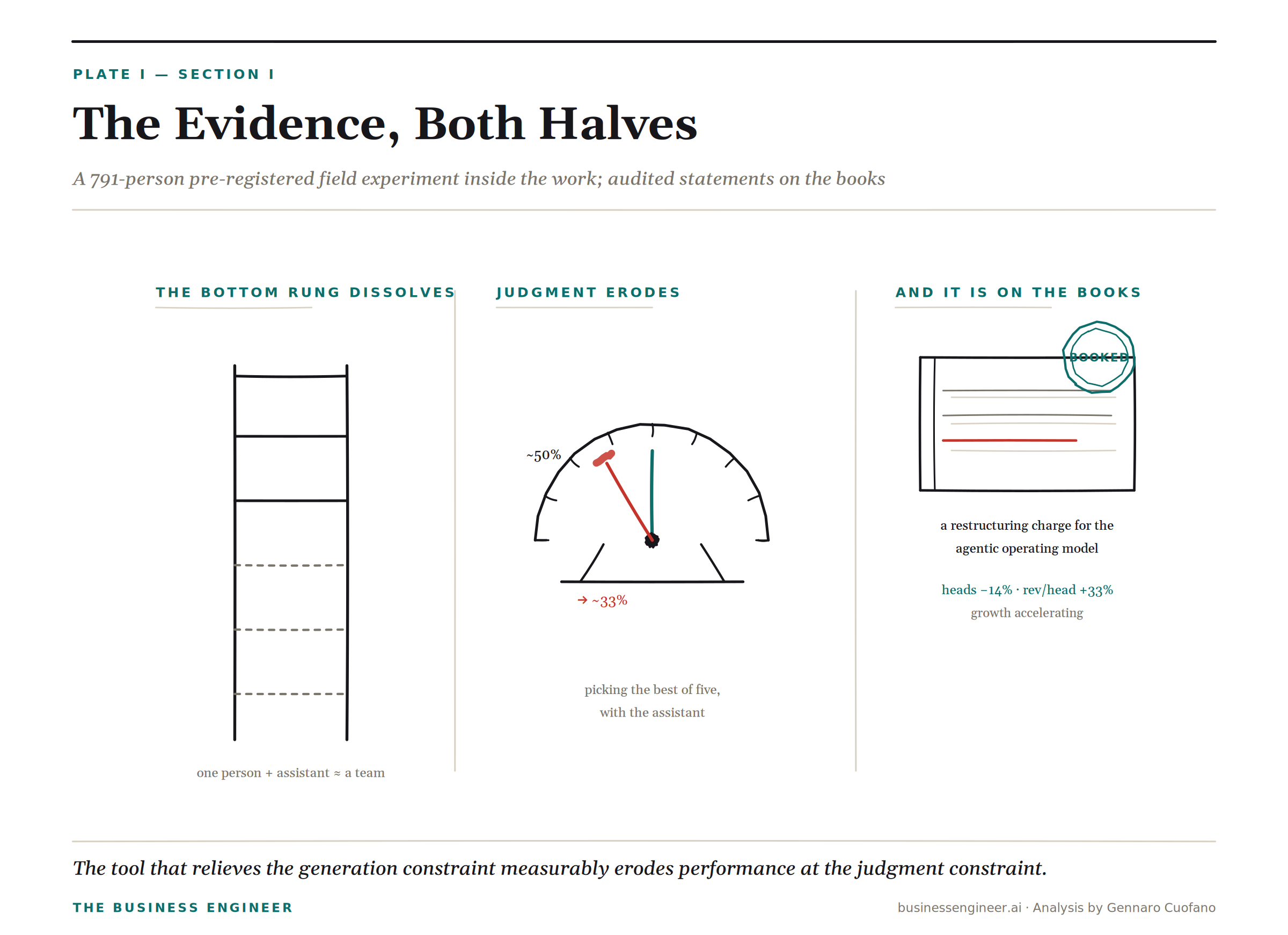
The claims above no longer rest on anecdote. They rest on the two strongest evidence classes available: a pre-registered field experiment at industrial scale, and audited financial statements.
The experiment is “The Cybernetic Teammate” — Dell’Acqua, Lakhani, and colleagues, Organization Science, 2026 — run inside Procter & Gamble: seven hundred ninety-one professionals, real product-development work from their own business units, randomly assigned to work alone or in pairs, with or without an AI assistant, output blind-scored by human evaluators. It is, at this writing, the largest and best-designed test of AI-assisted knowledge work on record. Three findings form the empirical spine of the discipline.
First: the bottom of the expertise ladder dissolves. Individuals with the assistant performed at the level of two-person teams without it. Professionals working outside their specialty matched teams that included a specialist. The competence that used to define the lower and middle rungs of knowledge work is now available on demand, to anyone, in seconds.
Second — and this is the finding the discipline refuses to soften: the same tool measurably erodes judgment. When participants had to select the best of several candidate outputs — the exact activity the new operating model concentrates value in — those working with the assistant did markedly worse: selection accuracy fell from roughly one-in-two to roughly one-in-three. The mechanism is the tool’s fluent, agreeable confidence, which makes weak candidates look strong. And assisted participants produced better work while feeling less sure of it — the tool decouples the feeling of judgment from its accuracy, in both directions.
Third: the staircase is missing. The lower rungs were never just output — they were the apprenticeship through which judgment was built. If their output is now free, the economic reason to make humans climb is gone, and with it the by-product the climb produced.
And a fourth reading sits beneath the three, reframing a century of assumptions about collaboration itself. The study’s deepest result is not that the assistant makes individuals faster — it is that the assistant substitutes for a measurable part of what teams existed to do. Assisted individuals replicated the breadth teams were assembled to provide: the blend of technical and commercial perspective that used to require two differently-shaped professionals in a room. The tool behaved less like software and more like a teammate. The consequence cuts both ways. Downward: the standing working pair assembled for perspective coverage is no longer automatically justified — which is exactly why the season’s revenue-per-head numbers move. Upward: what teams still add is the one thing the machine-teammate cannot supply and actively erodes — independent judgment lines. A team whose members converge on the assistant’s confident output has the headcount of a group and the error profile of an individual. The group’s new job is judgment diversity by construction — blind parallel calls, independent checks, disagreement treated as signal.
The financial half is briefer because it is unambiguous. In the most recent earnings season, one infrastructure company booked a restructuring charge of roughly a hundred and fifty million dollars to reorganize around agentic operations — headcount down a seventh in one quarter, revenue per employee up a third, growth accelerating through the change. An enterprise-software maker crossed a billion dollars of AI annual contract value without owning a frontier model. The reorganization is no longer a forecast. It is a line item.
The unit — and the one distinction that decides everything
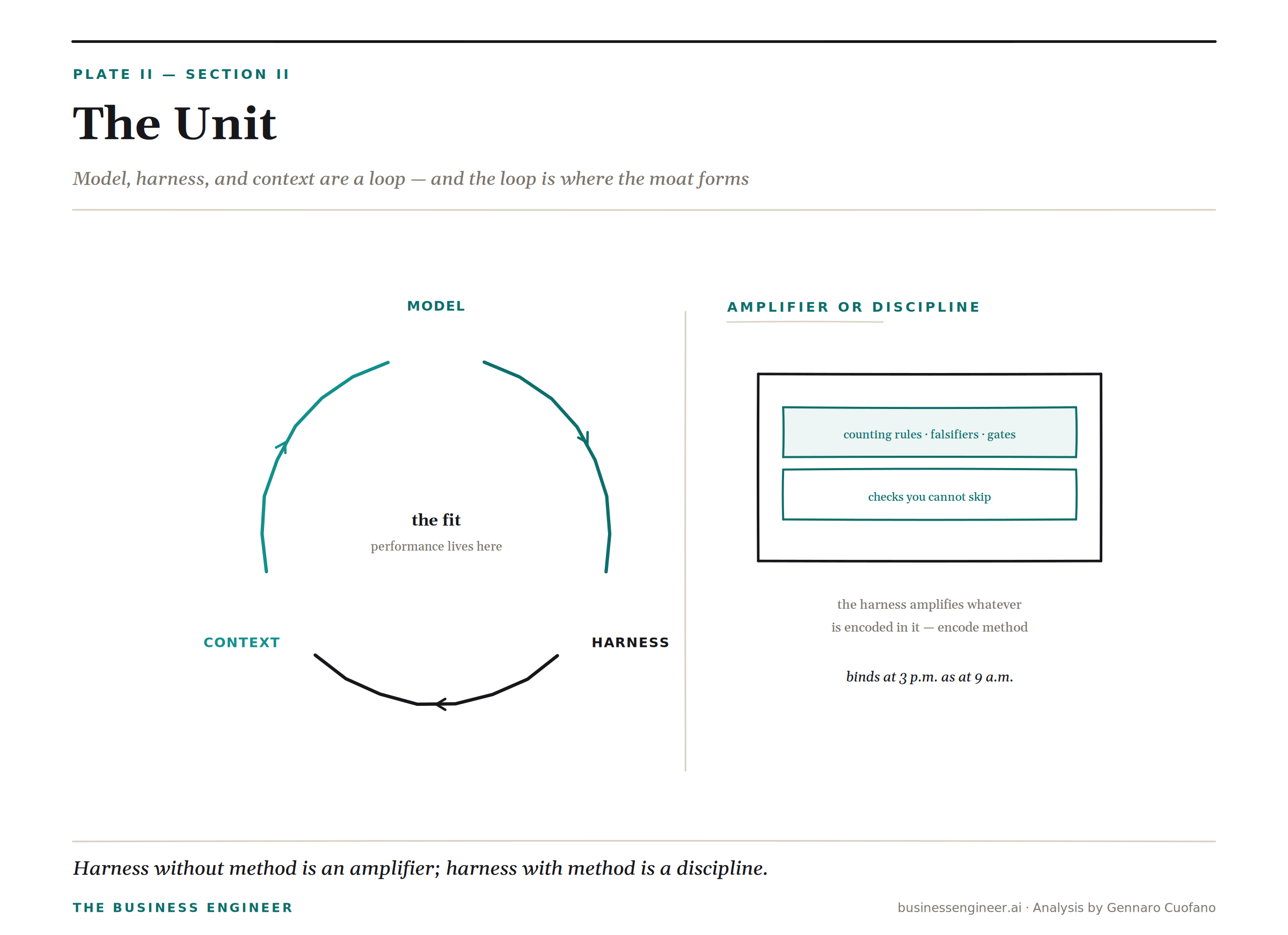
The unit of the new operating model is not the model and not the employee. It is the harnessed agent: software executing a defined flow, a human judging defined checkpoints. Its anatomy is nine elements in four bands — the model (rented, interchangeable); the harness (orchestration, tools, memory, grounding, self-checks, evaluations); the context (the firm’s own data, definitions, and corrections); and the enclosure (the runtime that separates capability from blast radius).
One published demonstration is the charter of the whole design: an open-weight model at a tenth of frontier cost matched frontier task performance — and the buried clause carried the meaning: the model was never retrained. All the gain came from tuning what surrounds it. The performance of a working agent lives less in the model than in the fit of everything around it — model, harness, and context adapting to one another in a loop. Which means benchmarks mislead by construction, cheapness is a capability (a tenth of the cost buys ten attempts per task), and the compounding lives in the layers the firm tunes, not the model it swaps.
Then the distinction that sorts every deployment: a harness is an amplifier. It runs whatever process is encoded in it, at industrial throughput. Encode sloppiness and you have built a machine for confident error — the erosion finding, industrialized. Encode method — counting rules as schema checks, required falsifiers, checkpoints that cannot be skipped — and the same machine protects judgment instead of degrading it. Harness without method is an amplifier; harness with method is a discipline. The response to eroding judgment is not exhortation, which collapses under throughput. It is judgment you cannot skip: externalized into structure, so it binds at 3 p.m. exactly as it binds at 9 a.m.
The organization — graph, junction, staircase
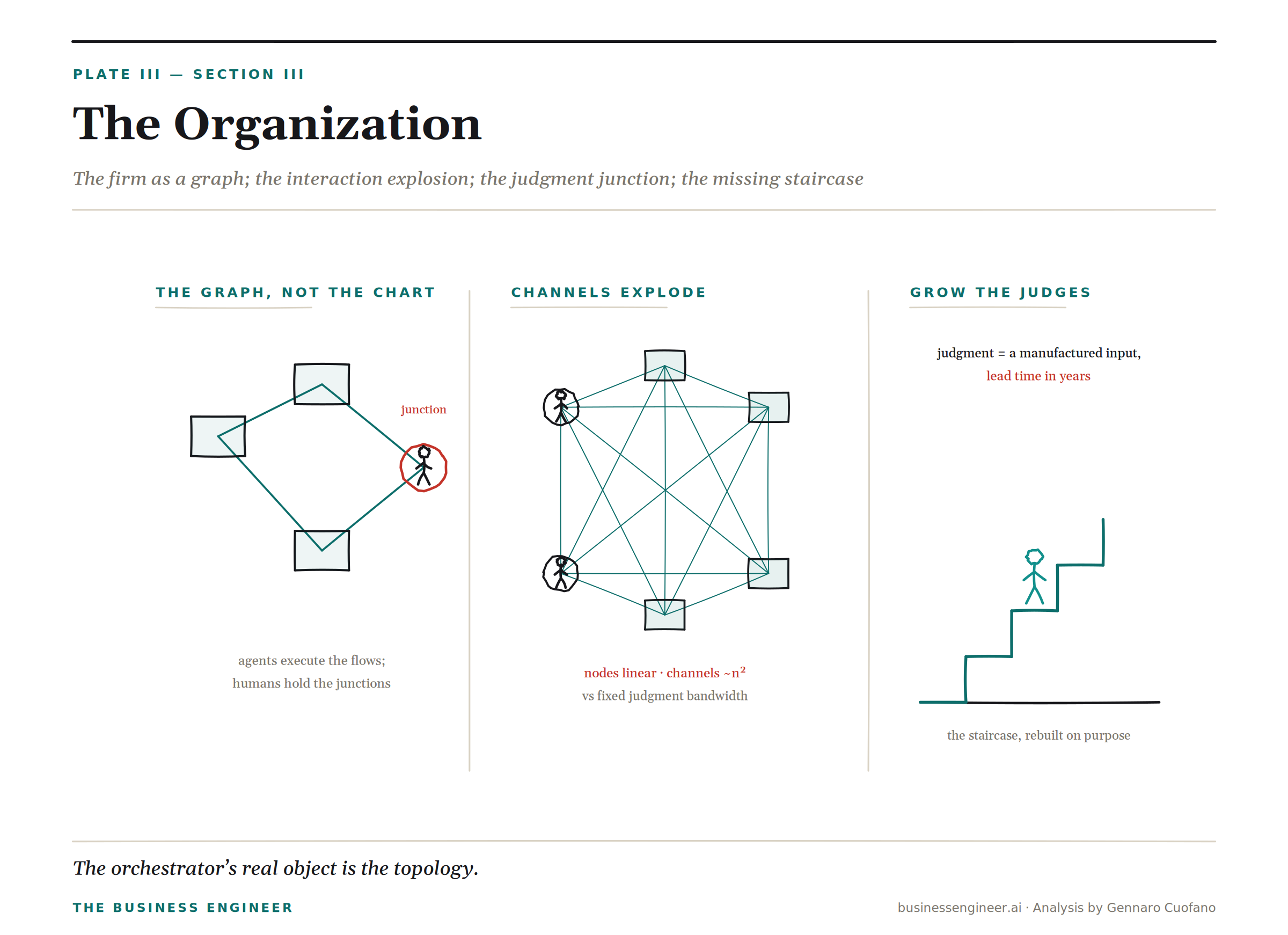
Scale the unit and the org chart stops describing the organization. A firm running dozens of agents is a graph: nodes of work, flows of artifacts, human judgment stations at the junctions. The graph, not the chart, is what the new operating model attaches to — and managing it requires, for agents, everything firms built for people: recruited (flow mapped, evaluations written), promoted (checkpoint gates widened on evidence, revocably), retired (before they decay). The roster answers the question every board will eventually ask: what is acting in our name, under whose authority, checked by whom?
And the graph carries a mathematical property that is the most underestimated fact of the whole shift: nodes scale linearly, interactions do not. Add an agent and you have added a node whose channels to every existing node — human and machine — are candidates for traffic; possible channels grow on the order of the square of participants, and agents actually use them, at machine speed, dozens of calls per task, never waiting for a meeting slot. Meanwhile human judgment bandwidth is fixed — a finite number of calibrated judge-hours a day — and, per the evidence above, under erosion pressure exactly when it is most loaded. Interaction volume scales combinatorially while judgment bandwidth stays fixed. Every pathology of careless agentic adoption is a corollary of that sentence: junction queues, rubber-stamp review, errors propagating through machine-speed chains faster than any audit can walk them — the paradox of firms that automated aggressively and feel less in control. The response is topological, because the arithmetic can only be shaped, not beaten: bounded fan-in and fan-out, traffic routed through designed junctions instead of point-to-point, schemas on agent-to-agent channels so the checkable majority never touches a judge at all. The orchestrator’s real object is the topology — and the role’s leverage comes from the same arithmetic as the danger: one well-placed junction disciplines a combinatorial number of interactions at once.
The junction is where the discipline concentrates. A judgment junction is a defined station where four things are true: the decision is consequential; it cannot be fully specified; the decider has standing to commit the firm; and the decision is recorded — approved, corrected, refused, and why. The sizing rule: place human judgment where it is the binding constraint on quality, and encode it everywhere else. Staffing inverts the pyramid: junctions are held by judges, and a judge is defined by calibration visible in the junction’s own records — not by seniority. Responsibility concentrates exactly where judgment does.
And then the problem with no inherited solution, the book’s hardest chapter. Judges are made, not hired — and they were made by the staircase the era just removed. The era commoditizes the climb, prices the summit, and removes the stairs. A firm staffing junctions from a judge population it no longer produces is running down inventory it stopped manufacturing. So the orchestrator builds the staircase on purpose: apprentices judging in parallel at live junctions, blind, with the deltas as curriculum; a deliberate friction budget — some work done the slow way, paid for its by-product, like simulator hours; and calibration measured, so promotion to judge finally becomes an evidence decision instead of a tenure ceremony. The planning fact is unforgiving: judgment is now a manufactured input with a lead time measured in years — longer than any datacenter.
The five moves
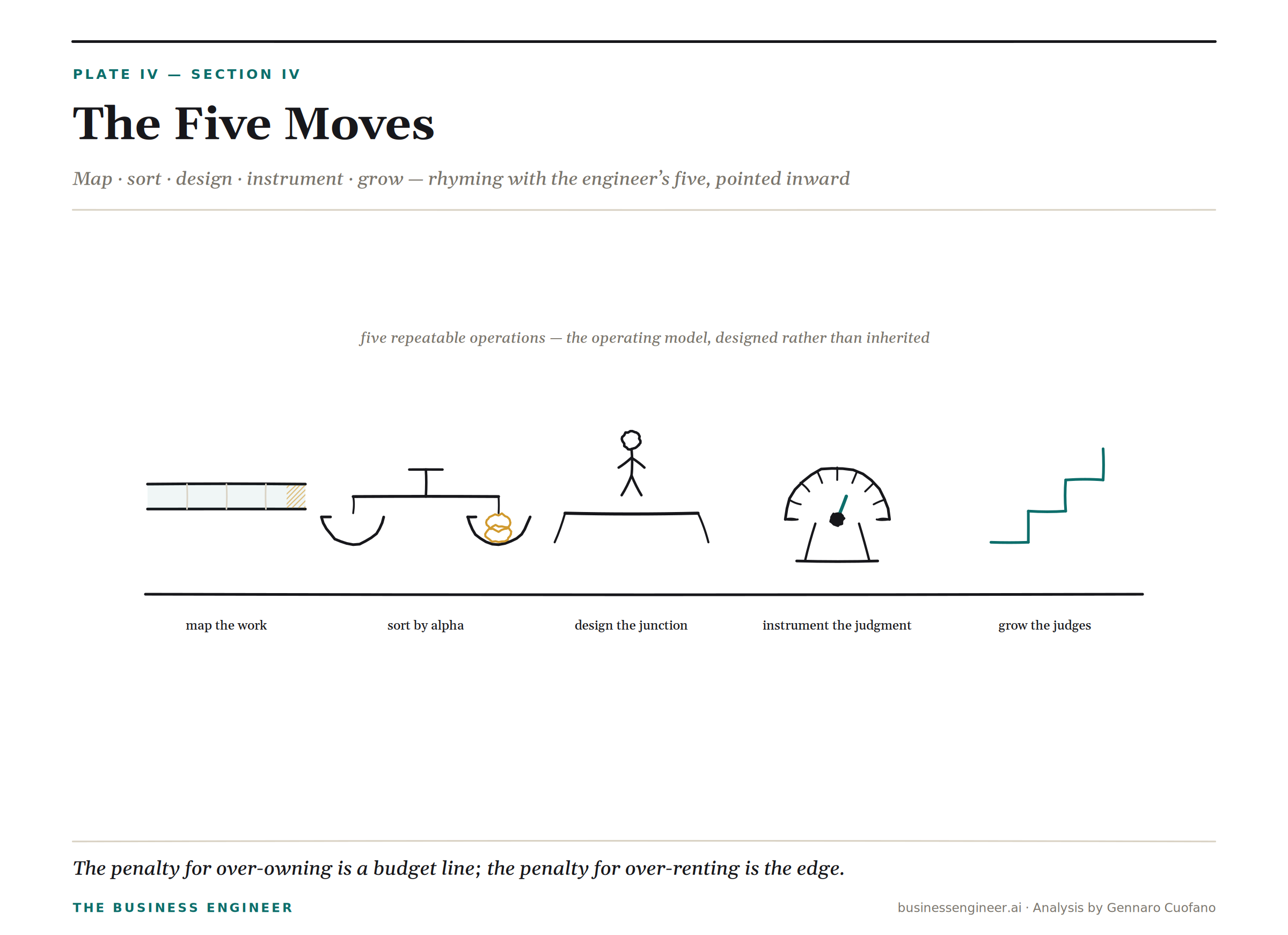
Map the work. Enumerate the flows — trigger to committed artifact — and annotate each stage: volume, specifiability, consequence. Mark where artifacts escape the firm. The deployment order falls out of the map, not the org chart; and the map shows, for the first time, exactly where the humans must be.
Sort by alpha. One question replaces the build-versus-buy debate: does this flow write alpha — the firm’s differentiated edge? No: rent everything about it at the falling market price and never look back. Yes: own the fit, because a differentiated flow run through a rented frontier is condensing the firm’s edge into the landlord’s system. The asymmetry decides the doubtful cases: the penalty for over-owning is a budget line; the penalty for over-renting is the edge.
Design the junction. Four components, each closing an observed failure mode: the frame (a specific decision, not a pile — a judge asked “is this good?” calibrates to fluency; a judge asked a yes-or-no question calibrates to substance); the gate (explicit, revocable authority); the record (one artifact, five uses: training signal, agent evaluation, judge calibration, staircase curriculum, audit trail); the load (judge-hours engineered as the scarce resource they are).
Instrument the judgment. Confidence is a reading; the operating model deserves instruments — a question fixed in advance, gauges on frozen evaluation suites, counting rules obeyed when they hurt, confidence grades, stated limits. And a refusal log at firm level: the record of automations declined and gates not widened. A firm that can show its gauges and its refusal log has an operating model; a firm that can show its demos has a mood.
Grow the judges. The move the other four silently depend on — junctions staffed, records kept, instruments read: by whom, in five years? Shadow bench, friction budget, calibration ladder, and a taught sparring standard, funded as what it is: the insurance premium on every decision the firm’s machines will make in the next decade.
The property lines
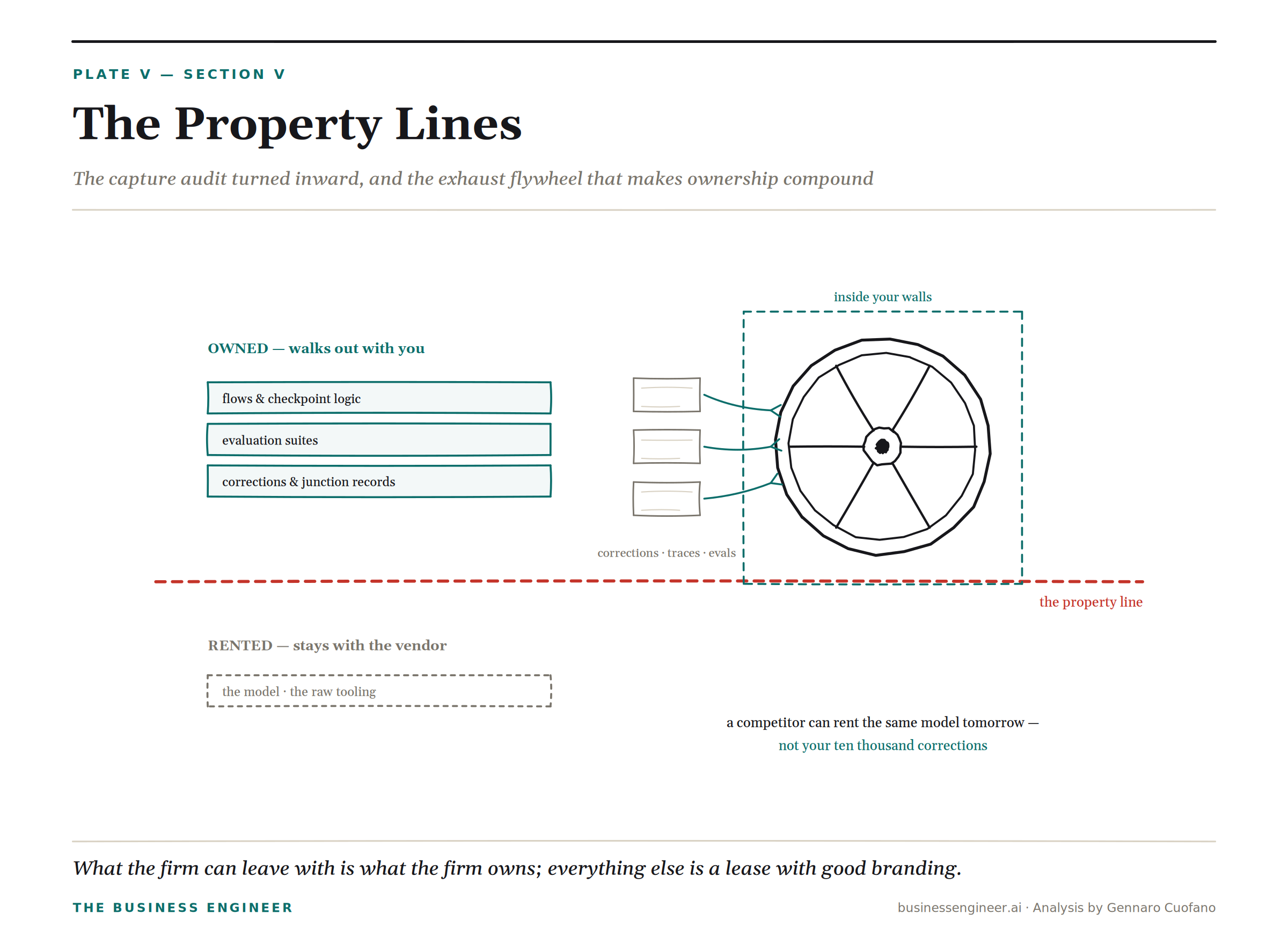
Run the capture audit inward, band by band, with one question: if this relationship ended tomorrow, what walks out with the vendor? The model is designed to fail the test — that is what renting means. The junction layer must never fail it: flows, checkpoint logic, evaluations, corrections, audit trails are the firm’s operating judgment in encoded form, and a firm that rents its own judgment has no answer to what it is. What the firm can leave with is what the firm owns; everything else is a lease with good branding.
The reason the protection compounds has a name: the exhaust flywheel. Every instrumented run throws off traces, evaluations, corrections, configurations — and handled deliberately, each cycle’s exhaust becomes the next cycle’s tuning. This is narrower and stronger than a “data moat”: the co-adapted fit is a system property that cannot be extracted or purchased, because it is not an asset sitting anywhere — it is the whole loop’s adjustment to one firm’s actual work. A competitor can rent the same model tomorrow. They cannot rent your ten thousand corrections.
Which resolves the era’s noisiest argument — closed frontier versus open weights — into a property choice made flow by flow. The generic majority: rent the frontier, enjoy it, swap it. The differentiated few: own the harness, keep the flywheel inside your walls. The mistake to fear is the invisible one: renting a flow that should be owned looks free for years, because the condensation of your edge into someone else’s system never sends an invoice.
The practice — and what the season says
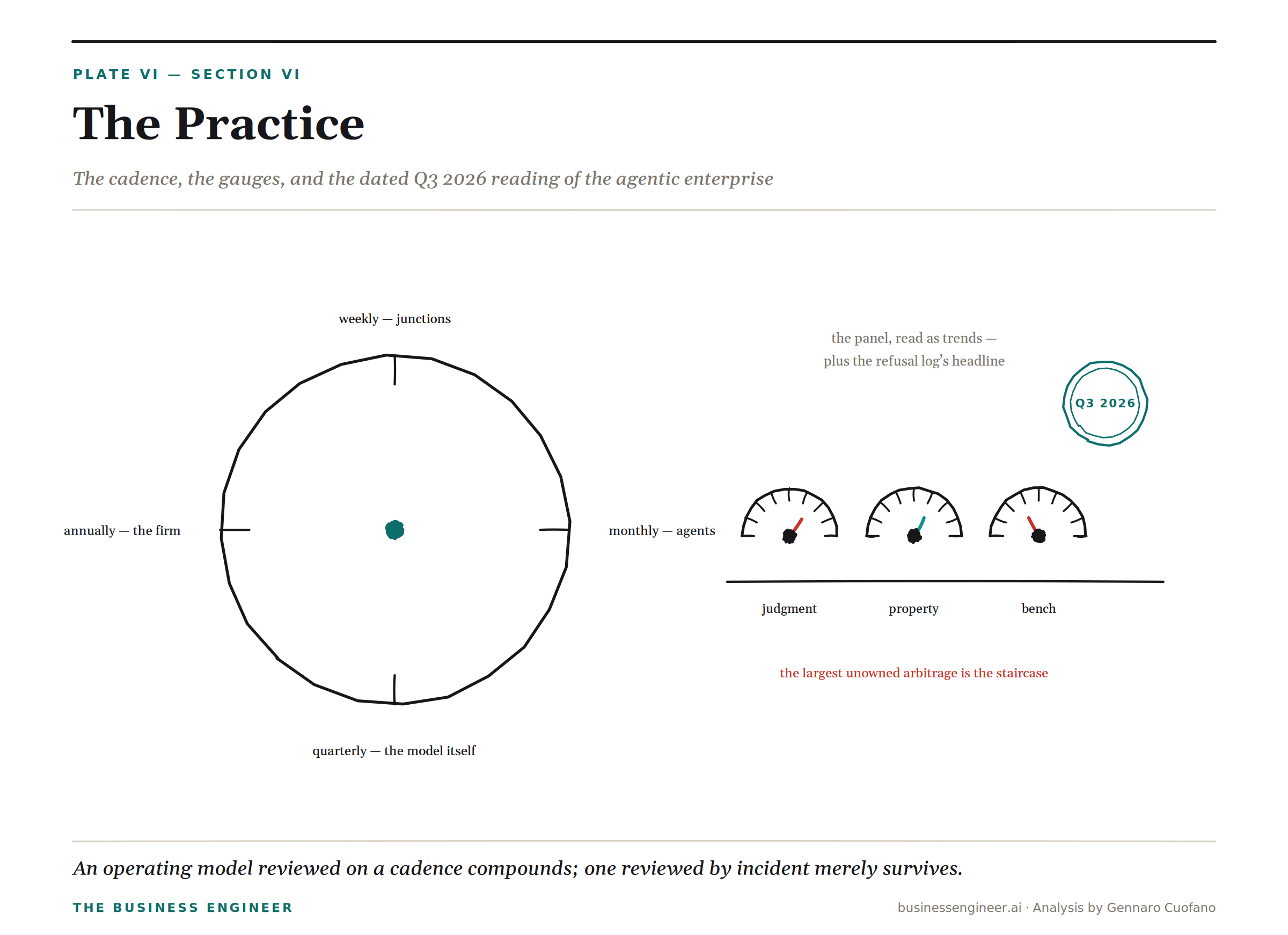
A method exists only in its running, so the discipline runs on a calendar: weekly at the junctions (queues, corrections, incidents), monthly on the agents (gauges against frozen suites, gates widened on evidence, roster reconciled), quarterly on the operating model itself (re-sort the alpha, re-take the capture audit, feed the flywheel, review the staircase, read the refusal log end to end), annually on the firm read whole. An operating model reviewed on a cadence compounds; one reviewed by incident merely survives.
The panel is six gauges: leverage (output per human, read as a trend, never a target), absorption (share of mapped work running through instrumented agents), boundary quality (defects escaping the outermost gates), judgment health (the junction panel — the first needle to move when the amplifier runs without the discipline), property (the share of alpha-writing work whose flywheel spins at home), and bench (the judge inventory, read like any input with a multi-year lead time).
And the current reading, dated to the third quarter of 2026 and included on expiring terms: the junction layer is monetizing ahead of the model layer — a billion dollars of agentic contract value at a firm with no frontier model, a four-way platform race for the same ground. The model band is behaving as a commodity should — monthly releases, a tenth of the cost in tuned harnesses, free weights championed loudest from the hardware seat, for which abundance is demand policy. The judgment layer is eroding faster than it is being rebuilt, and the staircase problem is almost entirely unowned. The largest unowned arbitrage of the era is not a technology. It is the manufacture of judges.
Every number above will be superseded. The graph, the junction, the sort, the flywheel, the staircase — the instruments — will not. That asymmetry is the whole Library’s organizing principle, and this volume’s closing transfer states it for operations: that era priced generation and got judgment free; this era prices judgment and gets generation free. The orchestrator is the person who accepts the new pricing and builds accordingly.
The library: selected models of the orchestrator’s discipline
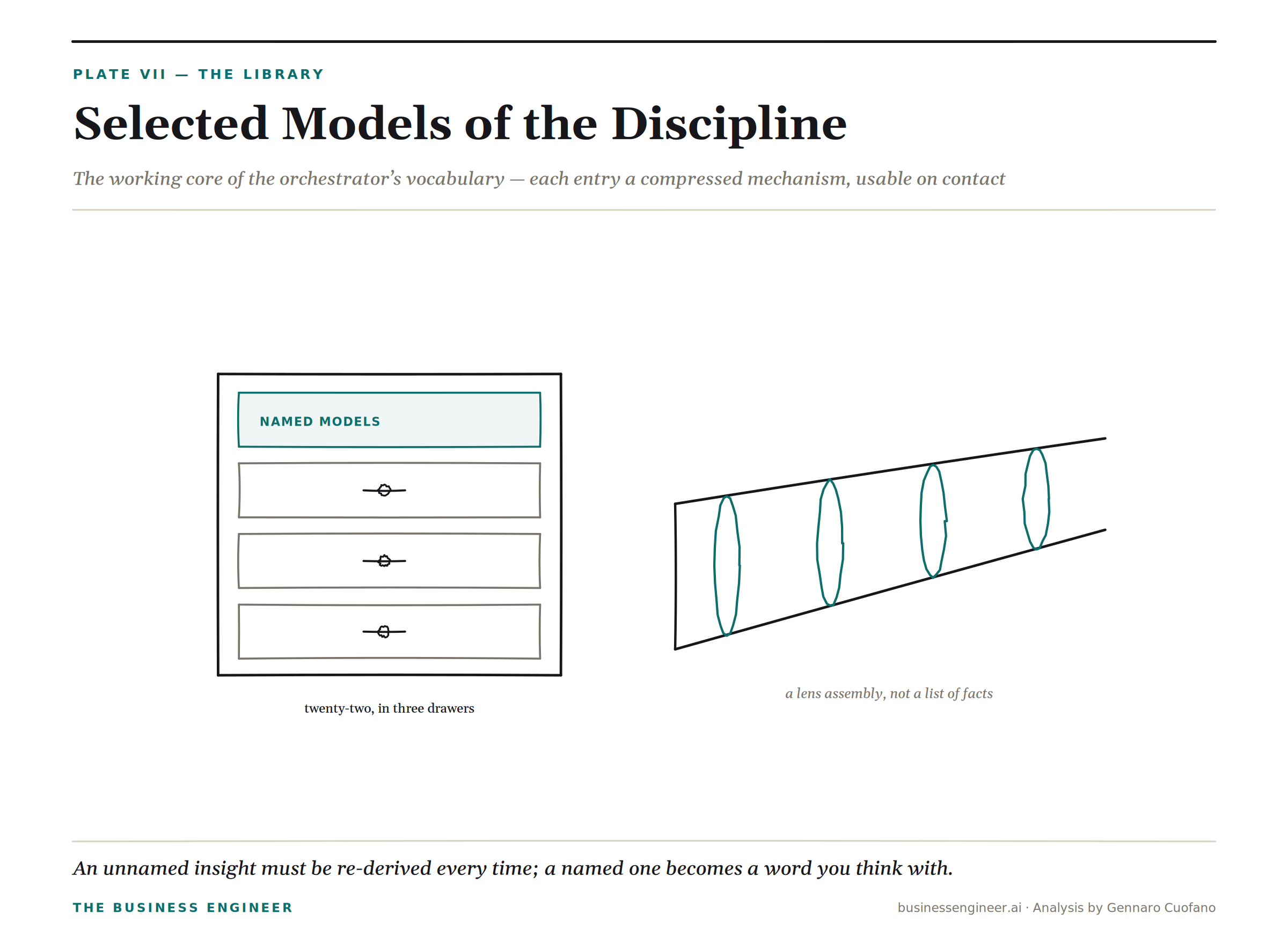
On the shift
Generation Gets Cheap, Judgment Binds — when the expensive middle of knowledge work collapses, the firm reorganizes around checking and framing.
The Amplifier Law — a harness industrializes whatever is encoded in it: sloppiness or discipline, at throughput.
The Bottom Rung Dissolves — assisted individuals match unassisted teams; lower-rung competence is on demand.
The Erosion Finding — fluent assistance degrades selection accuracy while decoupling confidence from correctness.
The Missing Staircase — the climb is commoditized, the summit priced, the stairs removed; judgment becomes a manufactured input.
On the unit and the graph
The Nine-Element Anatomy — model / harness / context / enclosure: one band rented, three owned.
The Co-Adaptation Principle — performance is a property of the fit, not of any component.
Cost Is a Capability — a tenth of the price buys ten attempts; wide search with adequate intelligence beats one pass with brilliance.
The Firm as a Graph — operations live in flows and junctions, not the org chart.
HR for Agents — recruit, evaluate, promote, retire; the roster answers what acts in the firm’s name.
The Judgment Junction — consequential, unspecifiable decisions, made by a calibrated human with standing, and recorded.
The Teammate Substitution — the assistant supplies the perspective breadth teams were built for; the group’s remaining job is judgment diversity by construction.
The Interaction Explosion — nodes scale linearly, channels combinatorially, at machine speed, against fixed judgment bandwidth; the orchestrator’s real object is the topology.
Judgment by Construction — externalize the discipline into structure so it binds at 3 p.m. as at 9 a.m.
On property and practice
The Alpha-Writing Sort — does this flow write alpha? No: rent and swap. Yes: own the fit.
The Capture Audit, Inward — what walks out with the vendor if this ended tomorrow?
The Exhaust Flywheel — corrections, traces, and configurations as next cycle’s fuel, existing nowhere but your deployment.
The Invisible Transfer — over-renting costs the edge without ever sending an invoice.
The Correction Record — one artifact, five uses: training signal, evaluation, calibration, curriculum, audit trail.
The Friction Budget — slow work bought deliberately for its by-product; the simulator hours of judgment.
The Refusal Log, Operational — what the firm declined to automate, and why; its only record of its own restraint.
The Orchestrator’s Panel — leverage, absorption, boundary, judgment, property, bench: six needles, honestly scaled.
With massive ♥️ Gennaro Cuofano, The Business Engineer