
I’ve spent the last few years mapping the Enterprise AI ecosystem around a very simple thesis:
AI does not develop from the bottom up, through consumer adoption first. It develops from the top down, through governance, enterprise deployment, and institutional control.
That thesis has held up remarkably well.
In fact, it has now become foundational to the strategy of the frontier AI labs, which are rapidly turning into some of the most powerful cash-generating machines ever created.
Before them, that title arguably belonged to Google and Meta.
But this is a completely different game.
Frontier AI models are no longer just models. They are becoming giant agents.
They can gather information, reason across enormous volumes of data, coordinate tools, execute workflows, and increasingly absorb the structure of that information into their own weights and surrounding systems.
Around those models, the labs are building increasingly powerful harnesses: memory, retrieval, tools, code execution, browsers, connectors, reasoning systems, and agentic infrastructure.
The neurosymbolic approach is being pushed toward its current extreme: multi-trillion-parameter intelligence combined with increasingly sophisticated execution harnesses capable of operating across almost any digital environment.
And this raises the fundamental question for enterprises.
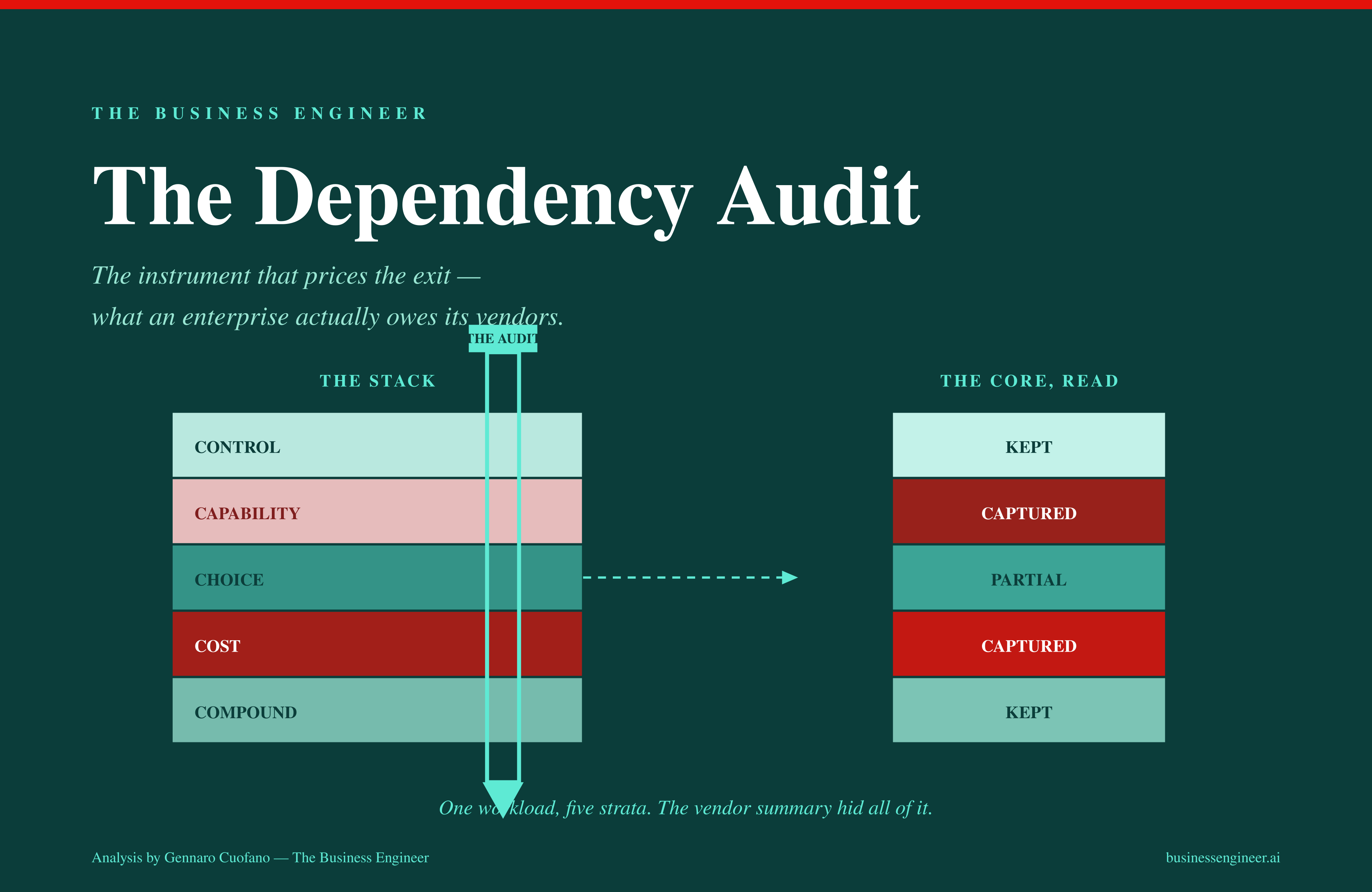
Does it make sense to merge your core knowledge, your competitive edge, and ultimately your alpha with the weights and infrastructure of a frontier AI provider?
Does it make sense for the most valuable intelligence inside your organization to become increasingly dependent on systems whose economics, architecture, governance, and strategic incentives you do not control?
I’ll leave the answer to you.
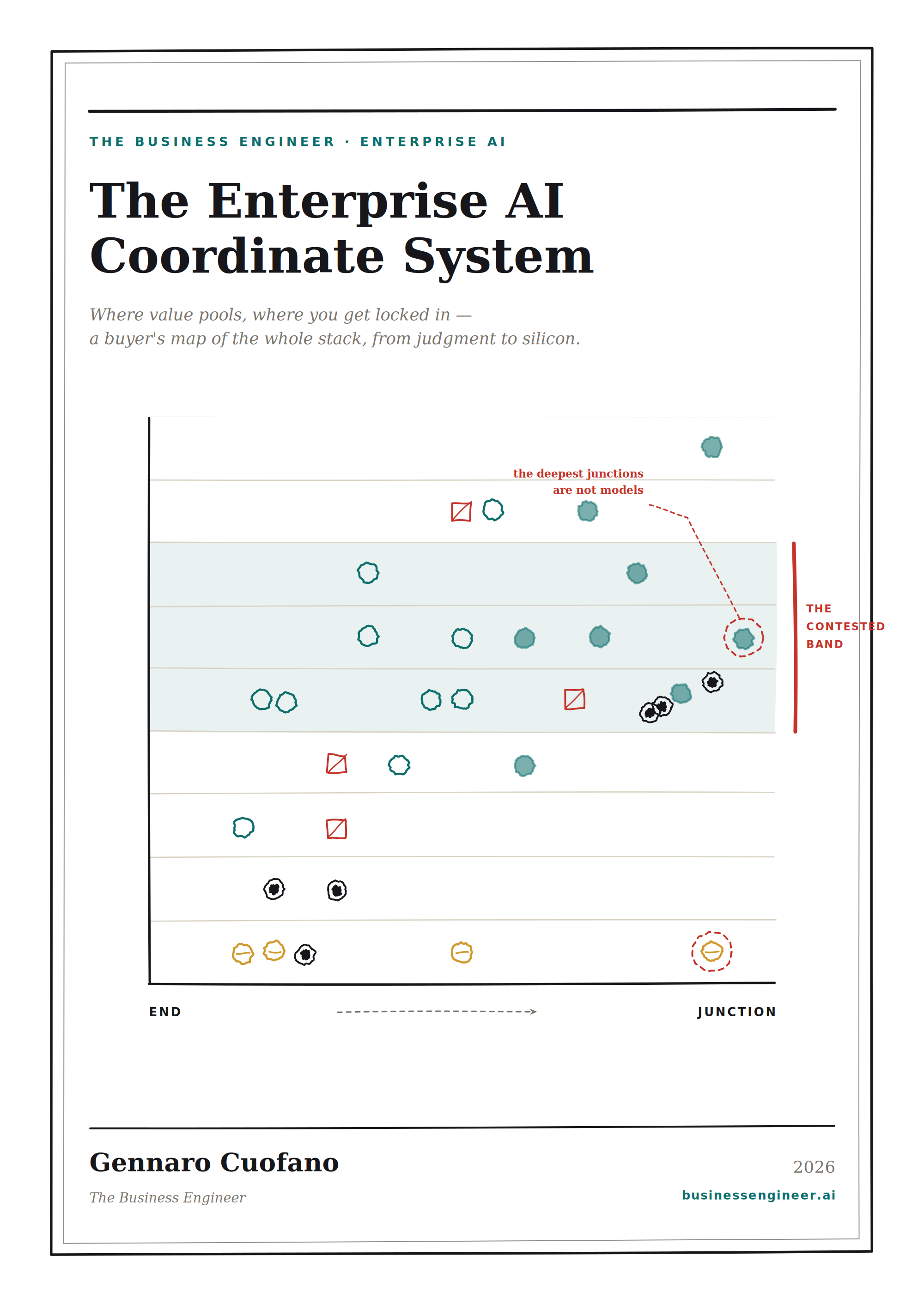
But if your answer is no, then this resource is for you
We are entering a turning point in the Enterprise AI market.
For the past few years, frontier AI has been dominated by a closed-model duopoly led by OpenAI and Anthropic. But that structure is now being challenged by an emerging open-weight alliance, increasingly championed by Jensen Huang and reinforced by a broader industry convergence around open models, sovereign AI, and more distributed AI infrastructure.
The Open-Weight Alliance

Yesterday, NVIDIA CEO Jensen Huang shook the AI industry once again—this time not by unveiling a new GPU, but by publishing an open letter arguing that open-weight AI is essential to preserving American technological leadership.
Thus, the real question over the next 12–24 months is what happens to the economics of closed frontier models?
Can OpenAI and Anthropic continue expanding aggressively both downstream, by absorbing more compute, and upstream, by locking in more distribution at the application layer?
If their revenues continue to grow exponentially, they may gain enough purchasing power to absorb an increasingly large share of global AI compute capacity. In that scenario, the market risks evolving into something close to a monopsonistic duopoly, where two major buyers effectively shape, price, and define a disproportionate share of compute demand (very close to what it is right now).
That would be the epitome of a circular and structurally fragile AI economy: model providers generate demand for compute, capture distribution, raise capital on the back of expected growth, and then recycle that capital into even more infrastructure.
Not surprisingly, much of the rest of the industry is converging in the opposite direction.
Open-weight models, Chinese AI labs, sovereign AI initiatives, hyperscalers, semiconductor companies, and enterprise platforms all have incentives to prevent the frontier from collapsing into a two-player market.
This does not necessarily mean that OpenAI or Anthropic will see slower revenue growth.
Enterprise AI and sovereign AI could remain extraordinarily lucrative. Governments and large enterprises will continue paying for top-tier capabilities in areas such as cybersecurity, reasoning, compliance, data sovereignty, and mission-critical automation.
The more plausible shift is therefore not the collapse of closed frontier AI, but the maturation of the competitive landscape.
The market may become significantly more fragmented before consolidating again around a broader group of five or six major players rather than just two. Closed and open models will coexist.
Sovereign stacks will emerge. Infrastructure providers will move upward into software. Model companies will move downward into compute and outward into applications.
The boundaries of the stack will continue to blur.
And that creates the real strategic question for enterprises:
How do you preserve your competitive edge when the underlying AI landscape is shifting this violently?
How do you avoid locking your organization into an architecture, model provider, or distribution layer that may look dominant today but become commoditized, constrained, or strategically misaligned tomorrow?
That is what this resource is designed to help you answer.