

As I’ve been arguing for the past few years, Enterprise AI has become the defining force shaping this phase of AI adoption.
Consumer AI will become increasingly important over the next couple of decades. But the harder and more consequential challenge is happening inside large enterprises: embedding AI deeply enough to transform the organization without destroying the very capabilities that made it competitive in the first place.
“Transformation” is an overused and loaded term. Here, it has a very specific meaning: what happens to an enterprise when AI becomes part of its core operating system?
I’ve explored how enterprise alliances are shaping the broader AI ecosystem. But as these alliances deepen, a more fundamental strategic problem is emerging.
For a large enterprise, and increasingly for mid-sized organizations as well, the primary risk is no longer failing to adopt AI. The risk is adopting it incorrectly.
An enterprise can deploy AI in ways that gradually erode its competitive advantage, weaken its organizational knowledge, or transfer control of critical capabilities to external AI-native players.
This can happen because the organization fails to adapt its operating model, embeds the wrong components of the AI stack into its core, or becomes structurally dependent on vendors whose incentives are not aligned with its own.
The alternative is to build what I think of as an agnostic enterprise AI harness: an architectural and organizational layer that makes AI adoption controlled, governed, modular, and adaptable.
Such a layer should allow the enterprise to integrate external models, platforms, and capabilities without surrendering control over its data, workflows, knowledge, economics, or strategic differentiation. It can be built internally, through external agnostic partners, or through a combination of both.
But the technical architecture is only part of the problem.
The AI system also has to be aligned with the organizational core and understood by the people operating it: employees, executive teams, global functions, local business units, and the stakeholders responsible for turning AI capabilities into actual business outcomes.
These dynamics deserve far more attention because much of the enterprise AI landscape over the next three to five years can ultimately be reduced to one strategic question:
How does an enterprise adopt AI, preserve and strengthen its competitive advantage, and improve its economics without losing control of its profitability, margins, organizational core, and strategic optionality to AI-native players that could eventually lock it into their platforms?
That is the problem this guide sets out to address.
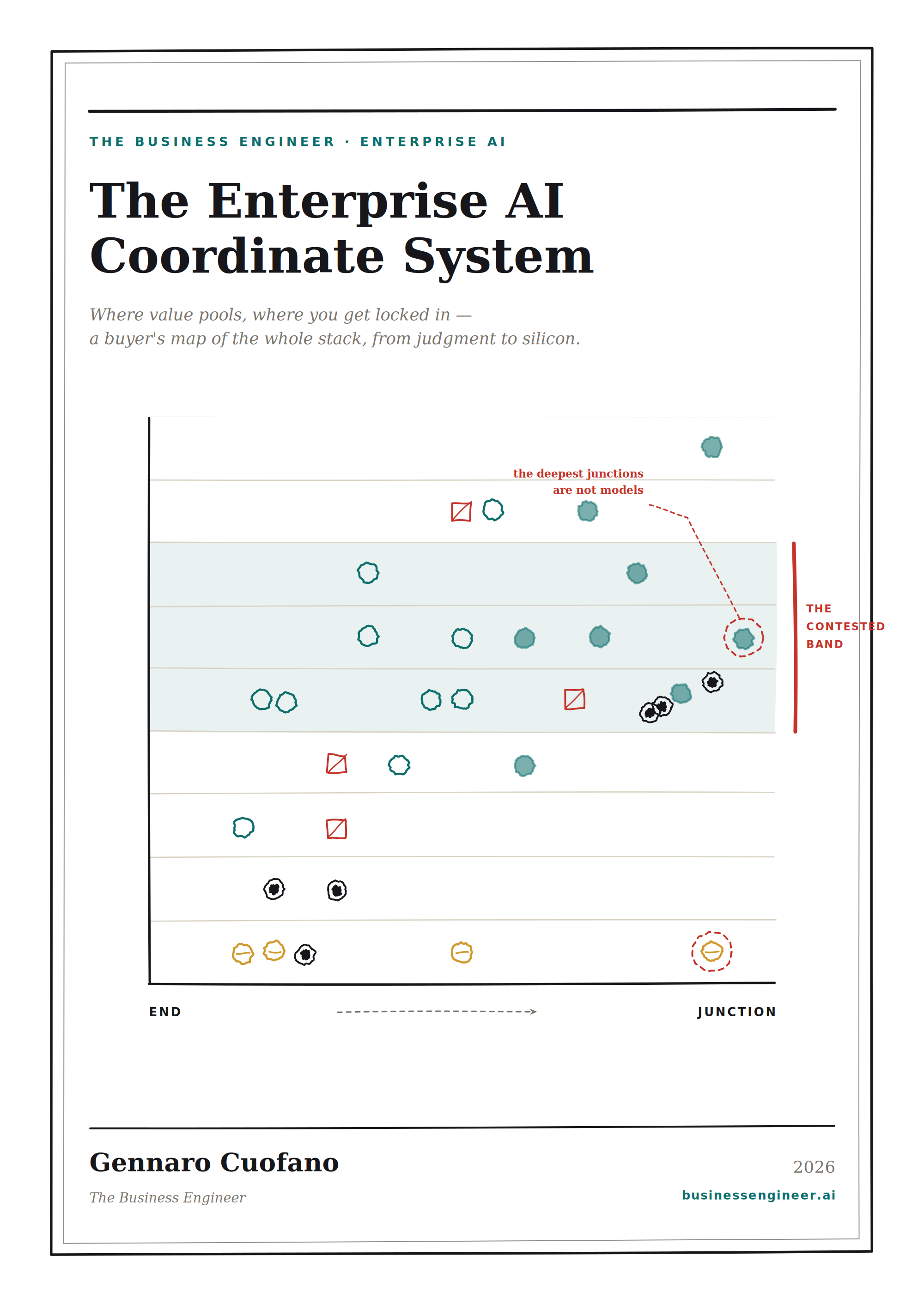
And if you want more: premium is the living version of that map — weekly teardowns applying the framework to real moves (Anthropic’s margin turn, Berkshire’s Alphabet bet), plus the full library and tools.
With massive ♥️ Gennaro Cuofano, The Business Engineer