
When the CEO of the world’s most valuable enterprise software company writes a manifesto and quotes the CEO of the industry’s most controversial data platform inside it, that is not decoration. That is a coalition forming in public.
Satya Nadella’s Reverse Information Paradox essay, just came out, and it argues that in the AI age, buyers pay twice for intelligence — once with money, and again with the proprietary knowledge they must reveal to make that intelligence useful.
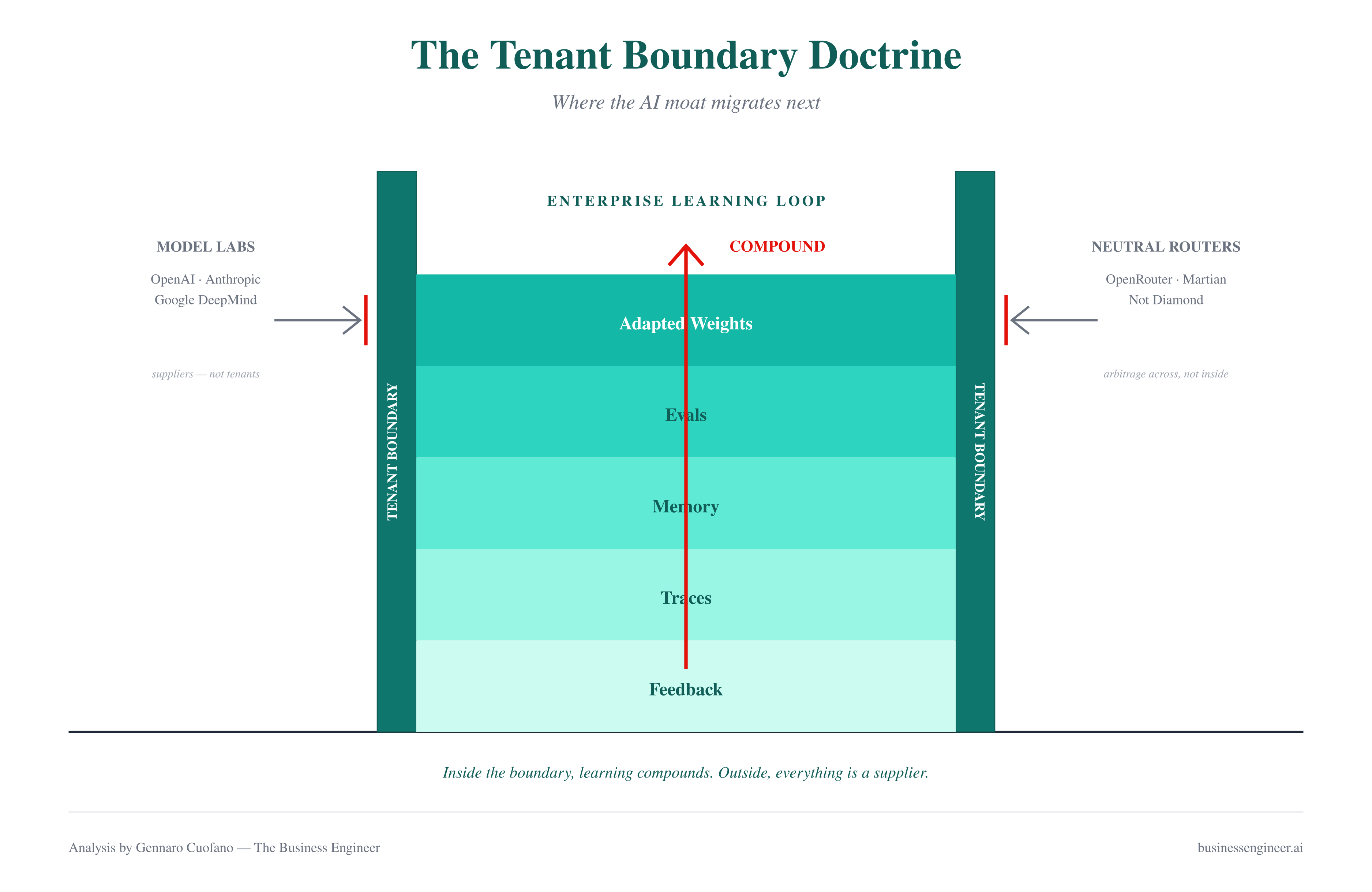
Every prompt, correction, eval, and trace becomes institutional know-how that leaks upward to the model provider. Nadella’s prescription is a “trust boundary” inside which the enterprise’s evals, memory, adapted weights, and orchestration accumulate untouched — and a set of five principles enterprises must own: Control, Capability, Choice, Cost, Compound.
Embedded halfway through the essay is a quote from Palantir CEO Alex Karp: “What the technical customers want is control over their compute, their models, their data stack, and their alpha. They want to know they own the means of production, and it’s not being transferred to someone else.”
That quote is not rhetorical borrowing. It is the two most important enterprise infrastructure players in the market publicly agreeing on where the AI moat lives next — and telling every buyer, analyst, and competitor to plan accordingly.
Read the essay that way and every paragraph clicks into place. Nadella’s five C’s are not principles. They are the requirements document for a class of infrastructure that Microsoft is building through Foundry, Azure AI, and Copilot Studio, and that Palantir has already shipped as AIP, Ontology, and Evolve. The essay’s closing call to “distribute the learning infrastructure to every firm” actually distributes something else: a shared strategic thesis between two of the enterprise’s most important vendors. The moat is migrating from the model to the tenant boundary that owns the enterprise’s learning loop.
Recent analysis in these pages — The Routing Paradigm for Enterprise AI — traced how price discovery entered the AI stack at the harness layer (see AI & The Harness Theory for the underlying mechanic) and cascaded up and down. Nadella’s essay is what that cascade sounds like when it reaches the C-suite. It names the compounding surface — evals, memory, traces, adapted weights, feedback — and asserts that this is the asset the enterprise cannot afford to give away.
That naming matters. Because as long as the moat was the model, Microsoft and Palantir were playing different games. Once the moat migrates to the tenant boundary, they are playing the same game — and they need the same argument to win it.
That argument now has a name. Call it the Tenant Boundary Doctrine: whoever operates the trust boundary within which enterprise evals, memory, and adapted weights compound — operates the enterprise’s learning loop, and therefore the enterprise’s AI-era moat.