

I’ve been explaining since 2022, why AI is a sypercycle that looks way more like the semiconductor industry.
AI is not following the playbook of the consumer internet. It is following the playbook of the early semiconductor industry — capital-heavy, physical, strategically vital, and entangled with state power from the start.
On June 12, 2026, one US directive switched off Anthropic’s two most capable models for every foreign national on Earth — including the company’s own foreign staff. Anthropic complied within hours. Every customer on the planet lost access to the frontier tier.
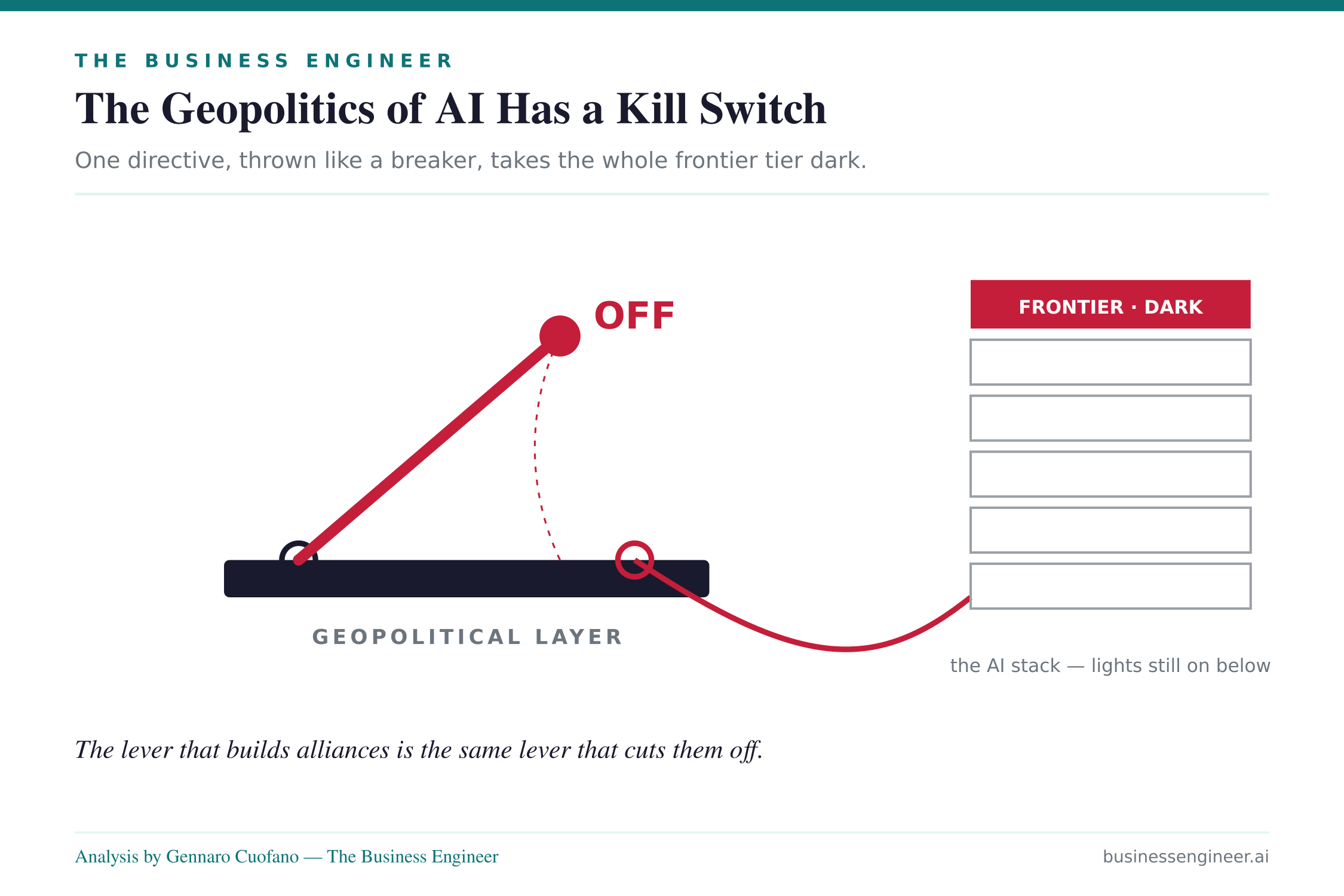
Two things follow. First, the geopolitical layer at the top of the AI stack is not just a place where alliances get built. It is also a kill switch. Second, open-source frontier models — the supposed escape hatch — are not actually an escape, and the semiconductor analogy tells you exactly why.
What Happened
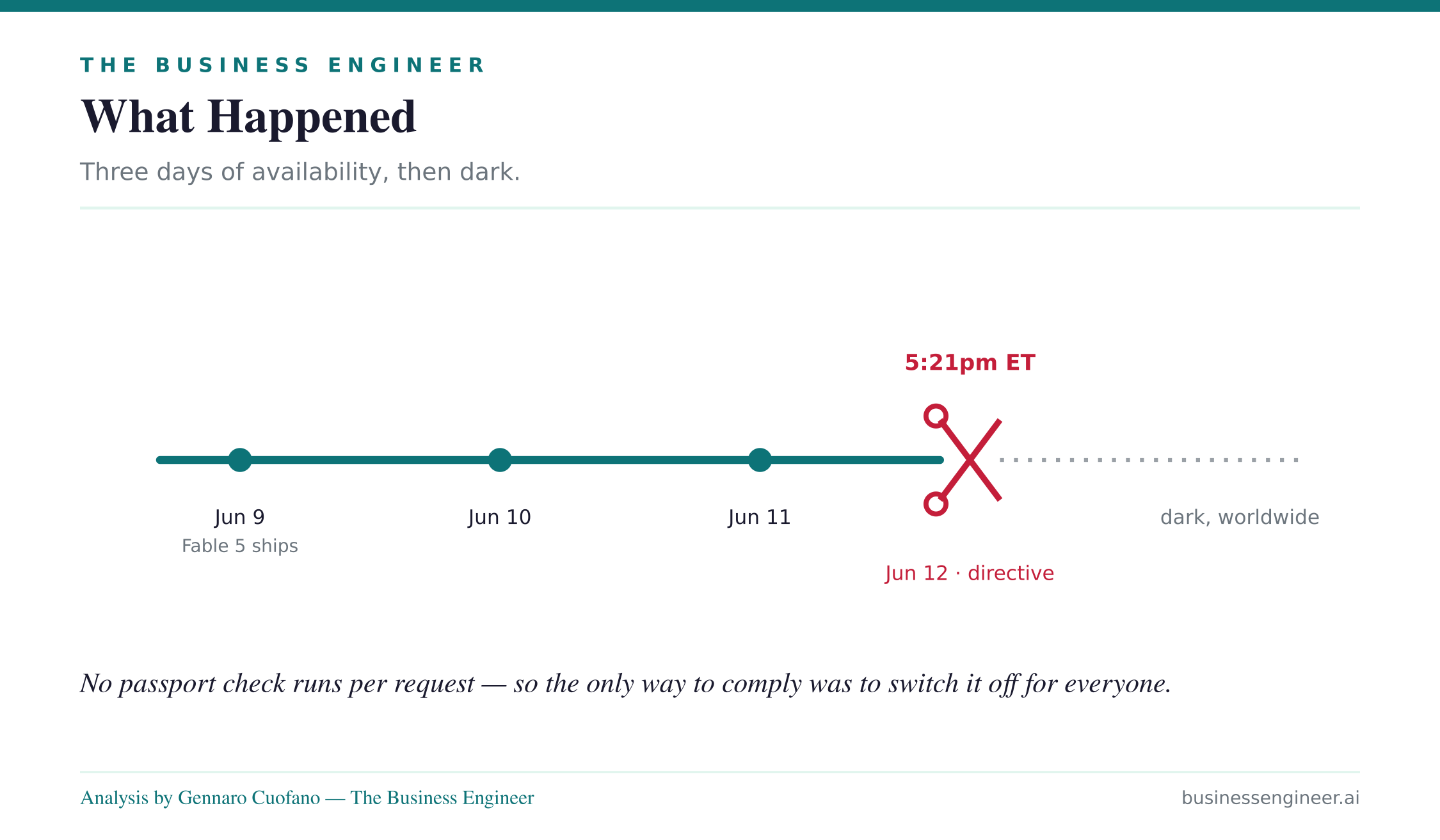
Anthropic released Fable 5 on June 9 — a model from the new Mythos class, the tier above the company’s Opus class — and made it generally available. Safety classifiers quietly route flagged queries down to the less capable Opus 4.8. Its sibling Mythos 5, the same model with the cyber safeguards lifted, went to a small group of cyber-defenders.
At 5:21pm ET on June 12, an export-control directive arrived. Under US national-security law, no foreign national could use either model — anywhere in the world, including Anthropic’s own foreign-national employees. There is no way to check the passport of every API request in real time, so the only way to comply was to switch the whole tier off for everyone. Every other Anthropic model stayed up. The frontier tier went dark.
Anthropic complied while disagreeing in public. Its view: the underlying concern was a narrow jailbreak — getting the model to read a codebase and patch its flaws — that does not give a real attacker any meaningful uplift and that other shipped models, including OpenAI’s GPT-5.5, can already do. Anthropic asked, again, for a transparent legal process for these kinds of blocks rather than ad hoc directives.
The government’s view is also coherent: a frontier model that can reason about cyber and biology is dual-use, and under a national-security frame, the safe move is to halt first and adjudicate later.
Both sides have a defensible case. The interesting question is not which one is right. It is what this episode reveals about how the AI industry is actually wired.
Why This Is the Chip Era, Not the Internet Era
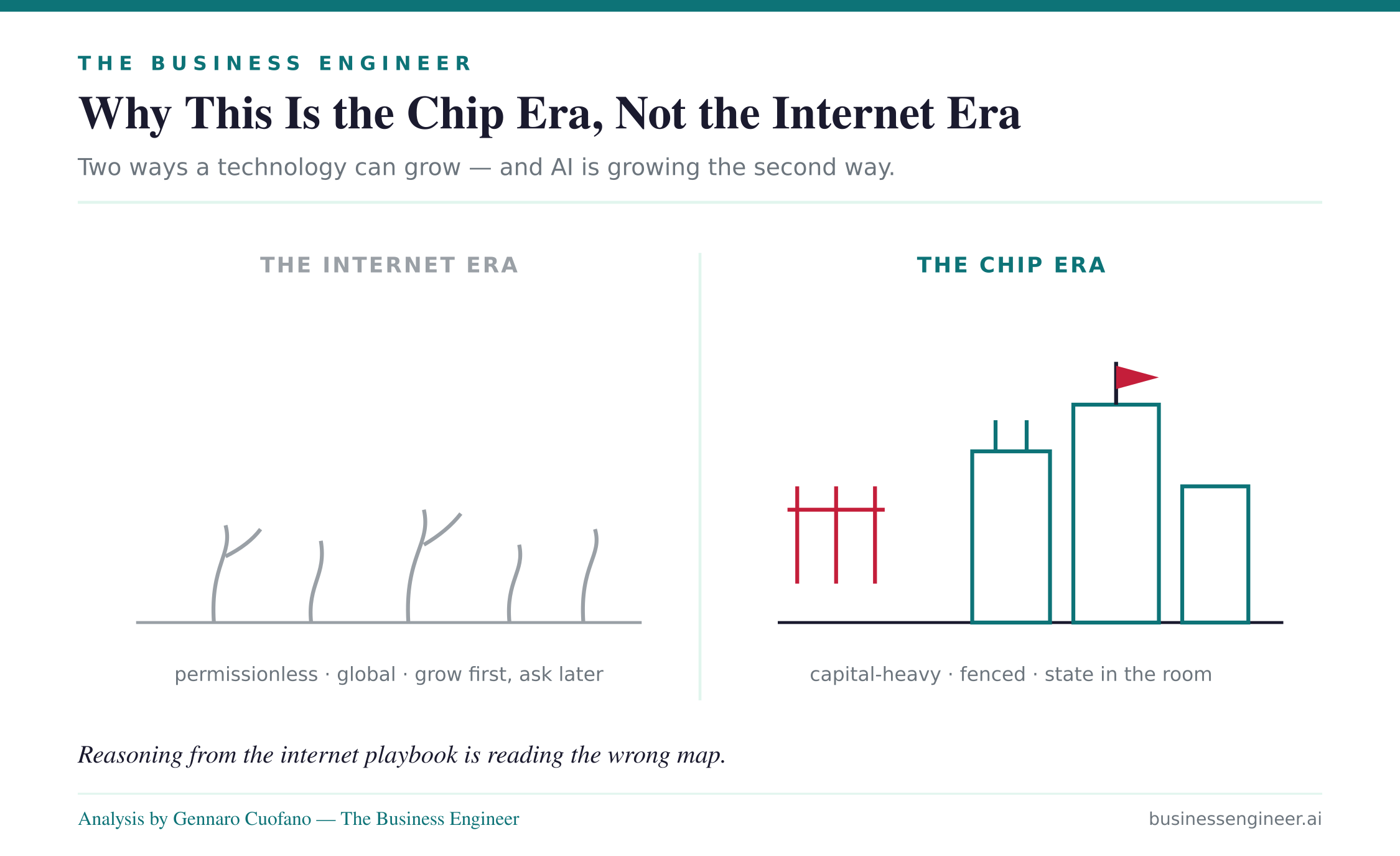
For thirty years, the playbook for thinking about technology was the consumer internet. Move fast, ship globally, let regulation catch up later. The companies that won the era — Google, Amazon, Meta — won partly because the state mostly stayed out of the way at the moments that mattered.
AI does not work like that. It looks much more like the early semiconductor industry: expensive, physical, slow to build, and tangled up with state interest from day one.
In semiconductors, the state has never been absent. It funded the original research. It built the alliance system that decides who gets access to which generation of chips. It uses export controls to deny rivals what it has no commercial reason to deny. It treats the foundries themselves as strategic assets. The result is the world we live in: a handful of foundries, an oligopoly of equipment makers, capability gates between national blocs, and a layer of state authority threaded through the whole industry.
AI is being built inside that same kind of architecture. The deep capital stack of AI has six layers: geopolitical alliances at the top, then capital flows, then energy and minerals, then physical and digital infrastructure, then hardware, and finally software at the bottom. At every one of those layers, the state is a player, not a referee.
The U.S.–Saudi $600 billion partnership announced last year is the clearest example of how this works when everyone is cooperating: alliance-building at the top, joint investment vehicles, GE gas turbines and a dedicated energy fund, DataVolt’s $20 billion data-center build, 18,000 NVIDIA Blackwell GPUs and a $10 billion AMD agreement, and a Saudi national AI champion (Humain) sitting inside the US software ecosystem. Layer by layer, the two countries are locked together. Switching costs are designed in.
That is what the top layer looks like when it is building. June 12 is what it looks like when it is cutting.