

Since ChatGPT kicked off the current AI race, one of the most interesting developments has been the growing divergence between consumer AI and enterprise AI. As we approach the end of 2026, I see those paths moving even further apart.
What enterprise AI needs is increasingly different from what consumer AI wants.
That distinction will become central to what I believe is the most important AI race of the next 12–24 months: the meta harness.
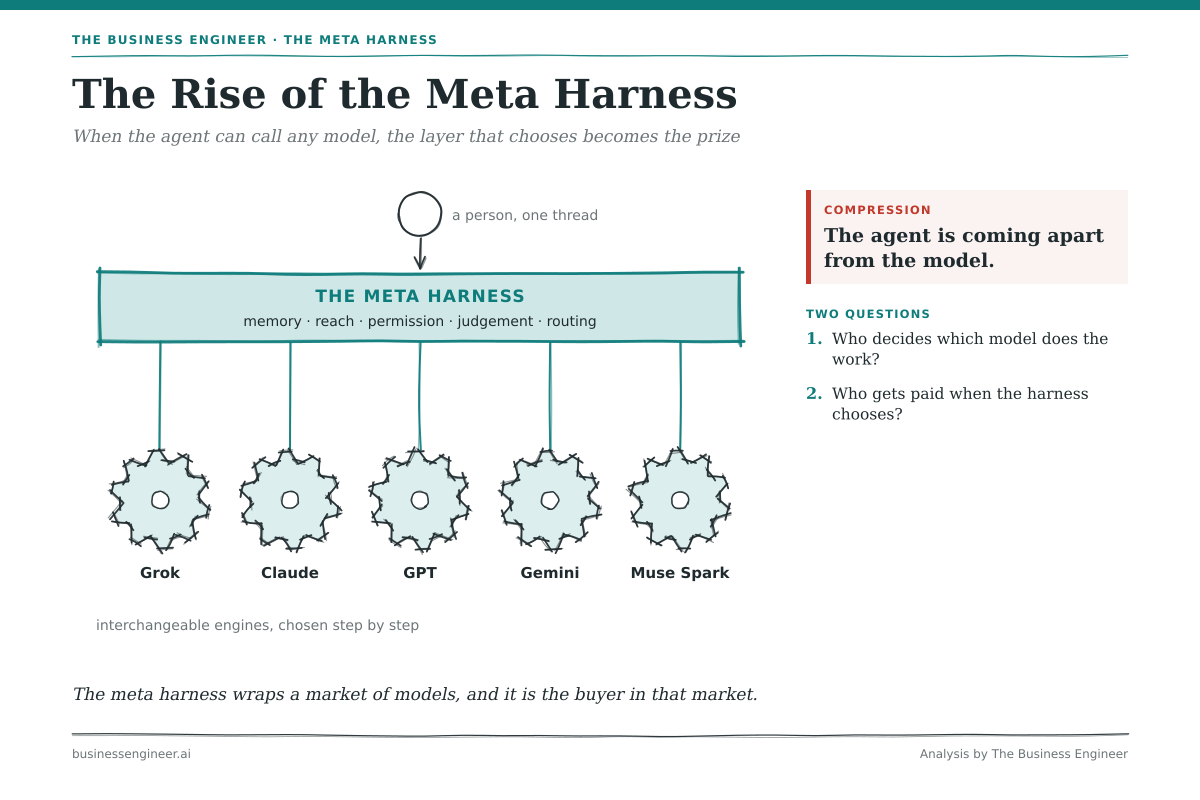
The term has already been circulating in the last year in closed tech circles. And while those circles have a habit of repeating the same language until everyone sounds identical, there is a meaningful signal underneath the buzzword.
A meta harness is the broader system that coordinates models, tools, context, and execution to get something done. I believe this layer will become critical across both consumer and enterprise AI. But its architecture, responsibilities, and sources of advantage will differ substantially.
In consumer AI, I expect the strongest expression of the meta harness to be a vertically integrated experience: a company owning the interface and managing the task from beginning to end. Something like Muse is the direction I have in mind.
For many everyday tasks, such as finding flights or planning a trip, you do not necessarily need the most powerful frontier model at every step. You need a system that understands what you want, works across the relevant services, and reliably completes the task. Much of the value sits in how seamlessly the company brings those pieces together.
For business and enterprise AI, the meta harness has a broader responsibility.
It needs to do far more than scaffold a powerful model or route requests between models. Routing was already an important problem two years ago. The next challenge is bringing different models and capabilities into a coherent system that improves through execution, feedback, and evaluation.
Here, model agnosticism means more than being able to switch providers. It means understanding how to divide the work between the models and the harness itself.
When can a frontier model perform a task from beginning to end, with minimal intervention? When does the harness need to take the lead, break the work into stages, coordinate tools, enforce constraints, or check the result?
That division of responsibility cannot remain fixed. As models become more capable, some of the work previously handled by the harness can move into the model. At the same time, enterprise requirements create responsibilities the broader system must continue to own: permissions, approvals, traceability, and accountability for execution.
This is what makes the enterprise meta harness a deeper architectural challenge. It must continually adapt to the intelligence available underneath it while keeping the overall process dependable.
I expect the shifting boundary between model intelligence and harness orchestration to define much of the next phase of AI.
Every meta harness provider will face the same question: where is the sweet spot between letting frontier intelligence do the work and building the structure that makes that intelligence useful, reliable, and controllable?
Too much scaffolding can constrain a capable model. Too little can leave the system unable to deliver consistently.
Finding that balance, and continuously improving it, is the race.
And in my view, Grok Bot helped open it.
If you are a paid member, reply to this to request access.