

In 1935, the word computer did not primarily describe a machine.
It described a person.
At Langley Memorial Aeronautical Laboratory, the predecessor of NASA’s Langley Research Center, a young mathematician named Virginia Tucker joined four other women in the laboratory’s first computing pool. Their job was to calculate. They processed experimental data, solved equations, plotted results and produced the mathematical work engineers needed to design aircraft.
They were called computers.
Over the following decades, hundreds of women would do this work at Langley. During World War II, the demand became so large that NACA expanded its computing workforce further, including the Black women of the segregated West Area Computing unit whose story would later become widely known through Hidden Figures.
Then the machines arrived.
And something interesting happened.
The work did not simply disappear. It moved.
The machine increasingly performed the calculation. The human moved toward programming it, checking it, interpreting its output and deciding what problem it should solve. Some of the women who had been called computers became among the early programmers of the electronic-computing age. Dorothy Vaughan, who had led Langley’s West Computing group, became an expert FORTRAN programmer as NASA reorganized around electronic computing.
The title migrated from the person to the machine.
The responsibility migrated in the opposite direction.
That history is useful because something similar is happening again.
The strongest signal in the AI labor market is not the proliferation of strange new titles. It is a change in who owns what.
Commercial teams are hiring builders. Product managers are taking responsibility for evaluation. Lawyers and other domain experts are moving from reviewing software to helping construct and supervise it. Deployment is splitting into engineering, rollout and enablement. AI work is moving directly into finance, recruiting, marketing, customer service and operations.
Meanwhile, much of the work that historically trained the entry-level professional — research, first drafts, basic analysis, annotation, ticket handling — is becoming the machine’s work.
Once again, the interesting question is not simply which jobs disappear?
It is:
Where does the human move when the machine takes the task?
This volume is an attempt to map that movement.
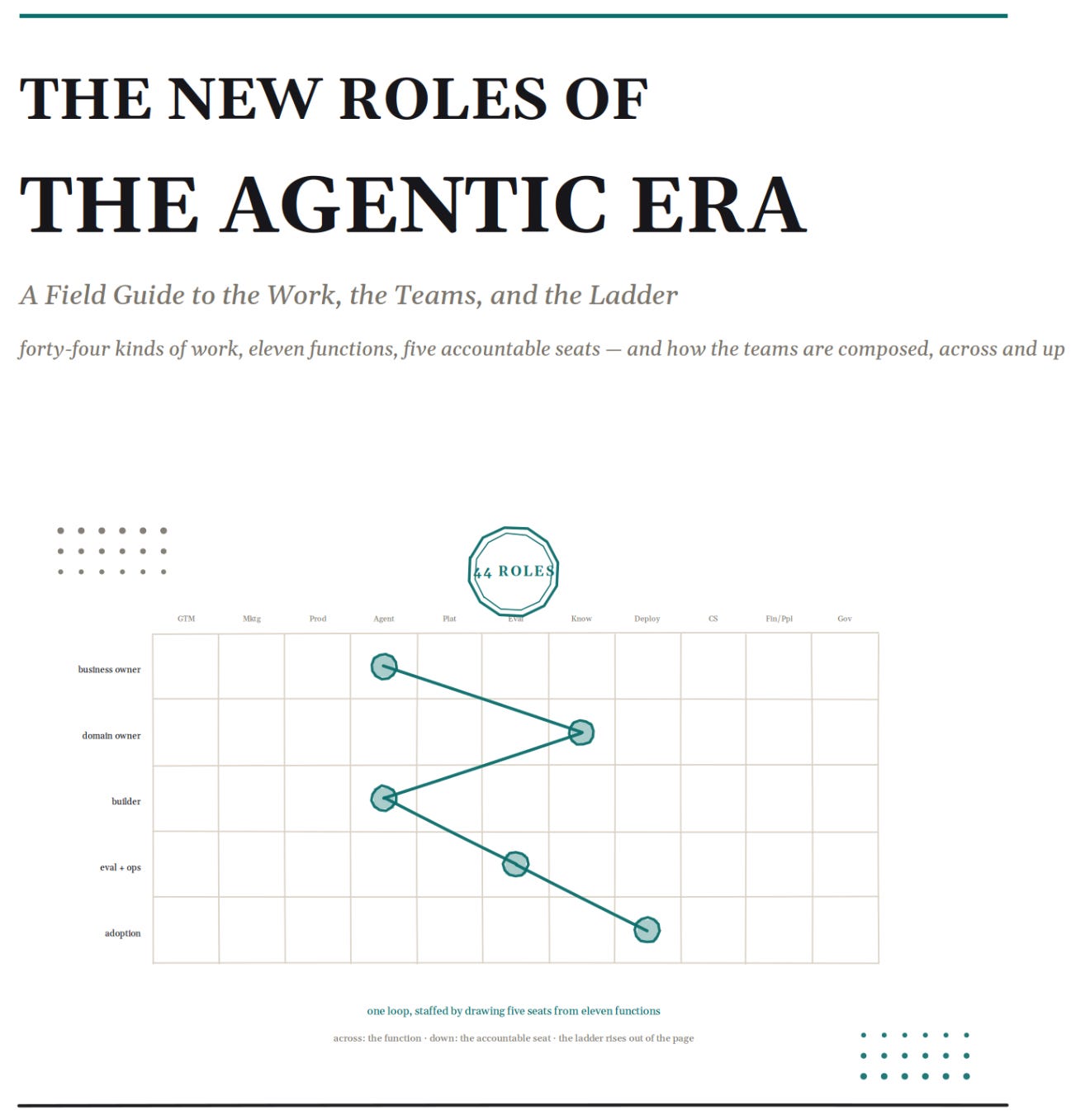
Across eleven business functions, forty-four kinds of work are already becoming visible. Their titles remain inconsistent, but the underlying pattern is remarkably stable. Humans are moving away from simply producing the work and toward designing the systems that produce it, supplying the expertise those systems need, evaluating what they produce, handling the exceptions they cannot resolve, and owning the outcomes they create.
The computer once moved from the person to the machine.
Now something similar is happening to knowledge work.
And once again, the work is not simply disappearing.
It is moving.
The shape of the new job can be compressed into three responsibilities:
Own a loop. Sit at a junction. Seed the standard.
This is another deep dive in The Business Engineer’s Foundation Series.
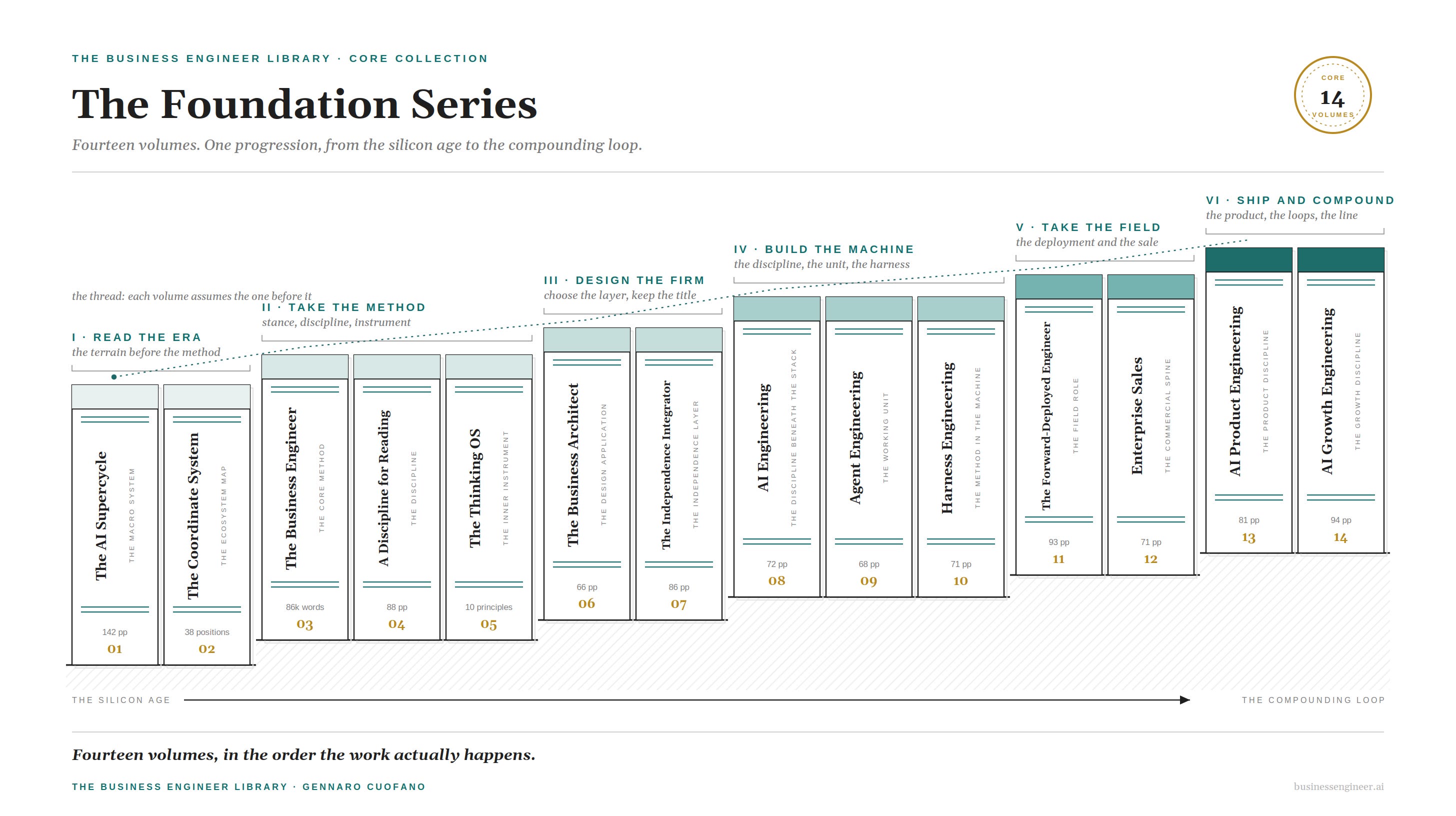
For the last three years, I’ve been rebuilding the Business Engineer’s curriculum from the ground up. That curriculum has now become the foundation of a new discipline, with the entire series taking shape around it.
If you’re already a paid member, simply reply to this email, and we’ll send it your way.