
Over the last decade, much of my work with The Business Engineer has revolved around a form of compression: taking the enormous complexity of a business and identifying the underlying mechanisms that explain how it works.
Business models, value chains, financial structures, technological architectures, organisational incentives. Each offers a different lens through which we can understand a company, abstract its complexity, and recognise patterns that would otherwise remain hidden.
For a long time, the primary objective was analytical. A useful mental model could help us explain why a business worked, where its competitive advantage came from, or what might cause its economics to change.
But as AI has become increasingly capable of performing work rather than simply helping us understand it, I’ve found myself returning to a more fundamental question: what does it take to move from understanding how a business operates to making that understanding executable?
I believe this distinction will become increasingly important as we move into the next phase of enterprise AI.
In my previous analysis, I explored how the development of AI can be understood, in part, through its growing ability to compress knowledge and capability. Large-scale pretraining allowed models to learn broad representations of the world. Post-training helped shape those capabilities into useful behaviours. Reasoning techniques and additional inference-time computation made it possible to tackle increasingly complex problems.
And as we move toward more persistent agents, memory, and potentially continual learning, the question becomes whether these systems can accumulate and reproduce some of the expertise that makes an experienced specialist valuable.
Yet there is a crucial difference between compressing knowledge about a domain and reproducing the work of an expert within an actual organisation.
An experienced underwriter, procurement manager or financial controller does not simply apply general knowledge to a sequence of tasks. Their judgement operates within a system of authority, institutional memory, exceptions, incentives and consequences. They know which rules are absolute, which require interpretation, when a decision must be escalated, and what evidence will be needed to justify it later.
Some of that knowledge is documented. Much of it is distributed across software, procedures, historical decisions and the experience of individuals. And some of it has never been properly agreed upon in the first place.
This is what makes the enterprise challenge so different from simply making models more intelligent.
A model may become extraordinarily good at recognising patterns and proposing decisions, while the organisation deploying it remains unable to specify which decisions it is authorised to make, how its performance should be evaluated, or who is accountable when something goes wrong.
Even capturing the process is not sufficient. We also need an environment in which the system can operate, encounter exceptions, make mistakes safely, receive feedback and progressively improve, without exposing the business to unacceptable consequences.
In other words, the challenge is not only to compress expertise into something reproducible, but to engineer the conditions under which that expertise can be reliably exercised.
There is an interesting historical parallel here.
In 1828, the Institution of Civil Engineers in London received its royal charter. In defining the profession, it drew on Thomas Tredgold’s description of civil engineering as:
“The art of directing the great sources of power in nature for the use and convenience of man.”
The choice of words matters.
Engineers did not invent the forces they learned to harness. Steam, water and gravity existed independently of them. What emerged was a discipline capable of understanding those forces, designing systems around them, and making their effects useful and increasingly predictable.
Canals, bridges, railways and eventually electrical infrastructure were not simply applications of scientific discoveries. They required an accumulated body of knowledge about materials, constraints, measurement, safety and the interaction between components.
The analogy with AI is not exact. Physical systems operate according to laws that do not change because two managers disagree. Businesses are social systems, where rules can be ambiguous, authority is negotiated, incentives evolve and the environment itself changes in response to decisions.
But that difference makes the need for a discipline more consequential, not less.
The model provides a new source of capability. Directing that capability into the core of an enterprise requires us to understand and redesign the systems in which work actually happens.
This is also where two strands of my research increasingly converge.
In The AI Supercycle, I’ve been examining how technology is becoming inseparable from the geopolitical, financial and institutional structures that determine where it can develop and at what scale.
Within the enterprise, a related dynamic is emerging. AI cannot simply be inserted into an organisation as though the underlying structures of work, authority and accountability were irrelevant. Those structures determine how much of its potential can actually be realised.
And this is where I believe Business Engineering takes on a different meaning.
It is no longer only about understanding and modelling the mechanisms of a business. It is about developing a systematic method for turning that understanding into operational systems: systems capable of combining human judgement, explicit rules and learned intelligence around measurable outcomes.
The fundamental unit of that transformation, I would argue, is not the individual task, nor the AI agent, but what I call the work loop.
A work loop connects an outcome to the decisions, processes, people, systems and controls required to achieve it. Crucially, it also includes the feedback necessary to understand whether the outcome was acceptable and what must change when it was not.
This shifts the objective away from automating isolated tasks toward redesigning how work is performed, evaluated and governed.
It also forces us to confront questions that conventional automation programmes often leave unresolved. Which steps are genuinely necessary? Which rules still reflect the reality of the business? Which decisions can be delegated? Which require a person? And how do we distinguish an apparent productivity improvement from an actual economic outcome?
These are not questions a more capable model can resolve on its own. Some require measurement and experimentation. Others require organisational choices and explicit accountability.
What follows is my attempt to bring these ideas together into a coherent discipline.
I start with how the executor has changed, and why that changes the design of work. I then connect the foundations of symbolic reasoning, learned intelligence and cybernetics to a practical method for understanding, redesigning and controlling business processes.
From there, I introduce the instruments, mental models and lifecycle through which this discipline can be applied, before examining the role of the Business Engineer itself.
The broader argument is that, as intelligence becomes increasingly accessible, the ability to direct it into reliable, accountable and economically valuable work may become one of the most important capabilities an organisation can develop.
And unlike access to a model, that capability cannot simply be purchased and switched on. It has to be built, tested, refined and accumulated over time.
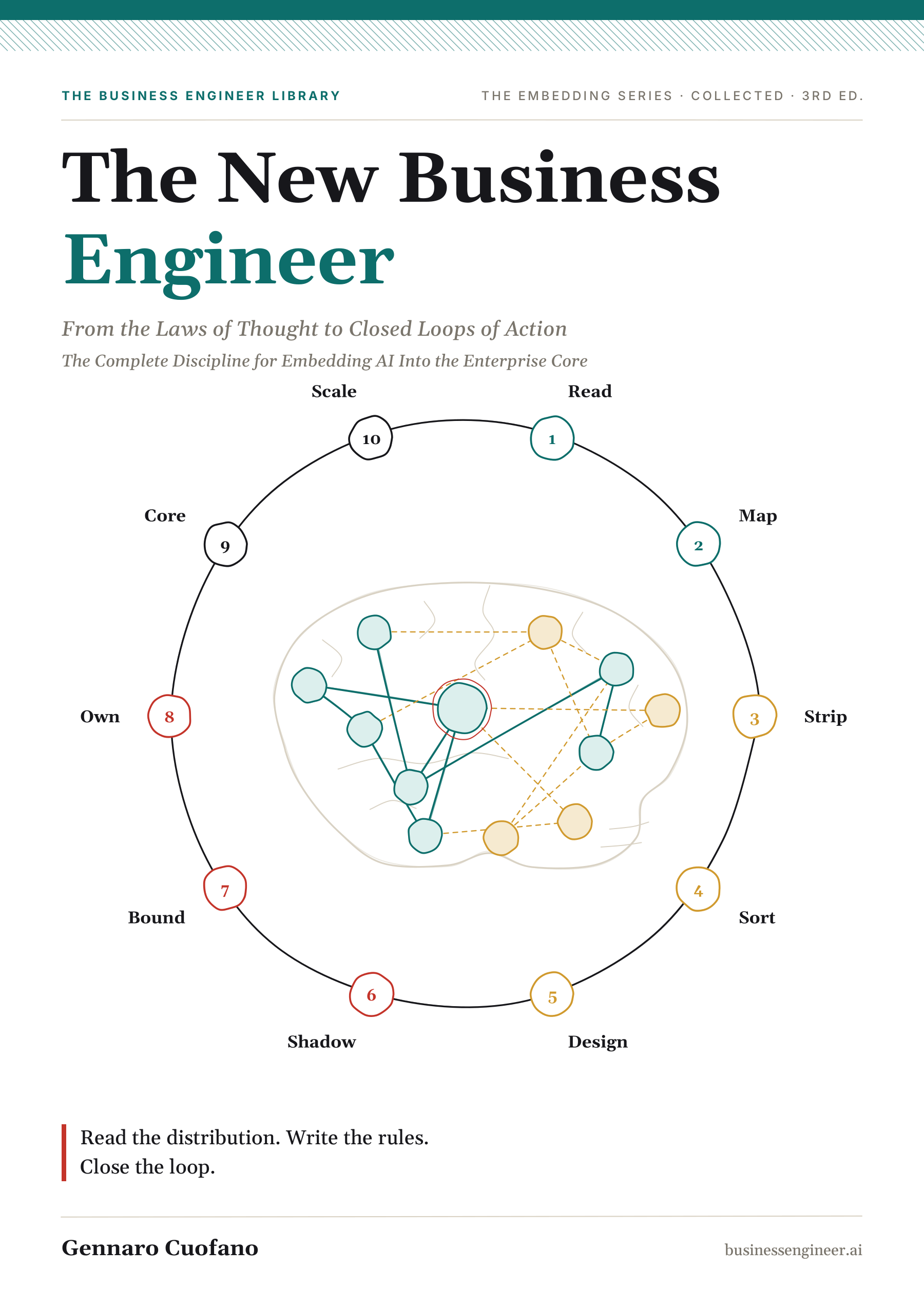
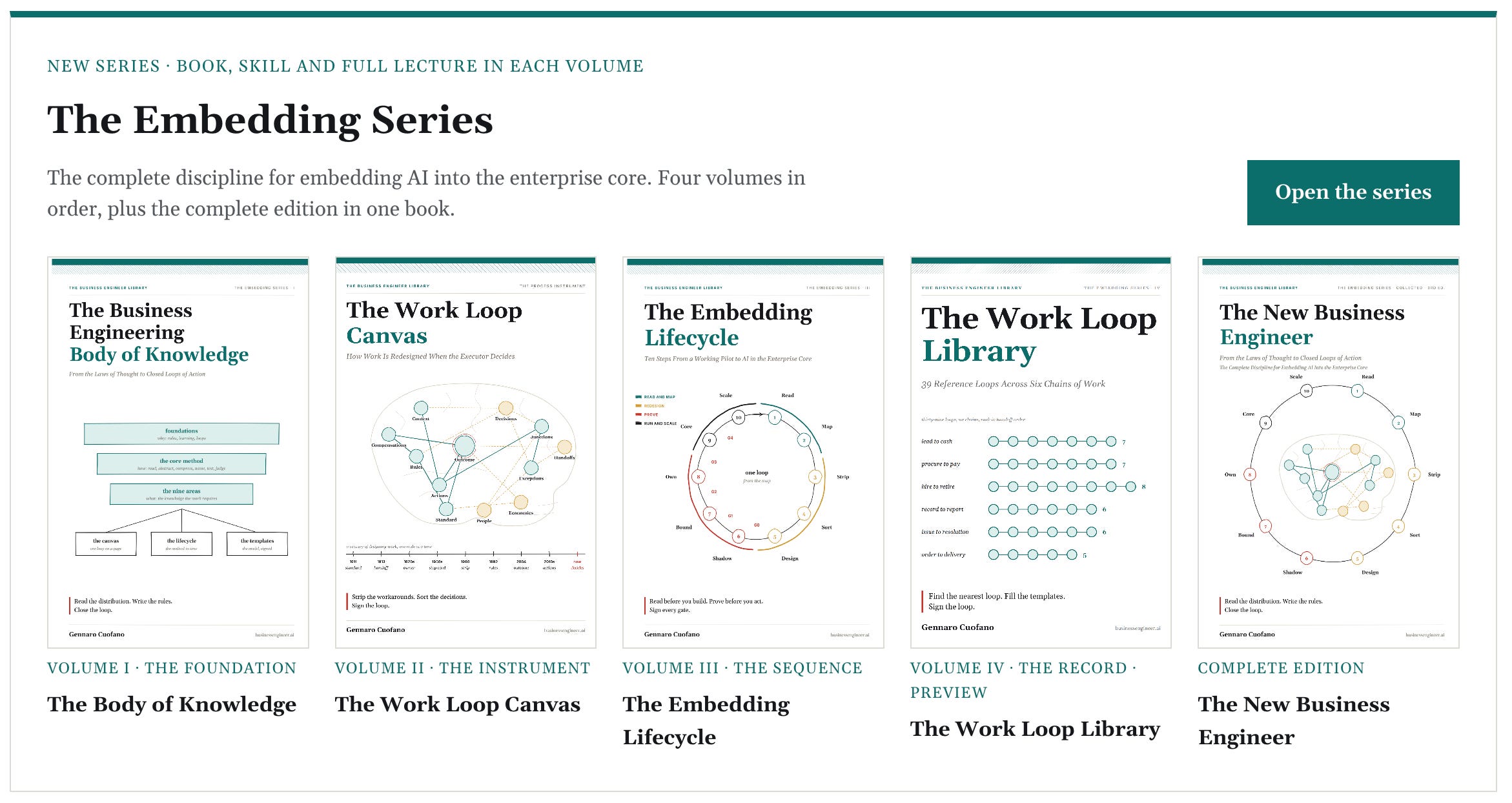
The New Business Engineer is Part of The Enterprise Embedding Series!