

One of the most striking aspects of the AI Supercycle, and one of the observations that shaped my thesis around it from the beginning, is how strange this cycle has been. It did start where most technology cycles start. It began as a consumer phenomenon. ChatGPT arrived almost as a surprise to the industry itself and immediately plugged into thirty years of existing Web distribution. Anyone with a browser could access frontier intelligence. There was no enterprise procurement cycle, no systems integration project, no six-month implementation. The distribution layer already existed.
For a while, that made AI look as if it would follow the Web’s trajectory: consumer first, enterprise second. The interface was conversational, the marginal cost of trying it was almost zero, and the first explosive use cases were individual. Even through much of 2024, the market could still be interpreted that way.
Then the shape of the competition began to change. Anthropic pushed aggressively into coding and enterprise workflows, coding agents became one of the clearest demonstrations of what sustained agentic work could look like, and the frontier labs increasingly found themselves competing not only for consumer attention but for the right to sit inside the enterprise.
OpenAI, Anthropic, Google, Microsoft, Amazon, and almost every serious model provider are now trying to solve different versions of the same problem: how do you turn general intelligence into useful work inside a very specific organization?
That shift is much more important than another model benchmark. It exposes the fundamental difference between AI and the previous wave of digitalization.
Digitalization was largely an outside-in transformation. The Web created a new external layer of distribution. Companies connected themselves to it through websites, search, e-commerce, social platforms, mobile apps, APIs, and eventually cloud infrastructure. The consumer interface changed first, and organizations reorganized themselves behind it. The Internet made the company reachable from the outside.
AI is increasingly an inside-out transformation.
It starts from intelligence and has to work its way into the machinery of the organization. And that is much harder. It does not matter how intelligent the underlying model becomes if it does not know which customer the employee means, which contract governs the transaction, which policy is current, which account is authoritative, which product can actually be sold in that market, which person owns the exception, what action it is permitted to take, and what the company considers a successful outcome.
Whether we eventually call the underlying capability AGI, ASI, or something less dramatic is almost secondary to the enterprise problem in front of us. Intelligence alone is not the product.
A frontier model has no intrinsic understanding of how your company works. It does not carry your operating model inside its weights. It does not know which version of reality your organization has agreed to treat as canonical. It does not possess authority merely because it can reason.
The bridge between intelligence and enterprise work is context.
But context here means much more than retrieval. It is the firm’s entities, relationships, rules, process states, ownership, permissions, exceptions, standards, history, and current operating reality. It is the semantic and operational layer that turns a general model into something capable of performing one narrow, vertical, consequential workflow.
The real enterprise AI problem is not simply making the model smarter. It is making intelligence situationally useful, operationally authorized, and economically valuable.
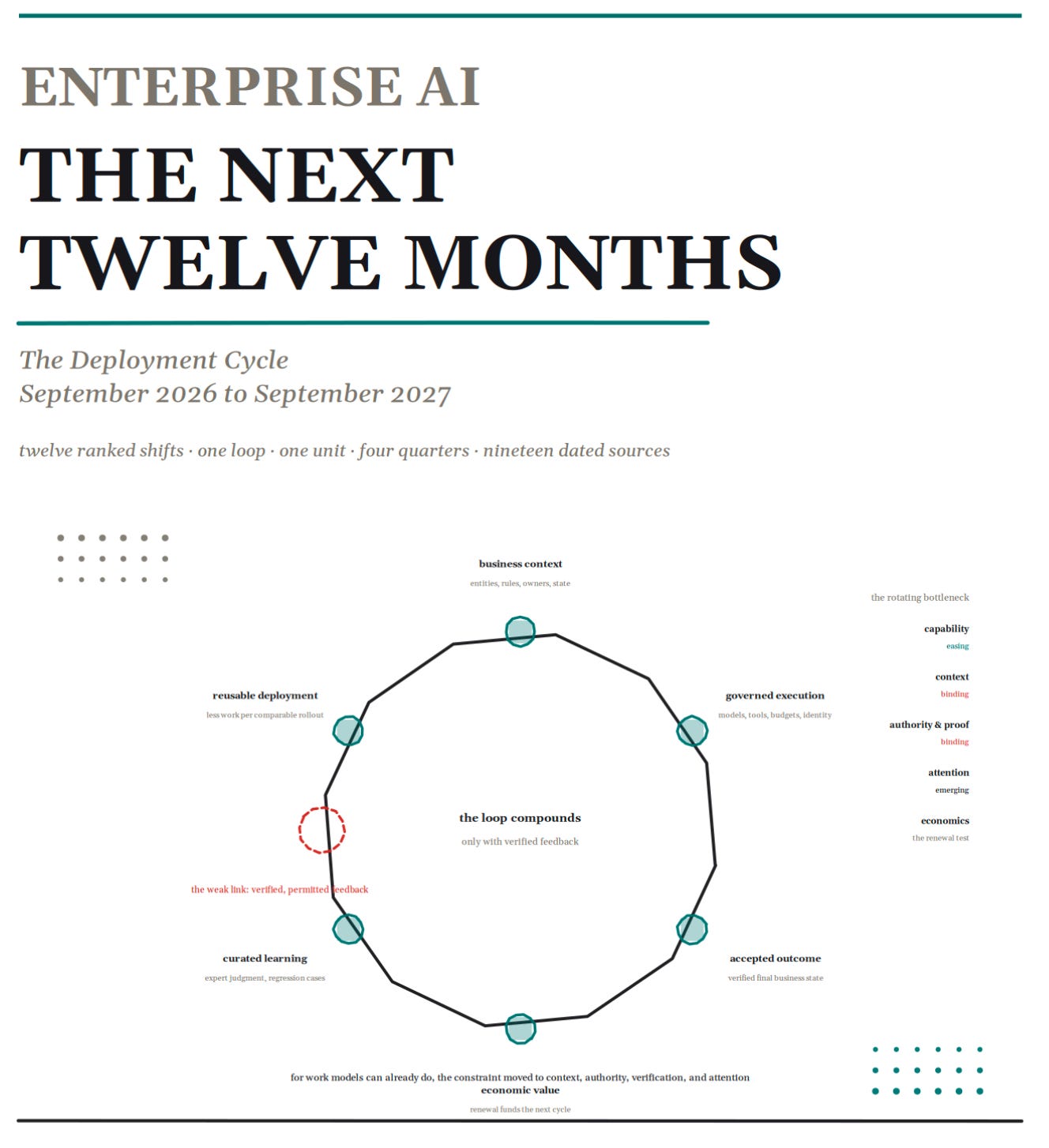
Once seen this way, the next phase of enterprise AI becomes easier to understand. For genuinely difficult work, model capability can still be the bottleneck. But for a growing class of bounded tasks, capability is already good enough that the constraint has moved elsewhere. The system needs the right context. Once it has context, it needs authority and proof. Once it can act, human attention becomes scarce. And once it operates at scale, economics decides whether it survives renewal.
This is the rotating bottleneck:
Capability → Context → Authority & Proof → Human Attention → Economics
A constraint binds until technology, capital, or organizational learning eases it. Then the next constraint becomes visible. The mistake is continuing to optimize for the bottleneck that just disappeared.
The enterprise operating loop follows naturally. Business context feeds governed execution. Governed execution produces accepted outcomes. Accepted outcomes create economic value. Exceptions generate expert judgment. Verified and permitted judgment becomes reusable learning. That learning improves the next execution and makes the next comparable deployment cheaper, faster, and more accurate. Then the loop starts again.
The weak link is that learning does not automatically belong to the vendor. Feedback can be noisy, confidential, biased, customer-specific, or contractually restricted. The loop compounds only when useful feedback can be verified, retained, and legitimately reused.
The operating doctrine for the next twelve months is therefore:
Productize deployment. Own context, control, and proof. Price accepted work.
What the Last Twelve Months Changed
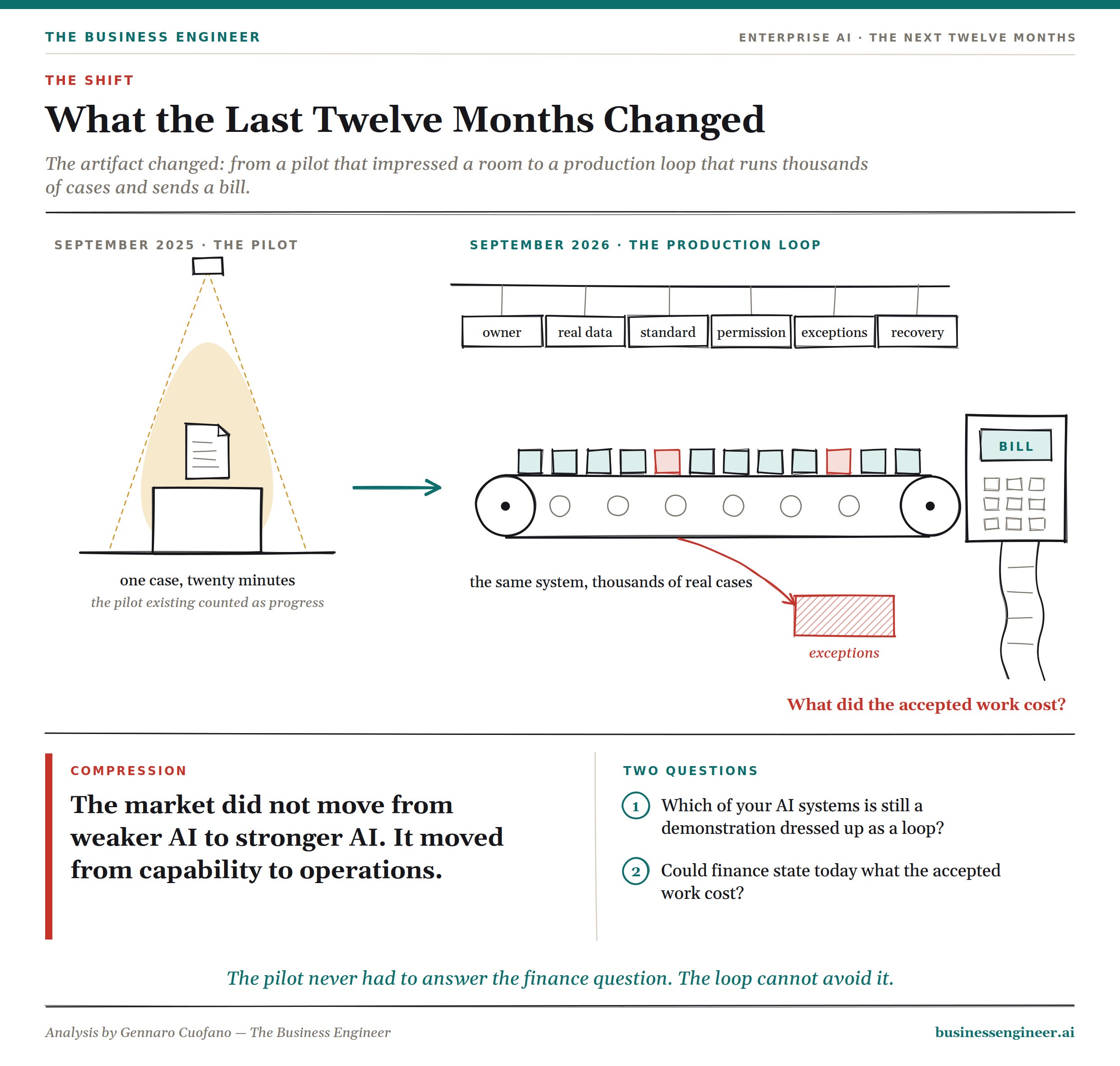
In September 2025, the characteristic enterprise AI artifact was still the pilot. A team identified a use case, found an internal champion, built something impressive enough for a demonstration, and added another initiative to an innovation portfolio. In many organizations, the fact that the pilot existed was itself treated as evidence of progress.
Twelve months later, the relevant artifact is increasingly the production loop and its bill. A production loop needs a named owner. It needs access to real systems and real company data. It needs a standard against which the work can be accepted or rejected. It needs permission to act, a path for exceptions, a way to recover when something fails, and somebody willing to pay for its ongoing operation. Most importantly, it runs repeatedly. The same system that looked extraordinary in a twenty-minute demonstration now has to survive thousands of real cases.
That is where the questions change. What happens when the model is uncertain? What happens when two systems disagree? Who decides which source is canonical? Which actions can the agent execute autonomously? Which require approval? How much human review does the workflow consume? What happens when the model provider changes the underlying model? What does the whole thing cost once inference, tooling, failures, rework, and review are included?
Eventually finance asks the question that the pilot never had to answer:
What did the accepted work cost?
The rest of the market moved in parallel. Coding agents showed what an agentic workbench could look like when the environment provides strong feedback. Application vendors started opening their systems to external agents and protocols. Semantic layers, ontologies, governance systems, evaluation infrastructure, and agent control planes moved from architecture diagrams into product roadmaps. Forward-deployed engineering became a strategic capability rather than a temporary implementation function. AI engineering became more central while parts of the entry-level knowledge-work ladder began narrowing.
All of these developments are easier to understand once the cycle is framed correctly. The market did not simply move from weaker AI to stronger AI. It moved from capability to operations.
The enterprise question changed from:
Can the model do this?
to:
Can the organization operate this repeatedly?
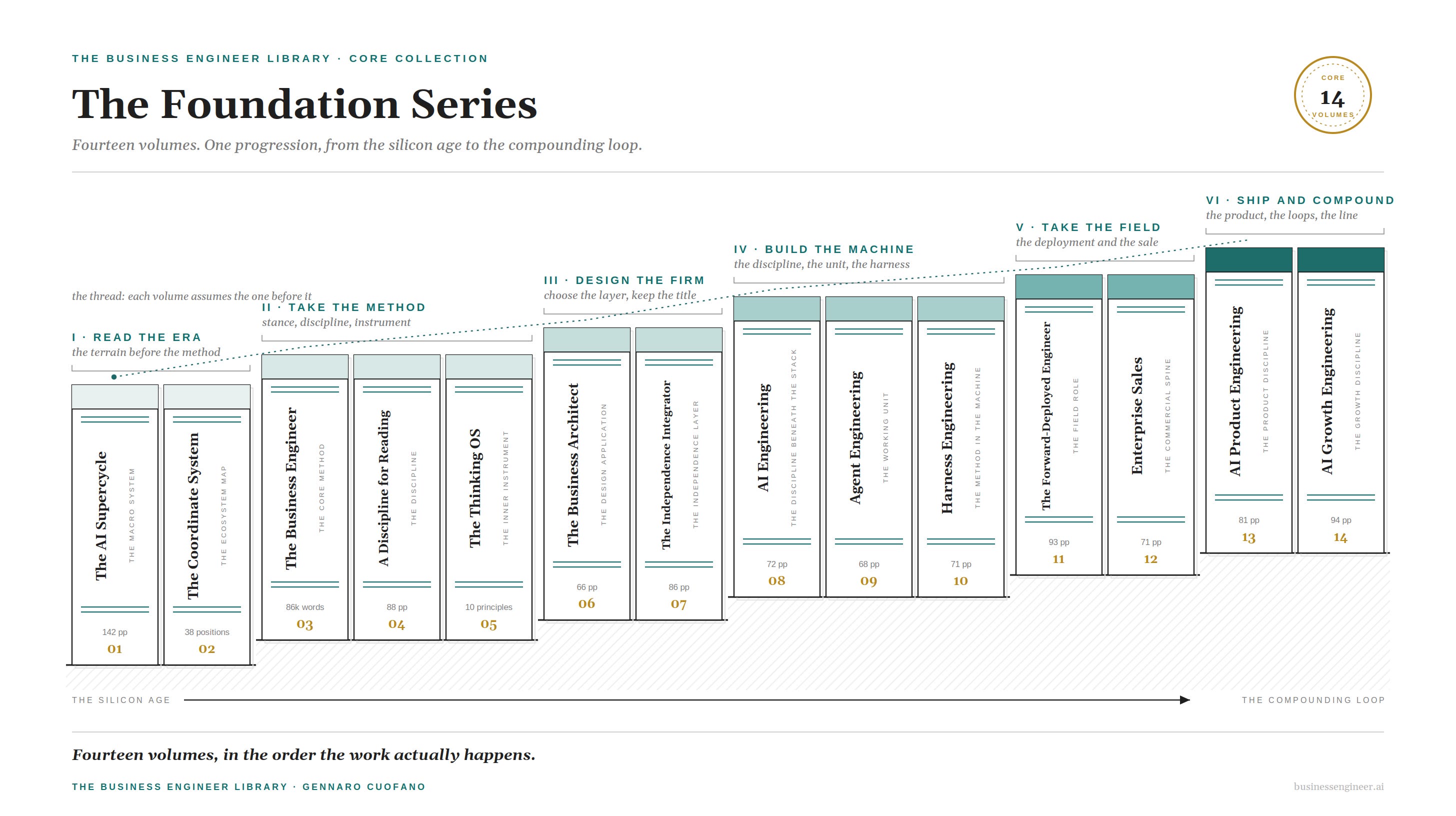
For the last three years, I’ve been rebuilding the Business Engineer’s curriculum from the ground up. That curriculum has now become the foundation of a new discipline, with the entire series taking shape around it.
If you’re already a paid member, simply reply to this email, and we’ll send it your way.