
A decade ago, I started covering the intricacies of the AI ecosystem. As early as 2016–17, I described AI as a multi-layered stack, almost like a layered cake of interconnected technologies and infrastructure.
A few years later, right after the launch of ChatGPT, I began mapping the AI landscape in a far more granular way. The reason was simple: the ecosystem was finally crystallizing around a few critical building blocks.
More importantly, however, something I had emphasized for years became impossible to ignore. This entire ecosystem has been shaped by constraints, bottlenecks, chokepoints, and scarcity at every layer.
In an era where AI represents the next computing paradigm, this cascading ecosystem revealed how unprepared we actually were to make it work at scale.
From that realization, I developed the idea of the AI Supercycle: the notion that the AI industry resembles the semiconductor wave that began in the 1940s and 1950s, matured in the 1970s, and ultimately enabled the first great computing wave.
That wave gave us the Internet, the cloud, mobile computing, and all the sub-waves attached to it, from browser wars and search engines to social media and now AI super apps.
Interestingly, until just a couple of years ago, I believed it was sufficient to update the AI map once a year. Then reasoning models started to emerge, alongside additional scaling laws converging with pre-training. At that point, it became clear to me that the landscape needed quarterly updates instead.
Yet another shift is happening now. We are entering a phase where four scaling laws are simultaneously shaping the AI ecosystem, while several converging forces are radically transforming the physical layers underpinning AI itself.
And to be clear: while the physical infrastructure supporting the AI revolution will likely take more than a decade to fully mature, entirely new paradigms will continue to emerge on top of it in parallel.
For that reason, don’t be surprised if this map evolves rapidly. The AI paradigm caught most of us by surprise, and understanding it requires a high degree of mental flexibility as the landscape keeps shifting beneath us.
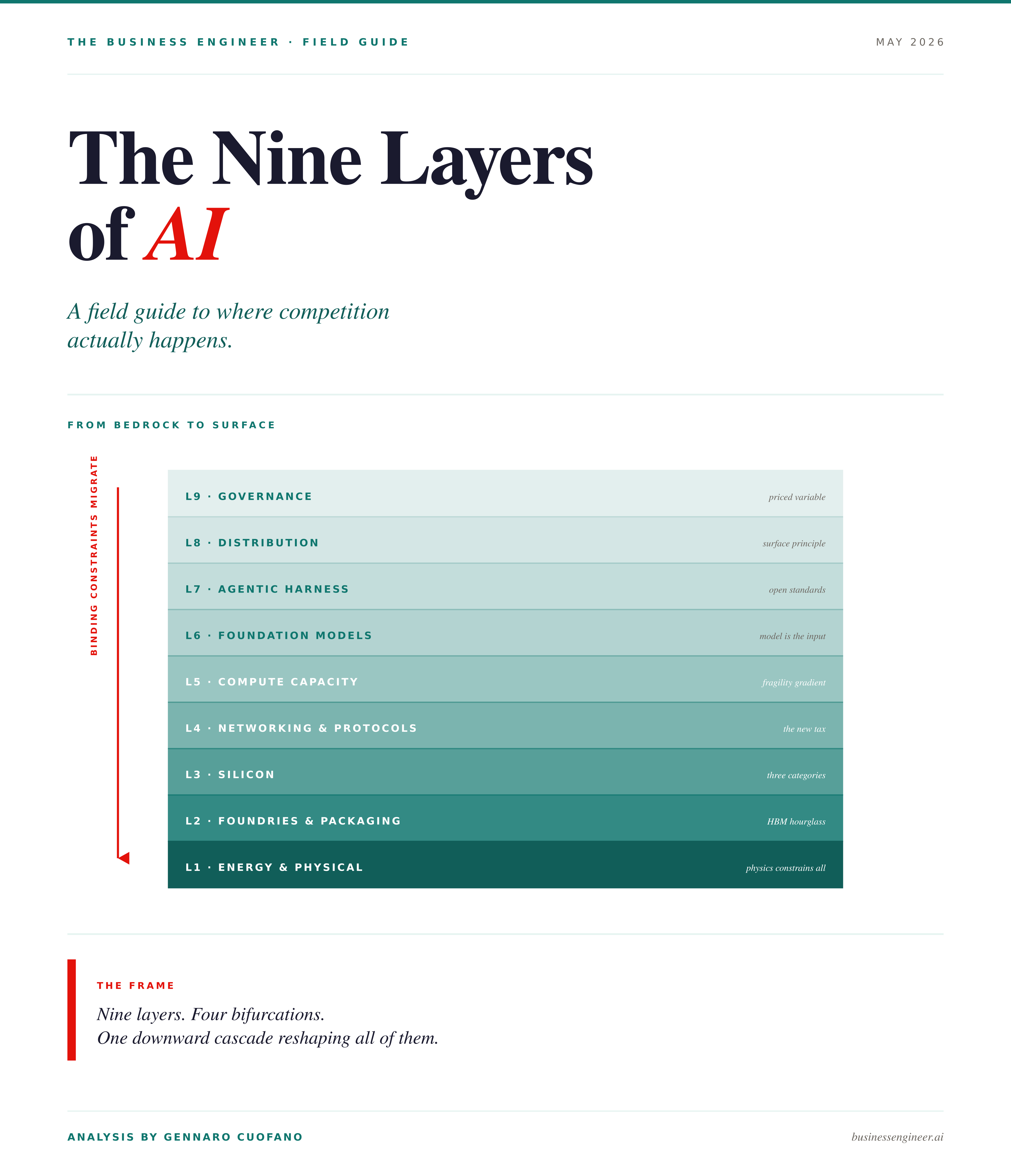
That is why the AI economy is not a list of companies racing each other. It is a layered industrial stack — and at any given moment, the binding constraint sits at a different layer than it did six months ago.
This research walks through all nine layers from bedrock to the surface, explaining what each layer is, why it matters right now, who controls it, and the mental model that governs its dynamics.
Read it as a field guide. Every headline, every valuation move, every strategic decision in the cycle lives inside one of these nine boxes.
For Premium Members: