
Over the last decade, much of my work with The Business Engineer has been about understanding what makes businesses work. Business models, financial structures, technological architectures, and organizational incentives are all ways of compressing the enormous complexity of a company into a set of mechanisms that explain how it creates and captures value.
But as I’ve become more involved in enterprise AI, I’ve found myself returning to a more fundamental question: where does the actual intelligence of an organization reside, and how much of it can we capture, abstract, and make reproducible?
The more I think about it, the more I believe that much of what makes a company exceptional is concentrated in relatively few places.
In almost every critical business process, two distributions overlap. A small proportion of cases accounts for a disproportionate share of the value, risk, or complexity. And a relatively small number of people possess the judgment required to navigate those cases effectively.
Think of the senior underwriter who recognizes a risk that everyone else overlooks. The procurement director who understands why a seemingly ordinary supplier decision could disrupt an entire production line. Or the controller who knows that a discrepancy in the books signals something far more consequential.
What makes these people exceptional isn’t simply that they know more. It’s that they recognize which distinctions matter, which questions to ask, and when the conventional process is no longer sufficient.
Yet their expertise doesn’t exist in isolation. It is deeply intertwined with the organization itself: its accumulated experience, informal relationships, decision-making structures, constraints, incentives, and the institutional knowledge developed over years of operating in a particular environment.
This combination of exceptional individual judgment and the organizational system that makes it effective is what I call the Organizational Genius.
And here lies what I believe is one of the most important, yet overlooked, opportunities for enterprise AI.
Most automation efforts start with the routine majority of work. They identify repetitive tasks, attach an AI executor, and measure success through productivity improvements and labor savings. This is useful, but it largely addresses the average case, leaving the most consequential decisions in the hands of the same few experts.
The real opportunity is different.
What if, instead of simply automating what the average employee does, we could capture the judgment of the organization’s best people and make it reproducible across thousands or millions of decisions?
That requires something fundamentally different from deploying an AI agent. It means understanding how expertise actually operates, separating valuable judgment from accumulated habits, identifying the evidence and distinctions that change decisions, and making explicit the rules, responsibilities, and authority through which that judgment becomes action.
Crucially, it also means recognizing what cannot yet be captured, and designing the system so that human expertise continues to shape, supervise, and improve it.
The goal isn’t to eliminate the expert. It’s to turn the expert from a bottleneck into a source of continuously expanding organizational capability.
This is the transition from automation to amplification.
And it changes the economic equation. Automating routine work primarily saves labor. Amplifying exceptional judgment can expand the organization’s capacity to make better decisions, take on more complex work, manage more risk, and create value at a scale that previously depended on the availability of a handful of individuals.
More importantly, that expertise becomes an organizational asset rather than something that disappears whenever a key employee leaves or the underlying technology changes.
I believe this is where the next frontier of Business Engineering lies: not merely modeling how a business works, but capturing the intelligence that makes it work, and building the systems through which that intelligence can be replicated, evaluated, and continuously improved.
Find the core of the business. Find the people who make it work. Capture their judgment, and build the system that allows it to travel further.
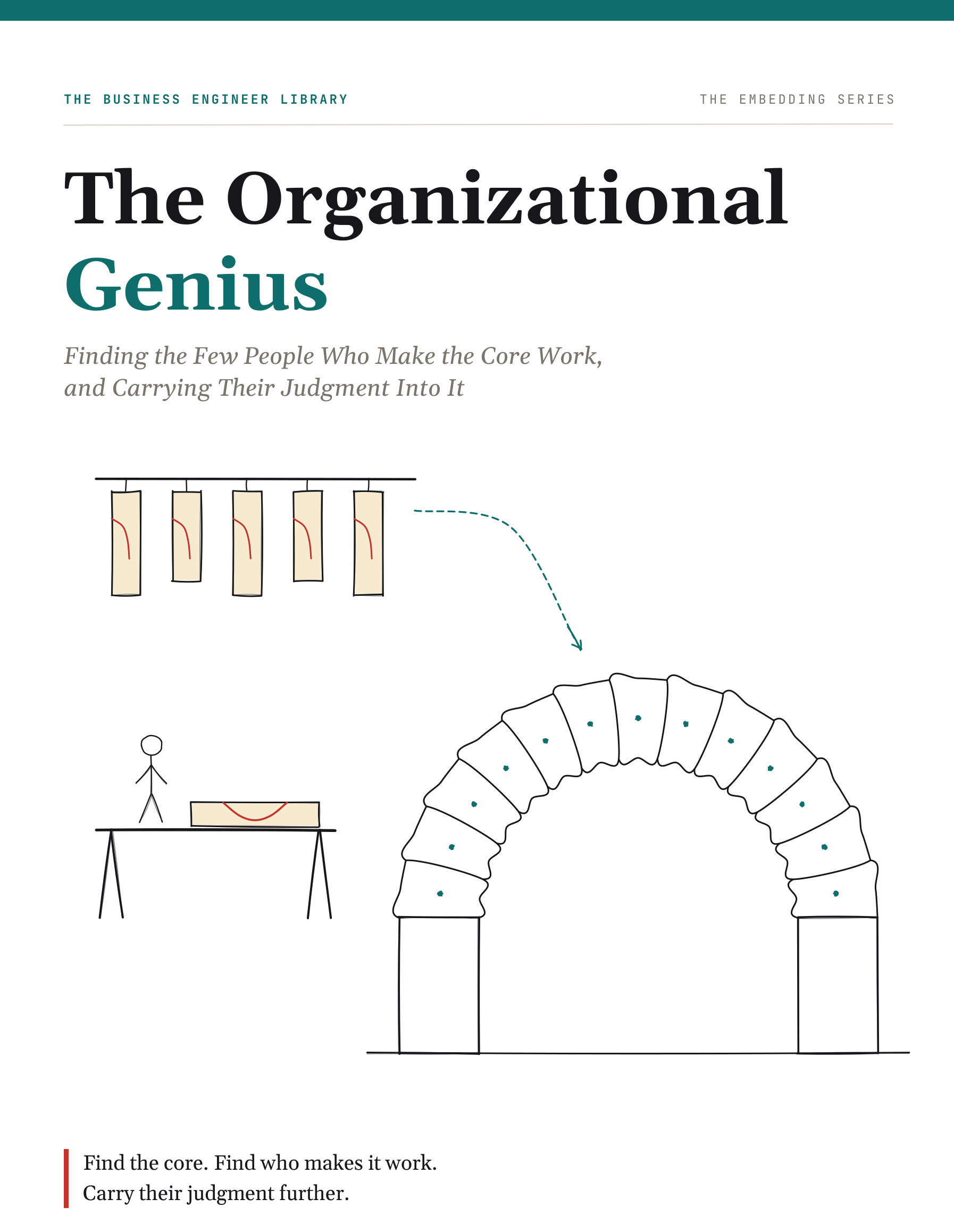
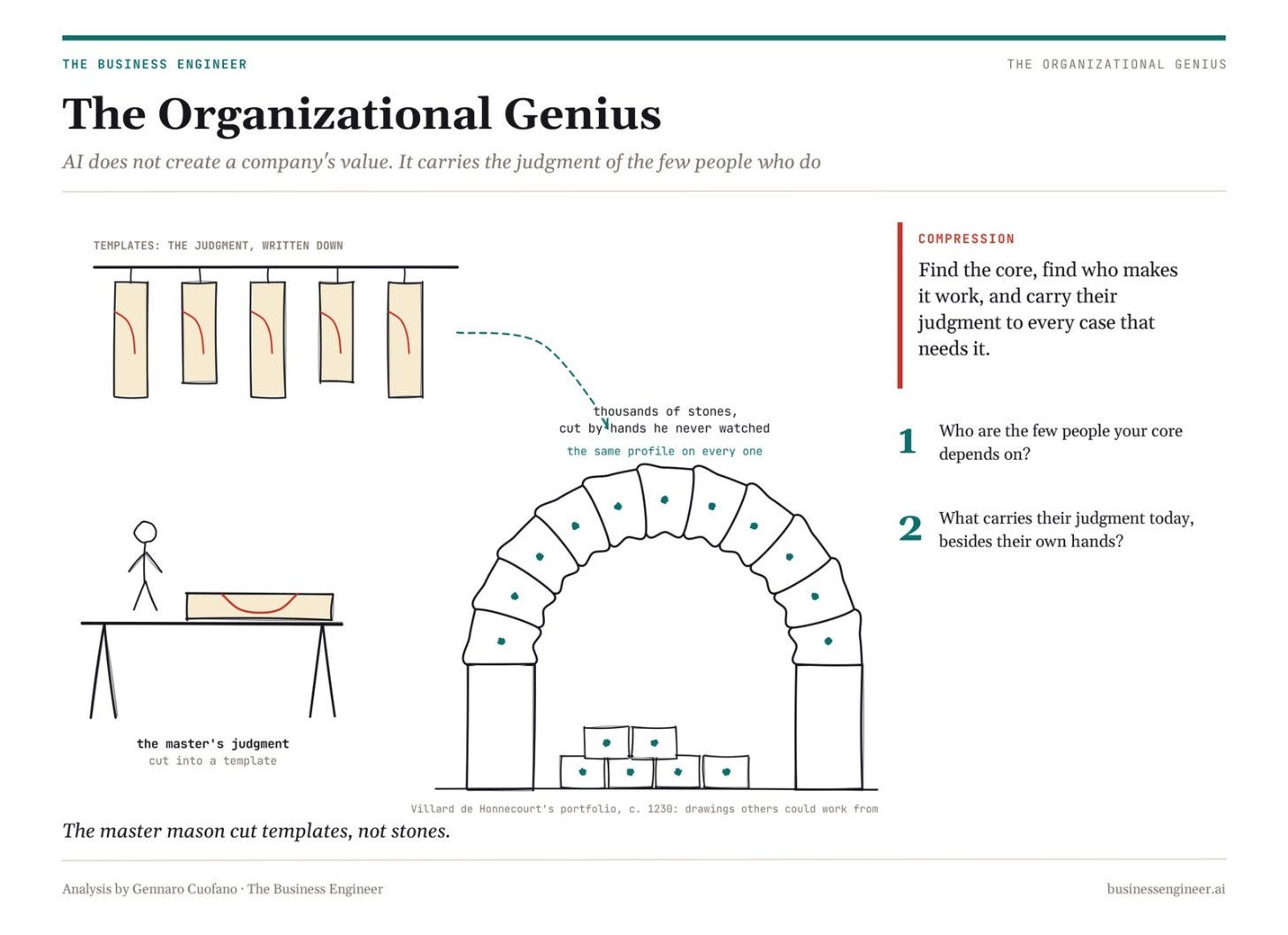
In a medieval cathedral lodge, the master mason cut very little of the stone. He cut templates. Thin boards traced the exact profile of an arch, a rib or a window moulding, and masons he never watched directly worked to them. A few people’s knowledge shaped thousands of stones over decades.
Around 1230, Villard de Honnecourt filled a portfolio with drawings of buildings, machines and geometric methods. Whatever its exact purpose, it shows how that knowledge travelled: as drawings other people could work from. The master’s judgment reached further than his hands.
Enterprise AI faces the same problem, and most programmes are solving the wrong half of it. They ask which tasks a machine can take over. The better questions are older. What is the core of this company? Who are the few people who make the core work? And what does it take to carry their judgment to every case that needs it?
Every volume of the embedding series is an answer to part of those questions. Here the thing they are all trying to carry gets a name.
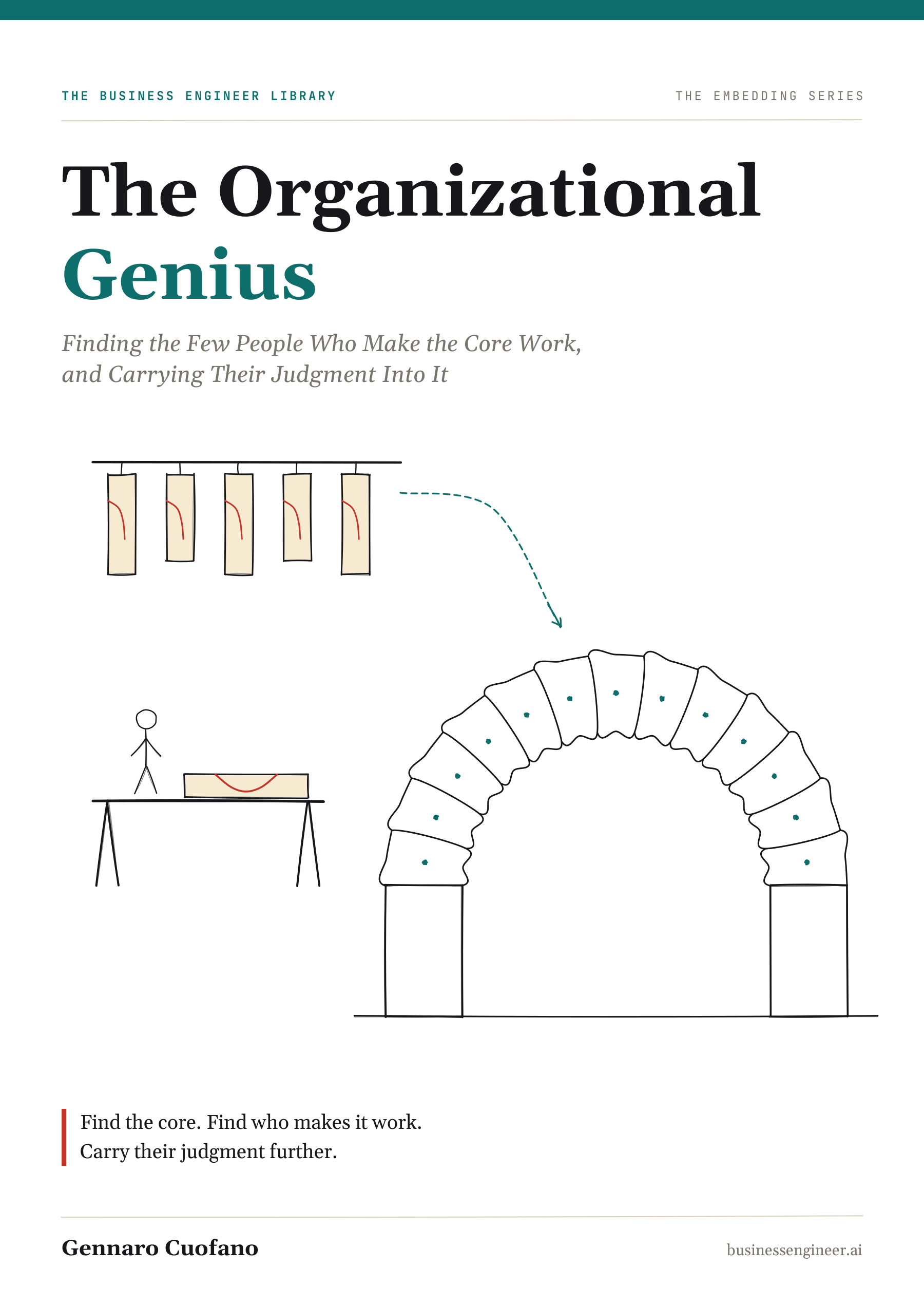
The Organizational Genius is Part of The Enterprise Embedding Series!