

For three years, using AI has meant opening a box and typing into it. You ask, it answers, the session ends, and the model forgets you were ever there.
That pattern is now breaking. Consider the last ten weeks. Meta shipped Muse and OpenAI shipped Dots. Perplexity turned Computer into a team of always-on “Teammates”. Anthropic published a blueprint for building always-on agents, and LangChain raised $300 million to sell the infrastructure that runs them. None of these products waits for a prompt. They wake up on their own, remember what happened last week, and keep working after you close the app.
The industry has tried several names for this. Ambient agents. Always-on agents. Proactive agents. Long-horizon agents. The name that is winning is persistent agents, and it is the right one, because it captures what is actually new. The agent persists. Its goal persists, its memory persists, and its presence across your tools persists.
Dylan Patel of SemiAnalysis put the demand side in one line on 11 November: persistent agents now account for 45% of his firm’s AI spend, up from zero at the start of the year.


This piece is a field guide to that shift. It starts with what a persistent agent is and why the change from tasks to goals matters. It then opens the machine: the wake cycle, the three layers of an agent, the runtime that surrounds it, and the memory problem at its centre. It closes with the market map, the use cases that already work, the business consequences, and the failure modes worth watching.
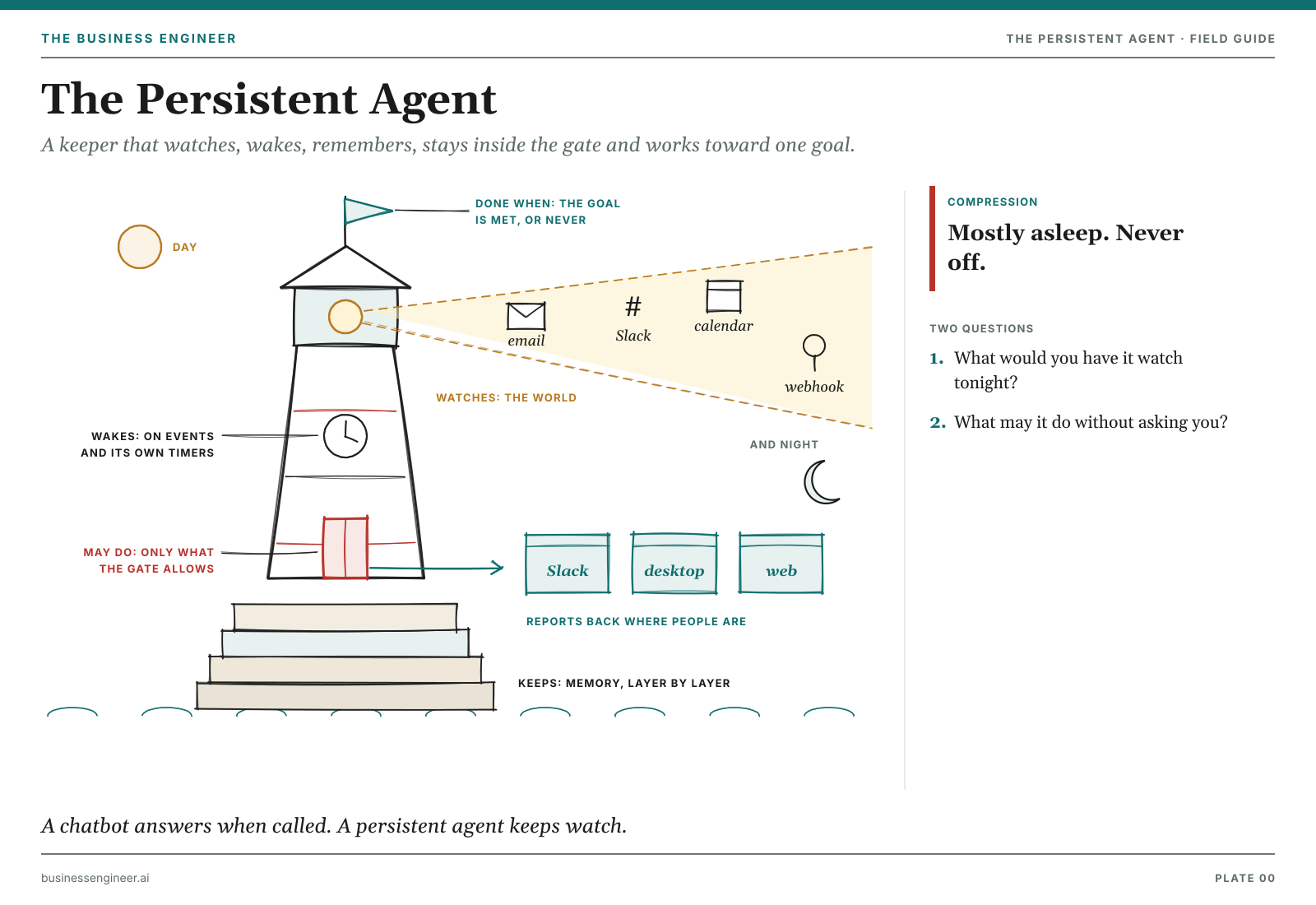
The organising idea is simple. A chatbot is a contractor you brief for each job. A persistent agent is closer to an employee with a standing responsibility. Almost everything that is hard about building one follows from that difference.
Get The New Enterprise AI Embedding Series

From Answering to Holding a Job
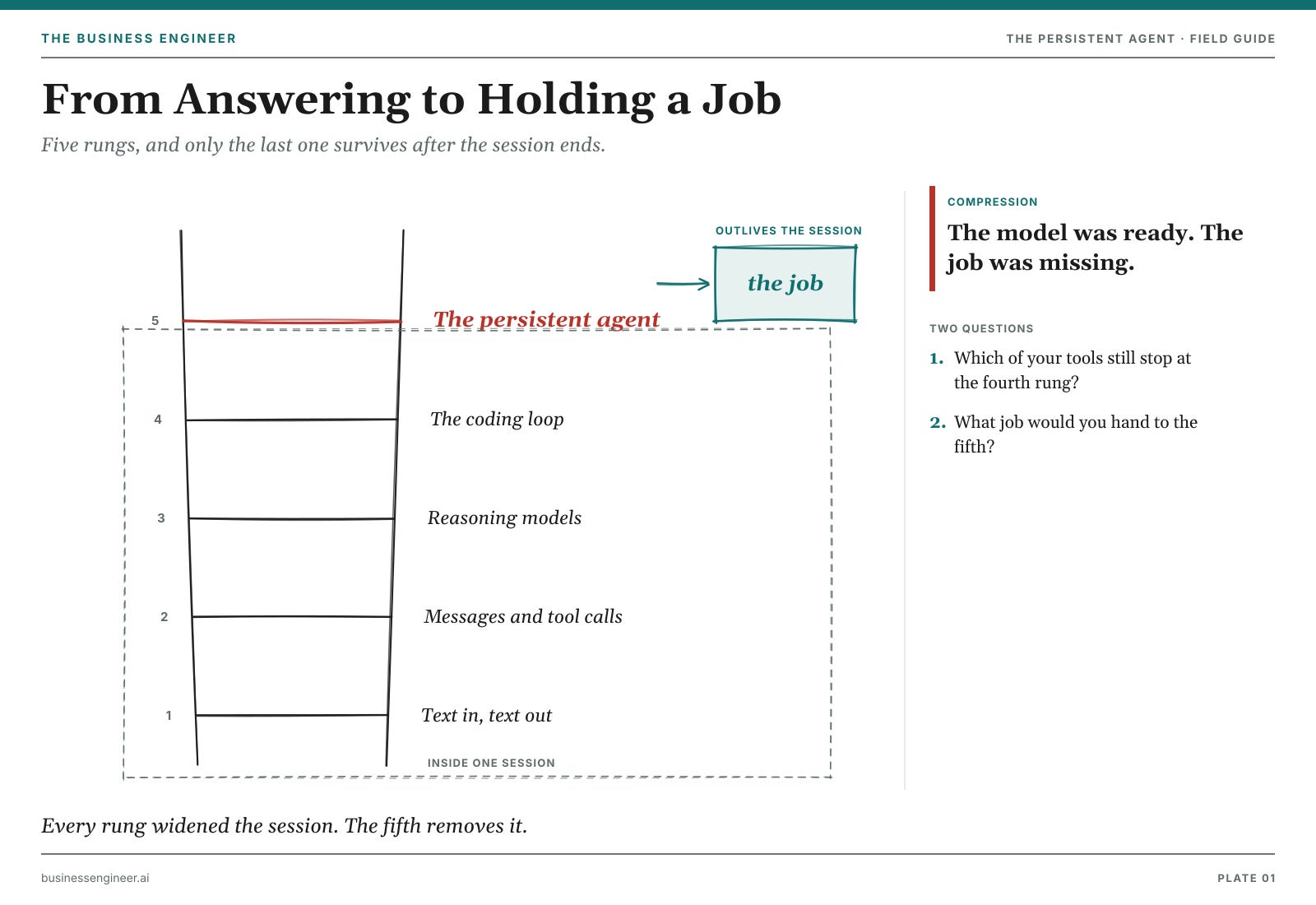
Five rungs, and only the last one survives after the session ends.
It helps to see the persistent agent as the fifth step in a short history.
The first step was text in, text out. A language model completed whatever you gave it, and that was all. The second step added messages and tool calling, so developers could build conversations and let a model call a search API or a calculator in sequence. The third step was reasoning models, which made every agent built on top of them noticeably more capable. The fourth step was the coding agent. For the first time, an agent was not a single model call but a loop that acted on an environment: reading files, running code, fixing what broke, and trying again.
Each step widened what the agent could do inside one session. The fifth step removes the session as the boundary. The agent now runs across days and weeks, against a goal rather than an instruction, and it acts when the world changes rather than when a person types.
Harrison Chase, LangChain’s chief executive, sketched the arc on X in October as a progression from coding agents, to personal agents, to something that looks like an operating system for the whole company.


A useful way to test whether something is truly persistent comes from a September essay by Arrington Capital titled “Good Agents Never Sleep”. It proposes five questions. What does the agent watch? What wakes it up? What state does it keep? What is it allowed to do without asking? And how does it judge whether a job is complete? An agent that can answer all five has crossed from contractor to employee. A chatbot cannot answer any of them, because it watches nothing and keeps nothing.
That test also explains why the category feels sudden. The models were capable enough a year ago. What was missing was everything around the model that lets it hold a responsibility over time. That surrounding machinery is what shipped in 2026.
The Four Properties of a Persistent Agent
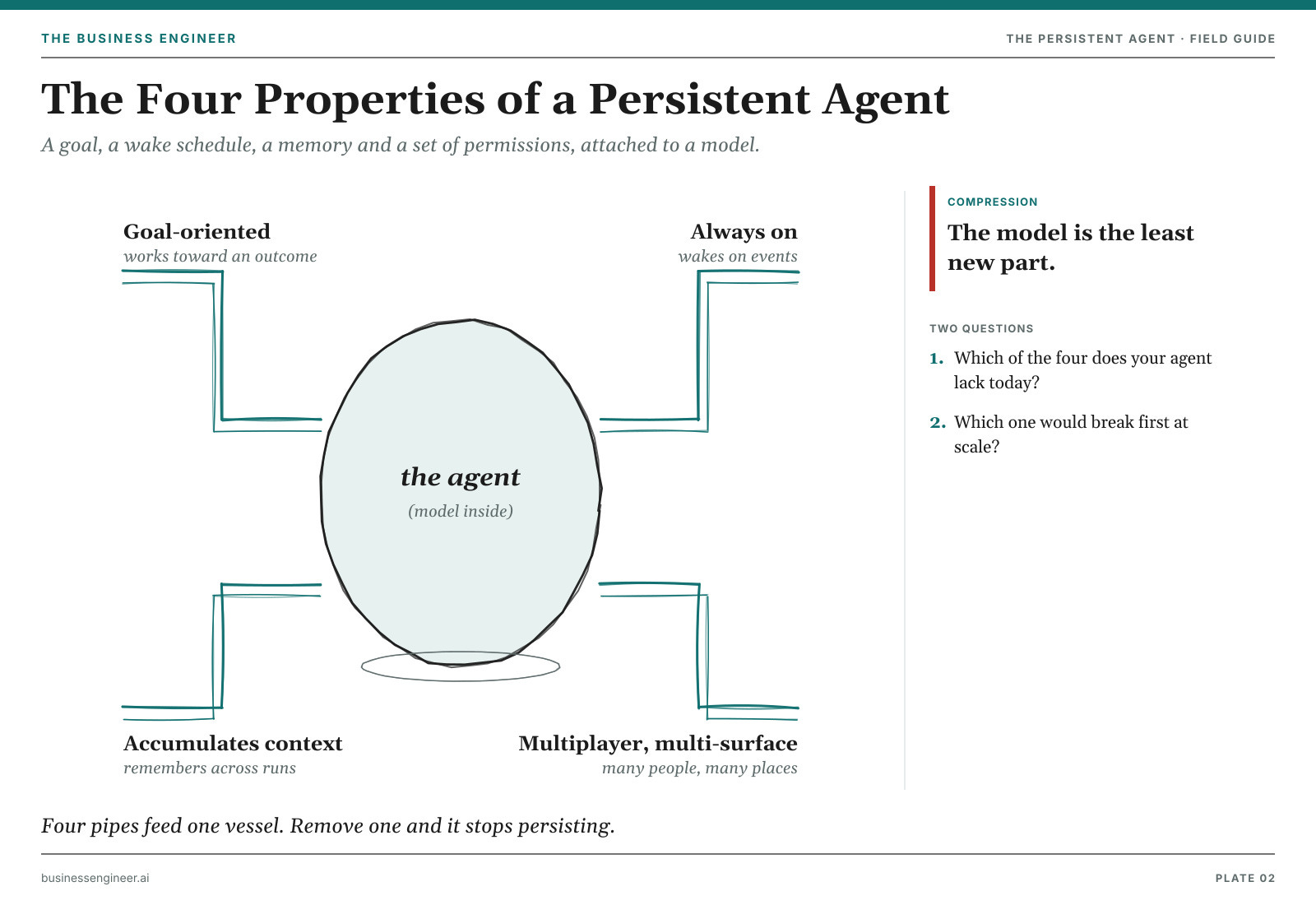
A goal, a wake schedule, a memory and a set of permissions, attached to a model.
In LangChain’s 20 November webinar on the topic, Chase described persistent agents through four properties. They are worth taking one at a time, because each one creates a distinct engineering problem.