

Having spent over a decade in the AI space, I still remember how, back in 2017, we were trying to build voice agents, then called voice assistants, on platforms like Amazon Alexa and Google Assistant. Seeing where we are today makes two things clear to me: the possibilities are enormous, and we are still incredibly early.
OpenClaw was the real aha moment for what personal agents could do, both for business users and consumers. In less than a year since its inception, the landscape has evolved dramatically. Things are moving incredibly fast, especially for business users, while consumer interfaces that initially looked like “OpenClaw copycats” are beginning to specialize and develop identities of their own.
For the vast majority of consumers, an agentic experience is still something they have never encountered. These new personal agents will be their first point of contact with AI that can actually act on their behalf.
As a business user working at the edge of the AI industry, interfaces like Instinct or Muse didn’t impress me technically in the same way that Claude Code, OpenClaw or Grok Bot did. Those harnesses offered a glimpse of the full capabilities of agentic AI. But my perspective isn’t necessarily the one that determines what succeeds with consumers.
Consumer AI is a different game. It sits at the intersection of interface design, monetization that can sustain free access at scale, and brand recognition. The most technically impressive harness won’t automatically become the interface millions of people use every day.
That is what makes this moment so interesting: the personal agent landscape is finally emerging in full swing, and we are beginning to see how these capabilities might reach a mass audience.
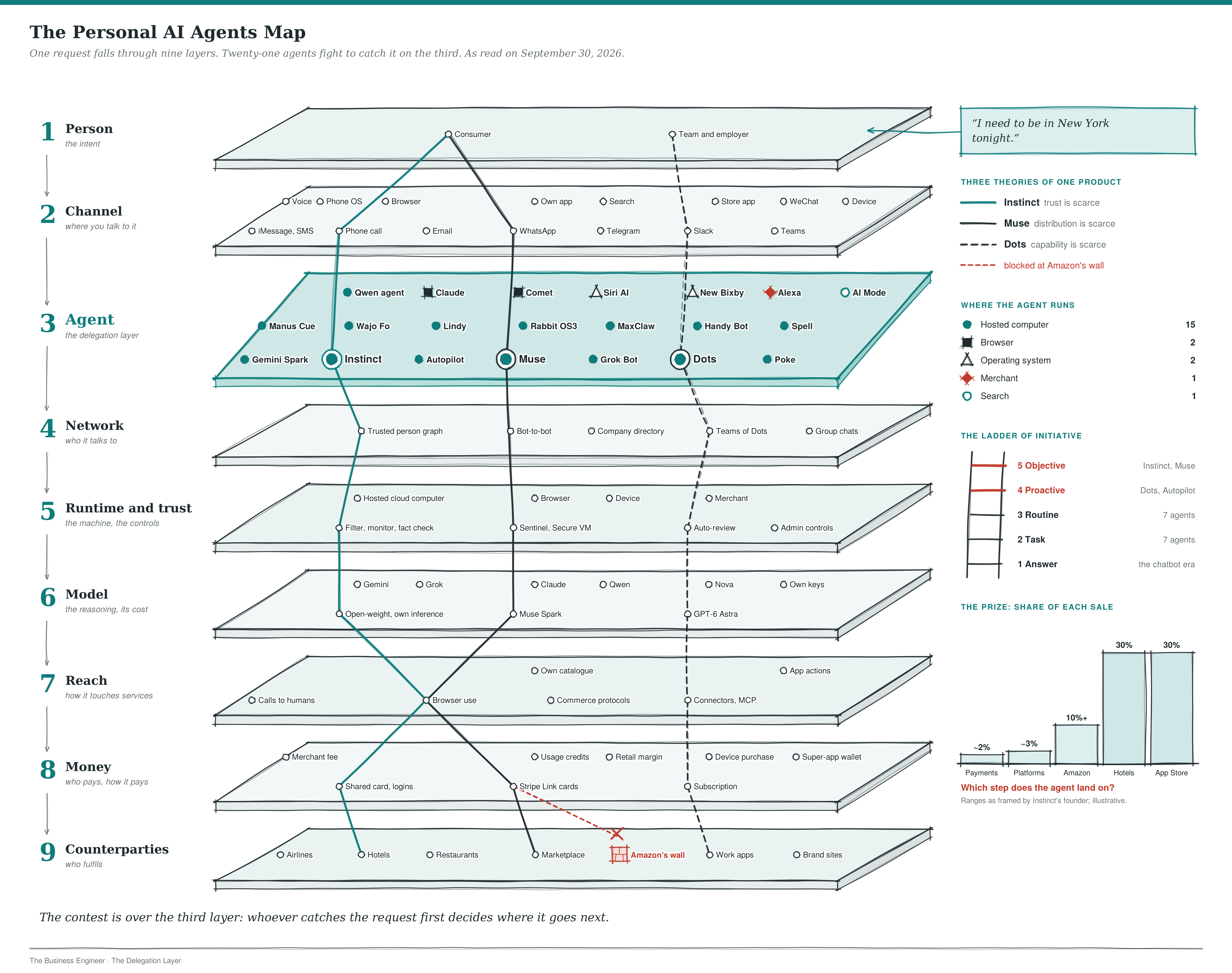
The personal agent is becoming a new layer between intent and fulfilment. The fight is no longer only over which model you use. It is over who receives the first request, who earns the right to act, and who gets paid when the work is done.
A user sends a voice note: “I need to be in New York tonight.” Nobody opens an airline app, compares hotels, checks Uber, copies the itinerary into a calendar or types a card number. The agent already knows the user’s location, preferred airline, seat, payment method and schedule. It books the flight, reserves the hotel, orders the car and updates the calendar. Earlier that day, the same agent may have called first because a document needed signing before 3 p.m.
That is how Noah Shinn describes Instinct. The product has no conventional app. It has a phone number, an email address and a computer. You deal with it much the way you would deal with another person. down
For the first few years of consumer generative AI, the chat window was the product. You opened ChatGPT, Claude, Gemini or another application, asked for something, received an answer, then completed the workflow yourself. The assistant sat beside the work.
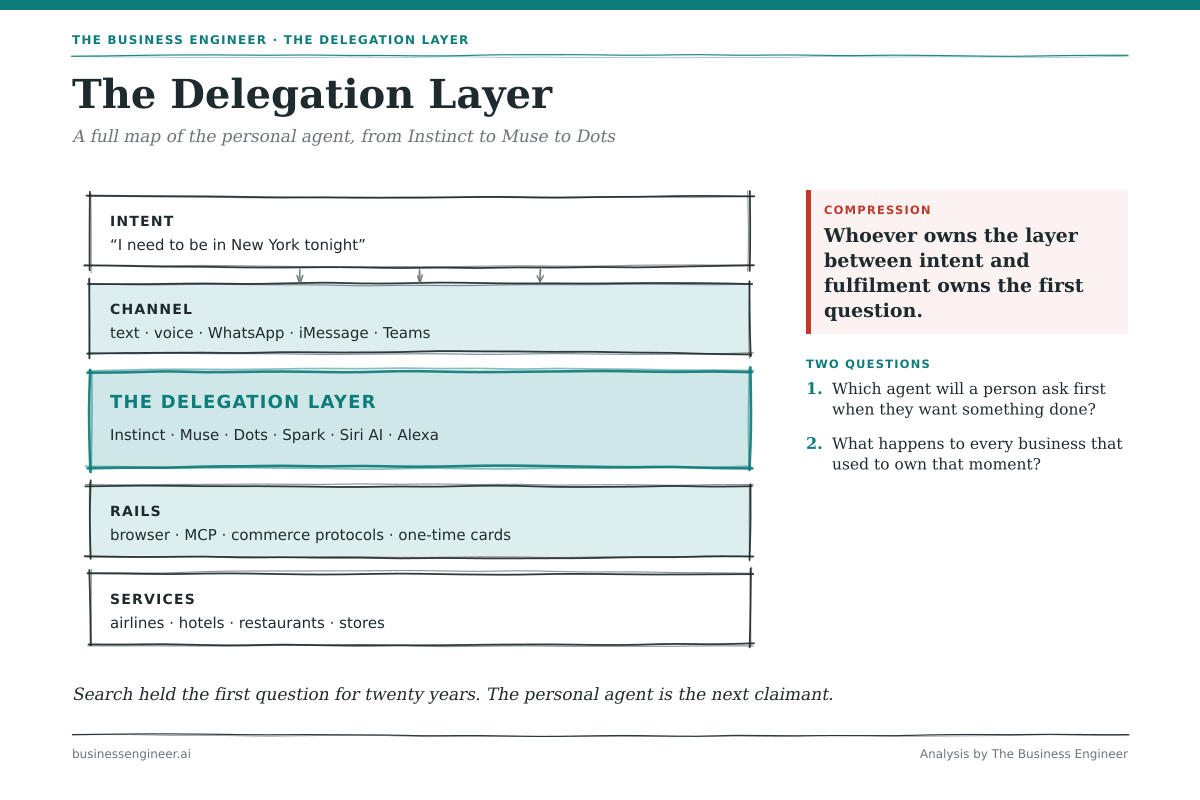
The new personal agents are trying to sit in front of the work.
They remember. They watch. They decide when something requires attention. They browse, call tools, spend money, coordinate with other people and increasingly continue working after the user has gone away.
By September 2026, Meta had launched Muse, Apple had put Siri AI into beta, Anthropic had folded Cowork into Claude, Rabbit had released OS3, Microsoft had announced Autopilot and OpenAI had launched Dots.
Google had already been running Gemini Spark, Amazon had pushed its shopping agent deeper into Alexa, and Chinese internet groups were reported to be testing their own versions. Instinct announced a $1 billion financing round at a $10 billion valuation in the same period.
The products differ enormously underneath, but they are converging on the same architectural idea:
The personal agent is becoming a new layer in the stack: the delegation layer.
Search engines spent two decades owning the moment when the user asked, Where can I find this? Marketplaces fought to own the moment when the user asked, Where should I buy it? The personal agent wants to own an earlier moment:
“Here is what I want. Take care of it.”
That position is potentially more valuable than the search box or the checkout page because it sits before both. The agent can decide where to search, which service to use, which merchant to trust, whether a transaction is worth making and whether the user needs to see the intermediate steps at all.
The category becomes much easier to understand through six questions: Where does the agent run? How do you reach it? Who starts the work? Who pays? How does it touch other services? Who else can it talk to?
If you are a paid member, reply to this to request access.
Also watch the full video lecture below!