

One of the most important shifts over the next 12 months will be the move away from using closed frontier models for everything.
Enterprises will increasingly push more strategic workloads toward open-weight models, not simply because they can be cheaper, but because they offer something more important: modularity, control, deeper customization, and greater protection over proprietary context and intellectual property.
The strategic goal is to bring the model closer to the enterprise, rather than continuously sending the enterprise into someone else’s model. That means adapting models to internal knowledge, workflows, policies and domain-specific context, while building a deeper understanding of where the company’s real AI moat can emerge.
In theory, this is extremely attractive. In practice, running, customizing, securing and maintaining open models inside the enterprise core is far from free.
And this is where the economic argument is often misunderstood.
If the main reason you are moving to open models is simply to save money on tokens, you may be approaching the problem from the wrong direction. The stronger case for open models is control, modularity, strategic independence and the ability to progressively encode proprietary enterprise context into the AI stack.
Cost matters, but it should be evaluated against those strategic benefits, not in isolation.
This analysis breaks down that trade-off in full: where open models actually save money, where they become more expensive than expected, and where the real strategic value lies beyond the token price.
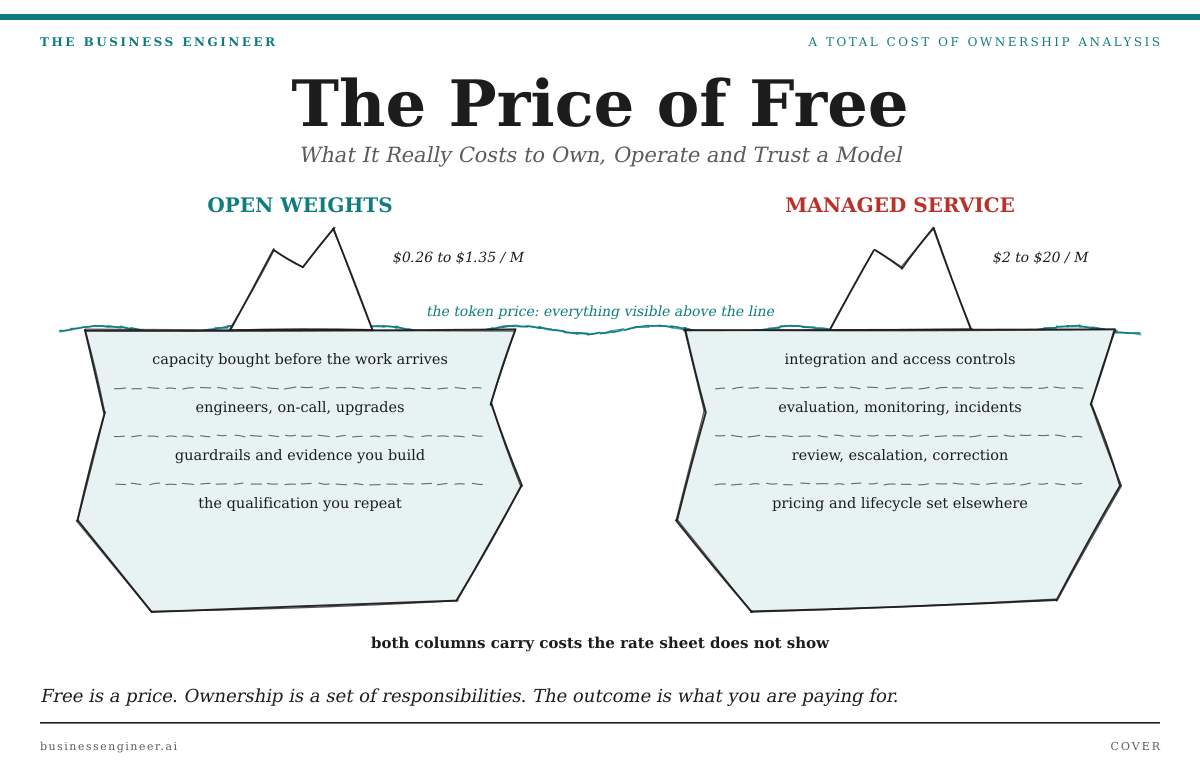
Open weights can give you more control, more flexibility and lower costs. But downloading a model, operating it and getting useful work from it are three different economic problems.
An open-weight model can cost nothing to download. That is a meaningful advantage. You receive the model’s learned parameters, with rights to use and modify them under its licence. But the download is not the service. Someone still has to supply the computing capacity, operate the software, monitor performance and handle failures. A free model does not automatically produce a low-cost system.
The opposite mistake is just as important: adding every engineering, evaluation and governance expense to self-hosting, then comparing that total with an API’s token bill alone. Buying access to a managed model does not eliminate the customer’s work on integration, access controls, output quality or oversight. It changes which responsibilities sit with the provider and which remain with the customer.
The useful question is not “Are open models cheaper?” It is “Which combination of model, deployment and supervision delivers the required outcome at the lowest acceptable cost and risk?”
That question has an established name: total cost of ownership.
To gain Full Access, subscribe below.