
What is emerging does not simply follow the structure of the web. In many respects, it does not even rhyme with it.
The current AI market cycle looks much more similar to the emergence of computing itself in the 1950s and 1960s than to the rise of the consumer internet.
That means we need a different lens.
The right question is not:
“Who is the next Google?”
At least not if by that we mean the next consumer-first AI company.
This was initially how OpenAI was perceived during the first phase following the ChatGPT moment, roughly between 2022 and 2024. The assumption was that OpenAI could become the dominant consumer interface for AI, effectively positioning itself as the next Google.
Rather than remaining primarily a consumer internet business, Google is increasingly evolving toward an enterprise-first and infrastructure-centric model, where AI infrastructure, cloud, compute, models, and enterprise distribution become progressively more central to its strategic identity.
This shift is also at the heart of many of the tensions and departures we are currently seeing inside the company.
Google is not simply adapting its existing business to AI. It is potentially redefining what kind of company it wants to become.
But the market evolved differently.
As OpenAI pushed aggressively toward that consumer ambition, Anthropic pursued almost the opposite strategic direction: focus on hard enterprise problems, win demanding workloads, and become deeply embedded inside enterprise infrastructure and workflows.
Over time, that difference in positioning became increasingly important.
Today, however, the strategies of the two companies are converging. Both are moving toward the same fundamental prize:
Enterprise AI.
And this changes the question entirely.
The question is no longer which AI company will become the next Google through consumer distribution.
The more interesting possibility is that the next Google emerges from enterprise AI first.
In other words, the dominant AI platform may not begin by owning the consumer interface. It may begin by becoming the intelligence layer on which enterprises increasingly depend, embedding itself across workflows, software, infrastructure, data, and decision-making.
That distinction is important for the argument that follows.
When I talk about the emergence of a Super Agent, I am not primarily talking about a consumer Super Agent.
At least, not yet.
The first Super Agent is much more likely to be an enterprise one.
An agent capable of operating across complex organizational systems, connecting models, tools, data, workflows, permissions, and infrastructure, while becoming increasingly embedded in how the enterprise itself operates.
That is the starting point.
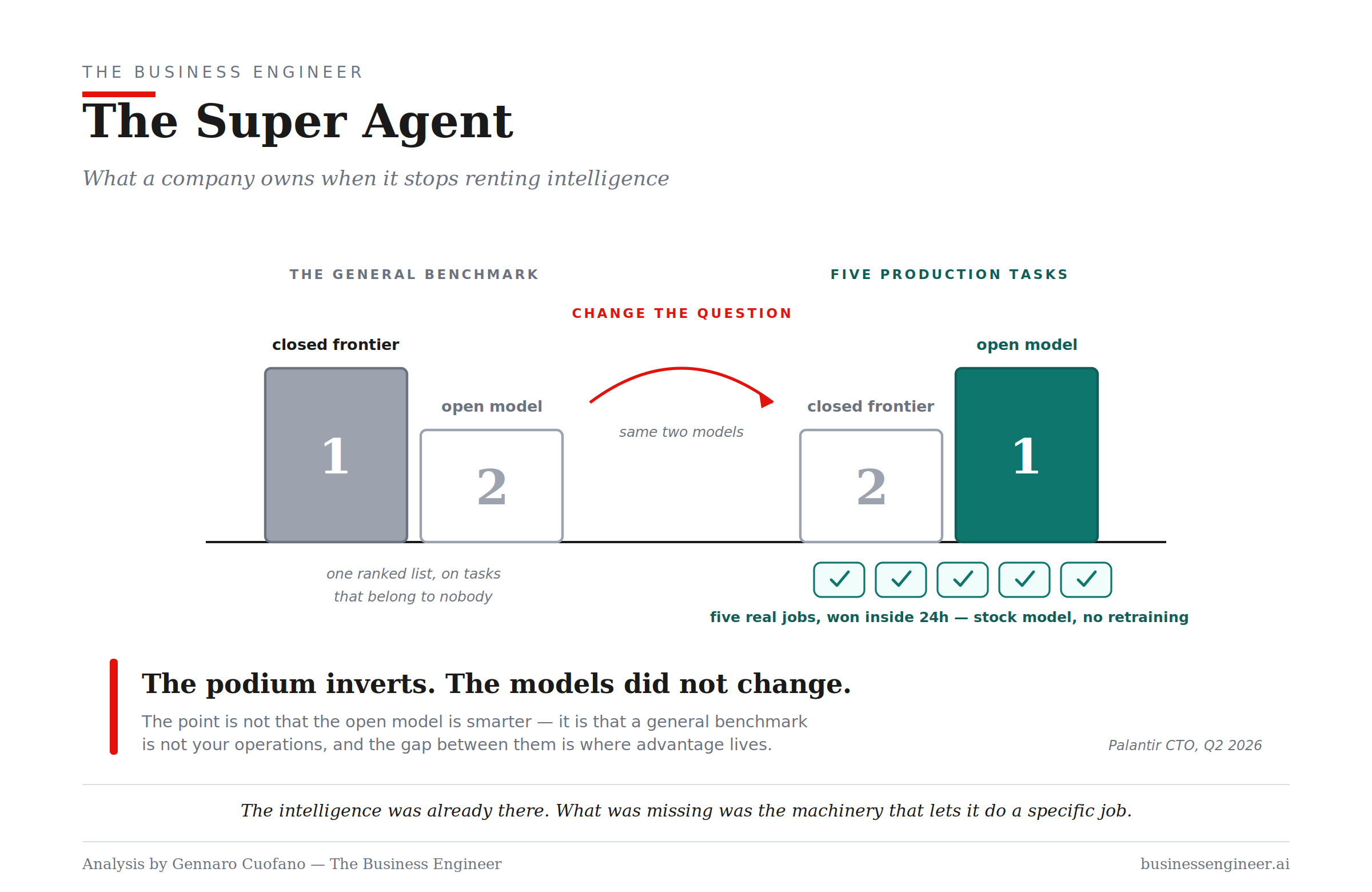
On Palantir’s Q2 call, CTO Shyam Sankar reported that a standard Nemotron Ultra model outperformed frontier models on five production tasks within twenty-four hours of deployment — a stock open-weight model, no retraining, beating the closed frontier on real work in a day. His point was not that the open model is smarter. It was the opposite: that general benchmarks may not reflect what a specific customer’s operations actually require.