


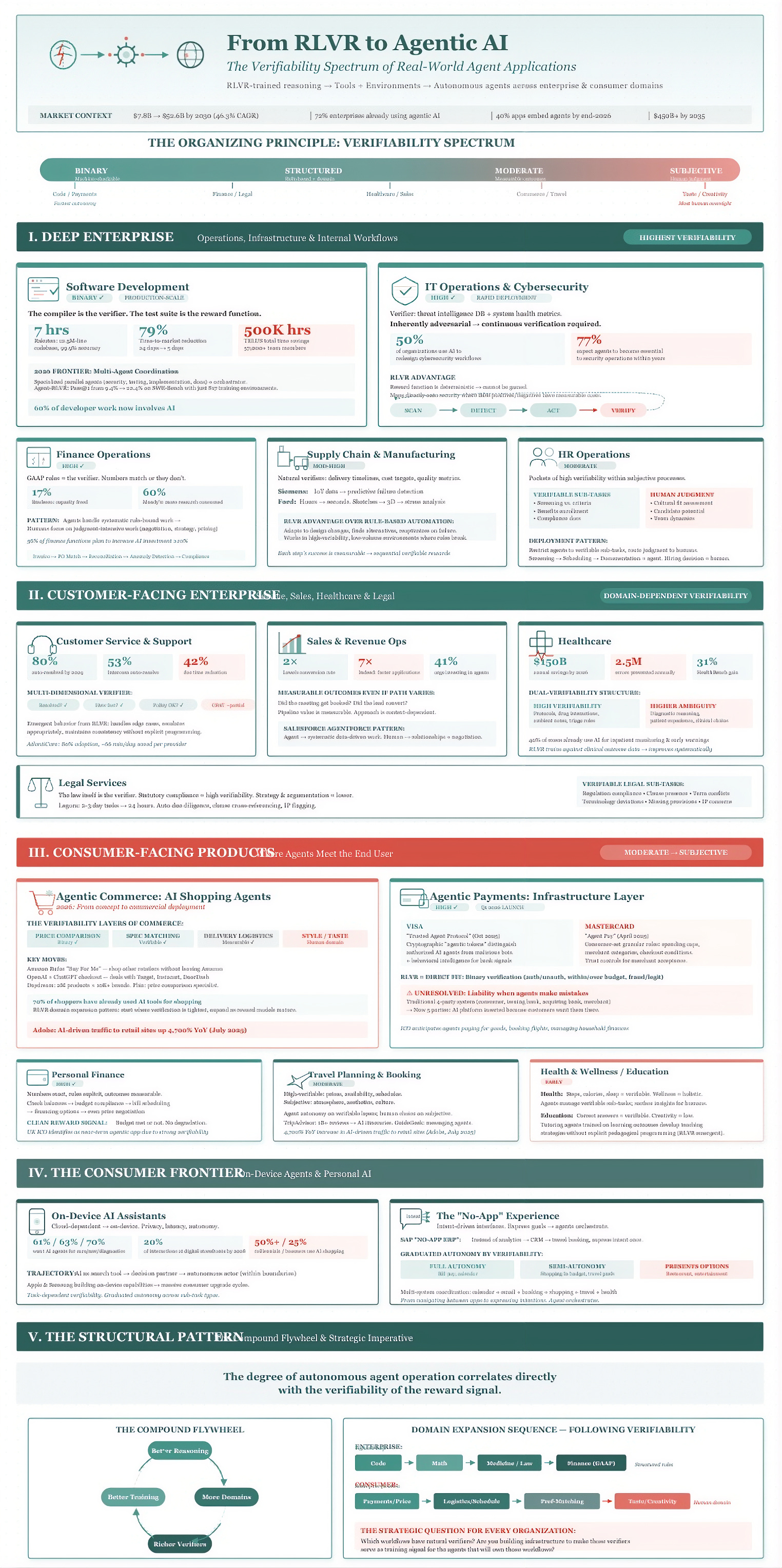
The organizing principle is verifiability. Every agentic use case sits somewhere on a spectrum from “machine-checkable in milliseconds” to “requires human taste and judgment.” Where a use case sits on that spectrum determines how quickly RLVR-trained agents can operate autonomously, how much human oversight remains necessary, and how fast the compound flywheel spins.
The market context: AI agents are projected to grow from $7.84 billion in 2025 to $52.62 billion by 2030 (46.3% CAGR). Gartner predicts 40% of enterprise applications will embed task-specific AI agents by the end of 2026, up from less than 5% in 2025. Agentic AI could drive approximately 30% of enterprise application software revenue by 2035 — surpassing $450 billion. These aren’t hypothetical projections. 72% of medium- and large-sized enterprises already use agentic AI, and an additional 21% plan to adopt it within 2 years.
Beyond Coding: The Agentic Revolution

The agentic coding revolution isn’t just a software engineering story. It’s the proving ground for a much larger structural shift in how work gets done across entire organizations.