

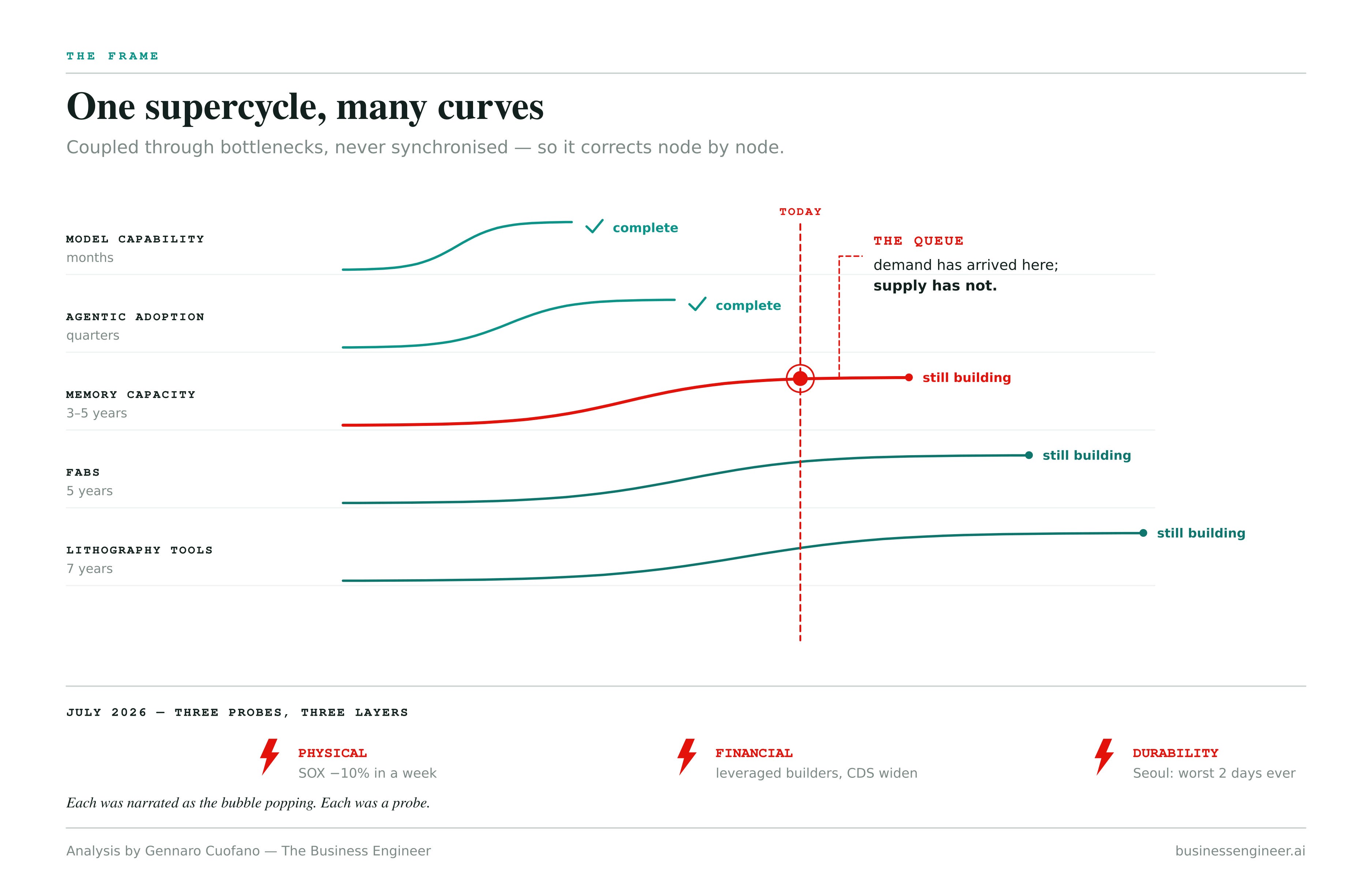
The AI supercycle is not one technology on one adoption curve. It is a stack of S-curves — lithography tools on a seven-year capacity clock, fabs on five, memory on three-to-five, data-center power on utility timescales, model capability on months, agentic adoption on quarters — coupled through bottlenecks but never synchronized. At any moment one layer’s demand climbs faster than another layer’s supply can follow; the whole stack queues at that node; the queue is where the rent concentrates; the rent is where the capital rushes. The bottleneck rotates — wafers, then packaging, then HBM, then power, then whatever binds next.
Underneath the rotation runs the cycle’s governing asymmetry: supply moves in years; demand moves in quarters. Supply is committed capital — a fab decided today ships wafers in 2029 and cannot un-decide. Demand reprices every quarter, twice over: in size, with the macro — rates, credit, the cost of the capital funding the build — and in shape, with each evolution of the ecosystem itself, as a cheaper open model, a new agentic workload, or a rival stack integrating behind a fence moves where on the map demand concentrates faster than any supply can follow. Demand is not a quantity that supply chases. It is a moving shape that supply commits against, blind, years in advance.
From that structure, one prediction — the premise everything below tests: there will be no single AI bear market. There will be many aggressive, localized drawdowns, each hitting the node whose committed position ran furthest ahead of its constraint, each violent because the nodes are concentrated — a handful of names, leveraged holders, index weight — and each diagnostic: a drawdown is the market discovering, in real time, which side of the map was overstretched short against a bottleneck.
They come in two species, matching the two clocks that can bind. A supply-durability drawdown hits when the story of who controls a physical bottleneck in three years shifts. A financial-absorption drawdown hits when the financing of the build outruns what the credit system will carry at current prices. Geopolitics is the trigger for either, because the bottlenecks are national assets and the fence around the stack is drawn by states — and both species are the same collision seen from different sides: quarterly demand meeting multi-year supply.
The last thirty days ran the experiment three times.
Mid-July: a physical-layer shock, the semiconductor index down nearly 10% in a week, memory hit hardest.
July 27–28: a financing shock, the most leveraged builders selling off as default-insurance spreads widened and a reported $250 billion vendor-financing backstop crystallized how much of the demand top is now financed rather than earned.
July 28–29: a durability shock, in Seoul.
Each was narrated, in the moment, as the bubble finally popping. Each was a probe into a different layer — local violence, global compounding. What follows reads the third and cleanest probe, the memory node, from the top down: geography, then macro, then the bottleneck’s supply side, then demand’s shape, then the whole map. It is the archetype, because at this node every element of the frame is legible in public documents from the same week.
Follow me on The AI Supercycle as well!

Two facts that have to be true at once
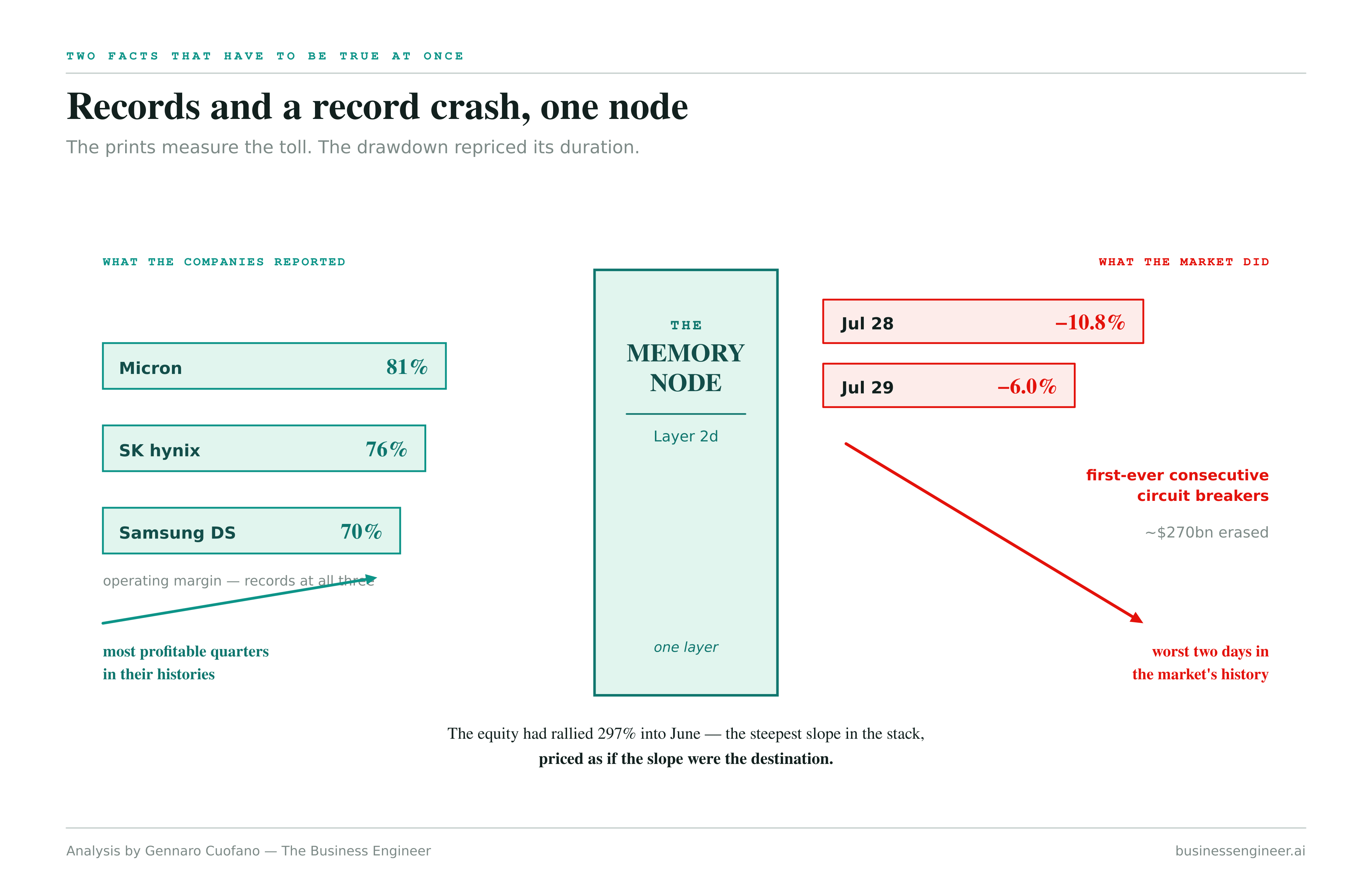
Between June 24 and July 29, the three companies that supply the memory every AI accelerator on earth depends on filed their most profitable quarters ever. Micron reported an 81% operating margin. SK hynix reported 76% — its fifth consecutive record. Samsung’s semiconductor division reported 70%, alongside the highest absolute operating profit any chip company has ever posted. All three named the same cause in the same language: the memory market is undersupplied, and will remain so beyond 2027. Not one of them saw a slowdown.
Inside the same window, the Korean stock market — now more than half made up of Samsung and SK hynix by index weight — had the worst two-day drop in its history. The KOSPI fell 10.8% on July 28 and nearly 6% more on July 29, about $270 billion of market value erased in two sessions. Market-wide circuit breakers fired on consecutive days for the first time ever. July is on course to be the worst calendar month in the index’s recorded history, down more than a third; the index sits roughly 40% below the peak it set only weeks earlier. SK hynix’s U.S.-listed shares crossed below their IPO price the same week the company posted the biggest quarter it has ever had.
Under the frame, this is not a paradox — it is the expected signature of an overstretched node. The prints measure the current toll; the drawdown repriced the toll’s duration. The equity of the bottleneck owner had rallied 297% from April 2025 to its June 2026 peak — the steepest slope in the stack, priced as if the slope were the destination. What follows is what actually moved it.
The toll-booth state
Follow me on The AI Supercycle as well!
Begin with what South Korea is in the architecture of AI, because it is unlike any other country’s position in the stack.
The build runs on nine layers — energy, equipment, foundries, silicon, networking, compute, models, agentic harnesses, distribution surfaces — with a governance fence around it. Most nations touch the stack somewhere: the Netherlands owns the equipment monopoly, Taiwan the leading-edge foundry, the United States the silicon designs and compute and models, China a growing share of everything below the fence.
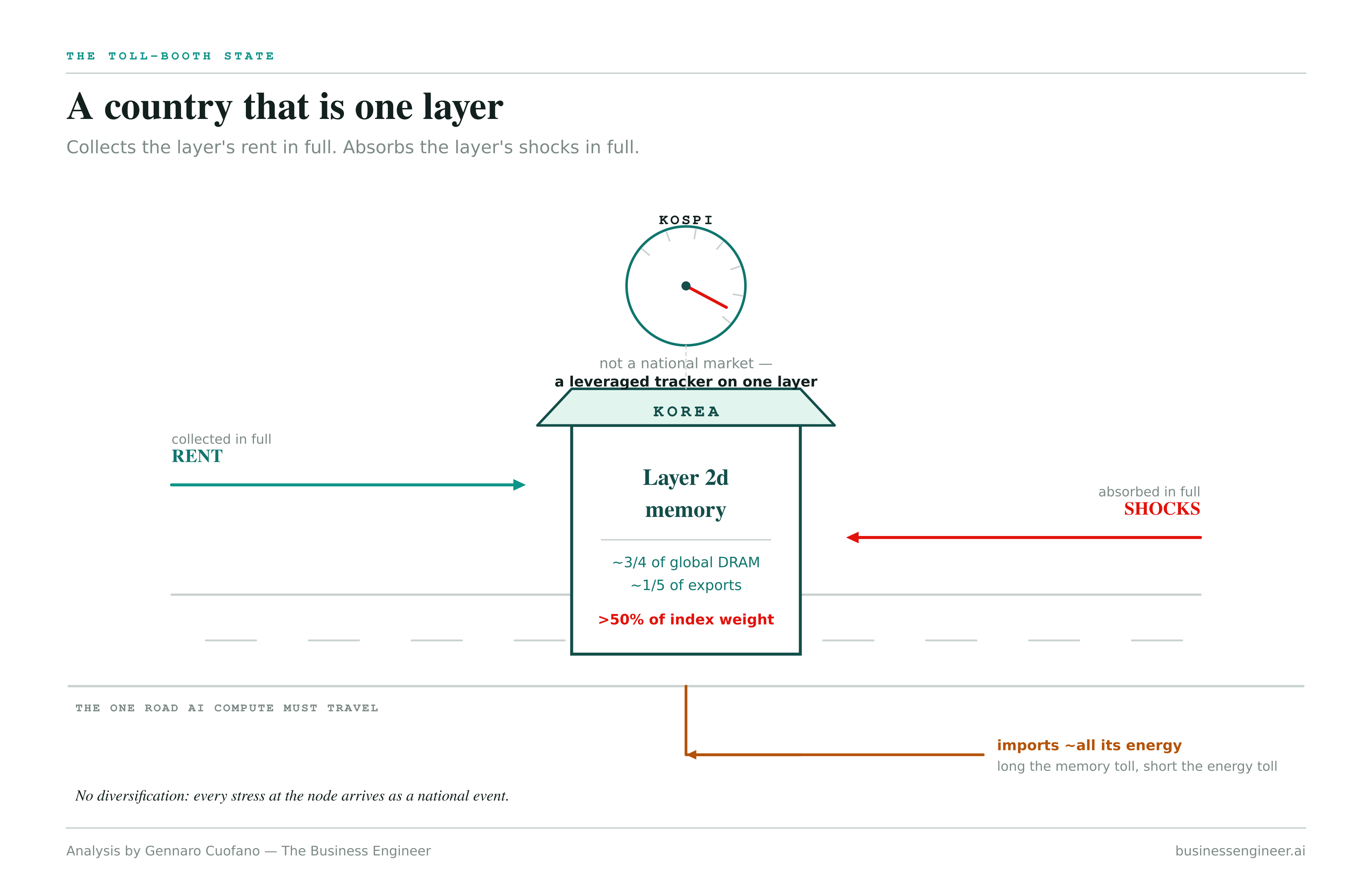
South Korea is the only country whose entire national economy is, functionally, one layer: Layer 2d, memory (which historically has gone thourhg boom and burst cycles).
Samsung and SK hynix together hold roughly three-quarters of global DRAM and, with Micron, essentially all high-bandwidth memory. Semiconductors are around a fifth of Korean exports. The two companies are more than half the national index by weight — which means the KOSPI is no longer a diversified national market; it is a leveraged tracker on the memory layer of the AI stack, and Korean household wealth, pension assets, and retail margin accounts are all, at one remove, positions on the same trade.
While the memory toll was rising, that concentration read as national triumph — the strongest rally since the 1980s, one of the best-performing markets on earth. But a country that is one layer of the stack inherits that layer’s entire risk profile with no diversification. Every stress the memory node faces — a challenger, a customer’s credit, a fence being redrawn, a macro repricing of the build — arrives in Seoul as a national event, amplified by whatever leverage the national market has built on top of it. That is what a toll-booth state is: it collects the layer’s rent in full, and it absorbs the layer’s shocks in full. This month it did both, days apart. And it carries a second wiring into the physical layer: Korea imports essentially all of its energy — long the memory toll it collects, short the energy toll it pays — and in the same 48 hours as the crash, renewed Iranian attacks on U.S. forces pushed oil higher. Both positions moved against it in the same week.
The challenger runs Korea’s own playbook
Now the geopolitical event itself — the durability shock. In the 72 hours before the crash, China made two moves aimed, precisely and by design, at the layer Korea’s economy sits on.
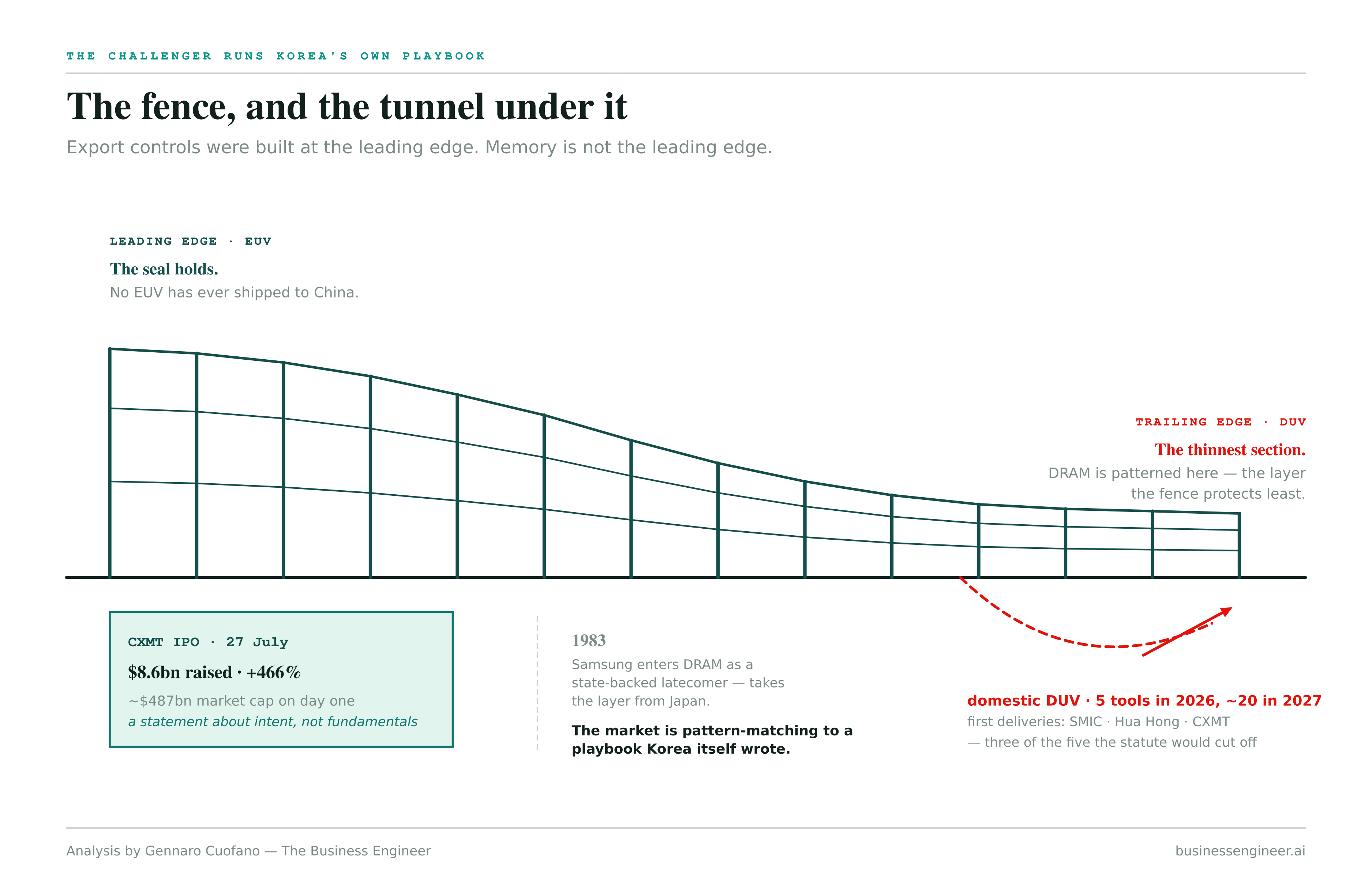
The first move was capital. ChangXin Memory Technologies, China’s DRAM champion and already the world’s fourth-largest DRAM maker at roughly 8% share, debuted on Shanghai’s STAR Market on July 27. It raised $8.6 billion — Asia’s largest IPO of the year — closed its first day up 466%, and reached a market capitalization of roughly $487 billion, briefly the most valuable listed company in mainland China, larger than any Chinese bank. The prospectus states the use of proceeds plainly: mass-producing memory wafers. On fundamentals, CXMT is roughly three years behind on high-bandwidth memory, carries an estimated 30% cost-per-bit disadvantage, cannot use extreme-ultraviolet lithography, and is being written into U.S. procurement bans. But a $487 billion valuation is not a statement about fundamentals. It is a statement about intent and capital available — and both now point at the memory layer.
The second move was equipment. The same weekend, reports confirmed that a state-backed Shanghai company has begun low-volume production of a domestically developed immersion DUV lithography machine — the class of tool that patterns DRAM. Output is small: about five units this year, perhaps twenty next, critical components still imported from Japan, performance well behind the Dutch monopoly that ships ~130 such systems a year at a 98.7% share. But the first deliveries go to SMIC, Hua Hong — and CXMT. Three of the five Chinese entities that a bill now moving through the U.S. Congress would cut off from ASML sales and servicing by statute are the named first customers of a machine that statute cannot reach, because it is made in their own country.
Put the two moves inside the governance frame and their shape is exact. Export controls are the fence around the AI stack — and the fence was built at the leading edge. Extreme-ultraviolet lithography has never shipped to China and still cannot; that seal holds, and it is what keeps China out of leading-edge logic. But DRAM is not leading-edge logic. Memory is patterned overwhelmingly with immersion DUV and multi-patterning — EUV touches only a handful of layers even at the incumbents — which means memory is precisely the layer the fence protects least. CXMT already makes competitive commodity DRAM entirely without EUV. A domestic DUV source, however immature, is a tunnel under the fence dug exactly where the fence was thinnest — and the layer on the other side of that thin section is the one Korea lives on. The fence holds where it matters most for Taiwan and least for Korea.
And here is the rhyme that gives the event its charge in Seoul, because Korea has seen this movie — from the other side of the screen. In 1983 Samsung announced its entry into DRAM as a state-championed latecomer, years behind the Japanese incumbents, and lost money for the better part of a decade behind patient chaebol and government capital — until the incumbents’ discipline broke, and by the early 1990s DRAM leadership had crossed the sea. China then ran the same play, successfully, through solar, batteries, shipbuilding, and LCD displays — the last of which was a Korean toll booth until BOE’s state-backed capacity broke it. The market that crashed on July 28 was not pricing CXMT’s current products. It was pattern-matching to a playbook Korea itself wrote — state capital, tolerance for a decade of losses, trailing-edge entry, then the climb — now aimed at the one layer Korea cannot afford to lose.
The structural point beneath the pattern is the one that matters for the supercycle premise: the memory toll rests on disciplined under-build. The triopoly’s 70-to-81-percent margins exist because all three capable producers restrain capacity into a shortage — whether by choice or by physics. A state-championed challenger capitalized at half a trillion dollars does not share that objective function. Beijing’s variable is share and sovereignty, not return on capital. State capital does not under-build. The toll’s durability has always depended on every capable producer honoring the discipline; as of this month, one well-funded producer conspicuously does not — three years away, at the trailing edge, but pointed in one direction. This is what a supply-constraint drawdown reprices: not the shortage, which binds regardless, but the slope of its far end.
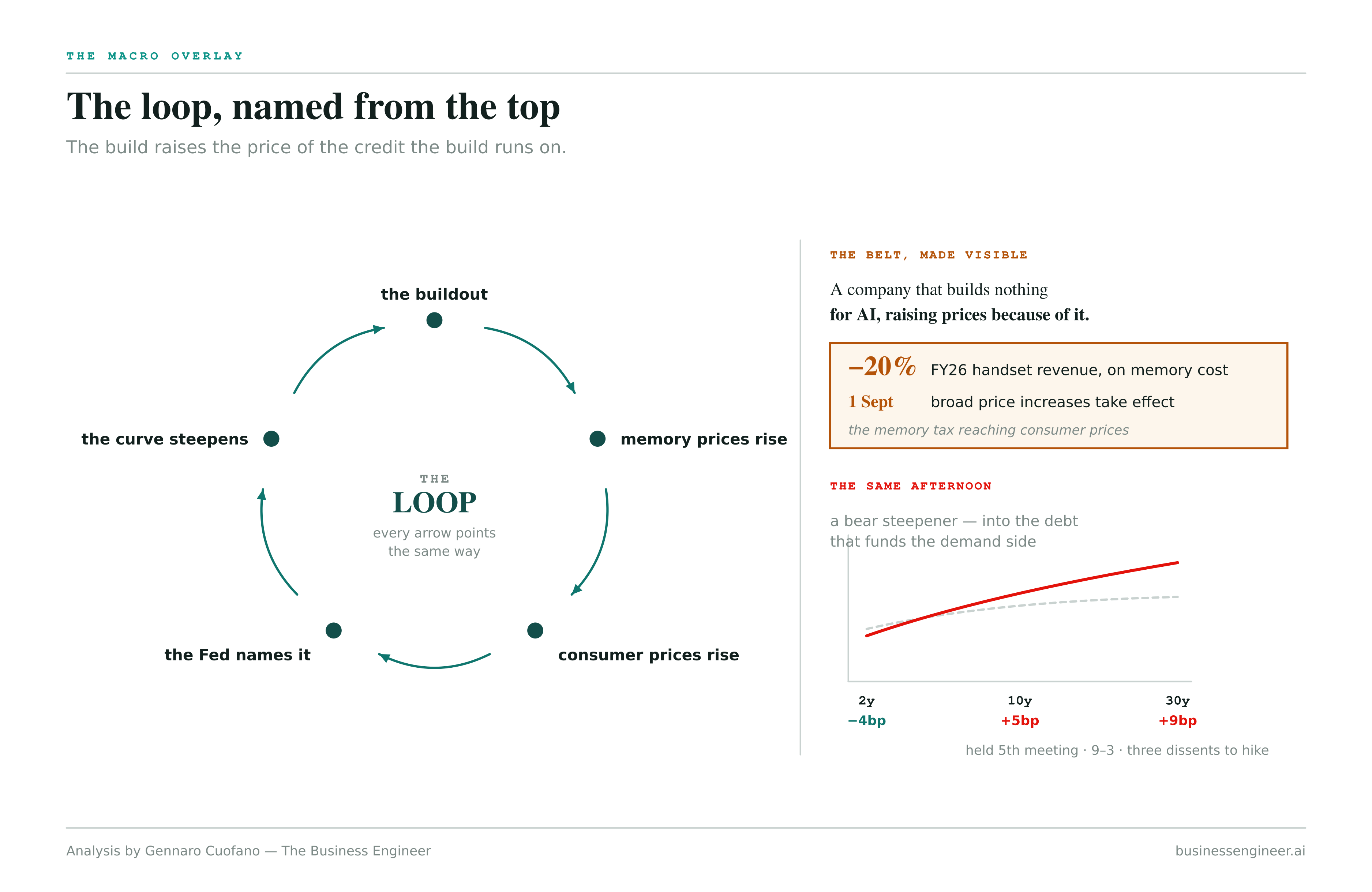
The macro overlay: the loop, named from the top
Follow me on The AI Supercycle as well!