
The Synthetic Version of Myself
The Business Engineer Agent

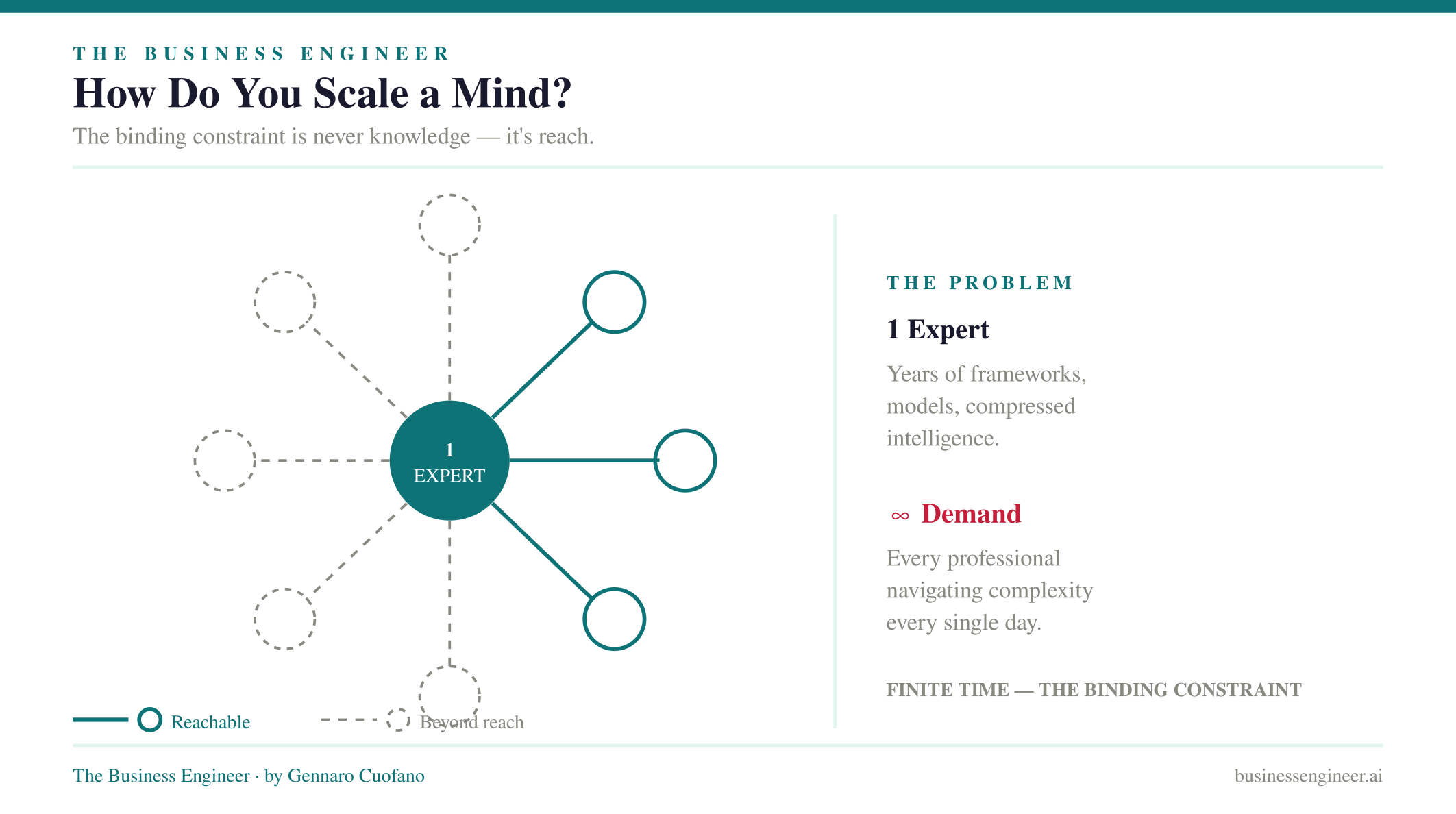
There’s a question I’ve been asking myself for years: how do you scale a mind?
Or
Not a company. Not a content library. A way of thinking.
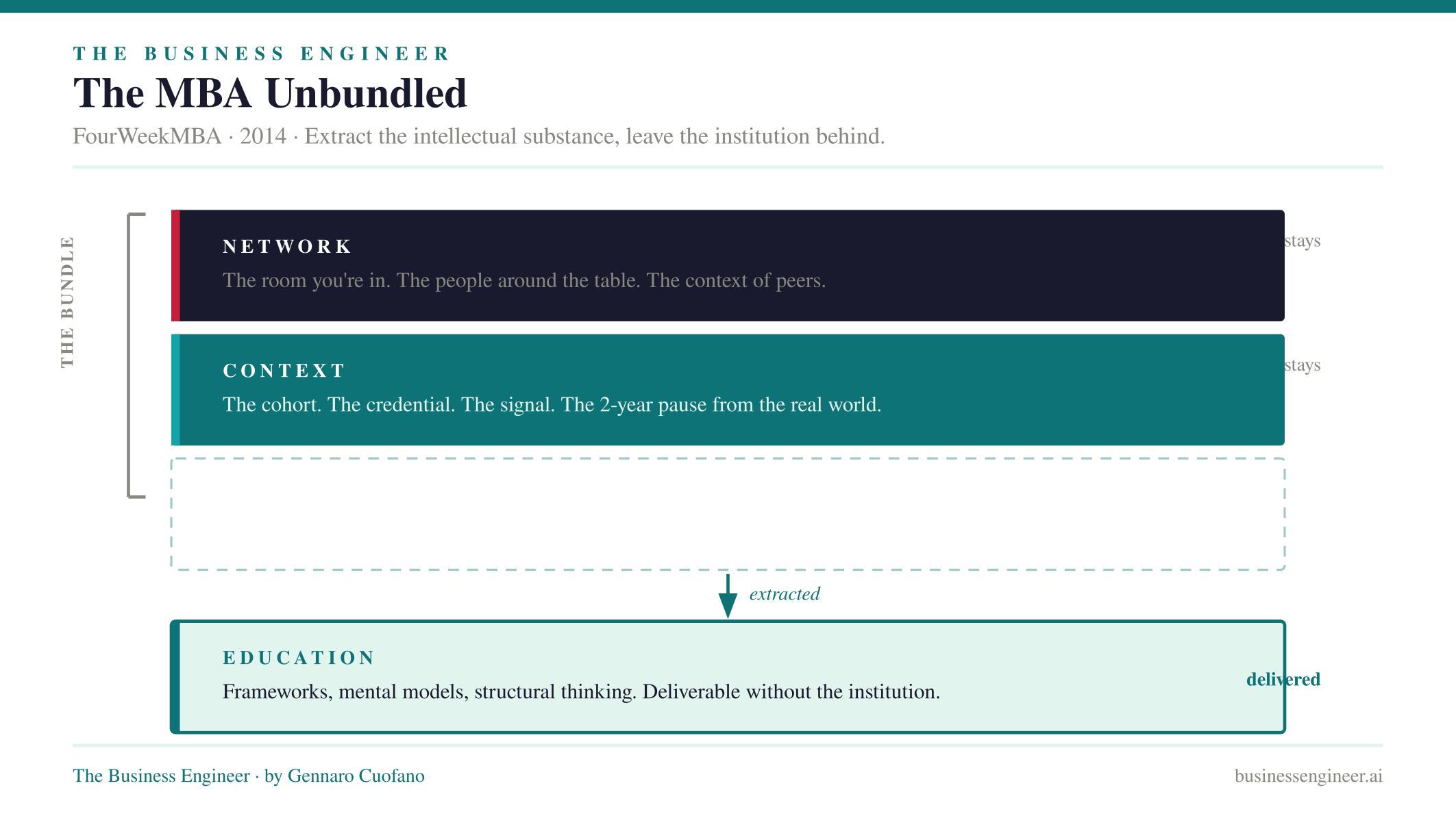
When I started FourWeekMBA back in 2014, the answer felt obvious — give people the resources they need to bootstrap their business education as fast as possible. I’d come from the business world, was transitioning careers, and I knew something firsthand: formal business education is about far more than education. The MBA — especially a good one — is about the network, the context, the room you’re in. Those are often the most valuable things. But I also knew that most people couldn’t step away for two years, leave the real business world, and return with a credential.
So the unbundling thesis was simple: what if you could get the intellectual substance — the frameworks, the models, the structural thinking — without the two-year pause?
That was what FourWeekMBA was supposed to do. And for a few years, that was enough.
Or
By 2018–2019, something shifted. The accumulation of years of research, daily executive experience, and a relentless obsession with how people actually understand complex systems started to converge into something new. What I began calling The Business Engineer.
Not a content platform. A discipline.
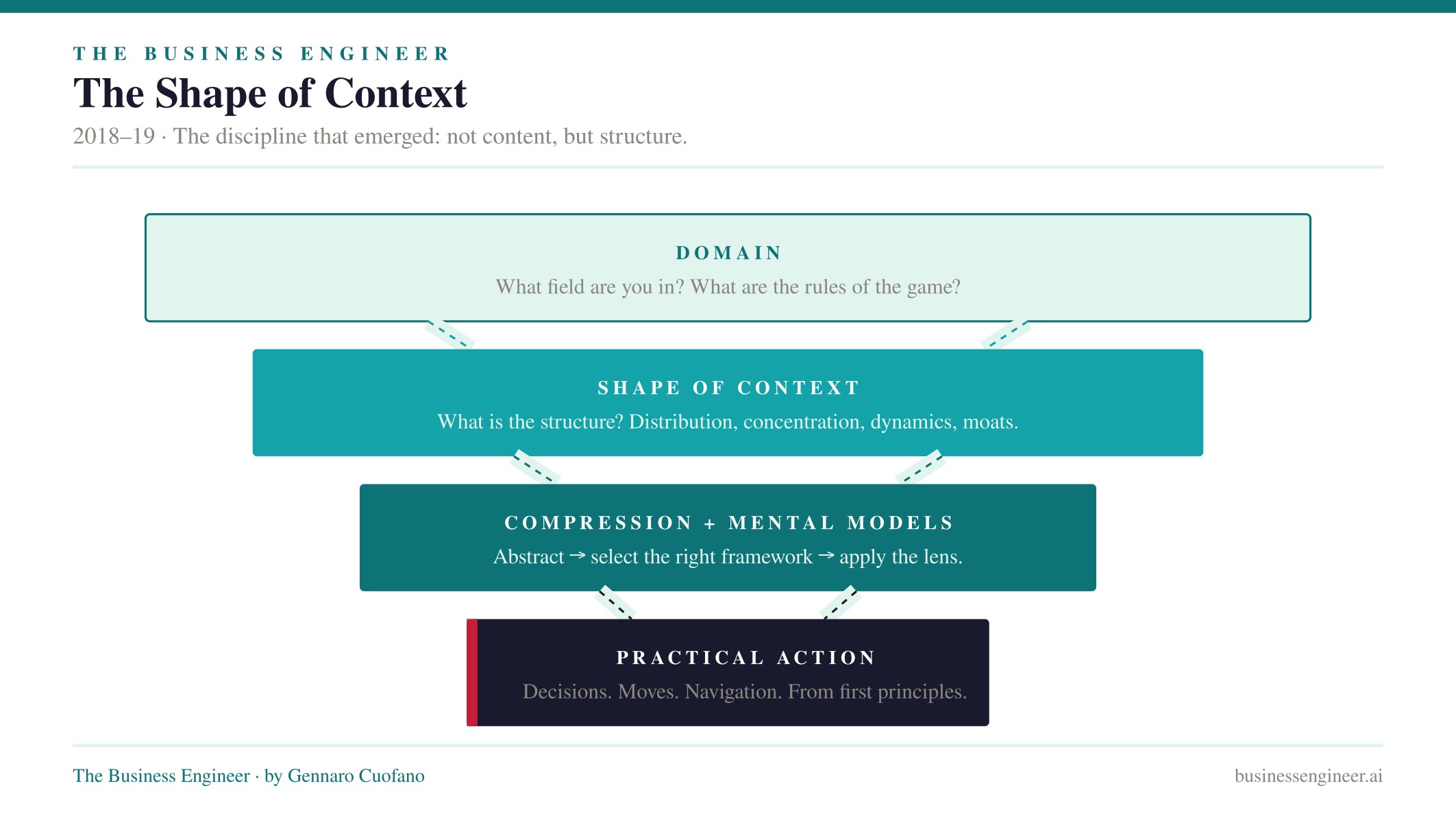
The Business Engineer is built on a specific idea: before you can do anything useful with information, you need to understand the shape of the context you’re operating in. What domain are you in? What’s the structure of that domain? How do you compress it, abstract it, and then arm yourself with the right mental models to navigate it practically?
Or
It sounds abstract. The output is anything but.
Then ChatGPT arrived.
And everything I was doing had to be reconsidered.
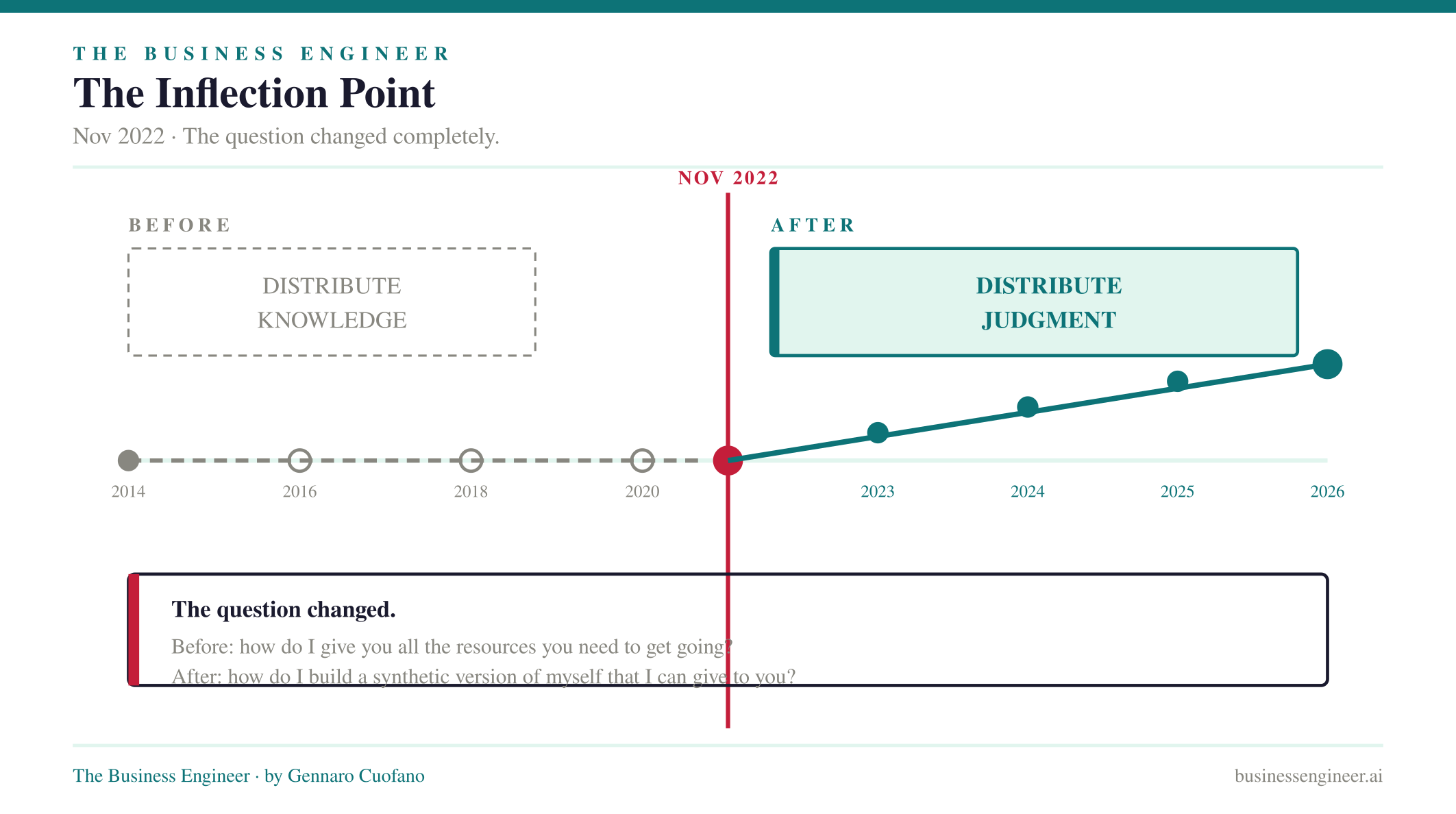
Before that moment, my obsession was supply: how do I give you — the reader, the professional, the operator — all the educational resources and frameworks you need to get going? Where I could, I’d follow specific projects closely. But the constraint was always the same: I can only be in so many places at once.
In the post-ChatGPT era — and especially now, in the agentic era — the question changed completely.
The new obsession became: how do I build a synthetic version of myself that I can actually give to you?
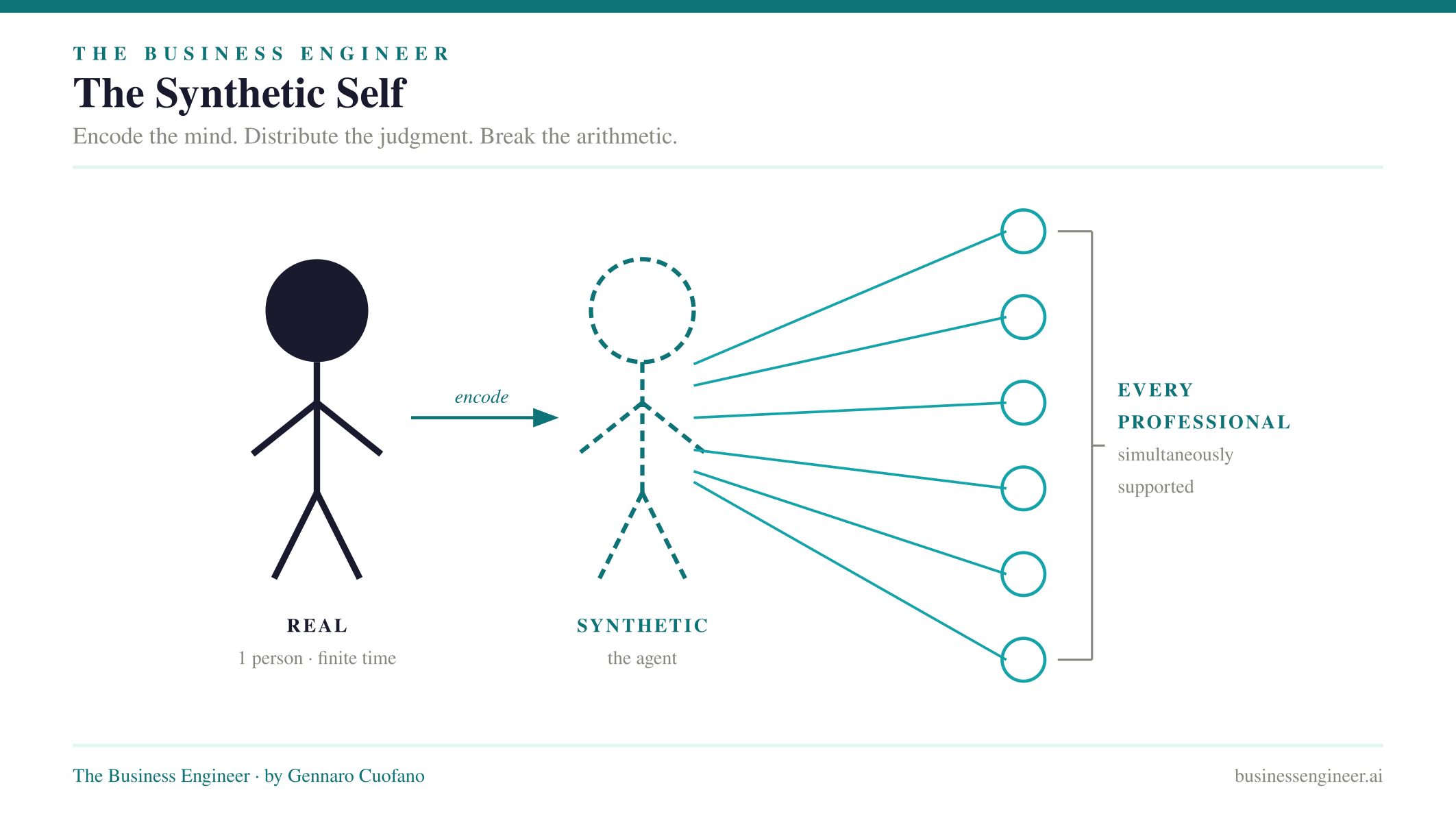
Not a chatbot. Not a search interface. A thinking system. One that has absorbed years of frameworks, compressed years of analysis, and can deploy that intelligence on your behalf — adapting to who you are, what you’re working on, and what you need to figure out today.
That’s what the Business Engineer platform is now becoming.
Or
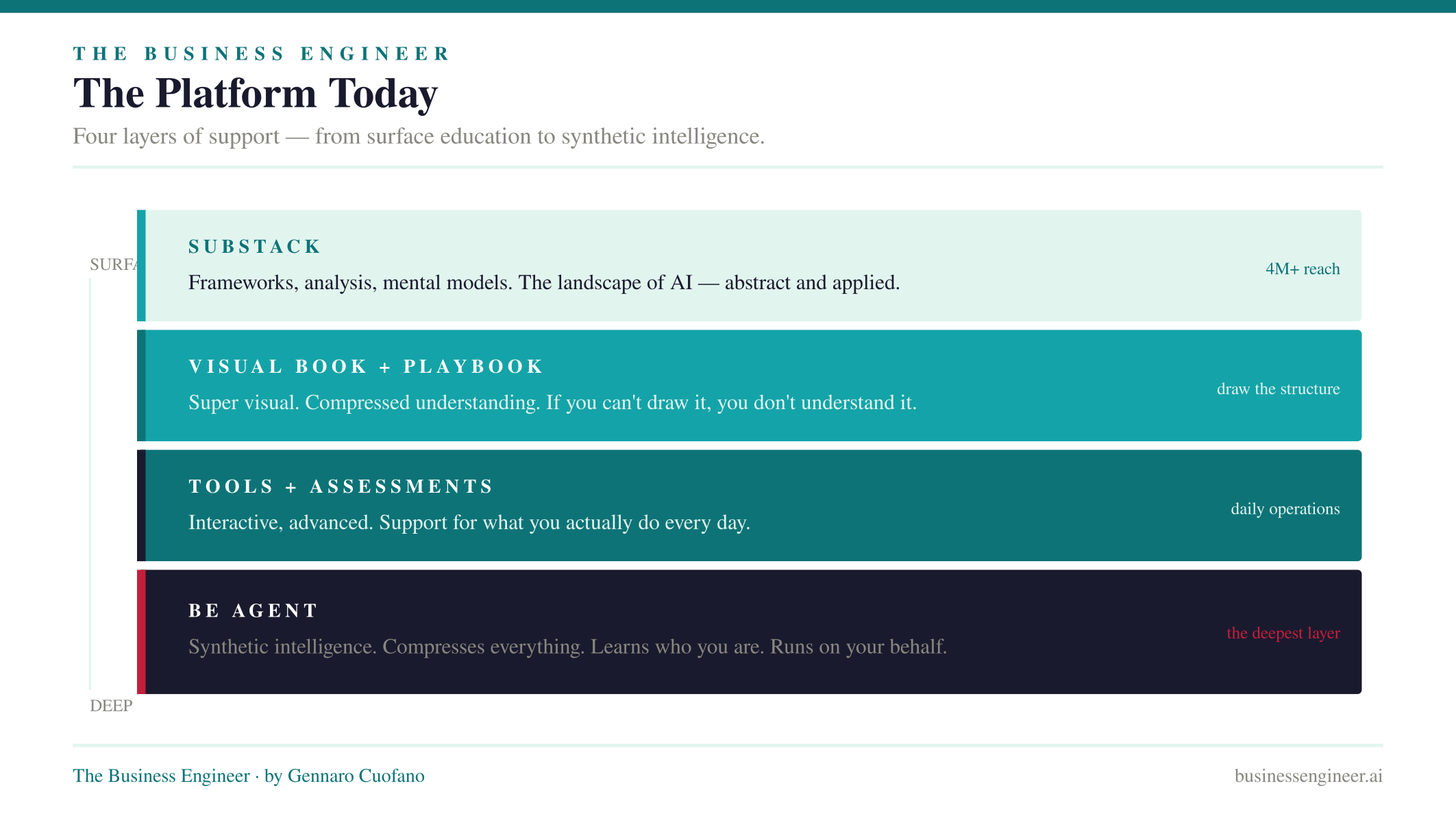
At one layer, you have the Substack — frameworks, analysis, mental models, a running mapping of where we are in the AI landscape. Both abstract and practical. Both structural and applied.
At another layer, you have the visual book and playbook — super visual, deliberately so, because the BE methodology has always believed that if you can’t draw it, you don’t understand it.
Then there are the tools: interactive, advanced, built to support the kinds of things you actually do on a daily basis.
And now, at the centre of it: the BE Agent.
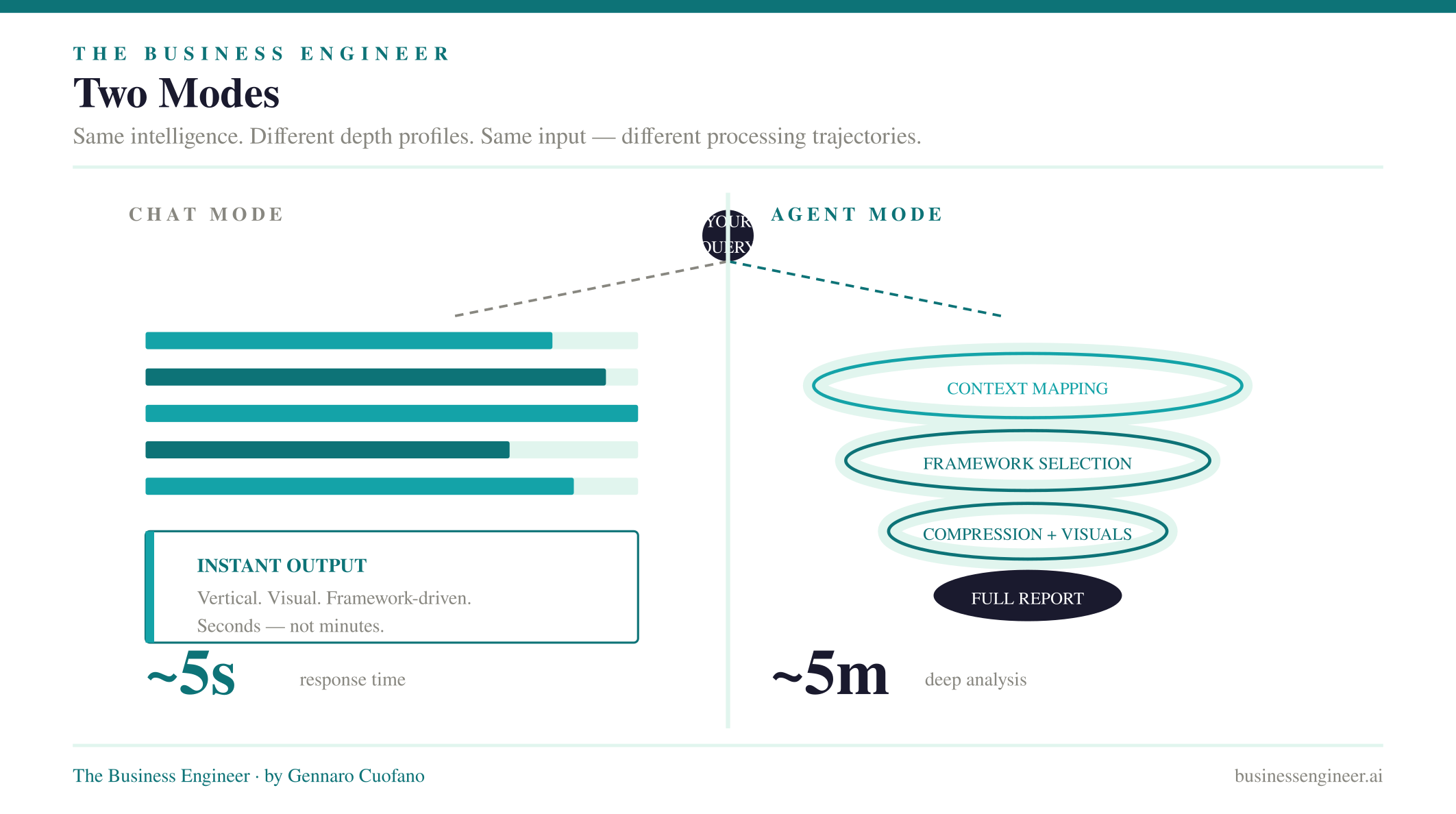
The agent works in two modes.
Or
In chatbot mode, it’s fast and vertical. You ask it something oblique — “Does Gemini stand a chance?” — and it immediately knows you’re talking about Google’s model.
No context-setting required. It pulls up the right frameworks, maps the competitive dynamics, formats the output visually, and gives you a complete picture. Instantly.
Because it’s not a general-purpose assistant — it’s specifically built around years of Business Engineer methodology.
In agent mode, it goes deeper. It asks defining questions if you want that precision. It runs full analyses — frontier AI races, market structures, strategic landscapes — and shows you its work as it goes: which frameworks it’s pulling, how it’s compressing the intelligence, what it’s doing with the shape of the problem. It can take five minutes for a deep analysis.
But you don’t have to wait. The report lands in your list, visual and complete, ready when you are.
What makes this different from something like Claude or ChatGPT in raw form? The harness.
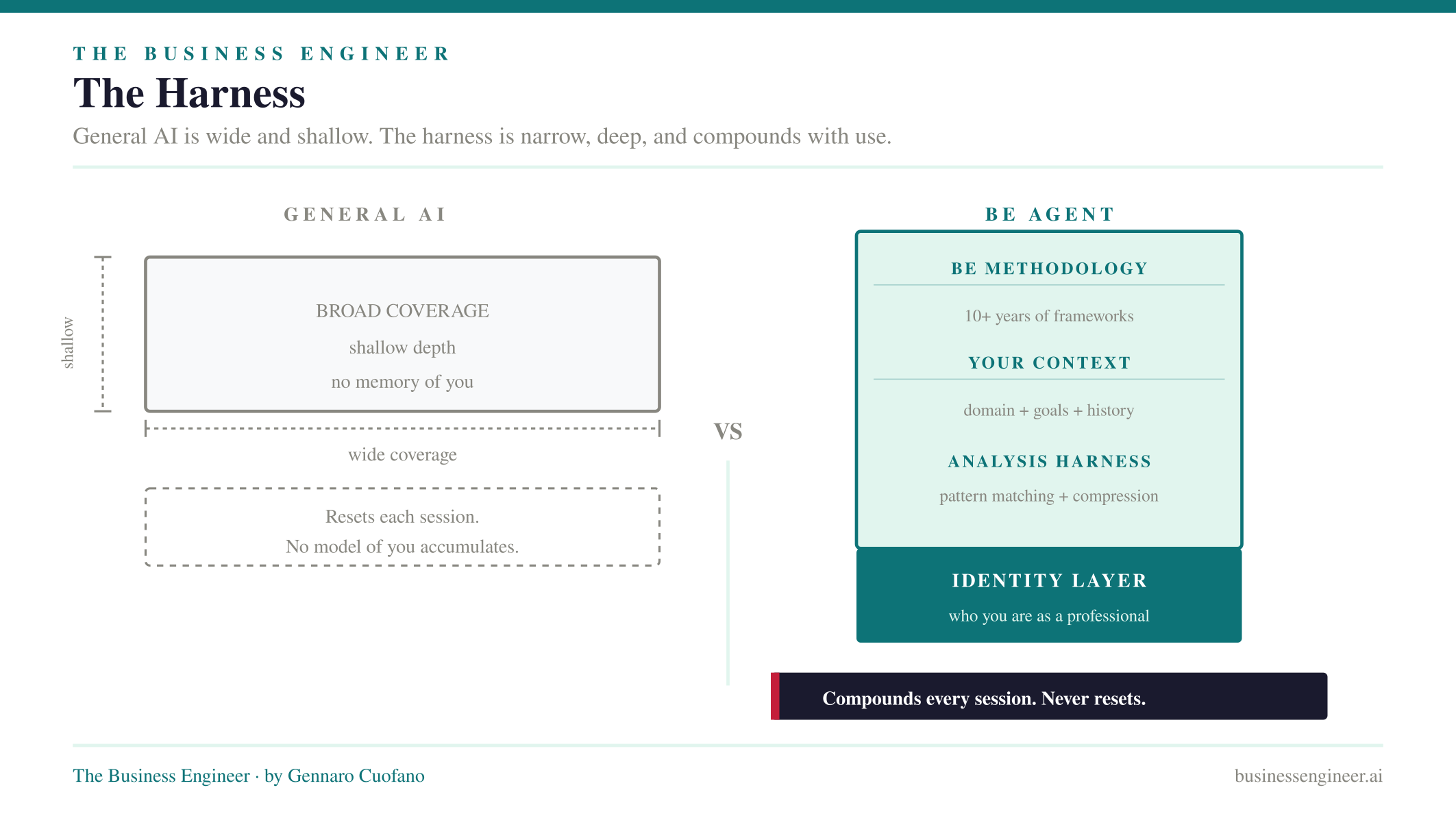
Everything the agent builds is consistent to you. There’s an identity layer: you tell it who you are as a professional, and it learns that, holds it, and uses it to calibrate every analysis going forward. It’s not just short-term memory from a single conversation.
It builds your ontology — a synthetic professional model of you — which you can edit, curate, and refine. And that ontology informs everything the agent does, in both modes, as you go.
The result is a system that isn’t just knowledgeable. It’s vertically calibrated: to the Business Engineer methodology, and to you.
Here’s the honest version of why I built this.
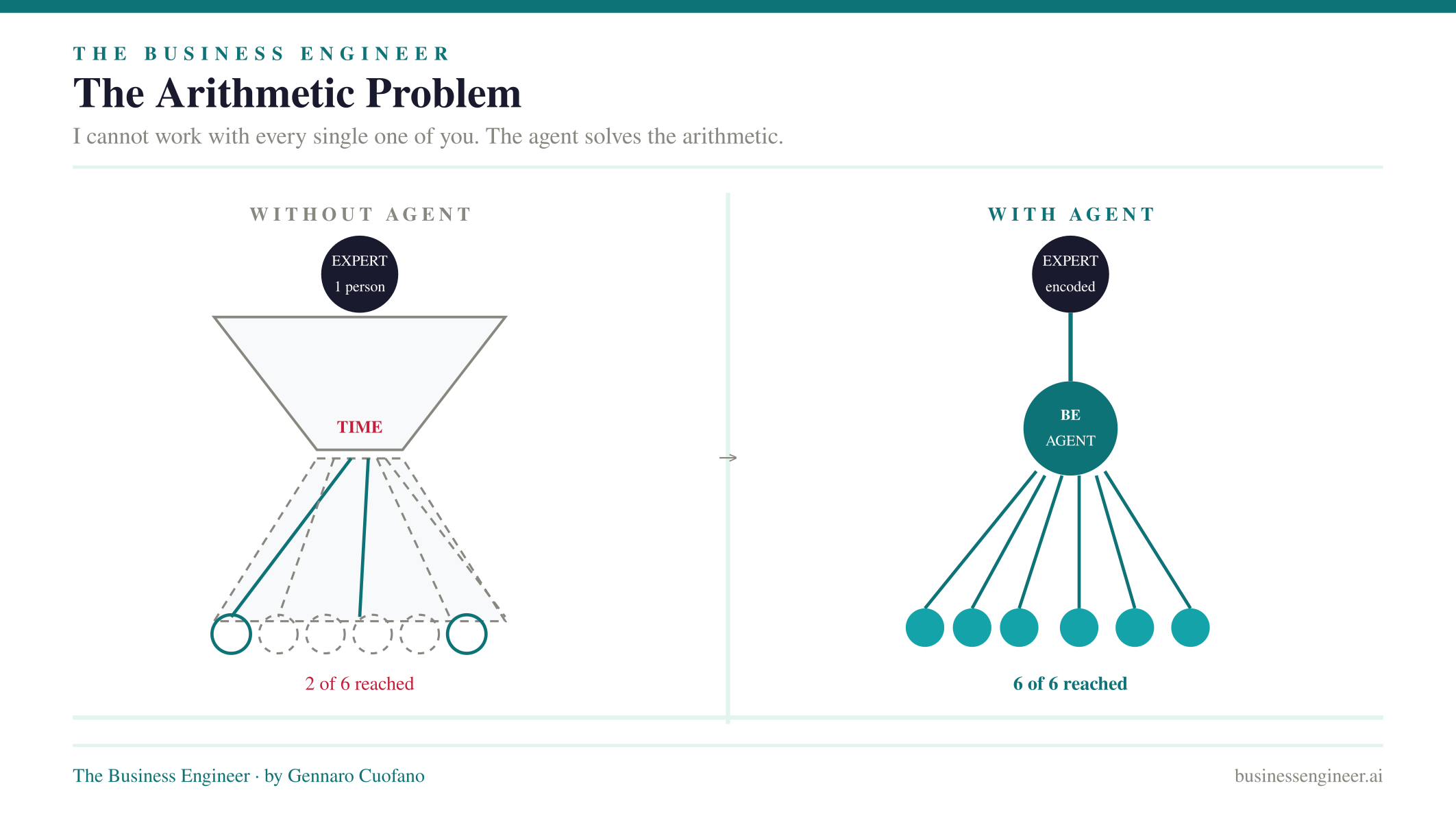
I cannot work with every single one of you. That’s just the arithmetic of it. And yet what I’ve been trying to do for over a decade is give people access to a particular kind of thinking — structural, compressed, visual, practical — that makes the complex navigable.
Or
The agent is the answer to that arithmetic problem.
It’s a first version. It will evolve. But the goal is already clear: a synthetic version of Gennaro that you can access daily, that supports the complex work you’re doing, and that gets smarter about how to help you the longer it operates.
Not a replacement for thinking. A force multiplier for it.
That’s what The Business Engineer was always trying to build. Now it can actually run.
Key Takeaways & Mental Models
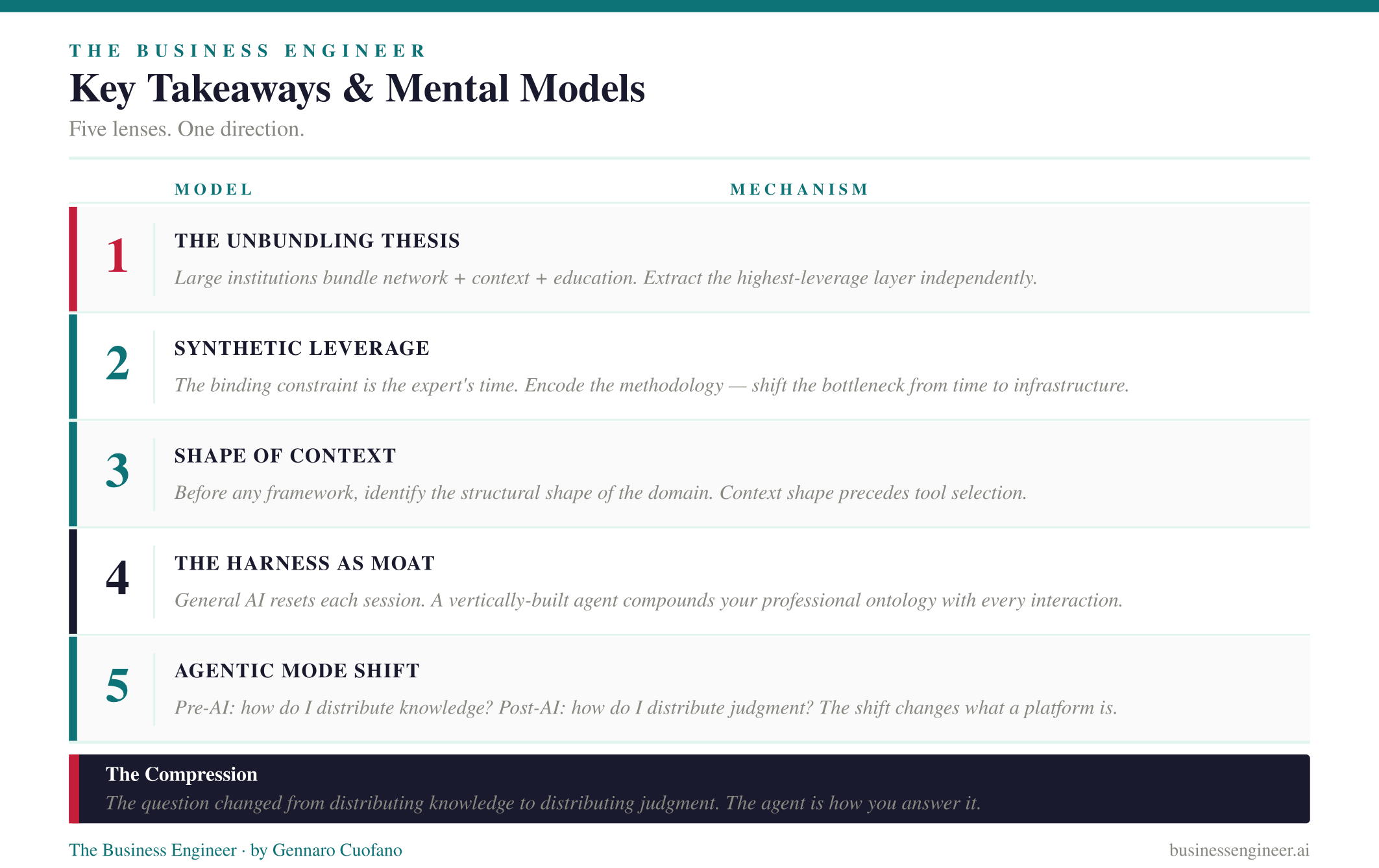
1. The Unbundling Thesis — Large institutions bundle value across multiple dimensions (education, network, credential, context). The first move is to isolate and deliver the highest-leverage component independently.
2. Synthetic Leverage — The binding constraint on expert value delivery is the expert’s time. Build a system that encodes the expert’s methodology and deploys it at scale; the constraint shifts from time to infrastructure.
3. Shape of Context — Before applying any framework, identify the structural shape of the domain you’re in. The right mental model for a winner-takes-all market is wrong for a fragmented one. Context shape precedes tool selection.
4. The Harness as Moat — A general-purpose AI has no persistent model of you. A vertically-built agent that accumulates your professional ontology compounds in value with every interaction. The harness is the durable advantage, not the base model underneath it.
5. Agentic Mode Shift — The pre-AI question was: how do I distribute knowledge? The post-AI question is: how do I distribute judgment? That shift changes everything about what a platform is supposed to do.
With massive ♥️ Gennaro Cuofano, The Business Engineer