
Back in 2014, as I was redefining my own career, I was trying to figure out what discipline could help me abstract and compress the business world as quickly and effectively as possible, by combining insights from multiple fields.
I had a rather unconventional background myself. I started in law, moved into business and finance, and was then pivoting toward technology, startups, and digital entrepreneurship.
What helped me navigate that transition was the concept of business modeling.
For a while, business modeling became almost all-encompassing for me. It gave me a way to simplify complexity, recognize patterns, and understand how businesses worked across industries.
But around 2017–2018, I realized something was missing. Business modeling was a powerful starting point, yet there were several critical building blocks needed to turn it into something far more complete, useful, and grounded in the real world than a canvas.
That’s when The Business Engineer began to emerge.
At its core, it was about creating a continuous loop of abstraction, compression, comparison, mental modeling, and real-world testing. A way to move between theory and practice, constantly refining how we understand, build, and operate businesses.
Importantly, this wasn’t the conventional definition of business engineering. I never found that definition particularly useful for what I was trying to achieve.
Instead, I shaped the discipline around my own experience and perspective: as a startup executive, a digital entrepreneur, a business analyst, and, perhaps most importantly, someone with an almost obsessive curiosity about how the business world works.
Over time, The Business Engineer became my attempt to bring those perspectives together into a coherent discipline. Not just to analyze businesses, but to understand their underlying mechanisms, model them, test them, and ultimately make better decisions in the real world.
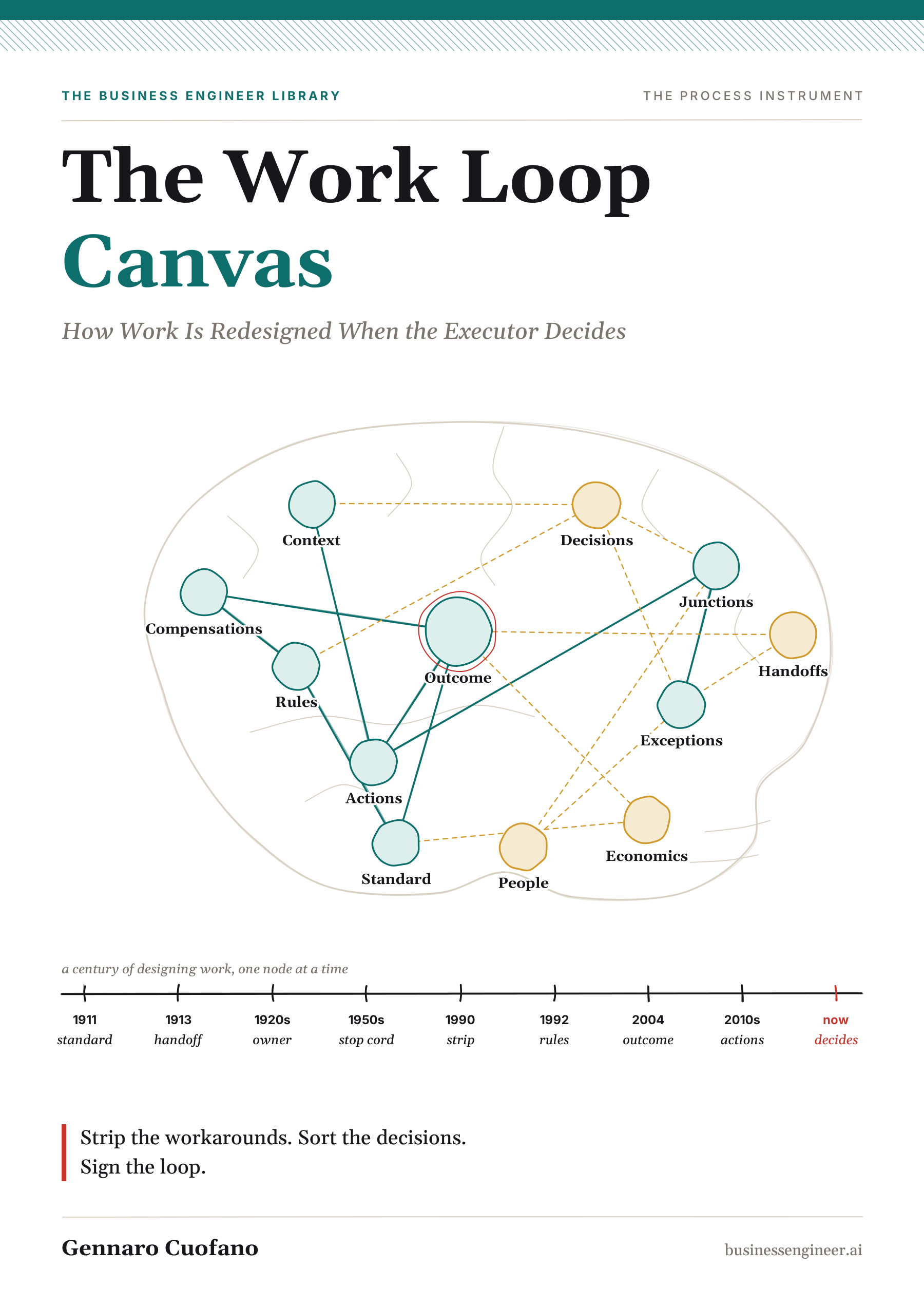
And today, I’m introducing another critical building block of The Business Engineer’s discipline, one that I believe becomes particularly important in the AI era: the Work Loop Canvas.


If you’re an existing paid annual subscriber, you already have access to the library (if you don’t, just request it). To unlock the full video lectures, skills, and all additional resources, upgrade to the Executive Plan.
Every era of business technology leaves behind one picture that people draw on whiteboards. For the 2000s it was a sheet of paper divided into nine boxes. Founders filled it with sticky notes. Bankers asked for it. Business schools taught it. It made a hard question easy to discuss: how does this company make money?
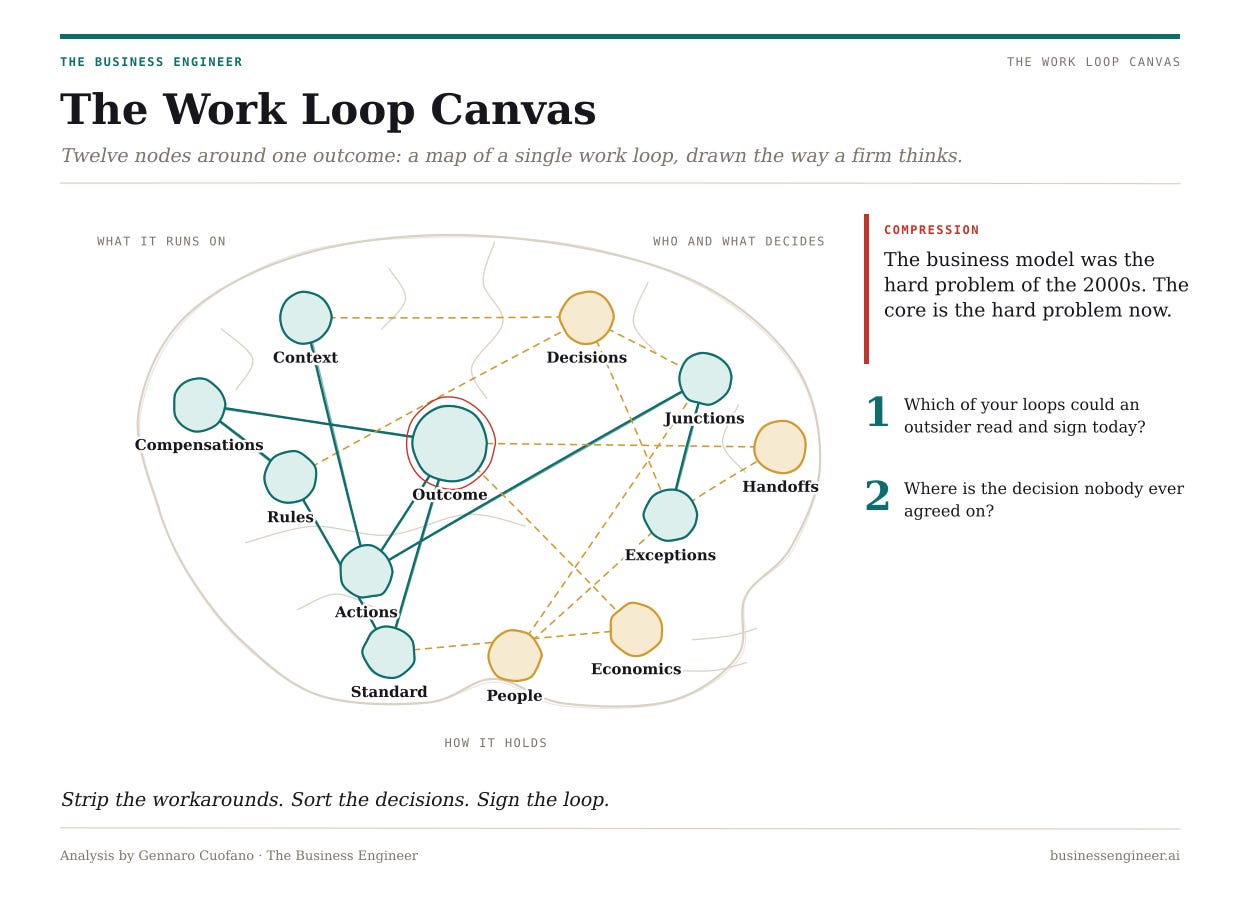
That question still matters, but it is no longer the hard one. A team can describe a workable business model in an afternoon, test it in a week and copy a competitor’s in a month. The hard question has moved inside the firm. It asks how the work actually gets done, and whether AI can do part of it.
Most companies are struggling with that question. They run AI pilots at the edge of the business and cannot move them into the core. The pilots work. The core does not change. This piece explains why, and offers an instrument for the problem: The Work Loop Canvas, a one-page map of a single work loop, drawn as a graph of twelve connected nodes. Its companion, the Work Loop Map, places every loop in the firm on one page.