
The easiest way to misunderstand the AI Supercycle is to look at it as a replay of the dot-com boom.
And after this week, I think that comparison is becoming increasingly misleading.
Consider what happened in just a few days.
Anthropic completed the largest IPO in history, raising more than $90 billion, only to see its shares lose much of their opening-day gains within 48 hours. Nvidia reported an extraordinary $115.8 billion quarter, doubling its revenue from a year earlier, yet lost almost $900 billion in market value in a single week. Meanwhile, the three companies producing the high-bandwidth memory that powers AI chips told customers that much of their capacity was already sold out years in advance.
Their shares fell too.
Think about the contradiction. The AI labs are raising unprecedented amounts of capital. The chipmakers cannot produce fast enough. Memory suppliers are selling capacity years ahead. Renting computing power is becoming more expensive.
And yet the financial markets are starting to question the economics of the entire buildout.
Last week, I argued that the money flowing into AI was changing route, moving beyond Nvidia and increasingly toward the AI labs themselves. This week exposed the next question: once all that capital has been raised and committed, who ultimately carries the risk?
But there is something even more important happening beneath those financial headlines.
While investors were trying to price Anthropic and Nvidia, Washington was redrawing the geography of AI.
New American export rules extended restrictions from the physical shipment of advanced chips to the remote access of computing power itself. In other words, it is no longer just about where a chip gets sold, but who can use it, even when that chip sits inside a data centre thousands of miles away.
The consequences were immediate. South-East Asia, which had been building an enormous data-centre industry partly around demand from Chinese companies, suddenly found that its business model depended on decisions made in Washington.
Meanwhile, in Shenzhen, the leaders of the world’s major powers met, but advanced chips remained outside the negotiations. Increasingly, these are no longer ordinary products that countries are willing to trade away for concessions elsewhere. They are becoming strategic assets.
And as the geopolitical map was being redrawn, the macroeconomic picture was becoming more complicated.
Banks started demanding tougher terms to finance data centres. Bond deals were delayed. Central bankers began drawing comparisons with previous investment bubbles. Even electricity became a political question, with US lawmakers debating who should pay for the grid upgrades needed to power the AI buildout.
Now step back and connect these stories.
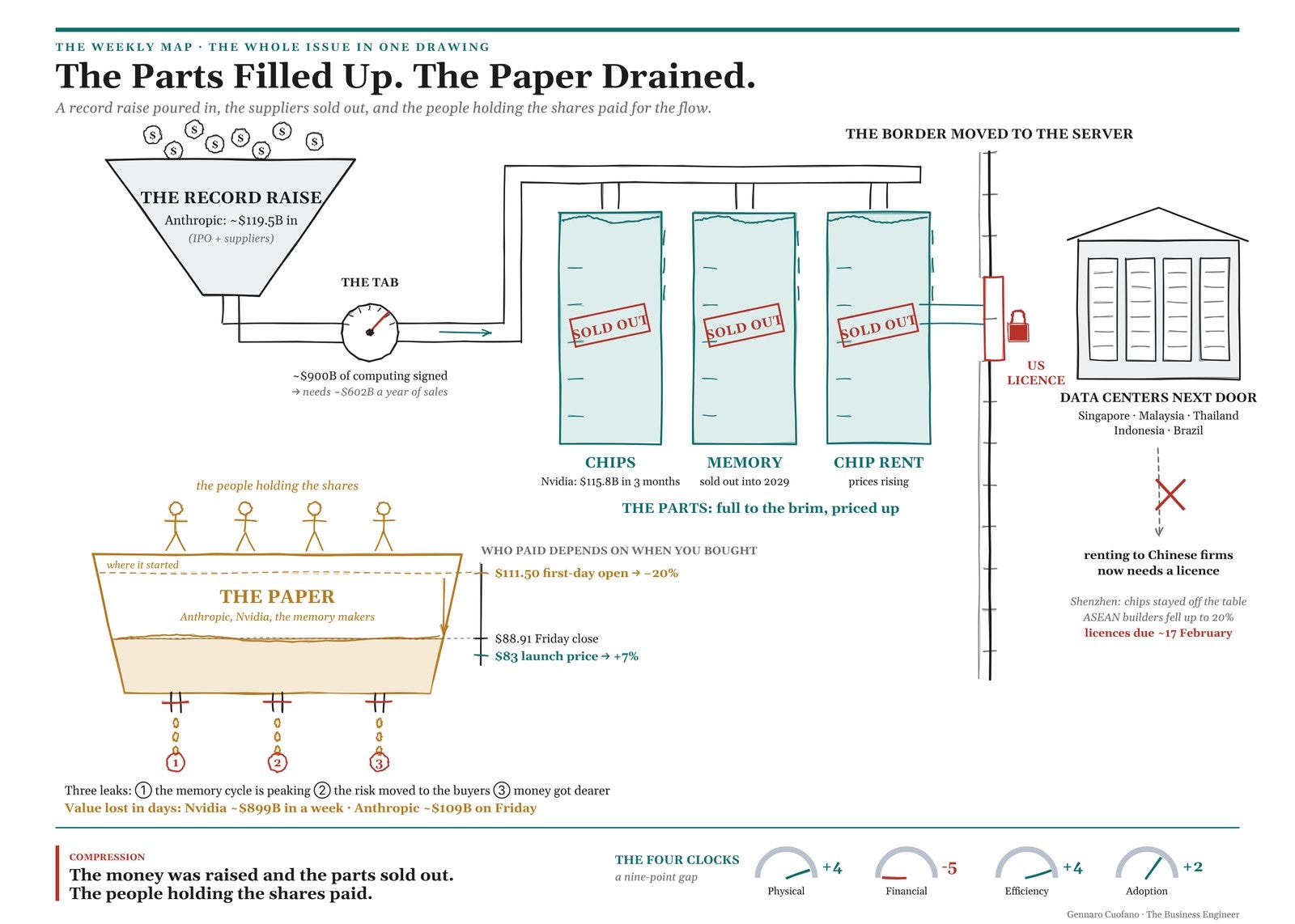
This is what makes the AI Supercycle fundamentally different from the internet boom.
The commercial internet expanded during an era of accelerating globalization. Capital, technology and supply chains were becoming increasingly interconnected, and the political and economic order broadly supported that expansion.
AI is emerging in almost the opposite environment.
The technology is advancing at extraordinary speed, but the physical infrastructure required to run it is concentrated in a handful of countries and companies. Its supply chains are increasingly subject to national security restrictions. Its energy requirements are becoming politically contentious. And its financing depends on enormous commitments made today against revenues that may take years to materialize.
In other words, we are trying to build an increasingly global technology inside an increasingly fragmented world.
This creates a peculiar dynamic. A technological breakthrough can accelerate demand while making existing infrastructure less economical. A new export restriction can destroy the business case for a data centre without changing a single line of its technology. Rising interest rates can undermine the economics of an AI lab even as its revenues double. And an industry can be simultaneously running out of physical capacity and losing financial confidence.
Which brings me to the four clocks I use to track this supercycle: physical infrastructure, finance, efficiency and adoption.
This week, the physical clock stood at +4, while the financial clock fell to −5. Efficiency remained at +4, and adoption held at +2.
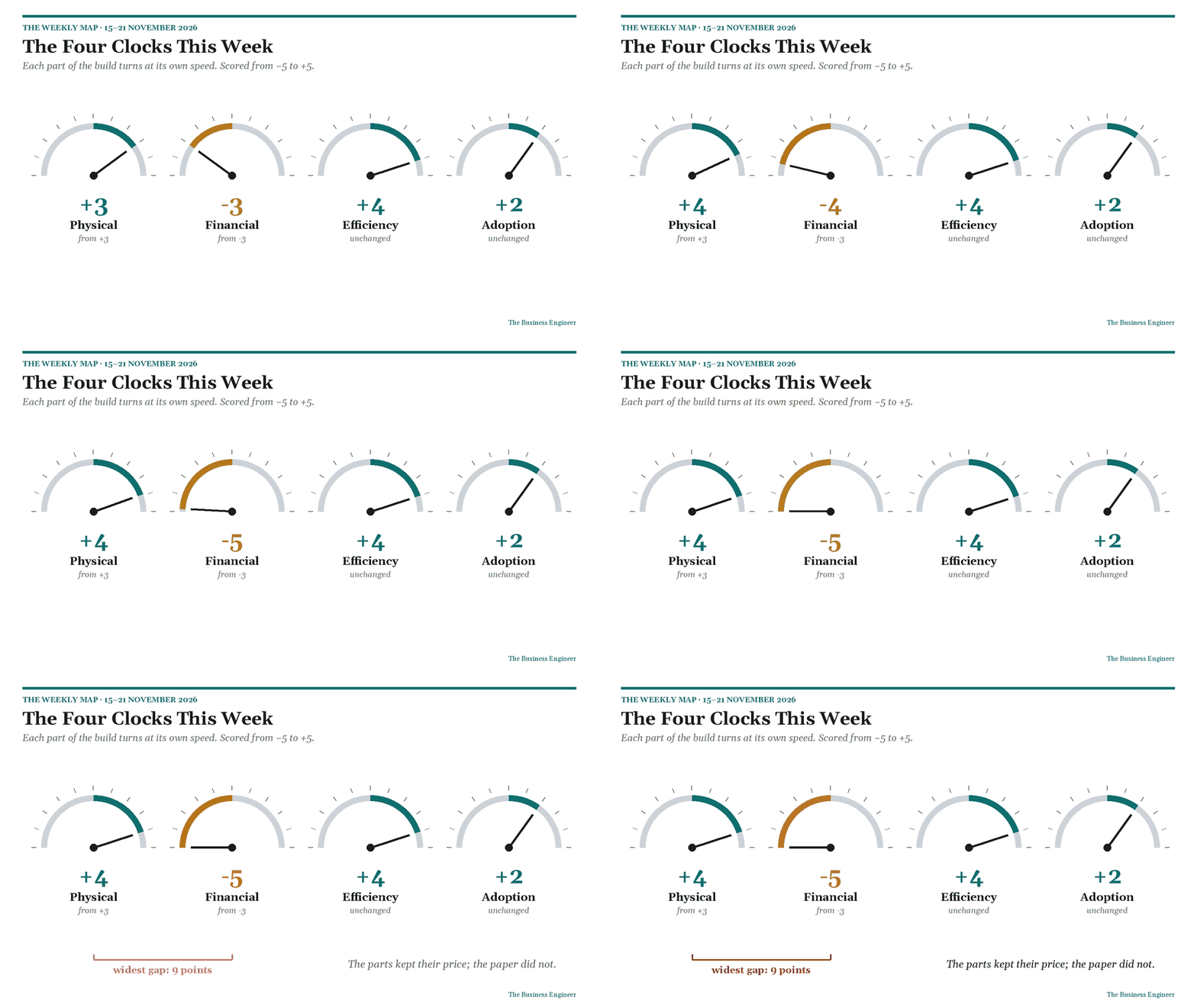
A nine-point gap between physical expansion and financial confidence, the widest we’ve recorded.
And here is the interesting part. Despite the financial turmoil, models keep getting better and cheaper. AI agents are taking on increasingly complex work. Companies are using more AI, even as they begin to impose budgets and controls around it.
So the underlying technological momentum remains strong. What is becoming more fragile is the economic and political architecture needed to sustain it.
This is why I believe we need to read the AI Supercycle through three connected lenses: geopolitics, macroeconomics and technology. Each influences the others, sometimes reinforcing the cycle, sometimes working against it.
And unlike the dot-com era, the outcome will not be determined by technology adoption and financial markets alone. It will also depend on industrial policy, access to energy, the cost of capital and the shifting relationships between the world’s major powers.
That is what makes this cycle so peculiar, and so difficult to compare with anything that came before it.
This week, we’ll connect those dots, from Anthropic’s historic IPO and Nvidia’s extraordinary quarter to the US–China chip confrontation, South-East Asia’s data-centre boom, the tightening credit markets, and the increasingly complex economics of the AI infrastructure race.
Because the question is no longer simply how far AI technology can advance.
It is whether the financial, physical and geopolitical systems supporting it can keep up.
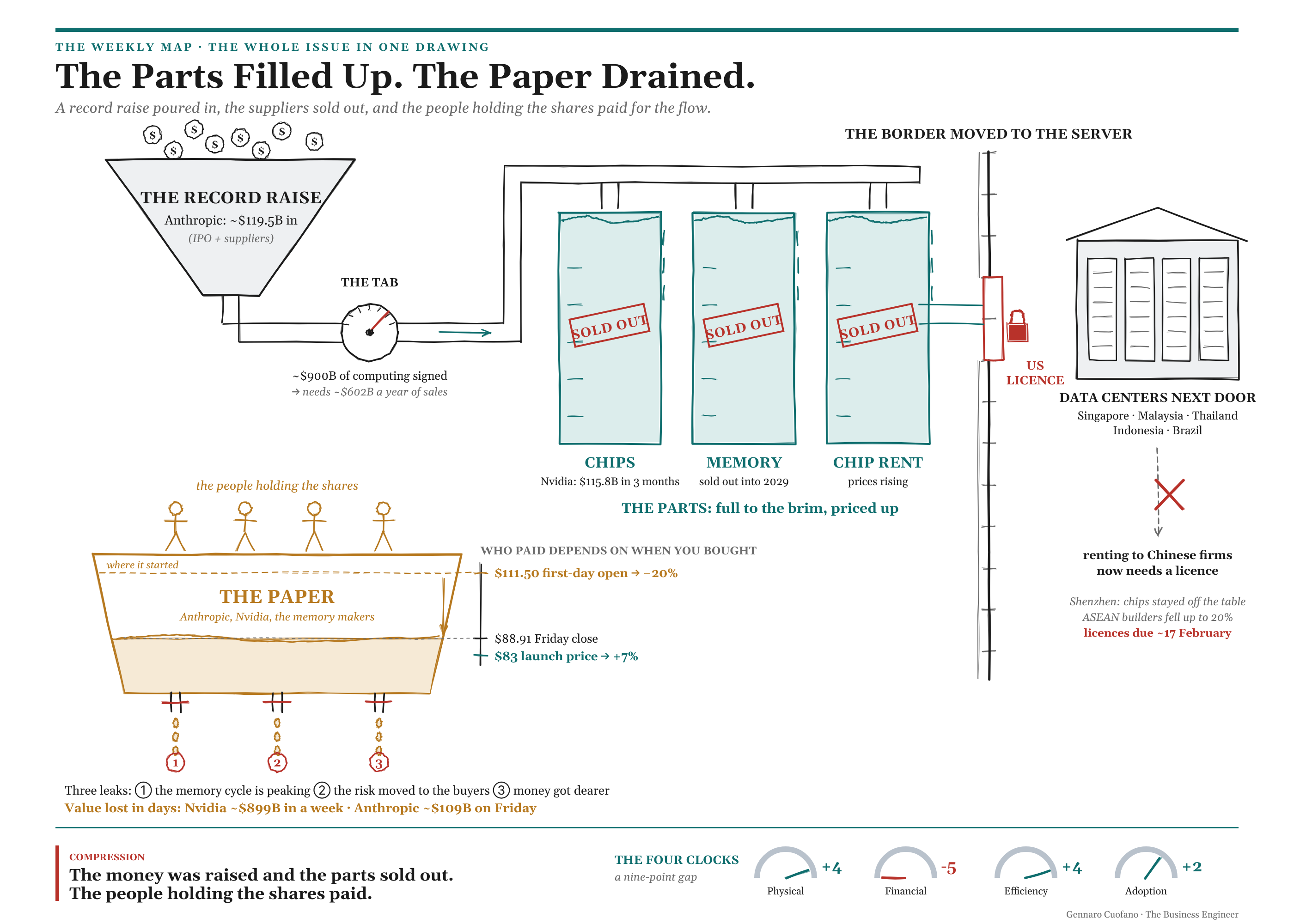
Before the Numbers: Who Carries the Money
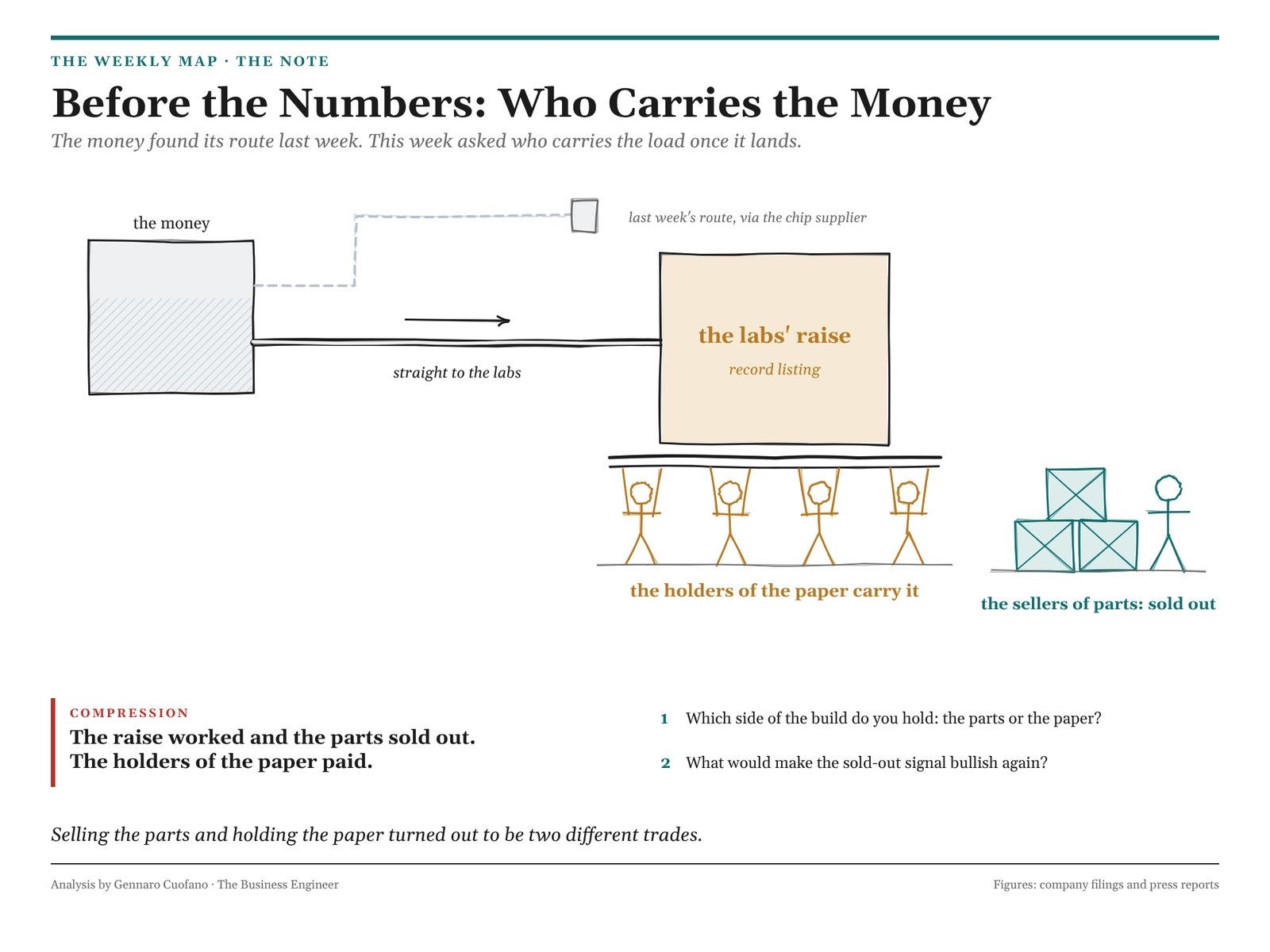
Last week I argued that the money paying for AI had changed route. For two years much of it flowed through Nvidia, the company that makes most AI chips. Last week it started going straight to the AI labs, the companies that build models like Claude and ChatGPT. This week answered the next question: once the money is raised, who carries the risk?
The answer, on six days of evidence, is the people who own the shares. It is not the companies that sell the parts.
Here is the week in four facts. Anthropic, the maker of Claude, raised more money in its stock market debut than any company in history. The makers of memory chips said their supply is sold out a year or more ahead. The price of renting AI chips went up. And yet the shares of Anthropic, of Nvidia and of the memory makers all fell in the same days.
The money was raised and the parts sold out. The people holding the shares paid.
“The people holding the shares” needs care, because it is not everyone. Anyone who got Anthropic shares at the official launch price of $83 is still making money. The people who lost were those who bought once trading started, plus the long-time owners of Nvidia and the memory makers. That difference is the thread running through this issue.
One thing changed my mind this week: memory chips. I had read “sold out until 2029” as the strongest good news the AI build, the huge spending on chips, data centers and power, could produce. Investors read it as a sign the good times are peaking. I now think they have a point, and I explain why below.
On Nvidia, whose chief executive left last week, we stick to the company’s filings, the markets and the rules. Where politicians say who should run the company, we report it and take no side.
Get The New Enterprise AI Embedding Series