

This has been one of the most intense weeks of the AI Supercycle, and we’ve already had plenty.
Anthropic’s impressive S-1 set the tone. It surprised many on the upside, particularly given concerns about customer concentration. Yet it also brought a broader dependency into focus: just how much of the AI trade now rests on Anthropic’s ability to sustain its extraordinary pace.
For the first time since I began tracking the AI Supercycle, the infrastructure being built ahead of demand started to look a little aggressive relative to how confidently we can project that demand into the future. Demand is still accelerating. The harder question is how durable that growth will prove, and whether its pace and economics will support the commitments being made today.
We are increasingly taking several assumptions for granted: that compute costs will keep rising, token prices will keep falling exponentially, and agents will drive an enormous expansion in demand. Each has profound implications for the infrastructure being built. Yet the speed of these changes, how they interact, and who ultimately captures the value remain open questions. The confidence behind today’s investment commitments depends on how those variables develop together.
Meanwhile, the foundations surrounding this industry are shifting. The geopolitical landscape is being redrawn. The macroeconomic environment is changing. And we are building what could become the most transformative industry in a century amid deep political instability, in the United States and across the world. Each of these forces can reshape the economics and direction of the AI buildout.
This week’s report is my attempt to make sense of that combination. I know it is a demanding read. Understanding this cycle requires us to hold several moving parts in view at once—and to keep questioning assumptions that can quickly begin to feel like certainties.
My goal is to give you a stronger compass through that complexity: a way to connect the signals, understand what is changing, and update our view as the evidence develops.
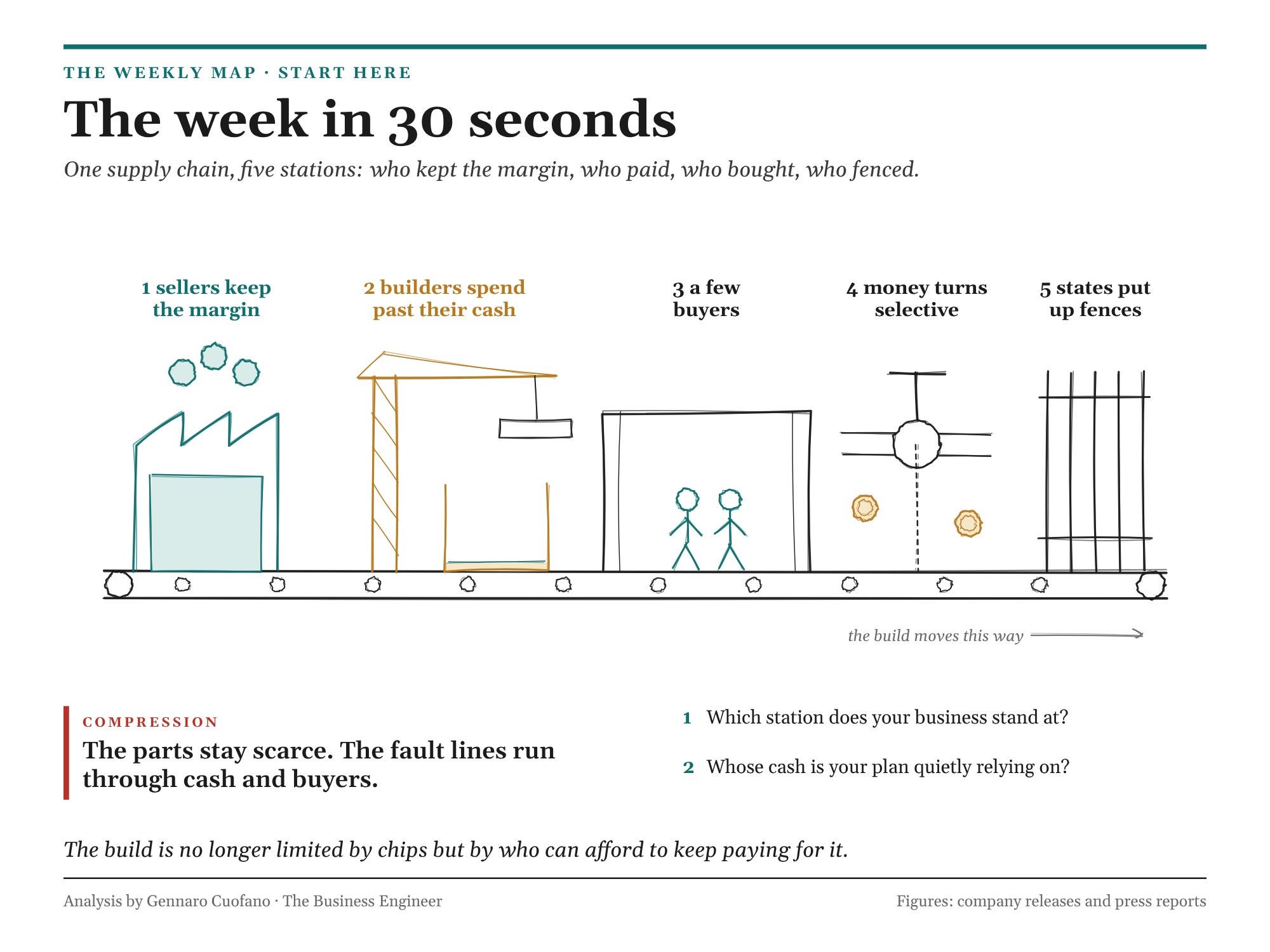
Think of the AI build-out as one long supply chain again. Last week we asked who pays for it. This week the companies that pay opened their books, and the answer came in five parts.
The sellers took the margins. SK hynix earned an operating margin of 80% in the quarter. Samsung’s chips made about 99% of a record profit, by our arithmetic from its release. Sandisk sold $11.0 billion in a quarter at an 85.0% gross margin.
The builders ran past their own cash. Alphabet spent 121% of its operating cash on property and equipment in the quarter. Amazon spent about 1.8 times. Microsoft spent 68%, the only one of the big builders inside its cash, by our arithmetic from their filings. S&P turned Meta’s outlook negative over the same gap.
The demand has a few names. Anthropic’s top five customers made up about 25% of its revenue in its first public filing. One AI customer made up 34.5% of SpaceX’s third-quarter revenue.
The money grew selective. Microsoft sold $25 billion of bonds at about 64 basis points over Treasuries. The same week, Blackstone reportedly told investors to expect a below-investment-grade rating for Anthropic, and OpenAI reportedly cut its round to about $20 billion.
The states built fences. Google is in talks to work on data security for the $185 billion Golden Dome missile-defence programme, Bloomberg reported. France’s lower house voted a tax of €0.055 on every gigabyte content providers send. A China-linked group ran AI agents against more than 200 organisations, CrowdStrike said.
The short version: the parts are still scarce and well paid. The fault lines now run through the cash of the builders and the breadth of the buyers, and governments are drawing lines around data, compute and capital.
The week in one line. For two years the AI build-out was priced as a growth story. This week it started being priced as a credit story. A ratings agency, the credit-default swap market, bond buyers and late-stage investors all put a cost of capital on the capex. That cost, not the supply of chips, became the constraint everyone else had to plan around.
Unlock The Full AI Supercycle Analysis
How to read this issue
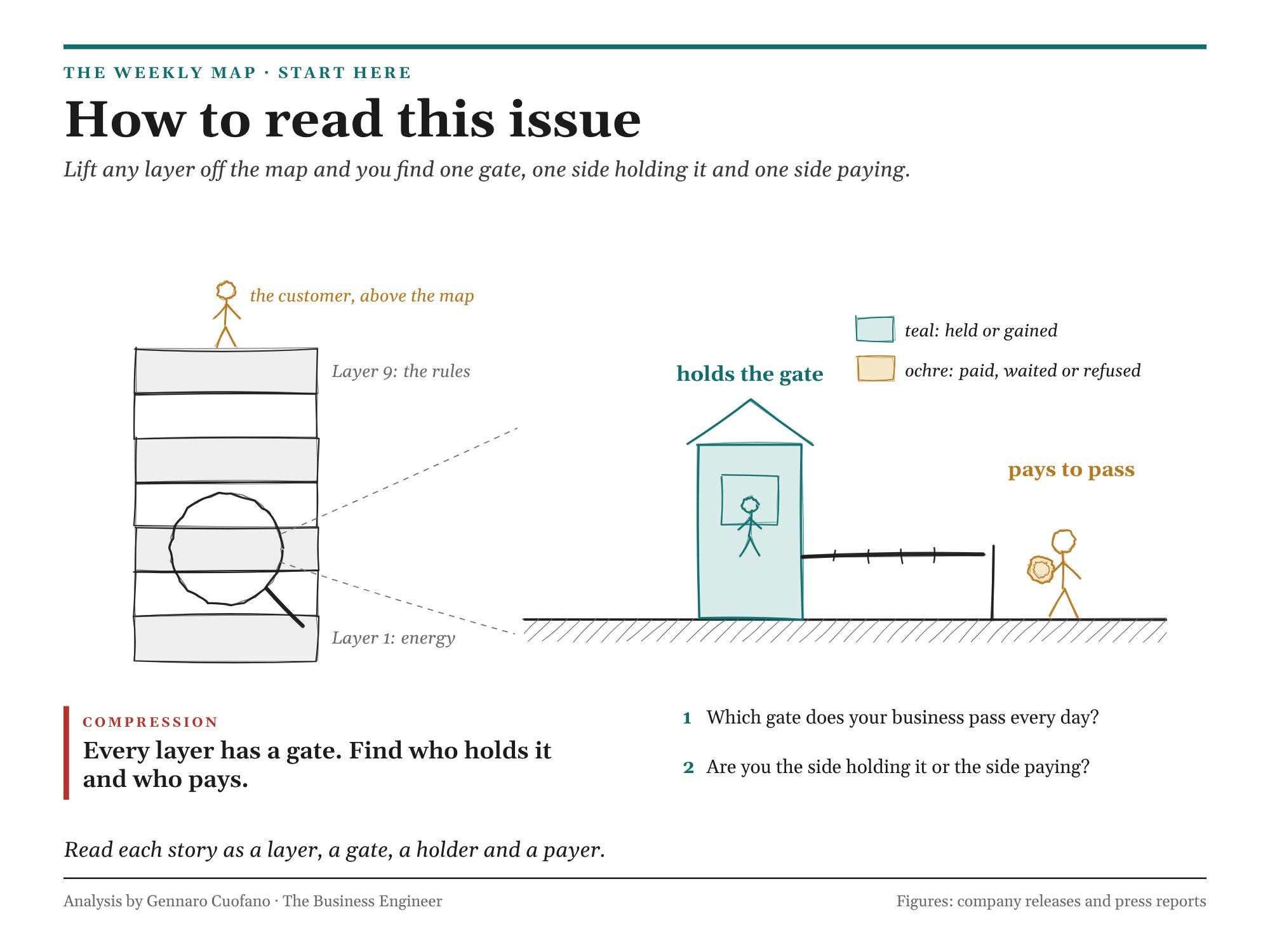
Every week we read the news onto one picture, the Map of AI. It stacks the industry in layers, from energy at the bottom to the rules at the top. Here are the five ideas the rest of the issue uses.
The layers. Energy is Layer 1, and chips and their parts are Layers 2 and 3. Compute and the money that pays for it are Layer 5, models Layer 6 and the agent software around them Layer 7. The stores and banks agents must pass are Layer 8, and the rules are Layer 9. The paying customer sits above the map as Adoption.
The chokepoint. Each layer has one scarce piece this week. For each, we name who holds it and who pays to use it.
The colours. In the pictures, teal marks the side that held or gained. Ochre marks the side that paid, waited or was refused.
The cascade and the loop. World politics shapes the economy, and the economy shapes technology. In a supercycle the arrows also run back: AI moves the economy and politics in return.
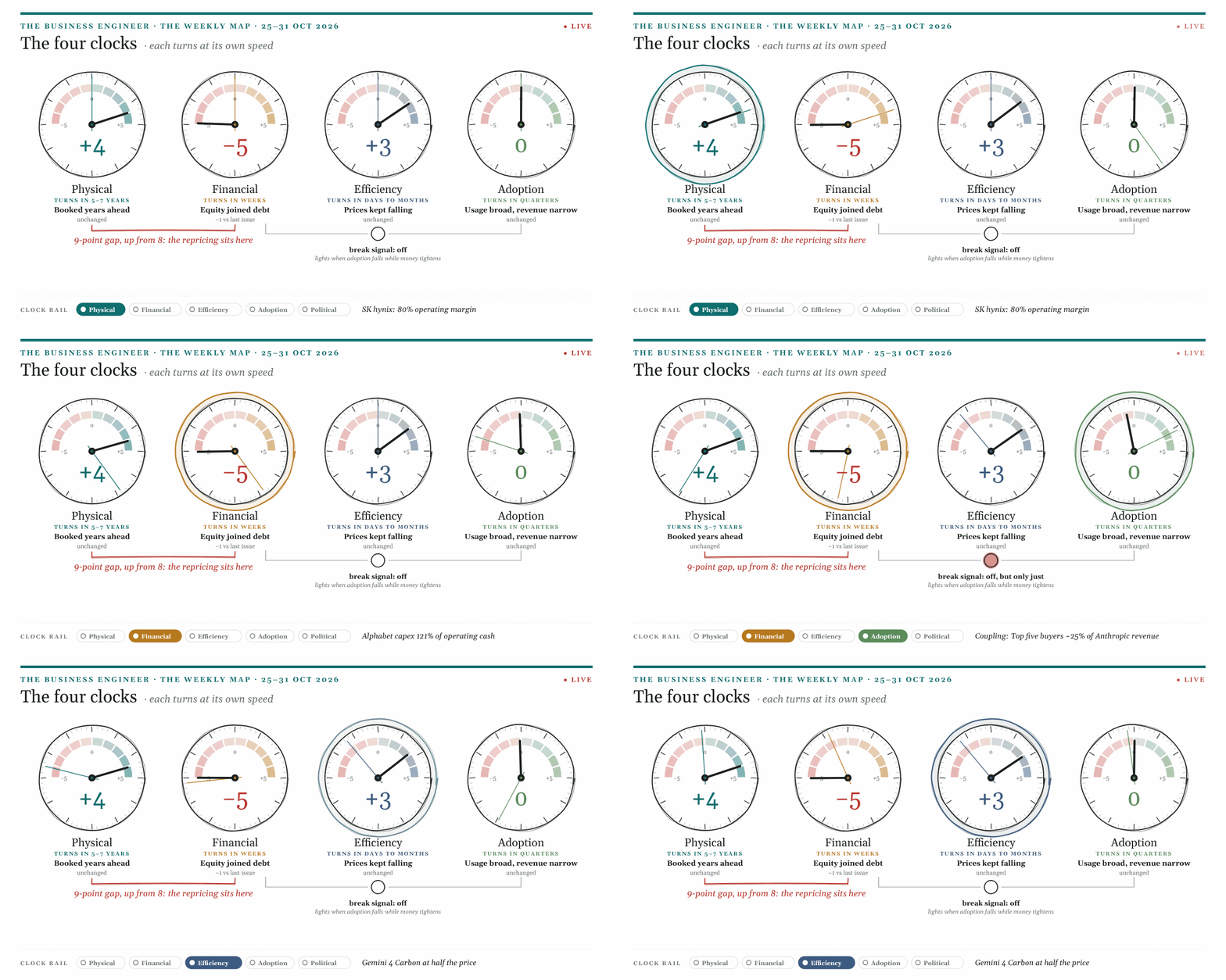
The four clocks. Each part of the build runs on its own clock: factories over years, money over weeks, efficiency over months, customers over quarters. Trouble starts when two clocks disagree.
Two habits to note. “Reported” marks figures from news outlets that the companies have not confirmed. “By our arithmetic” marks a sum or ratio we worked out from published figures.
The Week the AI Build-Out Got a Credit Rating
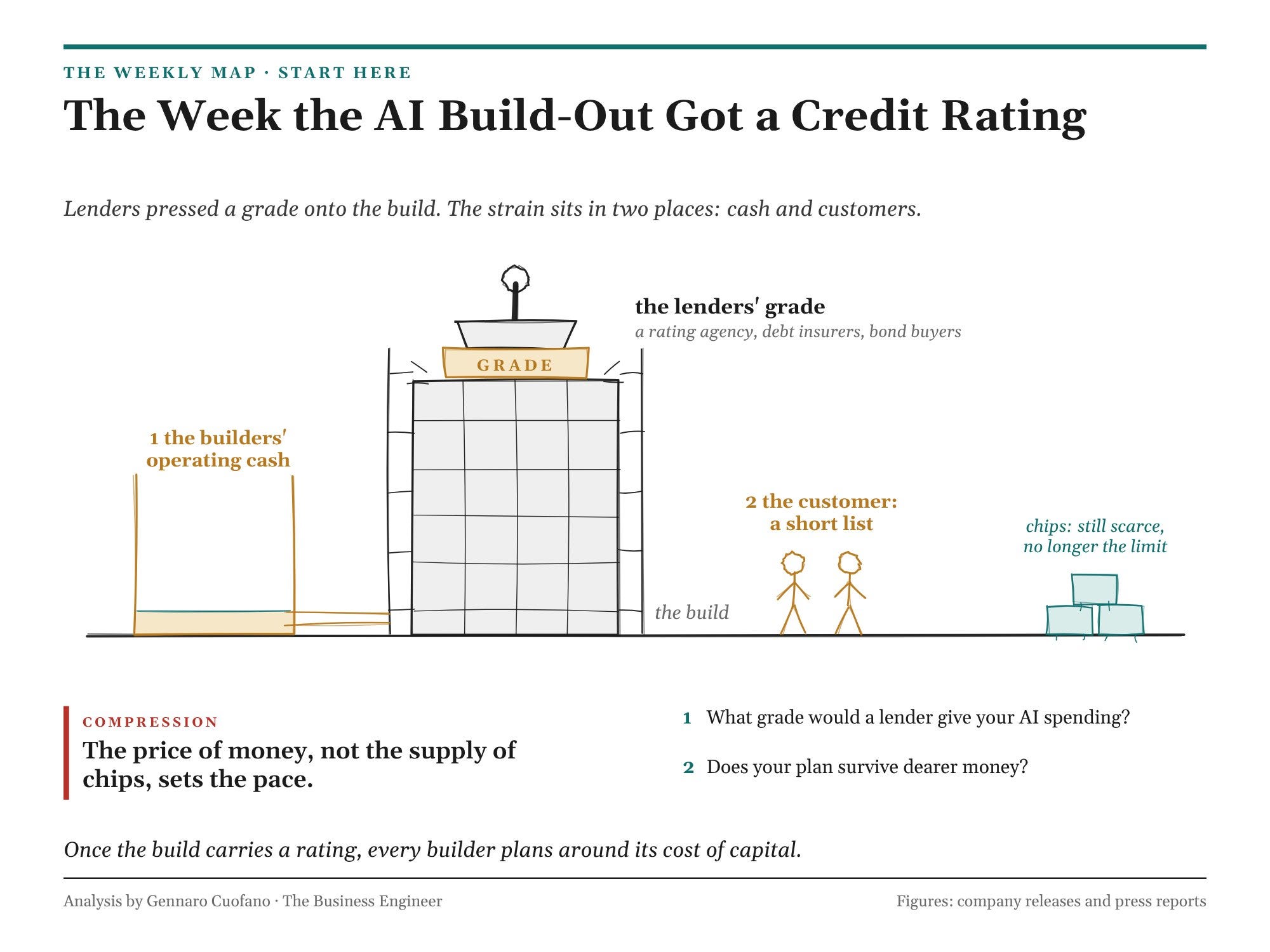
Start at the bottom of the map and climb. Every layer had a side that gained and a side that paid this week. The pressure gathered on two of them.
The first was the builders’ operating cash, in Layer 5, where the hyperscalers and labs pay for chips and data centres. The second was the customer, above the map, whose spending is meant to repay it all and who turned out to be a short list.
Get A Yearly Plan To Unlock The Library
From Who Pays for the Build to Who Rates the Build
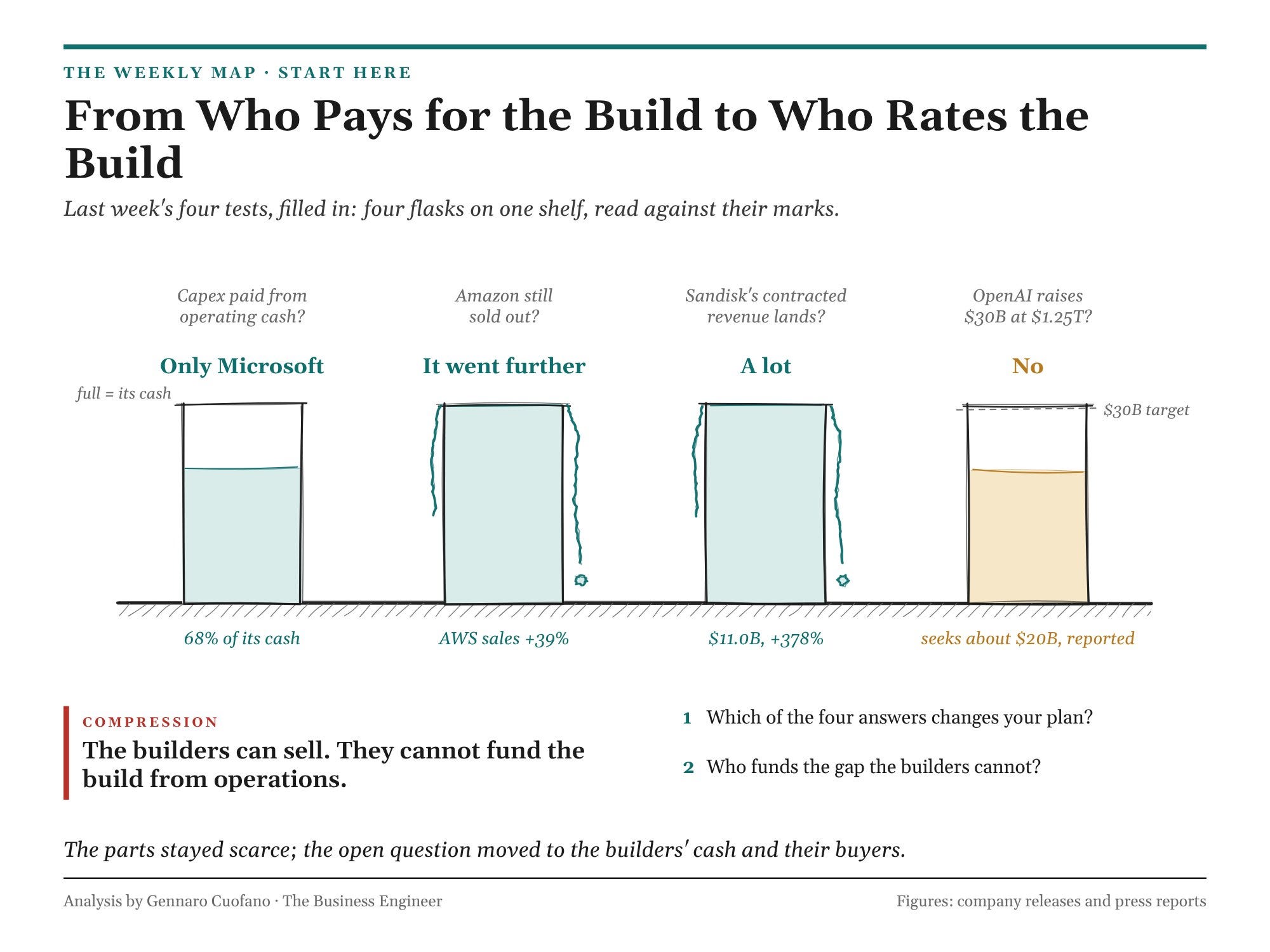
Last week’s issue asked who pays for the build, and whether they can keep paying. The answer was that the factories were booked for years while money got dearer and the customer base looked narrow. That issue closed with tests for this week. Four of them came back.
Would the hyperscalers pay for their capex from operating cash? Only Microsoft did. Its quarterly additions to property and equipment were $39.4 billion against $58.0 billion of cash from operations, 68% by our arithmetic. Alphabet spent $51.4 billion against $42.3 billion, or 121%. Amazon spent $77.3 billion against $42.4 billion, about 1.8 times, and borrowed $48.1 billion in the quarter.
Would Amazon repeat “largely sold out”? It went further. AWS sales rose 39% to $46.0 billion, its fastest growth in nearly five years. Andy Jassy said AWS has “projected revenue growth rates of over 40% both in 2027 and in 2028.” Cash capex for 2026 holds at about $220 billion.
How much of Sandisk’s contracted revenue would land? A lot. Its quarterly revenue reached $11.0 billion, up 378% from a year earlier, at an 85.0% gross margin, with data-centre revenue of $4.80 billion.
Would OpenAI’s reported $30 billion close at $1.25 trillion? No. The Financial Times reported that OpenAI “is now seeking about $20bn at a $1.25tn valuation.” The Wall Street Journal then reported it had raised “less than half” of its $30 billion target, at a valuation below its $1.4 trillion goal.
So this week’s question follows from last week’s answer. The parts stayed scarce. The builders proved they could sell, and showed they could not fund the build from operations alone. Where do the fault lines run, and who is the demand?
The Week in Our Data: The Build-Out Moved Onto the Balance Sheet
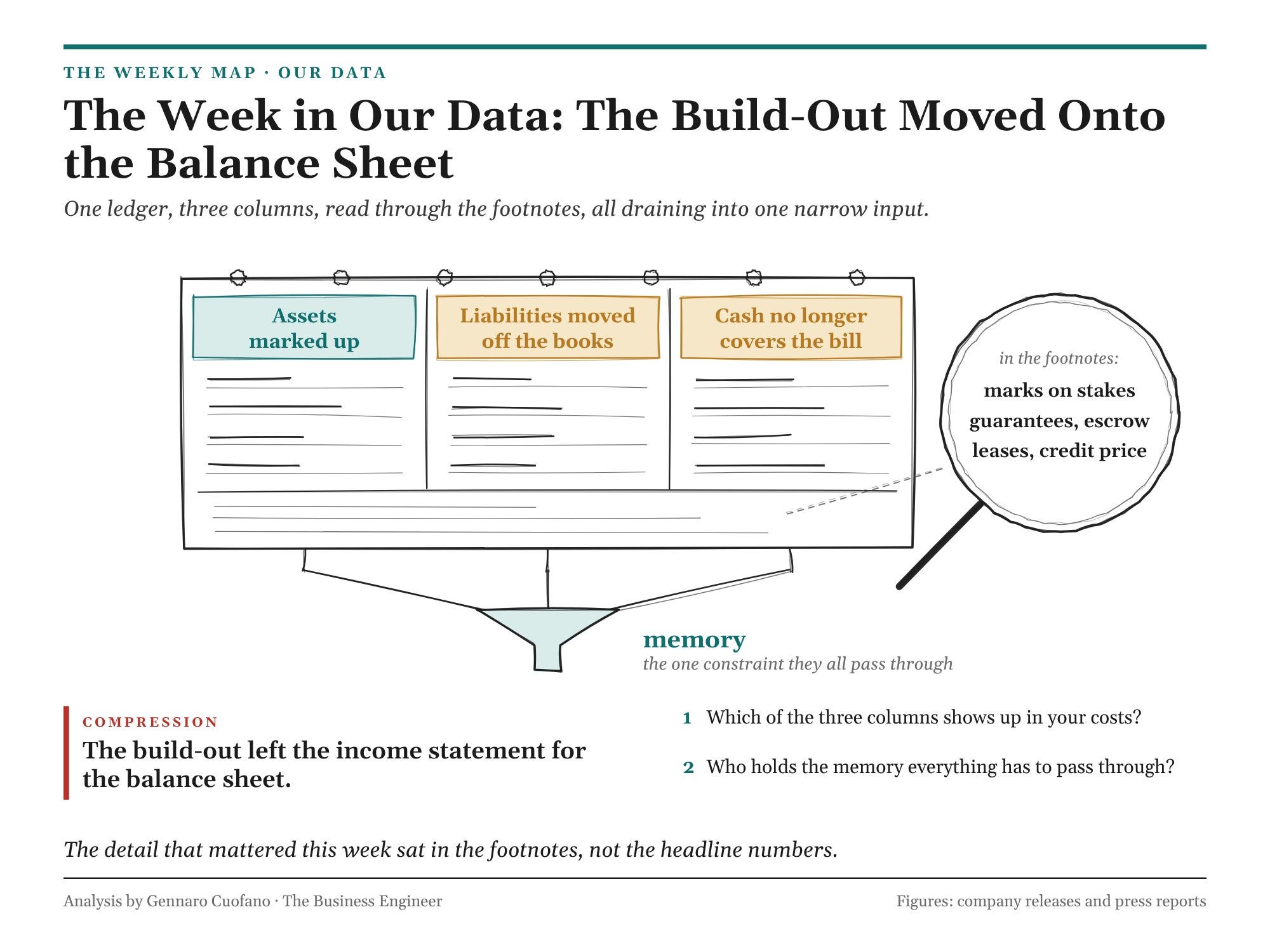
Every week we track the numbers underneath the headlines: the quarterly filings and their footnotes, credit spreads and ratings, funding rounds, and the spending data of companies that buy AI. This week that tracking pointed one way. The AI build-out stopped being an income-statement story and moved onto the balance sheet.
The numbers that mattered sat in the footnotes: marks on private stakes, guarantees, escrow, leases not yet started and the price of credit. Read together, they form three ledgers and one constraint. Each ledger points to the layer where the detail sits.
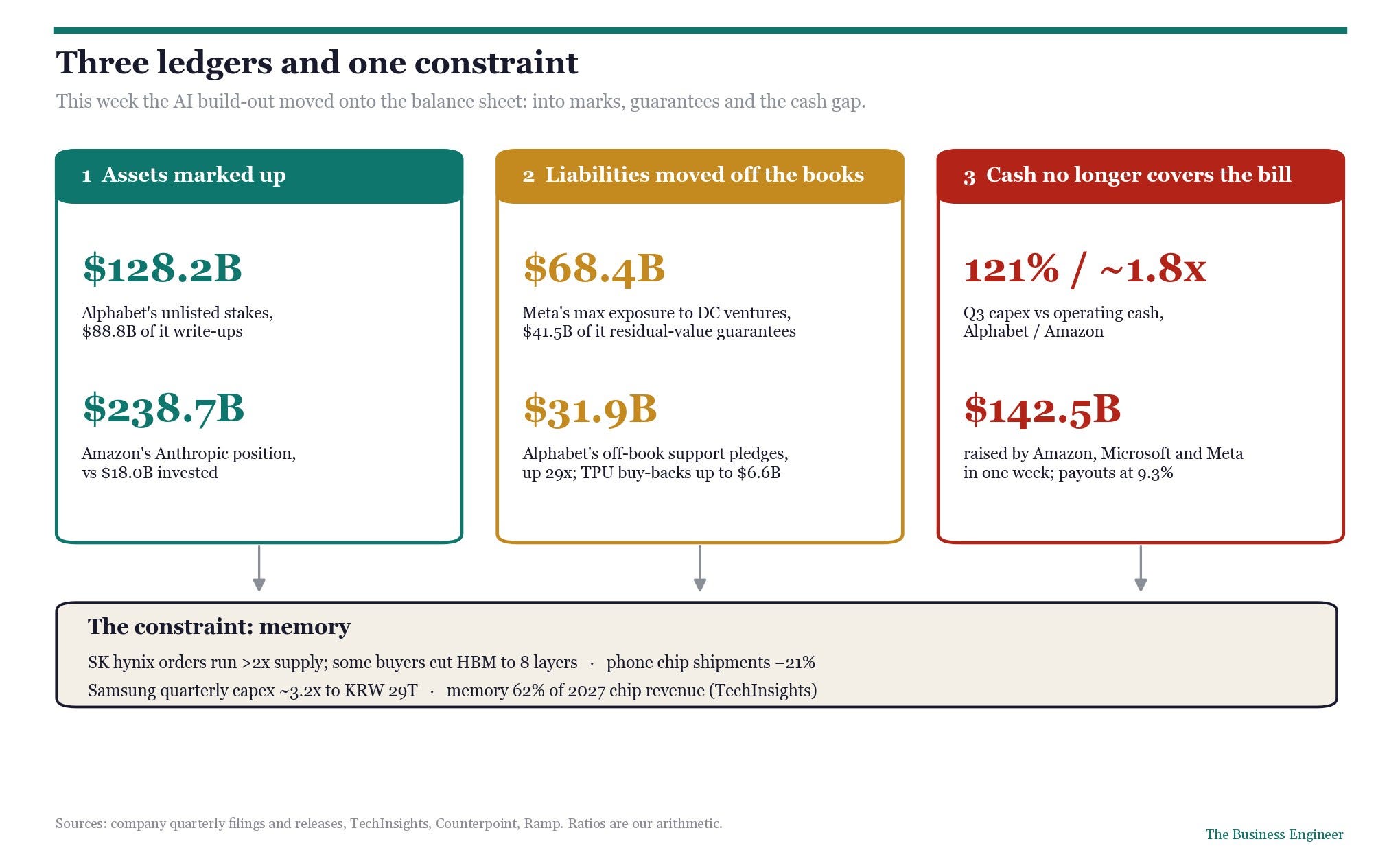
Three ledgers and one constraint: assets marked up, liabilities moved off the books, cash that no longer covers the bill, and memory as the binding input. From company filings and releases; ratios are our arithmetic.